
 Plymouth Hemi Cuda
Specs, engines and history
Updated Published Sources (2) Report an error
By Sarah Whitmore, Senior Automotive Writer Reviewed by Oleksandr Hnatiuk

- Built
- 1970–1971
- Top power
- 317 kW (431 PS)
Verdict: the 'Cuda to collect
Our verdict · Sarah Whitmore
For a collector, the Hemi 'Cuda is the top of the E-body pyramid. A 1970 hardtop is the most common and the easiest to verify, while a 1971 car with its four headlamps and gills is rarer and costs more. A 'Cuda 440 Six Barrel gives most of the experience for far less money. Whatever the choice, the paperwork matters as much as the paint.
The Plymouth Hemi 'Cuda is the 1970–1971 Barracuda fitted with Chrysler's 426 Hemi V8, rated at 317 kW (425 hp SAE gross) and 664 Nm. Built on the new E-body for only two model years, it was the fastest and rarest 'Cuda: 652 hardtops and 14 convertibles were made for the US in 1970, and even fewer in 1971.
In short
- What it is: the top engine option of the third-generation Plymouth Barracuda, sold as the 'Cuda in 1970 and 1971.
- Engine: 426 cu in (7.0 l) Hemi V8 with two four-barrel carburettors, 317 kW (425 hp gross) and 664 Nm (490 lb-ft).
- Gearboxes: four-speed manual or three-speed TorqueFlite automatic; 0–60 mph in 5.8 s and a 14.1-second quarter mile in a period test.
- Today: one of the most valuable American muscle cars, with 1971 convertibles among the rarest of all.

Specs by version
Engines
Dimensions and weight
Show all 1 versions
| Version | Width |
|---|---|
| 7.0 317 kW (431 PS) Coupe | 1,900 mm74.8 in |
Verified Manufacturer and type-approval data from our catalog · Sources and methodology
The Hemi 'Cuda at a glance: maker, years and purpose
Plymouth, the value brand of the Chrysler Corporation, built the Hemi 'Cuda for the 1970 and 1971 model years. It was not a separate model but the most powerful version of the 'Cuda, the sporty line of the Barracuda. The car was made for buyers who wanted the fastest pony car on the street and for drag racers who wanted a ready-made base. Its younger siblings and rivals sit in the Plymouth catalogue, and the whole Barracuda line from 1964 to 1974 is covered on our Plymouth Barracuda page.

| Fact | Value |
|---|---|
| Maker | Plymouth (Chrysler Corporation), USA |
| Model years | 1970–1971 |
| Platform | Chrysler E-body (shared with the Dodge Challenger) |
| Bodies | Two-door hardtop coupé, convertible |
| Engine | 426 Hemi V8, 7.0 l |
| Power | 317 kW (425 hp SAE gross) |
| Designer | John E. Herlitz |
| Built (1970, US) | 652 hardtops, 14 convertibles |
How the Hemi 'Cuda came about
The Barracuda arrived on 1 April 1964, about two weeks before the Ford Mustang. The first two generations were based on the compact Plymouth Valiant, and that limited the size of engine Plymouth could fit. The old 1cars text recalls that the most powerful early versions were even sold without power steering, which put buyers off. For 1968 Plymouth built a small run of Hemi Barracuda race cars for drag racing, but they were not road cars.

For 1970 Chrysler gave the Barracuda its own platform, the E-body. It was a shorter, wider version of the B-body used by the mid-size Road Runner, with a 108-inch wheelbase. The new engine bay was large enough for every big-block Chrysler engine, including the 426 Hemi. The sporty version was now simply called 'Cuda, and the Hemi became its top option.
The timing was difficult. Insurance companies were raising premiums for high-powered cars, and new emissions rules were coming. The 1971 model year was the last for the Hemi, and the big-block engines left the Barracuda after that. Barracuda production ended on 1 April 1974, ten years to the day after it began.
| Year | Event |
|---|---|
| 1964 | Plymouth Barracuda launched on 1 April, based on the Valiant |
| 1967 | Second generation; first 'Cuda performance package |
| 1968 | Small series of Hemi Barracuda drag-racing cars |
| 1970 | E-body Barracuda; 'Cuda name; 426 Hemi option; AAR 'Cuda races in Trans-Am |
| 1971 | Facelift with four headlamps and fender gills; last year of the Hemi |
| 1974 | Barracuda production ends on 1 April |
Design and engineering of the E-body
John E. Herlitz styled the 1970 Barracuda. Compared with the earlier car it was lower and much wider: the body grew by more than 5 inches in width and the tracks by 3 inches. The old 1cars text gives a length of about 4.75 m and a width of about 1.9 m. The Dodge Challenger used the same platform, with a wheelbase 2 inches longer. To see how the E-body compares in size with a modern car, try the size comparison tool.

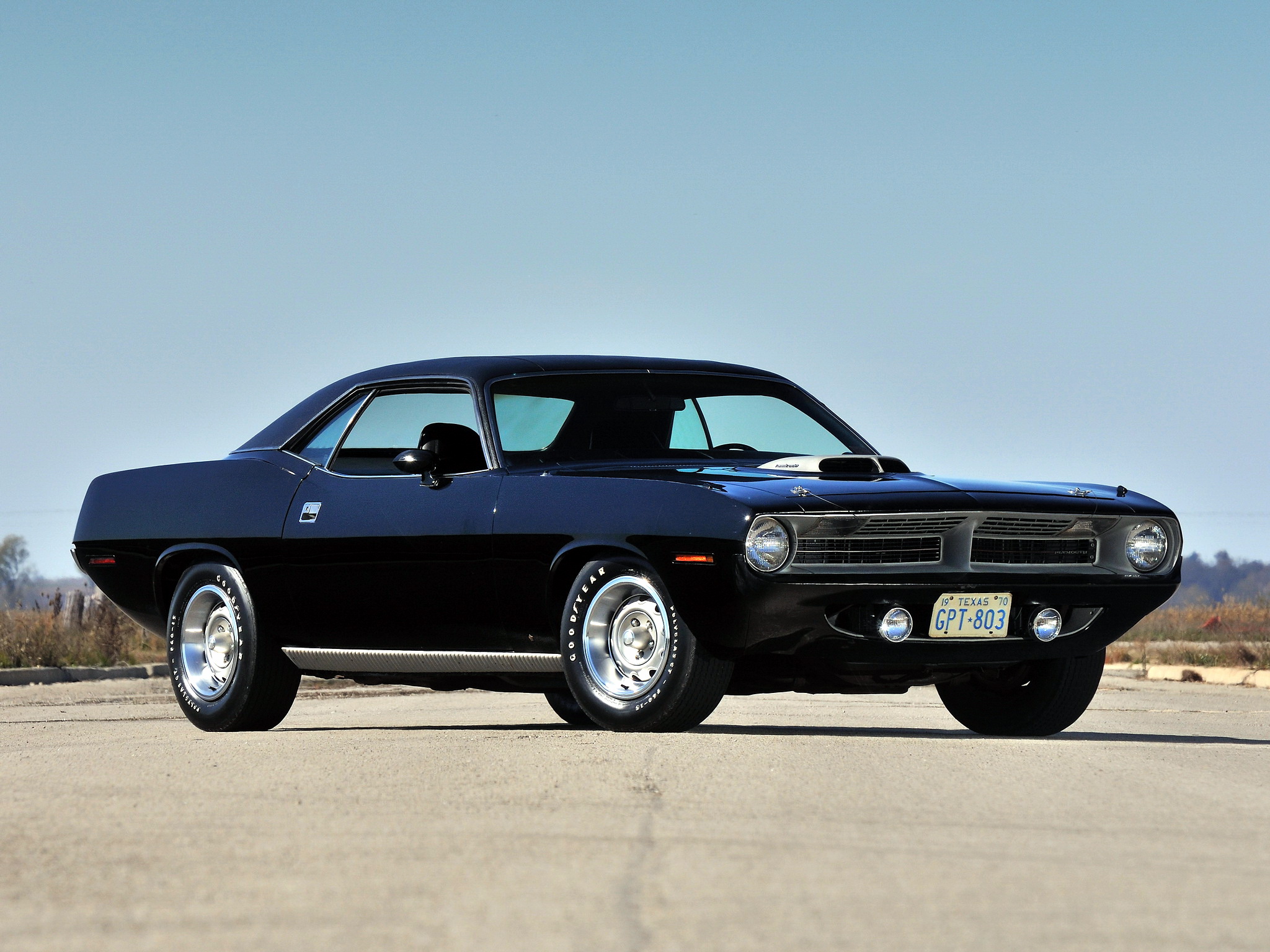
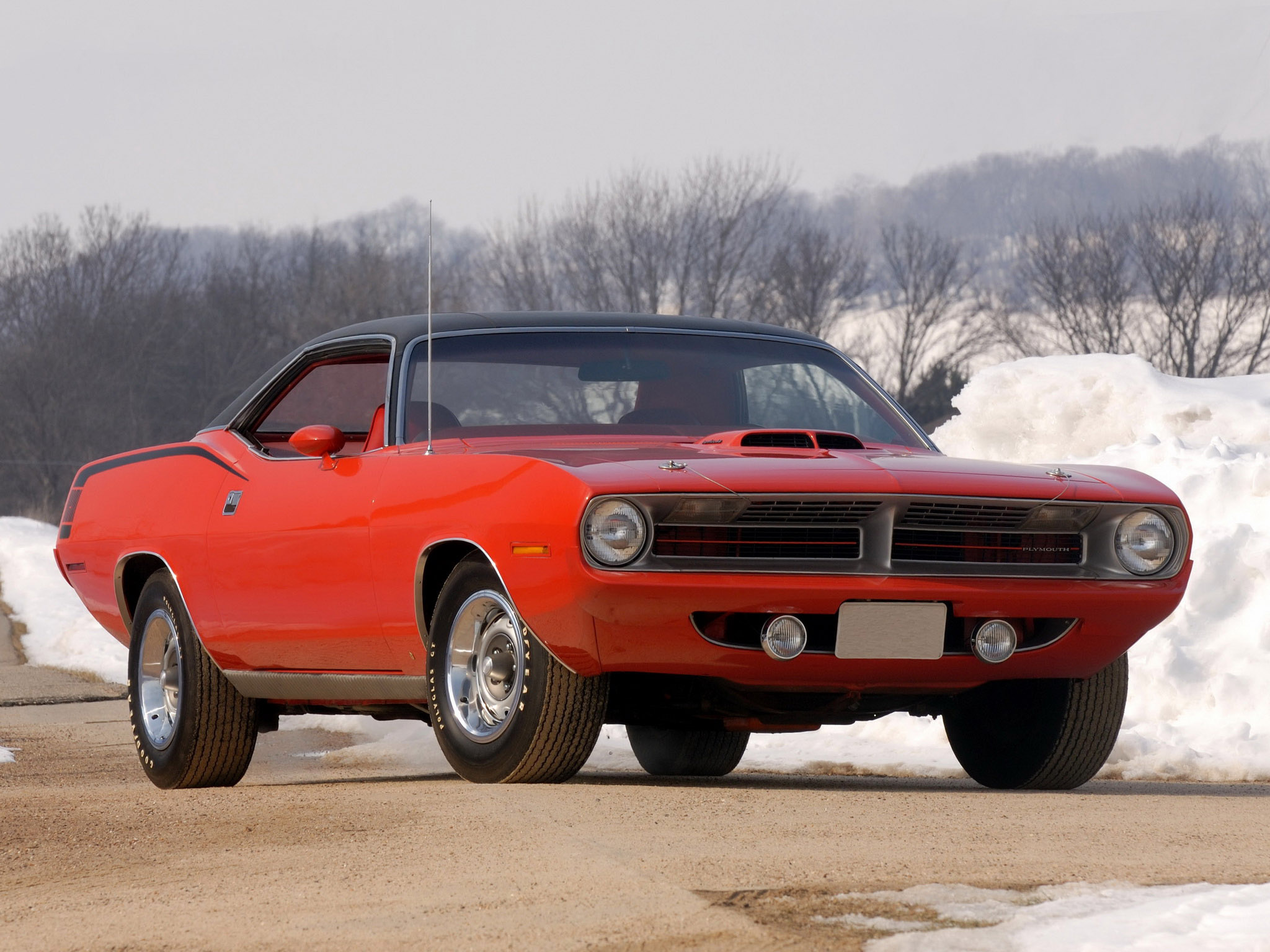
The Hemi 'Cuda is easy to spot. It has the "Shaker" hood scoop, which is bolted to the engine and moves with it through a hole in the bonnet, plus Hemi badges and, often, a bright "High Impact" paint colour. The body is a steel monocoque. At the front the suspension uses double wishbones with longitudinal torsion bars, Chrysler's usual layout; at the rear there is a live axle on leaf springs. The Hemi car's springs were uneven: six leaves on the right and five plus two half-leaves on the left, to resist axle wind-up under hard acceleration.
The 426 Hemi V8 and drivetrain
The heart of the car is the 426 cu in Hemi, a 7.0-litre V8 named after its hemispherical combustion chambers. Chrysler first explored the design during the Second World War, and the 426 version had won in NASCAR before it was offered in road cars. In the 'Cuda it was fed by two Carter AFB four-barrel carburettors and rated at 317 kW (425 hp SAE gross) at 5,000 rpm, with 664 Nm (490 lb-ft) at 4,000 rpm. For 1970 it received hydraulic valve lifters and a new camshaft profile, with no change to the rating.

Buyers could choose a New Process A-833 four-speed manual or the 727 TorqueFlite three-speed automatic. Power went to a heavy-duty Dana rear axle with a 9 3/4-inch ring gear. The Hemi 'Cuda rode on 15-inch wheels, 7 inches wide, with F60-15 tyres, and many cars had power front disc brakes with drums at the rear.
The performance figures still impress. A period test recorded 0–60 mph in 5.8 seconds and a quarter mile in 14.1 seconds at 103.2 mph. The much cheaper 440 V8 came close up to about 60 mph, but the Hemi pulled harder at high revs. By our count the Hemi had 37 kW more than the four-barrel 440 of 1970. For a sense of scale, compare its 317 kW with today's cars in the ranking of the most powerful coupés.
Hemi 'Cuda specifications
| Parameter | Metric | Imperial |
|---|---|---|
| Engine | 7.0 l Hemi V8, two four-barrel carburettors | 426 cu in |
| Power (SAE gross) | 317 kW at 5,000 rpm | 425 hp at 5,000 rpm |
| Torque (SAE gross) | 664 Nm at 4,000 rpm | 490 lb-ft at 4,000 rpm |
| Gearboxes | 4-speed manual or 3-speed automatic | – |
| Wheelbase | 2,743 mm | 108 in |
| Length | about 4,750 mm | about 187 in |
| Width | about 1,900 mm | about 75 in |
| Wheels and tyres | 15 × 7 in, F60-15 | 15 × 7 in, F60-15 |
| 0–60 mph | 5.8 s | 5.8 s |
| Quarter mile | 14.1 s at 166 km/h | 14.1 s at 103.2 mph |
Engines and variants of the 1970–1971 'Cuda
The Hemi was one of several 'Cuda engines. This table shows where it sat in the range, with the SAE gross ratings of the time.

| Variant | Years | Body / purpose | Engine | Notes |
|---|---|---|---|---|
| 'Cuda 383 | 1970–1971 | Hardtop, convertible | 6.3 l V8, 250 kW (335 hp) | Standard 'Cuda engine (Magnum) |
| 'Cuda 340 | 1970–1971 | Hardtop, convertible | 5.6 l V8, 205 kW (275 hp) | Lighter small-block |
| AAR 'Cuda | 1970 | Hardtop, Trans-Am homologation | 5.6 l V8, 216 kW (290 hp) | Three carburettors, side exhausts |
| 'Cuda 440 | 1970–1971 | Hardtop, convertible | 7.2 l V8, 280–287 kW (375–385 hp) | 1971 Six Barrel rating 385 hp |
| Hemi 'Cuda | 1970–1971 | Hardtop, convertible | 7.0 l Hemi V8, 317 kW (425 hp) | Shaker scoop, heavy-duty axle |
The AAR 'Cuda raced in the 1970 Trans-Am series with Dan Gurney and Swede Savage. It took three pole positions, and its best result was second place at Road America.
1970 versus 1971: how to tell them apart
The two model years differ more than many buyers expect. The 1971 car has four headlamps, a new grille and new tail lamps, and the only fender "gills" ever fitted to a 'Cuda. It could also carry the large "billboard" side decal with the engine size written inside it, again only in 1971. The 1970 car has two headlamps and a cleaner side.

The 1971 cars are rarer. Production fell as insurance costs rose, and only thirteen 1971 Hemi 'Cuda convertibles were built, seven of them sold in the USA. For comparison, 1970 production was 652 hardtops and 14 US convertibles, plus 3 convertibles for Canada and one sent overseas.
In service: what it was like to own
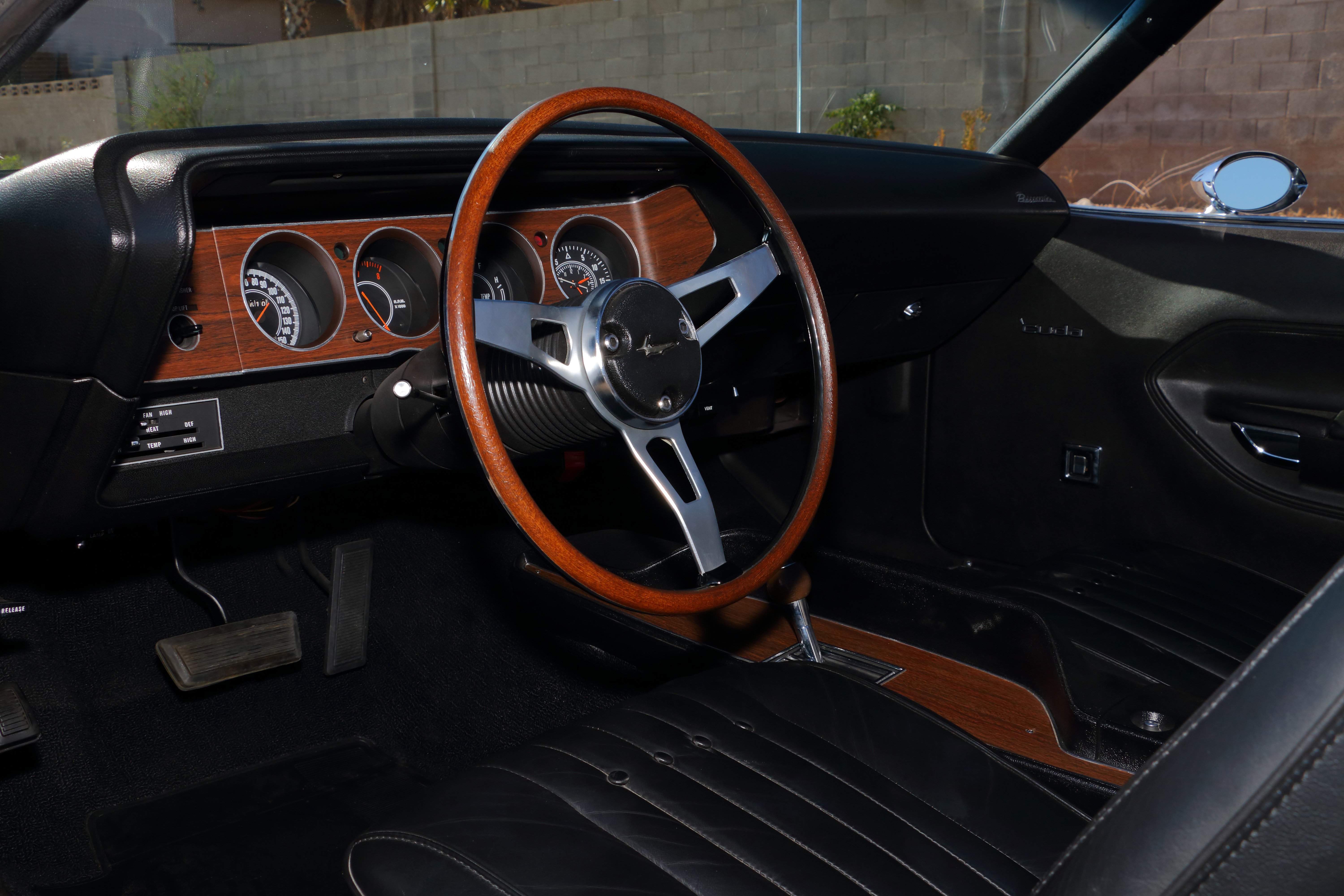
The Hemi 'Cuda was a street racer with few compromises. The Hemi option added almost 30 per cent to the price of the car, insurance was expensive and fuel use was high. The engine needed regular attention to its carburettors and valve gear to stay in tune. The old 1cars text describes the sporty cabin with high-backed bucket seats, extra gauges and a three-spoke steering wheel. Rear passengers had enough room for a short trip.

It was not a car for every day, and many were raced or modified, which is one reason why original examples are so scarce today. Its rivals were the Ford Mustang Boss 429, the Chevrolet Camaro and the Chevrolet Chevelle SS, as well as the Plymouth Road Runner, which offered the same Hemi in a bigger, cheaper body.
Collecting a Plymouth Hemi 'Cuda today
The Hemi 'Cuda is one of the most valuable American muscle cars. In June 2014 a blue 1971 Hemi 'Cuda convertible with a four-speed gearbox sold at Mecum's Seattle auction for a seven-figure sum. Well-restored 1970 hardtops change hands for six-figure sums, and the first 1970 convertible built has been valued in the millions.
Because the price gap between a real Hemi car and a clone is so large, buyers should check:
- The vehicle identification number: the fifth character is "R" for the 426 Hemi.
- The fender tag and the build sheet, which list the original engine, gearbox, colour and options.
- The engine block's stamping, matching the car's VIN.
- Original Hemi parts: the Shaker scoop, the heavy-duty axle and the uneven rear leaf springs.
- Rust in the floor, the boot floor and around the rear window, the usual weak spots of a 50-year-old steel body.
More classics of the period are in our selection of 1970s classic cars, and the company's story is told in the history of Plymouth.
Plymouth Hemi Cuda in our rankings
- No. 7 of 93 · Most powerful cars of the 1970s (317 kW)
- No. 48 of 642 · Biggest engines: cars (6,981 cc · top 8%)
- No. 37 of 189 · Biggest engines: coupes (6,981 cc · top 20%)
- No. 113 of 492 · Most torque: cars (664 Nm · top 24%)
- No. 297 of 1019 · Most powerful cars (317 kW · top 30%)
- No. 153 of 509 · Widest cars (1,900 mm · top 31%)
Bigger engine than 92% of ranked cars in the 1CARS catalog (No. 48 of 642).
Plymouth Hemi Cuda photos 18




Plymouth Hemi Cuda videos 2

Plymouth Hemi Cuda video 1

Video overview
FAQ
How many 1970 Hemi 'Cudas were made?
For 1970 Plymouth built 652 Hemi 'Cuda hardtops and 14 convertibles for the USA, plus 3 convertibles for Canada and one for export. Of the hardtops, 368 had the TorqueFlite automatic. Production fell further in 1971.
How much horsepower does a Hemi 'Cuda have?
The 426 Hemi was rated at 317 kW (425 hp SAE gross) at 5,000 rpm, with 664 Nm (490 lb-ft) of torque at 4,000 rpm. Net figures were lower, as with all gross ratings of the time.
What is the difference between a Barracuda and a 'Cuda?
In 1970 and 1971 the 'Cuda was the sporty, performance-oriented line of the Barracuda, with stronger engines, firmer suspension and sporty trim. The Hemi 'Cuda was the 'Cuda with the optional 426 Hemi V8.
Why was the Hemi 'Cuda only made for two years?
Rising insurance premiums for high-powered cars and new emissions rules ended the big-block era. The 1971 model year was the last with the 426 Hemi, and the Barracuda itself was discontinued in April 1974.
How do you tell if a 'Cuda is a real Hemi car?
Check the VIN, where the fifth character is "R" for the 426 Hemi, then the fender tag, build sheet and engine stamping. Clones are common, so an expert inspection is worth the cost before buying.
Data sources
Data checked by an editor against the sources below.
- The text of this article (1cars archive)
- Wikipedia - Plymouth Barracuda


