
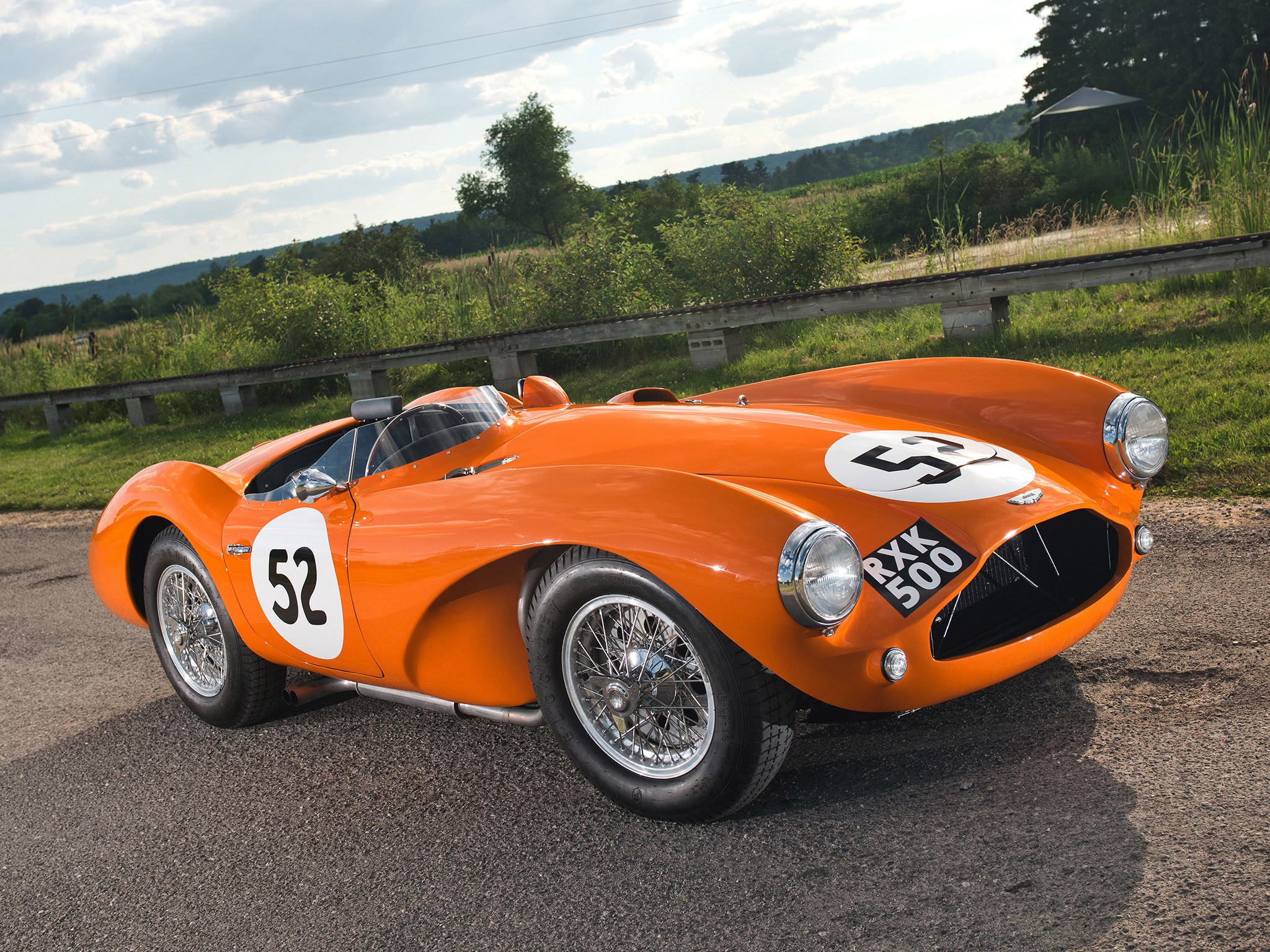
 Aston Martin DB3S
Specs, engines and history
Updated Published Sources (4) Report an error
By Felix Hartmann, Automotive Technology & EV Contributor Reviewed by Oleksandr Hnatiuk

- Built
- 1953–1956
- Top power
- 171 kW (232 PS)
The Aston Martin DB3S is a two-seat sports racing car built from 1953 to 1956, with 31 examples in total. It used a 3.0-litre Lagonda straight-six in a lighter tubular chassis than the DB3 it replaced. The DB3S won the 1953 Tourist Trophy and finished second at Le Mans in 1955, 1956 and 1958.
In short
- Eleven works cars and twenty customer cars, plus a 1994 car assembled from original spare parts.
- The 2,992 cc twin-cam six gave about 134 kW (180 bhp) in 1953 and close to 170 kW (230 bhp) in its final works form.
- Two works coupés crashed at Le Mans in 1954, which showed how much lift the body made at speed.
- The DBR1 replaced it as the main works racer from 1956 and won Le Mans in 1959.

Size at a glance
| Dimensions | Aston Martin DB3S |
|---|---|
| Length | 3,910 mm153.9 in |
| Width | 1,500 mm59.1 in |
| Height | 1,040 mm40.9 in |
| Wheelbase | 2,210 mm87.0 in |
Specs by version
Engines
Dimensions and weight
Verified Manufacturer and type-approval data from our catalog · Sources and methodology
Why David Brown ordered the Aston Martin DB3S
The DB3S was the car that turned Aston Martin from a class contender into a team racing for outright wins. David Brown, who owned the company, commissioned it in November 1952. The earlier DB3 had proved too heavy, so the new car had to be lighter, stiffer and better shaped.

A.G. "Willie" Watson engineered the chassis. He had worked as assistant to Robert Eberan von Eberhorst, the designer of the DB3. Frank Feeley drew the aluminium body, whose curved wings and low nose looked far more modern than the boxy DB3. Aston Martin's own history notes that the shape was more efficient but not always stable on the Mulsanne Straight.
| Fact | Detail |
|---|---|
| Maker | Aston Martin (David Brown era) |
| Built | 1953–1956 |
| Total | 31 cars: 11 works, 20 customer |
| Type | Open two-seater sports racer; some coupés |
| Engine | 2,992 cc Lagonda twin-cam straight-six |
| Successor | Aston Martin DBR1 |
From Charterhall to the customer cars
The first car raced in May 1953 at Charterhall in Scotland, where Reg Parnell won ahead of Ecurie Ecosse's Jaguar C-Types. Five open works cars were built that year. They carried the chassis numbers DB3S/1 to DB3S/5, and one of them was converted from David Brown's own road car.

For 1954, the team built two fixed-head coupés, DB3S/6 and DB3S/7. They had wind-tunnel-tuned bodies for lower drag at Le Mans, and a prototype tried front disc brakes. Both coupés crashed in the race because of lift at high speed. The works rebuilt them as open cars for 1955.
From May 1955, Aston Martin sold a slightly detuned customer version. Twenty were built, numbered DB3S/101 to DB3S/120. Three customers ordered coupé bodies. In 1994, Aston Service Dorset assembled one more car from original spare parts, numbered DB3S/121.
| Year | Event |
|---|---|
| November 1952 | David Brown commissions a lighter successor to the DB3 |
| May 1953 | Debut win at Charterhall (Reg Parnell) |
| 1953 | 1-2 at the Tourist Trophy, Dundrod; win at the Goodwood Nine Hours |
| 1954 | Two works coupés built; both crash at Le Mans |
| May 1955 | Customer version offered; 20 built |
| 1955 | Second overall at Le Mans (Collins/Frère) |
| 1956 | Second at Le Mans (Moss/Collins); DBR1 takes over as works car |
| 1958 | Whitehead brothers second at Le Mans in a private DB3S |
Watson's chassis and Feeley's aluminium body
Watson's chassis used two large tubes with cross-members, which saved weight against the DB3 frame. Front suspension used trailing arms and torsion bars. At the rear, a De Dion tube with trailing arms, torsion bars and a central slide kept the wheels upright.

The body was a thin aluminium skin. The car measures 3,910 mm long, 1,500 mm wide and 1,040 mm high, on a 2,210 mm wheelbase. Wikipedia gives a dry weight of 840 kg, although another figure of 880 kg also appears in its data. Tyres were 16-inch with 6-inch sections.
The body changed almost every season. The old 1cars text pointed out that the low-drag shape also created lift, and the 1954 crashes proved it. Later cars received different noses and tails, and DB3S/9 carried an aerodynamic head fairing behind the driver.
The Lagonda six and its power figures
The DB3S kept the Lagonda straight-six that W.O. Bentley's team had designed, enlarged from 2.6 to 2,992 cc. Compared with the DB3 unit, that is about 15 % more displacement. It had two overhead camshafts and three twin-choke Weber 35 DCO carburettors. Power went to the rear wheels through a David Brown S430 four-speed manual gearbox with a single-plate clutch.

| Parameter | Metric | Imperial |
|---|---|---|
| Engine | 2,992 cc straight-six, DOHC, petrol | 182.6 cu in |
| Power (1953) | about 134 kW | about 180 bhp |
| Power (customer car) | about 157 kW at 5,500 rpm | 210 bhp |
| Power (late works) | about 170 kW | close to 230 bhp |
| Gearbox | David Brown S430, 4-speed manual | - |
| Length / width / height | 3,910 / 1,500 / 1,040 mm | 153.9 / 59.1 / 40.9 in |
| Wheelbase | 2,210 mm | 87.0 in |
| Dry weight | 840 kg | 1,852 lb |
Power figures differ between sources, because the works kept changing the engine. Conceptcarz records just over 134 kW (180 bhp) in 1953 and nearly 170 kW (230 bhp) after a twin-plug head arrived. The 1954 coupés had about 168 kW (225 bhp), and one ran with a supercharger at around 179 kW (240 bhp). A customer car offered at auction was described with 157 kW (210 bhp) at 5,500 rpm.
The customer engine, coded VB6K, used a high-compression head and larger valves. By our calculation, a customer car with 157 kW and 840 kg carried about 5.4 kg per kW. That is better than many modern hot hatchbacks, in a car with drum brakes and narrow tyres. The 1cars power-to-weight calculator runs the same sum for any car.
Coupés and the DP155 single-seater
Three bodies existed in period: the open two-seater, the works coupé of 1954 and the customer coupé. The engine also came in a 2.5-litre version for an experiment. Aston Martin built one single-seater, project DP155, around DB3S parts for the 1954 Formula 1 rules.
Reg Parnell raced that car in the Tasman races of January 1956 and scored two podium finishes. It later received a Jaguar engine, and in 1957 a new owner turned it into a sports car with the body of customer car DB3S/105. RM Sotheby's offered it as a "DB3S Special" at Monterey in 2023, estimated at 1.75 to 2.25 million US dollars, but it did not sell.
The DB3S also linked the road and racing lines. Its engine family powered the Aston Martin DB2 and its successors, which shared the Lagonda six.
DB3S race record: Le Mans seconds and championship points
The DB3S was fast but rarely lucky at Le Mans. In 1953, none of the three team cars finished, and in 1954 all five retired. Aston Martin still won elsewhere. In 1953, the DB3S took a 1-2 at the Tourist Trophy, the sixth round of the first World Sportscar Championship, and the team finished third in the standings.

| Year | Le Mans result | Drivers |
|---|---|---|
| 1953 | All three works cars retired | - |
| 1954 | All five works cars retired | - |
| 1955 | 2nd overall | Peter Collins / Paul Frère |
| 1956 | 2nd overall | Stirling Moss / Peter Collins |
| 1957 | 11th overall, 3.0-litre class win | Jean-Paul Colas / Jean Kerguen |
| 1958 | 2nd overall | Peter Whitehead / Graham Whitehead |
In 1955, the team finished fifth in the championship, and in 1956 it was fourth. The 1956 Le Mans race did not count for points, because new rules followed the 1955 disaster. RM Sotheby's counts 15 wins from 35 starts in four years of factory racing.
Drivers included Reg Parnell, Peter Collins, Roy Salvadori, Tony Brooks and Peter Walker. Carroll Shelby and Stirling Moss also raced it, and Shelby later won Le Mans for Aston Martin in the DBR1. Its main opponents, the Ferrari 750 Monza and Jaguar's C-Type and D-Type, all had more power.
Collecting a DB3S: surviving cars and auction estimates
Surviving cars appear at historic races and concours events, and each has a documented history by chassis number. To compare the period horsepower figures with modern ones, use the 1cars power converter. DB3S/1, for example, won five races, including the 1953 British Empire Trophy. A DB3S won the Gran Turismo Trophy at the Pebble Beach Concours d'Elegance in 2013.

Customer cars travelled far. DB3S/102, one of three cars run by Australia's Kangaroo Stable, set an Australian land speed record of 143.19 mph (230.4 km/h) in 1957. It crashed at Bathurst in 1960 and was restored in the 1970s. Before its auction in September 2020, it carried an estimate of 4 to 5 million US dollars.
Values depend on the history: a works car with a Le Mans record is worth far more than a later customer car. Buyers should check the chassis number against factory records and any engine or body changes. Our history of Aston Martin explains how the DB3S fits into the company's racing story.

Aston Martin DB3S in our rankings
- No. 6 of 32 · Smallest convertibles and roadsters (3,910 mm)
- No. 38 of 531 · Smallest cars (3,910 mm · top 8%)
- No. 326 of 656 · Biggest engines: cars (2,992 cc · top 50%)
- No. 50 of 81 · Most powerful convertibles and roadsters (171 kW · top 62%)
- No. 648 of 1033 · Most powerful cars (171 kW · top 63%)
- No. 31 of 49 · Biggest engines: convertibles and roadsters (2,992 cc · top 64%)
Shorter than 92% of ranked cars in the 1CARS catalog (No. 38 of 531).
Aston Martin DB3S photos 14


FAQ
How many Aston Martin DB3S cars were built?
Aston Martin built 31 DB3S cars from 1953 to 1956: eleven works cars and twenty customer cars. A further car, numbered DB3S/121, was assembled in 1994 from original spare parts.
What engine does the DB3S have?
It uses a 2,992 cc Lagonda straight-six with two overhead camshafts and three Weber carburettors. Output rose from about 134 kW (180 bhp) in 1953 to close to 170 kW (230 bhp) in the last works cars.
Did the Aston Martin DB3S win Le Mans?
No. Its best results were second overall in 1955, 1956 and 1958. Aston Martin's first Le Mans win came in 1959 with the DBR1, driven by Roy Salvadori and Carroll Shelby.
Who designed the Aston Martin DB3S?
Willie Watson engineered the chassis and Frank Feeley designed the aluminium body. David Brown, the company's owner, commissioned the car in November 1952 to replace the heavy DB3.
How much is an Aston Martin DB3S worth?
Prices vary widely with history. A customer car with a racing record was estimated at 4 to 5 million US dollars in 2020, while a converted single-seater special failed to sell at a lower estimate.
Data sources
Data checked by an editor against the sources below.
- The text of this article (1cars archive)
- Wikipedia - Aston Martin DB3S
- Conceptcarz - Series
- Conceptcarz - Aston Martin Db3s


