
 Aston Martin DB7
Specs, engines and history
Updated Published Sources (2) Report an error
By Felix Hartmann, Automotive Technology & EV Contributor Reviewed by Oleksandr Hnatiuk

- Built
- 1994–2004
- Top power
- 324 kW (441 PS)
- New price
- from about €127,822 (1994)
- Used price today
- about €30,000–52,500 (AutoScout24, Nov 2026)
Which DB7 to buy
Our verdict · Felix Hartmann
A six-cylinder manual coupé is the best value and the purest early car, but manuals are rare: about three-quarters of the 2,451 six-cylinder cars were automatics. The V12 Vantage is faster and has an engine unique to Aston Martin, and the GT and GTA of the final year are the most sought-after. The Zagato and DB AR1 are collector's cars. Whichever you choose, buy the best example you can afford, with a full service history. The V12 family also powered the Vanquish of 2001, other grand tourers of the decade are in the 1990s classics section, and the full range is in the Aston Martin catalogue.
The Aston Martin DB7 is a 2+2 grand tourer built from September 1994 to December 2004 as a coupé and a Volante convertible. It started with a 250 kW supercharged six-cylinder, gained a 313 kW 5.9-litre V12 in 1999 and sold about 7,000 cars, more than any Aston Martin before it. The DB9 replaced it.
In short
- Designed by Ian Callum and engineered with Jaguar and TWR under Ford ownership; shown at Geneva in March 1993.
- Engines: 3.2-litre supercharged I6 with 250 kW (340 PS) to 1999, then the 5.9-litre V12 Vantage with 313 kW (426 PS).
- Final GT, GTA, Zagato and DB AR1 versions reached up to 324 kW (441 PS).
- Built at Bloxham in Oxfordshire; about 2,450 six-cylinder and 4,640 V12 cars were sold.

Size at a glance
| Dimensions | Aston Martin DB7 |
|---|---|
| Length | 4,646 mm182.9 in |
| Width | 1,830 mm72.0 in |
| Height | 1,268 mm49.9 in |
| Wheelbase | 2,591 mm102.0 in |
Specs by version
Engines
Dimensions and weight
Verified Manufacturer and type-approval data from our catalog · Sources and methodology
Aston Martin DB7 at a glance
The DB7 began as the "XX" project. Ford, which owned Aston Martin from 1988 to 2007, funded it, and Jaguar resources did most of the work. Tom Walkinshaw's TWR saw it as a successor to the Jaguar XJS, whose platform it uses in heavily modified form. Ian Callum reworked an earlier Jaguar design by Keith Helfet into the DB7 shape. The prototype was ready in November 1992 and appeared at the Geneva Motor Show in March 1993.

Production took place at Bloxham, Oxfordshire, in the former Jaguar XJ220 factory, while TWR engineered the car in Kidlington. The DB7 helped restore Aston Martin's finances and made possible the DB9. The wider story is in the history of Aston Martin.
| Parameter | Metric | Imperial |
|---|---|---|
| Length (I6 / Vantage) | 4,646 / 4,692 mm | 182.9 / 184.7 in |
| Wheelbase | 2,591 mm | 102.0 in |
| Width | 1,830 mm | 72.0 in |
| Height | 1,268 mm | 49.9 in |
| Kerb weight (Vantage coupé / I6 coupé / Volante) | 1,800 / 1,825 / 1,900 kg | 3,968 / 4,023 / 4,189 lb |
| Layout | Front engine, rear-wheel drive, 2+2 seats | – |
Supercharged six or V12: DB7 performance
The DB7 had two engine families: a Jaguar-based six-cylinder and Aston Martin's V12, built in Kidlington.
| Version | Years | Engine | Power | Torque | 0–62 mph | Top speed |
|---|---|---|---|---|---|---|
| DB7 (I6) | 1994–1999 | 3.2 supercharged I6 | 250 kW (340 PS) | 489 Nm | 5.7 s (manual) | 266 km/h (165 mph) |
| DB7 Vantage | 1999–2003 | 5.9 V12 | 313 kW (426 PS) | 542 Nm | 5.0 s (manual) | 296 km/h (184 mph) |
| DB7 GT | 2002–2003 | 5.9 V12 | 324 kW (441 PS) | – | 5.0 s | – |
| DB7 Zagato | 2002–2003 | 5.9 V12 | 324 kW (441 PS) | – | 4.9 s (0–60 mph) | 299 km/h (186 mph) |
The six-cylinder used a Getrag 290 five-speed manual or a GM four-speed automatic. The V12 came with a TREMEC T-56 six-speed manual or a ZF five-speed automatic, which is slower: the automatic Vantage tops out at 266 km/h (165 mph) and takes 5.1 seconds to 62 mph. The GTA is the automatic version of the GT and keeps 313 kW (426 PS); 190 GTs and 112 GTAs were built.
Compared with the six-cylinder car, the V12 Vantage has 63 kW more power, and its coupé is 25 kg lighter.
Body, cabin and practicality
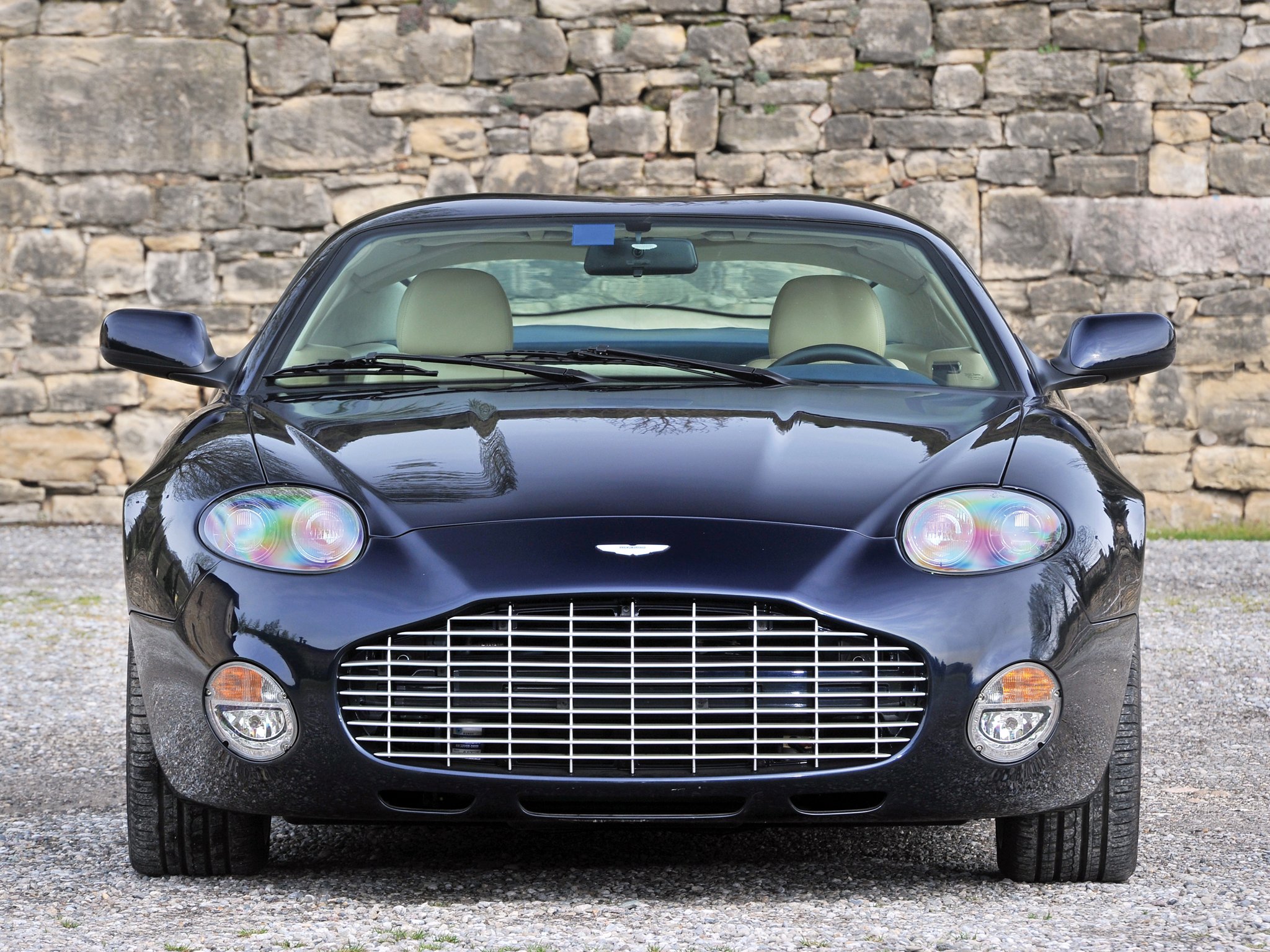
The body mixes steel for the main structure with composite front wings and bootlid; early cars also had a composite bonnet. The cabin is trimmed in Connolly leather, with air conditioning, electric front seats and heated mirrors as standard. The rear seats suit children or short trips, so the DB7 works best as a two-seater with extra luggage space. The Volante, shown at the 1996 Detroit show, has an electrically operated fabric roof.
Fuel use and running costs
Aston Martin did not publish EU-standard consumption figures for the DB7, so there is no official l/100 km rating. Both engines are thirsty, the V12 more so. Running costs depend above all on condition: a neglected DB7 can cost more to put right than a well-kept one costs to buy.

Common checks before buying include:
- rust on the rear wheelarch lips, the bottom corners of the rear window opening, floorpans, inner wings, suspension turrets and rear chassis legs; V12 cars are more prone to it;
- porous or bubbling composite panels and uneven gaps;
- on the six-cylinder, timing-chain rattle from neglected oil changes and cracked exhaust manifolds;
- on the V12, failing coil packs, which sit under the intake plenum and are costly to reach;
- the air-conditioning evaporator, door glass, damp carpets from a failed scuttle seal and, on the Volante, the hood mechanism.
Special editions and versions
The Alfred Dunhill Edition of 1998 included a built-in humidor; 78 of a planned 150 were made. The Zagato, shown at Pebble Beach in August 2002, has a shorter wheelbase and an aluminium body; 99 were sold plus one for the factory museum. The DB AR1 (American Roadster 1), introduced in Los Angeles in January 2003, was an open two-seater for the US market, also limited to 99 cars plus one for the factory.
Crash tests and safety equipment
The DB7 was never crash-tested by Euro NCAP or the IIHS, which rarely test low-volume sports cars. Driver and passenger airbags and traction control were part of the standard equipment.

Rivals: how the DB7 compares
When new, the DB7 competed with the Porsche 911, the Mercedes-Benz SL and Ferrari's front-engined 2+2s, as well as its Jaguar cousin, the XK8. It was the most traditional of them: less sharp than a 911, but more exclusive and hand-finished. To see how it stacks up against later Aston Martins such as the Vantage, use the 1cars comparison tool or the specifications section.

Aston Martin DB7 in our rankings
- No. 10 of 112 · Most powerful cars of the 1990s (309 kW)
- No. 110 of 645 · Biggest engines: cars (5,900 cc · top 18%)
- No. 275 of 1022 · Most powerful cars (324 kW · top 28%)
- No. 427 of 1092 · Longest-running car nameplates (10 years · top 43%)
- No. 238 of 531 · Longest cars (4,646 mm · top 45%)
- No. 56 of 118 · Most powerful British cars (324 kW · top 48%)
More powerful than 91% of ranked cars of the 1990s in the 1CARS catalog (No. 10 of 112).
Aston Martin DB7 photos 18


Aston Martin DB7 videos 2
Aston Martin DB7 video 1

Video overview
FAQ
What engine does the Aston Martin DB7 have?
Early cars have a 3.2-litre supercharged six-cylinder with 250 kW (340 PS). From 1999 the DB7 Vantage uses a 5.9-litre V12 with 313 kW (426 PS), and the GT and Zagato versions reach 324 kW (441 PS).
How many Aston Martin DB7s were made?
More than 7,000 were built between 1994 and 2004, making it the best-selling Aston Martin of its time. About 2,450 had the six-cylinder engine and about 4,640 were V12 Vantage models.
Is the Aston Martin DB7 based on a Jaguar?
Yes, in part. Its platform evolved from the Jaguar XJS, and Jaguar engineers did much of the development work under Ford ownership. The body, the V12 engine and the final assembly at Bloxham were Aston Martin's own.
What are the main rivals of the Aston Martin DB7?
It competed with the Porsche 911, the Mercedes-Benz SL, Ferrari's front-engined 2+2 models and the Jaguar XK8. The DB7 was the most traditional and exclusive of the group.
What replaced the Aston Martin DB7?
The DB9 replaced it in 2004. The DB9 moved to an aluminium platform and kept a version of the 5.9-litre V12 that had first appeared in the DB7 Vantage.
Data sources
Data checked by an editor against the sources below.
- The text of this article (1cars archive)
- Wikipedia - Aston Martin DB7


