
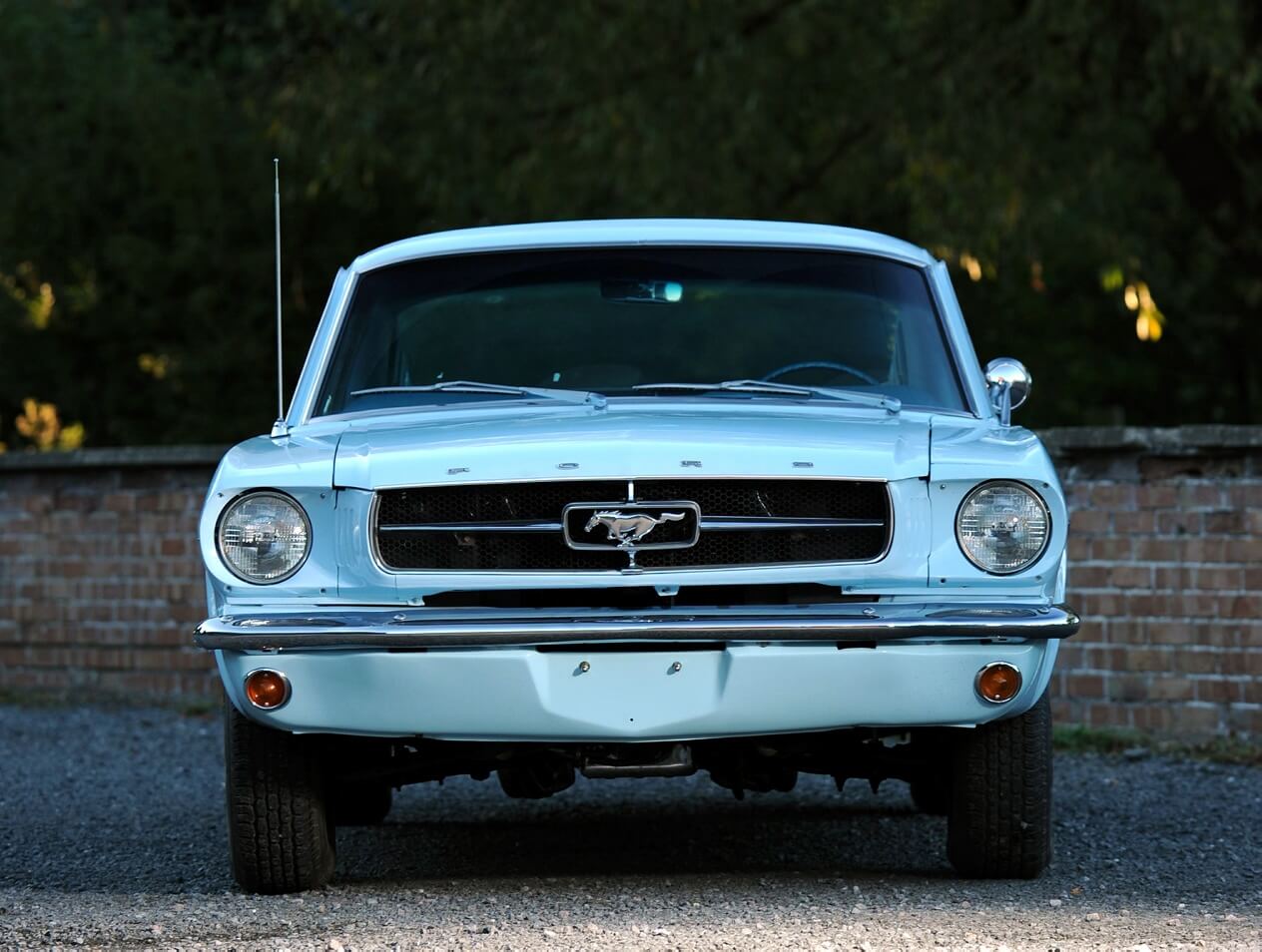
 Ford Mustang Fastback
Specs, engines and history
Updated Published Sources (3) Report an error
By Sarah Whitmore, Senior Automotive Writer Reviewed by Oleksandr Hnatiuk

- Built
- 1964
- Top power
- 202 kW (275 PS)
Which Mustang fastback to buy
Our verdict · Sarah Whitmore
A 1965–1966 fastback with the 289 V8 is the classic choice, and the K-code cars and GT models are the most valuable. The 1967–1968 cars with the 390 offer big-block power, and the 1968 428 Cobra Jet is a collector's item. Check rust on the floors, frame rails, lower doors, cowl vent, rear-window surround, battery tray and shock towers. Verify engine codes and options against the factory paperwork, because fastback panels, Pony Interiors and K-code engines are often added to lesser cars; a four-speed manual adds value. Ford's modern Mustang coupé is also sold as the Mustang Fastback, and the full range is in the Ford catalogue.
The Ford Mustang fastback is the sloping-roof 2+2 body of the original Mustang, added in August 1964, four months after the car's launch, and sold from the 1965 model year. It shared the Falcon-based platform and engines from a six-cylinder to V8s, the best-known being the 289 K-code with 202 kW (271 bhp). About 77,000 were built in the first model year.
In short
- Hardtop and convertible launched on 17 April 1964; the fastback followed in August 1964 for the 1965 model year.
- Engines from the 200 cu in six to the 289 V8, then the 390 and the 428 Cobra Jet of 1968 with 250 kW (335 bhp), all gross ratings.
- The base for the 1965 Shelby GT350, offered only as a fastback, and for the 1968 Mustang GT of the film Bullitt.
- From 1969 Ford called the body "SportsRoof"; it ran until the 1973 model year.

Specs by version
Verified Manufacturer and type-approval data from our catalog · Sources and methodology
Ford Mustang Fastback at a glance
The Mustang was the car that created the "pony car" class: compact, sporty and cheap to buy, with a long bonnet, a short rear deck and a huge list of options. Lee Iacocca, then general manager of the Ford Division, championed the project. Before the launch at the 1964 World's Fair the press coverage was so intense that some dealers had to lock their doors to control the crowds, according to period accounts. The full story of the model is told in the history of the Ford Mustang.

Joe Oros came up with the idea of a fastback, and Charlie Phaneuf's studio designed it; Gale Halderman later recalled that the car was built in secret. The fastback has a steeply raked roof, unique rear glass and deck lid, and a fold-down rear seat that turns the back into a long load area, which is why Ford marketed it as a 2+2.
| Parameter | Metric | Imperial |
|---|---|---|
| Wheelbase | 2,743 mm | 108 in |
| Width (1965) | 1,732 mm | 68.2 in |
| Kerb weight | about 1,166 kg (six) to 1,361 kg (equipped V8) | about 2,570–3,000 lb |
| Layout | Front engine, rear-wheel drive, 2+2 seats | – |
| Platform | Ford Falcon-based unibody | – |
From the 200 six to the 428 Cobra Jet
All power figures of the period are gross ratings, measured without accessories, so they are higher than modern net figures.

| Engine | Model years | Power (gross) |
|---|---|---|
| 200 cu in (3.3 l) six | 1965–1966 | 89 kW (120 bhp) |
| 289 cu in (4.7 l) V8, 2-barrel | 1965–1966 | 149 kW (200 bhp) |
| 289 V8, 4-barrel | 1965–1966 | 168 kW (225 bhp) |
| 289 Hi-Po "K-code" V8 | 1965–1966 | 202 kW (271 bhp) |
| 390 cu in (6.4 l) FE V8 | 1967–1968 | 239–242 kW (320–325 bhp) |
| 302 cu in (4.9 l) V8 | 1968 | 157–172 kW (210–230 bhp) |
| 428 Cobra Jet (7.0 l) V8 | 1968 | 250 kW (335 bhp) |
The K-code 289 is the most sought-after small-block: it has solid lifters, high-flow heads and aluminium pistons. The six came with a three-speed manual, V8s offered a four-speed manual, and the Cruise-O-Matic three-speed automatic was available with the 225 bhp V8. The suspension uses coil springs at the front and leaf springs on a live rear axle, as on the Falcon. Compared with the 200 bhp 289, the K-code produces 53 kW more.
Body, cabin and equipment
The 1965 fastback's interior had vinyl front bucket seats, a thin-rimmed three-spoke steering wheel and simple round gauges. From mid-1965 the Pony Interior added embossed running ponies on the seat backs, upgraded door panels, wood-grain trim and a five-gauge instrument cluster. The GT Equipment Package of 1965 brought fog lamps in the grille, rocker-panel stripes, a handling package and front disc brakes.

The 1967 redesign made the car larger, with a wider track to take big-block V8s, and the fastback roofline now ran in one sweep to the tail. The 1968 model kept that shape with minor changes.
Production numbers by year
| Model year | Fastback production | All Mustangs |
|---|---|---|
| 1965 | 77,079 (71,303 standard, 3,987 luxury, 1,789 luxury GT) | 559,451 |
| 1966 | 35,698 (27,809 standard, 7,889 luxury) | 607,568 |
The 1965 total includes 121,538 cars built in calendar 1964 with 1965 serial numbers. In 1966 the Mustang passed one million units overall.

Shelby, Bullitt and the screen
The 1965 Shelby GT350 was built only as a fastback, and later Shelby models, including the 1967 Shelby GT500, stayed with the body; Shelby's own story is told separately. The most famous fastback is the modified 1968 Mustang GT 2+2 driven by Steve McQueen's character in Bullitt, which chases a Dodge Charger through San Francisco. A 1967 fastback also appears in The Fast and the Furious: Tokyo Drift (2006), where it races in the mountains.

1960s safety and modern upgrades
Like other cars of the 1960s, the original Mustang has no crash-test rating, and its protection is basic by modern standards. Front disc brakes were part of the 1965 GT package; owners who drive their cars regularly often fit disc-brake conversions and other modern upgrades.

Rivals: how the Mustang fastback compares
| Model | Launch | Body |
|---|---|---|
| Ford Mustang fastback | 1964 (1965 model year) | 2+2 fastback |
| Plymouth Barracuda | 1964 | Fastback |
| Chevrolet Camaro | 1966 (1967 model year) | Coupé, convertible |
| Pontiac Firebird | 1967 | Coupé, convertible |
The Mustang reached the market first and sold far more: its 1966 total of 607,568 cars was well ahead of any rival. Compare it with later muscle cars in the 1cars comparison tool, browse the 1960s classics section or look up data in the specifications section.


Rivals
Compare with…
Compare Ford Mustang Fastback with
- Chevrolet Camaro quick spec comparison
- Plymouth Barracuda quick spec comparison
-
Ended 2024
- Years
- 1966–2024
- Body
- Coupe, Convertible
- Fuel
- Petrol
- Power
- 66–485 kW (90–659 PS)
-
Classic
- Years
- 1964–1974
- Body
- Coupe, Convertible
- Fuel
- Petrol
- Power
- 75–317 kW (102–431 PS)
3 generations
- I
- II
- III


Popular comparisons
Ford Mustang Fastback in our rankings
- No. 167 of 627 · Biggest engines: cars (4,700 cc · top 28%)
- No. 91 of 181 · Biggest engines: coupes (4,700 cc · top 52%)
- No. 542 of 1011 · Most powerful cars (202 kW · top 54%)
- No. 56 of 97 · Most powerful cars of the 1960s (202 kW · top 58%)
- No. 119 of 168 · Most powerful American cars (202 kW · top 72%)
- No. 253 of 326 · Most powerful coupes (202 kW · top 78%)
Bigger engine than 72% of ranked cars in the 1CARS catalog (No. 167 of 627).
Ford Mustang Fastback photos 16


FAQ
When did the Ford Mustang fastback come out?
The fastback joined the Mustang range in August 1964, four months after the hardtop and convertible were launched on 17 April 1964. It was sold as a 1965 model and continued, renamed SportsRoof from 1969, until the 1973 model year.
What engine does the Ford Mustang fastback have?
Early fastbacks offered a 200 cu in six with 89 kW (120 bhp) and 289 V8s up to the K-code with 202 kW (271 bhp). From 1967 a 390 V8 was available, and the 1968 428 Cobra Jet produced 250 kW (335 bhp), all gross figures.
How many 1965 Mustang fastbacks were made?
Ford built 77,079 fastbacks for the 1965 model year, including 1,789 luxury GT versions. For 1966 the figure fell to 35,698, while total Mustang production reached 607,568 cars that year.
Which Mustang fastback was in Bullitt?
Steve McQueen's character drove a modified 1968 Mustang GT 2+2 fastback in Bullitt, chasing a Dodge Charger through San Francisco. The car became one of the most famous Mustangs ever built.
What are the main rivals of the Mustang fastback?
Its rivals were the Plymouth Barracuda, launched in 1964, and later the Chevrolet Camaro and Pontiac Firebird of the 1967 model year. The Mustang came first and outsold them by a wide margin.
Data sources
Data checked by an editor against the sources below.
- The text of this article (1cars archive)
- Wikipedia - Ford Mustang
- Wikipedia - Ford Mustang (first generation)


