
 Lamborghini Countach
Specs, engines and history
Updated Published Sources (2) Report an error
By Felix Hartmann, Automotive Technology & EV Contributor Reviewed by Oleksandr Hnatiuk

- Built
- 1974–1990
- Top power
- 335 kW (455 PS)
- New price
- from about €53,583 (1974)
The Lamborghini Countach is a mid-engined V12 supercar built in Sant'Agata Bolognese from 1974 to 1990. Marcello Gandini of Bertone drew the wedge, Paolo Stanzani's team engineered it, and the prototype appeared at Geneva in March 1971. Across five versions, 1,983 cars were made, and the V12 grew from 3.9 to 5.2 litres.
In short
- Built: 1974–1990 in Italy; 1,983 cars including the 1971 prototype; the 25th Anniversary (657) is the most common, the LP400 (157) the rarest.
- Layout: V12 mounted lengthways behind the cabin, gearbox ahead of the engine, rear-wheel drive, steel tube frame with aluminium panels.
- Power: from 276 kW (375 PS) in the LP400 to 335 kW (455 PS) in the Quattrovalvole.
- Successor: the Diablo of 1990; the name returned on the hybrid LPI 800-4 in 2021.

Size at a glance
| Dimensions | Lamborghini Countach |
|---|---|
| Length | 4,140 mm163.0 in |
| Width | 2,000 mm78.7 in |
| Height | 1,070 mm42.1 in |
| Wheelbase | 2,450 mm96.5 in |
Specs by version
Engines
| Version | Engine | Power | Torque | Gearbox | Drive | Production years |
|---|---|---|---|---|---|---|
| LP500 S (4.8 V12) | 4.8 l · 12 cyl · Petrol 4,754 cc | 276 kW 375 PS370 hp | 418 Nm308 lb-ft | 5-sp Manual | Rear-wheel drive | 1982–1985 |
| 5000 Quattrovalvole / 25th Anniversary (5.2 V12) | 5.2 l · 12 cyl · Petrol 5,167 cc | 335 kW 455 PS449 hp | 500 Nm369 lb-ft | 5-sp Manual | Rear-wheel drive | 1985–1990 |
Performance
Show all 2 versions
| Version | 0–100 km/h | Top speed |
|---|---|---|
| LP500 S (4.8 V12) | 5.2 s 0–62 mph | 293 km/h182 mph |
| 5000 Quattrovalvole / 25th Anniversary (5.2 V12) | 4.8 s 0–62 mph | 298 km/h185 mph |
Dimensions and weight
Show all 1 versions
| Version | Length | Width | Height | Wheelbase |
|---|---|---|---|---|
| LP500 S (4.8 V12) | 4,140 mm163.0 in | 2,000 mm78.7 in | 1,070 mm42.1 in | 2,450 mm96.5 in |
Verified Manufacturer and type-approval data from our catalog · Sources and methodology
The Countach in one table

| Item | Lamborghini Countach |
|---|---|
| Maker | Automobili Lamborghini, Sant'Agata Bolognese |
| First shown | LP500 prototype, Geneva, March 1971 |
| Series production | 1974–1990 |
| Built | 1,983 (all versions, prototype included) |
| Designer | Marcello Gandini (Bertone) |
| Chief engineer | Paolo Stanzani |
| Engine | V12, 3,929 to 5,167 cc, six Weber carburettors (fuel injection on US cars from 1985) |
| Power | 257–335 kW (349–455 PS) |
| Gearbox / drive | 5-speed manual / rear-wheel drive |
| Successor | Lamborghini Diablo (1990) |
From project LP112 to the first customer car
Ferruccio Lamborghini wanted a successor to the Miura, and work began in 1970 under the internal code LP112. Paolo Stanzani led the engineering, test driver Bob Wallace developed the chassis, and Gandini, who had also styled the Miura at Bertone, drew a body made of flat, angled planes. His earlier show cars, the Alfa Romeo Carabo of 1968 and the Lancia Stratos Zero of 1970, already pointed in this direction.
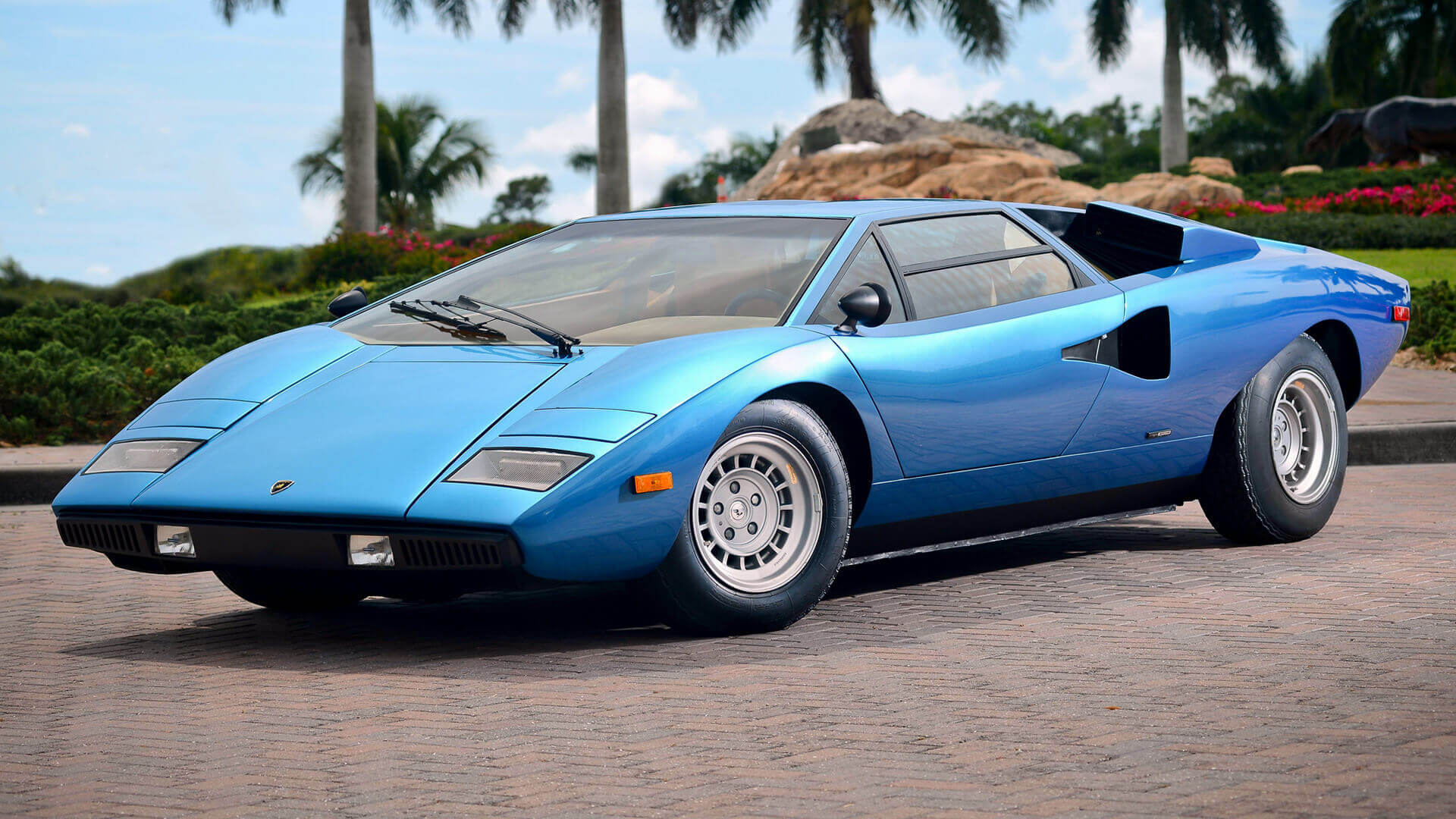
The yellow LP500 prototype stood on the Bertone stand at Geneva in March 1971. It had a 5.0-litre V12 that failed during road testing the same year, so the production car went back to the proven 4.0-litre unit. Production was approved in May 1972, a revised prototype followed in 1973, and the original LP500 ended its life in a crash test at the MIRA proving ground in England in March 1974. The first customer car was delivered on 11 April 1974.
The name is not Italian. "Countach" is an exclamation of amazement in the Piedmontese dialect of the Turin area. Gandini later said the choice began as a joke in the workshop.
Production timeline

| Year | Event |
|---|---|
| 1970 | Project LP112 starts under Paolo Stanzani |
| 1971 | LP500 prototype shown at Geneva (March) |
| 1972 | Production approved (May) |
| 1974 | First LP400 delivered (11 April); prototype crash-tested at MIRA |
| 1978 | LP400 S with wide arches and 345 mm rear tyres |
| 1982 | LP500 S with a 4.8-litre engine |
| 1985 | 5000 Quattrovalvole with four valves per cylinder and 5.2 litres |
| 1988 | 25th Anniversary facelifted by Horacio Pagani |
| 1990 | Production ends; the Diablo takes over |
| 2021 | Countach LPI 800-4 marks the 50th anniversary of the prototype |
Gandini's shape and the scissor doors
The body is low and wide: 1,070 mm tall on a 2,450 mm wheelbase. The Countach was the first production car with doors hinged at the front that swing upwards, and every V12 Lamborghini since has kept that feature. The doors were partly a practical answer: the later cars are about two metres wide, and conventional doors would have needed a lot of space to open.

The clean prototype lost some of its purity on the way to production. Engineers found that the V12 ran hot, so the LP400 gained the NACA ducts in the doors and the boxes behind the side windows that feed air to the radiators. Later versions added wheel-arch extensions, a front spoiler and, on request, a large rear wing. On the LP400 S the wing cut top speed by at least 16 km/h, according to period figures, so many buyers chose it for looks rather than speed.
Under the panels sits a tubular steel spaceframe of round tubes, built by Marchesi in Modena. The frame weighs about 90 kg. The outer panels are unstressed aluminium, 1.5 mm thick on the LP400. Suspension uses double wishbones at each corner with coil springs and anti-roll bars, and all four brakes are ventilated discs.
Why the gearbox sits in front of the engine
"LP" stands for longitudinale posteriore: the V12 is mounted lengthways behind the seats. Stanzani turned it around compared with a usual mid-engined car, so the five-speed gearbox sits between the seats, ahead of the engine. The drive goes back through a shaft that runs through the engine sump to the rear differential. This keeps the gear lever close to the gearbox, gives a direct shift and puts more of the mass inside the wheelbase.

The V12 itself goes back to Giotto Bizzarrini's 1963 design for the 350 GT, with four overhead camshafts. In the Countach it breathed through six side-draught Weber carburettors. The first 3,929 cc version developed its peak power at a high 8,000 rpm, with 361 Nm of torque. Displacement rose to 4,754 cc in 1982 and to 5,167 cc in 1985, when the four-valve heads arrived.
Lamborghini Countach specifications
Figures below are for the LP400 unless a later version is named. By our calculation, the LP400 had about 3.9 kg of dry weight per kW; the heavier 25th Anniversary had about 4.7 kg per kW.

| Parameter | Metric | Imperial |
|---|---|---|
| Engine (LP400) | 3,929 cc V12 | 239.8 cu in |
| Power (LP400) | 276 kW (375 PS) at 8,000 rpm | 370 hp |
| Torque (LP400) | 361 Nm | 266 lb-ft |
| Engine (5000 QV) | 5,167 cc V12, 48 valves | 315.3 cu in |
| Power (5000 QV) | 335 kW (455 PS) at 7,000 rpm | 449 hp |
| Torque (5000 QV) | 500 Nm at 5,200 rpm | 369 lb-ft |
| Length | 4,140 mm | 163.0 in |
| Width | 1,887 mm (LP400); 2,000 mm (later) | 74.3 in; 78.7 in |
| Height | 1,070 mm | 42.1 in |
| Wheelbase | 2,450 mm | 96.5 in |
| Dry weight | 1,065 kg (LP400) to 1,590 kg (25th Anniversary) | 2,348–3,505 lb |
| Top speed | 254–298 km/h depending on version | 158–185 mph |
| 0–100 km/h | 4.5–5.9 s | 0–62 mph |
Every version: LP400 to 25th Anniversary
| Variant | Years | Body / purpose | Engine | Notes |
|---|---|---|---|---|
| LP500 prototype | 1971 | show car | 5.0 l V12 | 1 built, crash-tested 1974 |
| LP400 "Periscopio" | 1974–1978 | road coupé | 3,929 cc, 276 kW | 157 built; roof channel for the rear-view mirror |
| LP400 S | 1978–1982 | road coupé | 3,929 cc, about 257–261 kW | 237 built in three series (50, 105, 82); wide arches |
| LP500 S | 1982–1985 | road coupé | 4,754 cc, 276 kW | 321 built; more torque (418 Nm) |
| 5000 Quattrovalvole | 1985–1988 | road coupé | 5,167 cc, 335 kW | 610 built; 66 with fuel injection for the US (313 kW) |
| 25th Anniversary | 1988–1990 | road coupé | 5,167 cc, 335 kW | 657 built; facelifted by Horacio Pagani |
| Walter Wolf specials | 1975–1978 | private commissions | about 5.0 l, 333 kW | 3 cars, developed with Giampaolo Dallara |
| Turbo S | early 1980s | twin-turbo test car | 4.8 l turbo | 2 built |
| QVX | 1985 | Group C race car | 5.7 l V12 | built for endurance racing |
| Evoluzione | 1987 | composite-body test car | V12 from the Quattrovalvole | 1 built, crash-tested |
The power figure of the LP400 S differs between sources: 257 kW (349 PS) in English references and 261 kW (355 PS) in German ones. Both agree that the S was slower than the LP400 because of its wider tyres and extra drag.
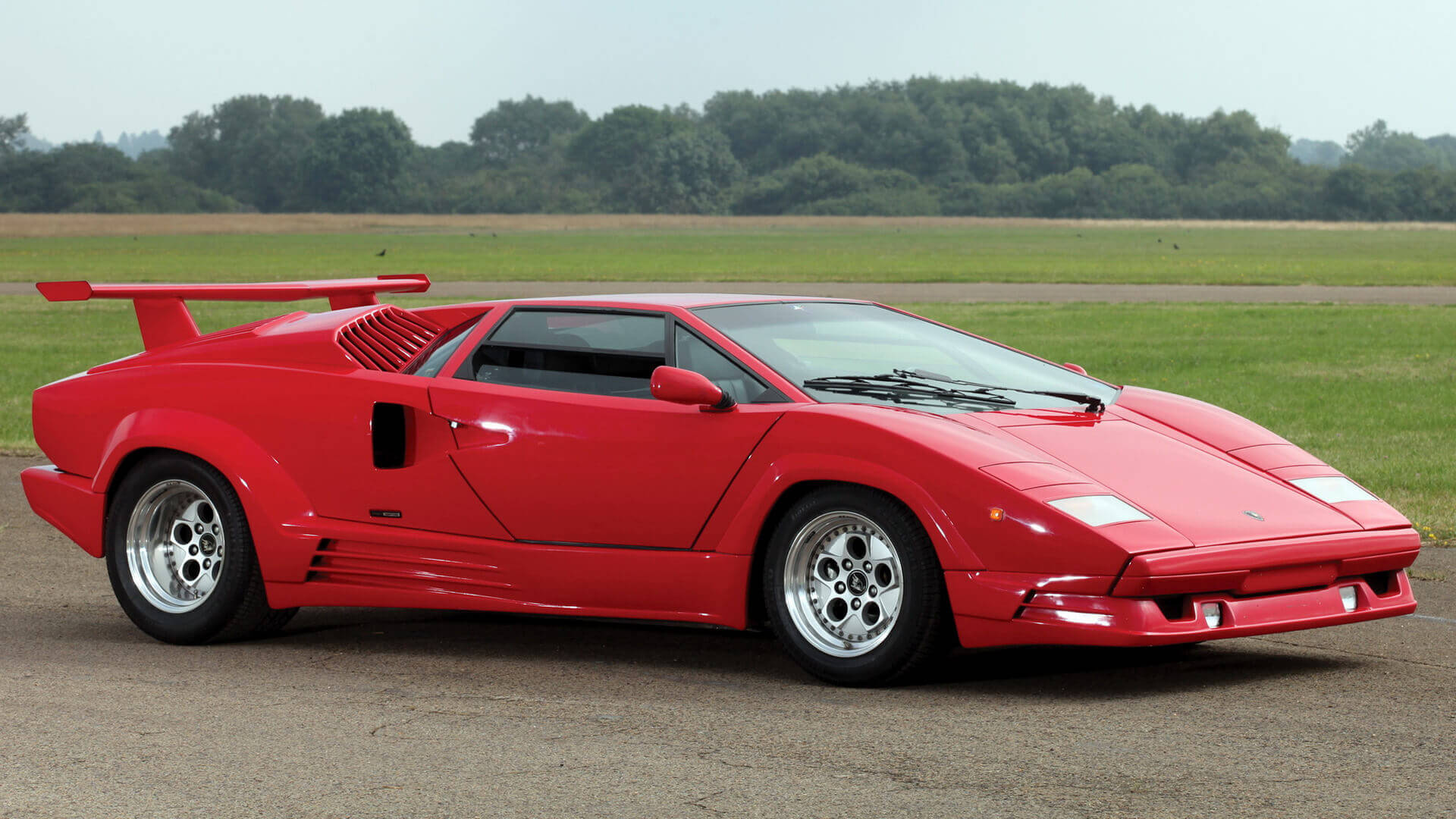
The 5000 Quattrovalvole was also the first Countach that Lamborghini built for the United States. Earlier cars reached American owners through private importers. The federal version had large bumpers and Bosch K-Jetronic injection instead of carburettors, which lowered output to 313 kW (426 PS).
The 25th Anniversary celebrated the company's founding in 1963. Horacio Pagani, then working for Lamborghini, reshaped the intakes, bumpers and sills, and rally champion Sandro Munari helped tune the handling. It was meant as a short farewell before the Diablo, but the Diablo was late, so it became the best-selling Countach of all.
How the Countach compared with its rivals
The Countach's direct rival was Ferrari's flat-12 Berlinetta Boxer. In 1975 the Swiss importer listed the LP400 at 115,000 Swiss francs. The Ferrari 365 GT/4 BB cost 4,500 francs more, while the Maserati Bora was listed at 81,500 francs and the Porsche 911 Turbo at 78,650 francs. By our calculation, the Countach cost about 46 % more than the Porsche.

| Car (1975) | Engine | Swiss list price |
|---|---|---|
| Lamborghini Countach LP400 | 3.9 l V12, mid | CHF 115,000 |
| Ferrari 365 GT/4 BB | 4.4 l flat-12, mid | CHF 119,500 |
| Maserati Bora | 4.7 l V8, mid | CHF 81,500 |
| Porsche 911 Turbo | 3.0 l flat-six turbo, rear | CHF 78,650 |
Each new Ferrari pushed the Countach further. The LP500 S answered the Boxer's larger engine, and the Quattrovalvole answered the Testarossa of 1984. You can line up these cars in our car comparison tool and check how their weight and power stack up with the power-to-weight calculator.
Living with a Countach: operation and legacy
The Countach was never an easy car. The low roof and small rear window leave little view backwards, which is why early cars have a channel in the roof for the mirror, and the cabin is narrow. Six carburettors on a V12 also need careful setting up. The 25th Anniversary was the most comfortable version, with air conditioning and electric windows.

Its influence is larger than its numbers. The wedge shape and upward-opening doors carried over to the Diablo, the Murciélago and the Aventador. A US-model LP400 S appeared in the 1981 film "The Cannonball Run", and a LEGO model of the 5000 Quattrovalvole went on sale in June 2024. The full story of the company is in our history of Lamborghini.
In 2021 Lamborghini revived the name for the Countach LPI 800-4, a hybrid V12 limited to 112 cars. The number refers to the LP112 project code. It shares the look of the old car but has a carbon-fibre chassis, a 6.5-litre engine and an electric motor, so it is a separate model rather than a sixth Countach version.
Collecting a Countach today
Collectors rank the versions clearly. Early LP400 "Periscopio" cars are the rarest and usually the dearest, while the 25th Anniversary is the most common. In 2022 a 25th Anniversary delivered new to the US sold at RM Sotheby's in St. Moritz for 415,000 Swiss francs, about €410,000 at the exchange rate of that year.

What buyers check:
- Chassis and history: the factory records list each chassis number, so the version and original specification can be confirmed.
- Frame corrosion: the steel tubes rust where water collects; inspect them with the car on a lift.
- Cooling: a radiator or fan problem shows up quickly in traffic.
- Clutch and gearbox: a worn clutch is expensive because the engine and gearbox layout makes access hard.
- Originality: many cars were fitted with wings, bumpers or wheels from later versions; returning to factory specification is costly.
- US conversions: federal cars often had their large bumpers swapped for slim European ones.
For a Countach with a modern drivetrain, the LPI 800-4 is the alternative. For the original experience, the LP400 and the Quattrovalvole are the two poles: the lightest, purest design versus the most powerful engine. The profile of Marcello Gandini covers the designer's other work.
Lamborghini Countach in our rankings
- No. 3 of 71 · Most powerful cars of the 1980s (335 kW)
- No. 3 of 18 · Fastest cars of the 1980s (298 km/h)
- No. 7 of 99 · Smallest coupes (4,140 mm)
- No. 38 of 509 · Widest cars (2,000 mm · top 8%)
- No. 56 of 378 · Fastest cars (298 km/h · top 15%)
- No. 15 of 98 · Widest coupes (2,000 mm · top 16%)
More powerful than 94% of ranked cars of the 1980s in the 1CARS catalog (No. 3 of 71).
Lamborghini Countach photos 17


Lamborghini Countach videos 2
Lamborghini Countach video 1

Lamborghini Countach video 2
FAQ
When was the Lamborghini Countach made, and where?
Lamborghini first showed it as the LP500 prototype on the Bertone stand at Geneva in 1971. Series production ran from 1974 to 1990 at the factory in Sant'Agata Bolognese, near Bologna in northern Italy.
How many Lamborghini Countach were built?
1,983 in total, counting the prototype: 157 LP400, 237 LP400 S, 321 LP500 S, 610 5000 Quattrovalvole and 657 25th Anniversary. Some German sources round this to about 2,000.
What engine does the Countach have?
A Lamborghini V12 with four overhead camshafts, mounted lengthways behind the seats. Displacement grew from 3,929 cc in the LP400 to 5,167 cc in the Quattrovalvole and the 25th Anniversary, and output rose by 59 kW along the way.
What does the name Countach mean?
It is an exclamation of surprise or admiration in Piedmontese, the dialect of the Turin region. Marcello Gandini said the name started as a joke during the build of the prototype.
Is the Countach LPI 800-4 the same car?
No. The LPI 800-4 of 2021 is a 112-car tribute built on modern Lamborghini hybrid technology. It borrows the name and styling cues, but shares no parts with the 1974–1990 Countach.
Data sources
Data checked by an editor against the sources below.
- The text of this article (1cars archive)
- Wikipedia - Lamborghini Countach


