
 Dodge Viper ACR
Specs, engines and history
Updated Published Sources (3) Report an error
By Sarah Whitmore, Senior Automotive Writer Reviewed by Oleksandr Hnatiuk

- Built
- 2016–2017
- Top power
- 481 kW (654 PS)
- New price
- from about €106,260 (2015)
Verdict: who the Viper ACR suits
Our verdict · Sarah Whitmore
The ACR is for drivers who use their car on track and want an analogue experience. It offers a big naturally aspirated engine, a manual gearbox and no turbo lag. It is a hard car to drive at the limit, with no stability tricks to hide mistakes, and the stiff suspension and low splitter make it tiring on rough roads. Buyers who want a Viper for road use will find the standard GTS more comfortable; collectors should look for low-mileage cars with the Extreme Aero Package and full documentation.
The Dodge Viper ACR of 2016–2017 is the track-focused version of the fifth-generation Viper, with an 8.4-litre V10 of 481 kW (645 hp), a six-speed manual and an aero package that produces more than 770 kg of downforce. In 2015 it set 13 production-car lap records on US circuits. Production ended when the Conner Avenue plant in Detroit closed on 31 August 2017.
In short
- ACR means American Club Racer; this was the third ACR after the 1999 and 2008 versions.
- Engine: naturally aspirated 8.4 V10 with 481 kW (645 hp) and 813 Nm (600 lb-ft), Tremec six-speed manual, rear-wheel drive.
- Extreme Aero Package: 1,876 mm rear wing, splitter extension, dive planes and diffuser, over 1,700 lb (about 770 kg) of downforce at 285 km/h.
- Laguna Seca in 1:28.65 with Randy Pobst, faster than the Porsche 918 Spyder and McLaren P1 on the same track.

Size at a glance
| Dimensions | Dodge Viper ACR VX I |
|---|---|
| Length | 4,470 mm176.0 in |
| Width | 1,950 mm76.8 in |
| Height | 1,250 mm49.2 in |
| Wheelbase | 2,500 mm98.4 in |
Specs by version
Performance
Show all 1 versions
| Version | Top speed |
|---|---|
| 8.4 475 kW (646 PS) Coupe | 335 km/h208 mph |
Dimensions and weight
Verified Manufacturer and type-approval data from our catalog · Sources and methodology
Dodge Viper ACR at a glance
The ACR is a road-legal car built for track days and club racing. Dodge's SRT division developed it on the VX I Viper, launched for the 2013 model year. It kept the formula of earlier ACRs: no extra power, but a lot more grip, downforce and braking. Compared with the standard Viper, it has stiffer, adjustable suspension, lighter components, carbon-ceramic brakes, special tyres and aerodynamic parts that turn speed into grip.

| Version | Years | Base car | Engine | Power |
|---|---|---|---|---|
| Viper GTS ACR | 1999 | SR II | 8.0 V10 | about 343 kW (460 hp) |
| Viper ACR | 2008–2010 | ZB II | 8.4 V10 | 447 kW (600 hp) |
| Viper ACR | 2016–2017 | VX I | 8.4 V10 | 481 kW (645 hp) |
The racing background of the name is covered on the Dodge Viper GTS-R page: the GTS-R won its class at Le Mans three years running, in 1998, 1999 and 2000. The whole brand story is in the history of Dodge.
The 8.4 V10, gearbox and performance
The engine is an all-aluminium 8.4-litre V10 with pushrods and two valves per cylinder, assembled by hand. In the VX I it produced 477 kW (640 hp) at launch and 481 kW (645 hp) from 2015, with 813 Nm (600 lb-ft) of torque. Dodge called that the most torque of any naturally aspirated sports car engine of its day. The only gearbox is a Tremec TR6060 six-speed manual driving the rear wheels.
The ACR is not about top speed. Dodge quoted its downforce figures at 177 mph (285 km/h), and the drag of the wing and splitter limits the car to about that speed, well below the standard Viper. In return, it is much faster through corners: the ACR lapped Laguna Seca 5.27 seconds faster than the 2008 ACR.
| Parameter | Metric | Imperial |
|---|---|---|
| Engine | 8.4 l V10 (8,382 cc) | 511 cu in |
| Power | 481 kW | 645 hp |
| Torque | 813 Nm | 600 lb-ft |
| Length | 4,463 mm | 175.7 in |
| Width | 1,941 mm | 76.4 in |
| Height | 1,246 mm | 49.1 in |
| Wheelbase | 2,510 mm | 98.8 in |
| Front / rear tyres | 295/25 R19 / 355/30 R19 | – |
Aerodynamics: wing, splitter and diffuser
The standard ACR has a front splitter, lower dive planes and a 1,776 mm-wide adjustable dual-element rear wing. It generates 1,101 lb (about 500 kg) of downforce at 150 mph and 1,533 lb (about 695 kg) at 177 mph.

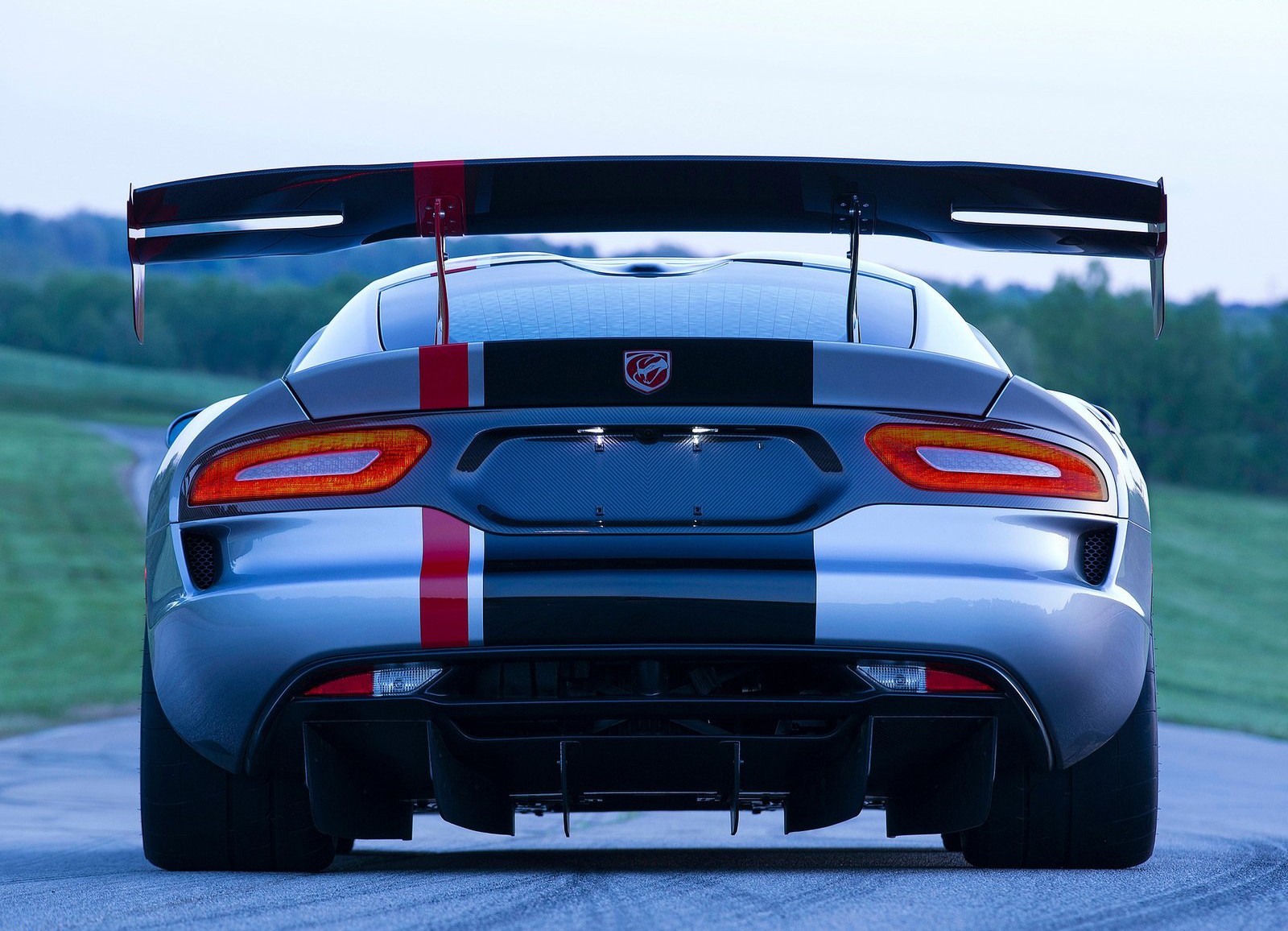
The optional Extreme Aero Package adds a 1,876 mm wing with special end plates and a Gurney lip, plus a detachable splitter extension and four dive planes. A carbon-fibre diffuser starts ahead of the rear axle and carries six removable strakes. With the package, downforce rises to more than 1,200 lb at 150 mph and more than 1,700 lb at 177 mph, about 12% more on the straights and 21% more in fast corners. An SRT bonnet with removable louvres over the front wheels lowers pressure in the wheel arches.
The old 1cars text spoke of about a tonne of downforce at top speed. The factory figure at 177 mph is just over 770 kg.
Chassis, brakes and tyres
The suspension uses aluminium-bodied, double-adjustable Bilstein coil-over dampers with ten settings each for rebound and compression. The ride height can be changed by more than 75 mm (3 in). Spring rates are 600 lb/in at the front and 1,300 lb/in at the rear, and the wheels have 1.4 degrees more negative camber than an entry Viper SRT. The suspension is independent, with double wishbones and anti-roll bars at both ends.
Brembo carbon-ceramic brakes are standard: 390 mm two-piece discs with six-piston calipers at the front and 360 mm discs with four-piston calipers at the rear, cooled through detachable ducts. The Kumho Ecsta V720 tyres were developed for the car, with different tread patterns and compounds front and rear.
Inside the ACR
The cabin is the VX I Viper's, with a Uconnect touchscreen, a digital instrument cluster, a small steering wheel and supportive bucket seats. Air conditioning and audio remain, so the car can be driven to the circuit and home again.

Lap records and the Nürburgring
In 2015 the ACR set 13 lap records for production cars, certified by the SCCA. The best known is Randy Pobst's 1:28.65 at Laguna Seca, against 1:29.89 for a Porsche 918 Spyder and 1:30.71 for a McLaren P1 with the same driver.

| Circuit | Lap time |
|---|---|
| Laguna Seca | 1:28.65 |
| Road Atlanta | 1:26.54 |
| Virginia International Raceway | 2:40.02 |
| Willow Springs | 1:21.24 |
| Buttonwillow | 1:47.70 |
| GingerMan | 1:31.91 |
An unofficial Nürburgring lap of 7:01.67 was reported for an ACR with the Extreme Aero Package in October 2015, but speed limits on the Nordschleife stopped an official attempt that year. In 2017 a crowdfunded team of owners tried to break seven minutes in a GTS-R Commemorative Edition ACR. It ran 7:01.3 on a warm-up lap, but a tyre failure and a crash ended the attempt without an official record.
End of production and value today
FCA announced in July 2017 that Conner Avenue Assembly would close on 31 August 2017. With it the Viper ended after about 32,000 cars over 26 years. The ACR therefore exists in only two model years, 2016 and 2017, including a limited GTS-R Commemorative Edition. No official euro price was published, as the car was sold only in North America, and late ACRs are now sought-after collector cars.

Rivals: how the Viper ACR compares
| Model | Engine | Power | Gearbox |
|---|---|---|---|
| Dodge Viper ACR | 8.4 V10, naturally aspirated | 481 kW (645 hp) | 6-speed manual |
| Chevrolet Corvette Z06 (C7) | 6.2 V8, supercharged | 485 kW (650 hp) | 7-speed manual or 8-speed automatic |
| Porsche 911 GT3 RS (991) | 4.0 flat-six | 368 kW (500 PS) | 7-speed dual-clutch |
| McLaren 675LT | 3.8 V8 twin-turbo | 496 kW (675 PS) | 7-speed dual-clutch |
The Viper ACR stood out for its downforce and its manual gearbox. Check how its power compares with modern cars in the most powerful coupés ranking, or set it against a rival in the 1cars comparison tool.

Dodge Viper ACR in our rankings
- No. 3 of 229 · Biggest engines: coupes (8,400 cc)
- No. 3 of 44 · Fastest American cars (335 km/h)
- No. 3 of 730 · Biggest engines: cars (8,400 cc)
- No. 21 of 440 · Fastest cars (335 km/h · top 5%)
- No. 115 of 1111 · Most powerful cars (481 kW · top 11%)
- No. 24 of 199 · Most powerful American cars (481 kW · top 13%)
Bigger engine than 99% of ranked cars in the 1CARS catalog (No. 3 of 730).
Dodge Viper ACR photos 12



Dodge Viper ACR videos 2

Test drive

Video overview
FAQ
What does ACR stand for on the Dodge Viper?
ACR means American Club Racer. Dodge used the name for track-focused Vipers in 1999, 2008–2010 and 2016–2017. Each kept the standard engine but added aerodynamic parts, adjustable suspension and stronger brakes.
How much horsepower does the Viper ACR have?
The 2016–2017 ACR has an 8.4-litre naturally aspirated V10 with 481 kW (645 hp) and 813 Nm (600 lb-ft) of torque. Power goes to the rear wheels through a Tremec six-speed manual gearbox.
How much downforce does the Viper ACR make?
With the Extreme Aero Package, more than 1,700 lb (about 770 kg) at 177 mph (285 km/h). The standard ACR aero produces 1,533 lb at the same speed and 1,101 lb at 150 mph.
What lap records did the Viper ACR set?
In 2015 it set 13 SCCA-certified production-car records. They include 1:28.65 at Laguna Seca with Randy Pobst, 1:26.54 at Road Atlanta and 2:40.02 at Virginia International Raceway.
When did Dodge stop making the Viper?
Viper production ended when FCA closed the Conner Avenue Assembly plant in Detroit on 31 August 2017. About 32,000 Vipers were built over 26 years, and the ACR was offered for the 2016 and 2017 model years.
Data sources
Data checked by an editor against the sources below.
- The text of this article (1cars archive)
- Wikipedia - Dodge Viper
- Moparinsiders - Throwback Thursday 2016 2017 Dodge Viper Acr American Club Racer


