
 Lexus LFA
Specs, engines and history
Updated Published Sources (3) Report an error
By Felix Hartmann, Automotive Technology & EV Contributor
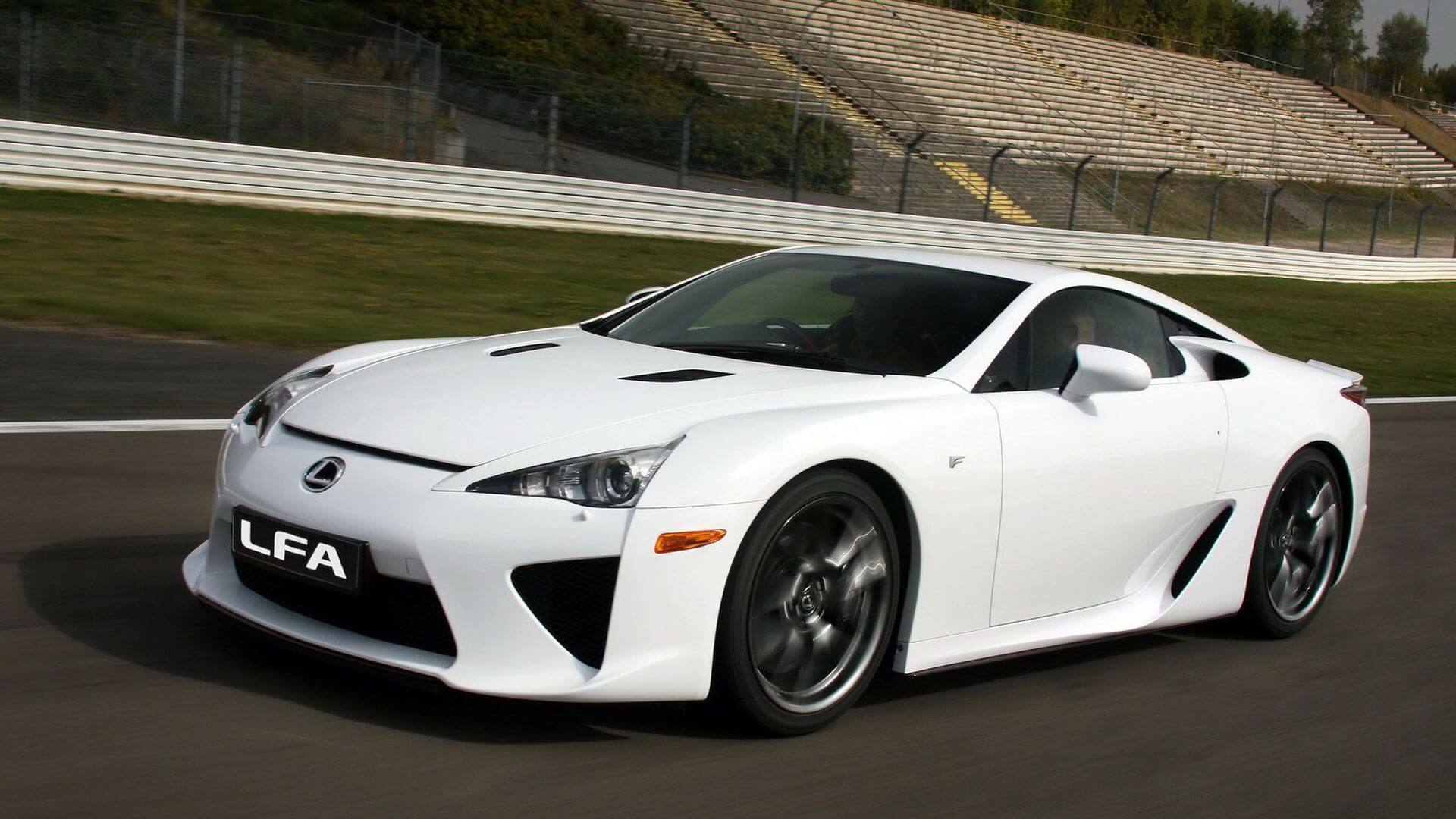
- Built
- 2010–2012
- Top power
- 420 kW (571 PS)
- New price
- from about €375,000 (2010)
Which Lexus LFA to buy
Our verdict · Felix Hartmann
There is only one generation, so the choice is between the standard car and the Nürburgring Package. The standard LFA is the better road car, with a softer setup and less aerodynamic clutter. The Nürburgring Package is the rarer and more valuable car and suits collectors who want the ultimate version.
In Germany the Nürburgring Package added about 70,000 EUR to the list price at launch. Today prices are set by the collector market, and condition and history matter more than mileage alone. A buyer should check the records of the ASG gearbox and clutch, the carbon-ceramic brakes and any carbon-body repairs, which need specialist workshops. A workshop with documented LFA experience is the safest place for service.
The Lexus LFA is a two-seat front-engined supercar that Toyota's luxury brand built by hand from December 2010 to December 2012. Exactly 500 were made. A 4.8-litre V10 co-developed with Yamaha gives 412 kW (560 PS) and revs to 9,000 rpm, and 65 per cent of the body is carbon-fibre-reinforced plastic.
In short
- Development took about ten years, from the TXS project of 2000 to the production car shown in Tokyo in October 2009.
- The 1LR-GUE V10 makes 412 kW (560 PS) at 8,700 rpm and 480 Nm; top speed is 325 km/h and 0–100 km/h takes 3.7 seconds.
- About 50 to 64 cars were built as the Nürburgring Package with 420 kW (571 PS) and more aerodynamic downforce.
- It is a collector's car today: rare, mechanically complex and valued mainly for its engine sound and response.

Size at a glance
| Dimensions | Lexus LFA |
|---|---|
| Length | 4,505 mm177.4 in |
| Width | 1,895 mm74.6 in |
| Height | 1,220 mm48.0 in |
| Wheelbase | 2,605 mm102.6 in |
Specs by version
Engines
| Version | Engine | Power | Gearbox | Drive | Production years |
|---|---|---|---|---|---|
| 4.8 L 10 cyl Automatic (S6) · 2012 (EPA) | 4.8 l · 10 cyl 4,800 cc | - | 6-sp Automatic | Rear-wheel drive | 2012 |
| 420 kW (571 PS) Coupe | - | 420 kW 571 PS563 hp | - | - | 2011 |
Performance
Show all 1 versions
| Version | Fuel consumption |
|---|---|
| 4.8 L 10 cyl Automatic (S6) · 2012 (EPA) | 18.1 l/100 km13.0 mpg US · 15.6 mpg UK |
Dimensions and weight
Show all 1 versions
| Version | Length | Width | Height | Wheelbase | Kerb weight |
|---|---|---|---|---|---|
| 420 kW (571 PS) Coupe | 4,505 mm177.4 in | 1,895 mm74.6 in | 1,220 mm48.0 in | 2,605 mm102.6 in | 1,540 kg3,395 lb |
Verified Manufacturer and type-approval data from our catalog · Sources and methodology
Lexus LFA at a glance
The LFA was Lexus's first and so far only series-built supercar. It was meant to show what Toyota's engineers could do with materials and engines, not to make money, and the history of Lexus explains how far it sat from the brand's comfortable saloons.

| Fact | Lexus LFA |
|---|---|
| Body | two-door, two-seat coupé |
| Production | December 2010 – 14 December 2012 |
| Built | 500 cars, about 20 a month |
| Plant | Motomachi plant, Toyota City, Aichi, Japan |
| Engine | 4.8 l (4,805 cc) 72° V10, front-mid mounted |
| Power | 412 kW (560 PS, 553 hp) at 8,700 rpm |
| Gearbox | 6-speed automated single-clutch (ASG), rear-wheel drive |
| Chief engineer | Haruhiko Tanahashi |
From the TXS project to the Tokyo show
Work began in early 2000 under the code name TXS. The first prototype was finished in June 2003, and testing at the Nürburgring started in October 2004. Lexus showed the LF-A concept at the Detroit show in January 2005, a second, closer-to-production study in January 2007 and an open LF-AR roadster study in January 2008.

The most important change came during development. The original body structure was aluminium, but the engineers switched to carbon fibre to save weight and improve stiffness. In the finished car about 65 per cent of the structure is carbon-fibre-reinforced plastic and 35 per cent aluminium. Akio Toyoda confirmed production in August 2009, and the production LFA appeared at the Tokyo Motor Show on 21 October 2009, styled under chief designer Kengo Matsumoto.
The old 1cars article claimed the car was planned as a better-known Toyota Supra. That is not correct: the LFA was a clean-sheet Lexus project with its own V10. Toyota's six-cylinder sports coupé history is told on the Toyota Supra page.
The 1LR-GUE V10 and the ASG gearbox
The engine was co-developed with Yamaha. It is a 72-degree V10, a cylinder angle that gives even firing intervals, with 88 mm bore, 79 mm stroke and a 12.0:1 compression ratio. Titanium connecting rods, solid titanium valves and forged aluminium pistons keep the moving parts light. The engine alone weighs about 200 kg.

It produces 412 kW (560 PS, 553 hp) at 8,700 rpm and 480 Nm at 6,800 rpm. The red line is at 9,000 rpm and the fuel cut at 9,500 rpm. Lexus says the engine can go from idle to the red line in 0.6 seconds, so fast that an analogue needle could not follow it. That is why the car has a digital tachometer drawn on a TFT screen.
| Parameter | Metric | Imperial |
|---|---|---|
| Displacement | 4,805 cc | 293 cu in |
| Power | 412 kW (560 PS) at 8,700 rpm | 553 hp |
| Torque | 480 Nm at 6,800 rpm | 354 lb-ft |
| Top speed | 325 km/h | 202 mph |
| 0–100 km/h | 3.7 s | 0–60 mph about 3.6 s |
| Length × width × height | 4,505 × 1,895 × 1,220 mm | 177.4 × 74.6 × 48.0 in |
| Wheelbase | 2,605 mm | 102.6 in |
| Kerb weight | 1,480–1,580 kg (sources differ) | 3,263–3,483 lb |
| Fuel tank | 73 l | 19.3 US gal |
Power reaches the rear wheels through a six-speed automated manual gearbox from Aisin, mounted at the rear as a transaxle and connected to the engine by a carbon-fibre propeller shaft. A Torsen limited-slip differential is standard. Shift times range from about 150 to 200 milliseconds depending on the mode, and the driver can choose between Wet, Normal, Sport and Auto settings. With the engine placed behind the front axle and the radiators at the rear, Lexus quotes a weight distribution of 48:52 front to rear.
Chassis, brakes and the Nürburgring Package
The LFA uses double wishbones at the front and a multi-link layout at the rear, with height-adjustable KYB dampers. Carbon-ceramic brake discs measure 390 mm at the front and 360 mm at the rear. Twenty-inch wheels fill the wide arches, and an active rear wing rises at speed.

The Nürburgring Package was presented at the Geneva show in March 2011. It raised output to 420 kW (571 PS), cut shift times by 0.05 seconds and added aerodynamic parts for more downforce. Lexus planned 50 cars; some sources count 64 built. In September 2011 a Nürburgring Package car lapped the Nordschleife in 7 minutes 14.64 seconds, reported at the time as the fastest lap by a road-legal production car.
The car's racing record is modest but real. Development cars won the SP8 class at a VLN race in 2008, and in 2010 the number 50 LFA won its class at the Nürburgring 24 Hours. Akio Toyoda himself drove in the 2009 edition of the race.
Interior and equipment
The cabin is built for two and finished in leather, Alcantara, carbon fibre and metal. The old 1cars review listed the launch equipment. It included a TFT instrument display that changes its layout in Sport mode and a Remote Touch controller for the central screen. Navigation with a hard disk, dual-zone climate control and a 12-speaker Mark Levinson audio system were also standard. Twelve leather colours and ten Alcantara shades were offered.

Luggage space is minimal, and the sports seats have eight adjustment directions. The LFA was never meant as a grand tourer; it is a road car built around the driver and the engine.
Safety and testing
As a hand-built car made in only 500 copies, the LFA was never crash-tested by Euro NCAP or the IIHS. Its safety equipment includes front and side airbags, ABS, traction control and a stability system that can be relaxed in Sport mode. The carbon-fibre passenger cell and front crash structures were designed to protect the occupants in a collision.

Rivals: how the LFA compares
| Model | Engine | Power | Layout |
|---|---|---|---|
| Lexus LFA | 4.8 l V10 | 412 kW (560 PS) | front-mid engine, rear-wheel drive |
| Ferrari 599 GTB | 6.0 l V12 | 456 kW (620 PS) | front-mid engine, rear-wheel drive |
| Lamborghini Gallardo LP 560-4 | 5.2 l V10 | 412 kW (560 PS) | mid engine, all-wheel drive |
| Audi R8 V10 | 5.2 l V10 | 386 kW (525 PS) | mid engine, all-wheel drive |
| Nissan GT-R (R35, 2011) | 3.8 l twin-turbo V6 | 390 kW (530 PS) | front engine, all-wheel drive |
On paper the LFA was not the fastest car of its time, and the twin-turbo Nissan matched it on acceleration for a fraction of the price. Compared with the Gallardo, which has exactly the same 412 kW, the Lexus is front-engined and drives only the rear wheels. With 1,480–1,580 kg it carries 3.6–3.8 kg per kW. The LFA's case rests on the engine's response, its sound and the carbon-fibre structure, not on lap-time tables. Other supercars from the same period are listed in the most powerful supercars guide, and any two can be checked side by side in the comparison tool.

What came after the LFA
No direct successor followed when production ended in December 2012. Lexus has since used sports-car concepts to keep the idea alive, and according to reports in December 2025 it applied the LFA name to a battery-electric sports car concept. Whether that becomes a production car is not yet known.


Lexus LFA in our rankings
- No. 3 of 132 · Most powerful Japanese cars (420 kW)
- No. 41 of 443 · Power-to-weight: cars (273 kW/t · top 10%)
- No. 176 of 1111 · Most powerful cars (420 kW · top 16%)
- No. 64 of 367 · Most powerful cars of the 2010s (420 kW · top 18%)
- No. 195 of 730 · Biggest engines: cars (4,800 cc · top 27%)
- No. 103 of 373 · Most powerful coupes (420 kW · top 28%)
More powerful than 97% of ranked Japanese cars in the 1CARS catalog (No. 3 of 132).
Lexus LFA photos 15


FAQ
How many Lexus LFAs were made?
Exactly 500 cars were built between December 2010 and December 2012, at a rate of about 20 per month. Between 50 and 64 of them were finished as the faster Nürburgring Package, depending on the source.
How much horsepower does the Lexus LFA have?
The standard LFA has 412 kW (560 PS, 553 hp) at 8,700 rpm from its 4.8-litre V10. The Nürburgring Package raises this to 420 kW (571 PS) and shortens the gearshift times.
Why does the Lexus LFA have a digital tachometer?
The V10 can rev from idle to its 9,000 rpm red line in about 0.6 seconds. Lexus says an analogue needle could not keep up, so the rev counter is drawn on a TFT screen.
Who made the engine of the Lexus LFA?
The 1LR-GUE V10 was developed by Toyota together with Yamaha, the company's long-time engine partner. It uses titanium connecting rods and valves and forged aluminium pistons.
Is the Lexus LFA all-wheel drive or hybrid?
Neither. The LFA is a petrol-only car with rear-wheel drive, a front-mid-mounted V10 and a six-speed automated manual gearbox at the rear axle. Lexus never offered an all-wheel-drive or hybrid version.
Data sources
Data checked by an editor against the sources below.
- The text of this article (1cars archive)
- Wikipedia - Lexus LFA
- US EPA fueleconomy.gov - 31089.shtml


