Lexus: How Toyota Built a Luxury Brand from Scratch
Lexus is the luxury division of Toyota Motor Corporation, launched in the United States in September 1989 with the LS 400 saloon. It grew from a secret project started in 1983, became the best-selling premium import in the US by 1991, pioneered luxury hybrids in 2004 and today sells a mainly SUV range in more than 70 countries.

Key takeaways
- Born from the F1 ("Flagship One") project: about 1,400 engineers, 2,300 technicians and roughly 450 prototypes before the LS 400.
- First Lexus built outside Japan: the RX 330 in Cambridge, Ontario, from 2003; Japan launch only in July 2005.
- The RX 400h (2004) was the first luxury-brand production hybrid SUV; one million Lexus hybrids were sold by March 2016.
- Today the line-up runs from the LBX small crossover to the LX off-roader and LM luxury MPV, with the RZ as its first dedicated EV.
Lexus at a glance

| Fact | Value |
|---|---|
| Parent company | Toyota Motor Corporation |
| Launched | January 1989 (Detroit show), sales from September 1989 |
| First models | LS 400 and ES 250 |
| Name | Created with the agency Lippincott & Margulies, evolved from "Alexis" |
| Original slogan | "The Relentless Pursuit of Perfection" |
| Main plants | Tahara and Miyata (Japan), Cambridge (Canada), Georgetown (USA) |
| Headquarters | Aichi Prefecture, Japan (Shimoyama since 2024) |
| Performance line | F (from 2007), F Sport trims |
The F1 project and the LS 400 (1983–1989)
In 1983 Toyota chairman Eiji Toyoda asked his engineers whether they could build the best car in the world. The answer became a project code-named F1, for "Flagship One". In May 1985 Toyota researchers studied American luxury buyers, and the design team rented a house in Laguna Beach, California, to watch how wealthy customers lived and drove.

The scale was huge for a single car: about 60 designers, 24 engineering teams, 1,400 engineers, 2,300 technicians and some 450 prototypes. Chief engineer Ichiro Suzuki set targets for cabin noise, fuel use and top speed that were meant to beat the German flagships of the time. The result was the LS 400, a rear-wheel-drive saloon with a new 4.0-litre V8.
Finding a name took almost as long. The branding agency Lippincott & Margulies prepared a list of 219 names, with Vectre, Verone, Chaparel, Calibre and Alexis among the favourites. "Alexis" was dropped because of its link with a television soap character, and the edited form "Lexus" was chosen. The legal publisher LexisNexis won a temporary injunction over the similar name, which an appeals court lifted before the launch.
Launch and fast growth in America (1989–1999)
The LS 400 made its debut at the North American International Auto Show in Detroit in January 1989. Sales began in September through a network of 81 dealers, with the LS 400 and the smaller ES 250, which was based on a Toyota Camry model sold in Japan. Lexus sold more than 16,000 cars in the last months of 1989, just above its target.

The first big test came in December 1989. Lexus recalled all 8,000 LS 400s built so far over a wiring fault and an overheating brake light. Technicians collected, repaired and returned the cars within 20 days, free of charge. The way the recall was handled did more for the brand's reputation than the fault did harm.
Growth was quick. The brand sold 63,594 cars in the US in 1990 and started limited exports to the UK, Switzerland, Canada and Australia. In 1991 came the SC 400 coupé and the ES 300, and the newcomer became the best-selling premium import in the US with 71,206 vehicles. The GS 300 followed in 1993, and in 1994 the second-generation LS 400.
The decade also brought the first Lexus SUVs. The LX 450 of 1996 was based on the Toyota Land Cruiser, and the RX 300 of 1998 is widely seen as the first luxury crossover. Sales started in Brazil the same year, and in 1999 Lexus passed one million cars sold in the US.
New body styles, hybrids and independence (2000–2009)
The 2000s turned Lexus from an American success into a global brand. The compact IS saloon arrived in 1999 and in North America as the IS 300 in 2000. The SC 430 of 2001 was the first Lexus convertible, with a folding hard top, and the GX 470 joined the SUV range in 2002.
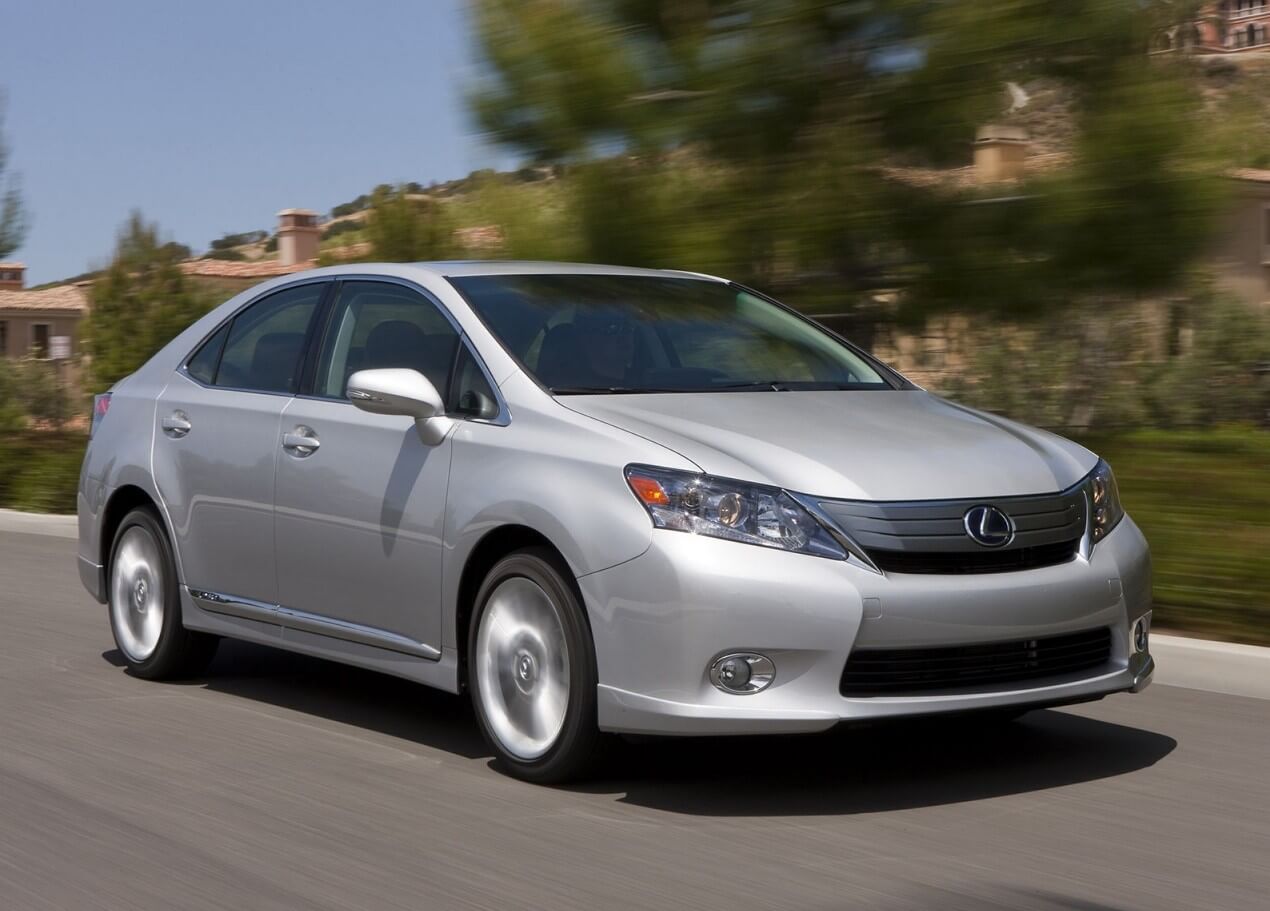
In 2003 the second-generation RX 330 became the first Lexus built outside Japan, at Toyota's plant in Cambridge, Ontario. In 2004 the RX 400h was revealed as the first production hybrid SUV from a luxury brand. Hybrid saloons followed: the GS 450h and the LS 600h. In 2008 the LS 600h L became the first production car with LED headlamps.
The division completed its organisational separation from Toyota in 2005 and finally launched in Japan in July of that year. Until then, Japanese buyers knew most Lexus models as Toyotas such as the Celsior and Aristo. Global sales reached 475,000 in 2006 and an all-time high of 518,000 in 2007. The 2008 financial crisis cut them by 16% to 435,000.
F models, the LFA and the spindle grille (2007–2019)
In January 2007 Lexus announced the F line of high-performance cars. The first was the IS F, shown at the Detroit show that month with a 5.0-litre V8 of about 310 kW (423 PS). The F Sport trim level followed later in 2007.

The most ambitious F car was the Lexus LFA, a carbon-fibre supercar with a 4.8-litre V10 of 412 kW (560 PS). Toyota built 500 of them between 2010 and 2012, including a small series with the Nürburgring Package. It let Lexus engineers prove what they could do with carbon fibre and a high-revving V10.
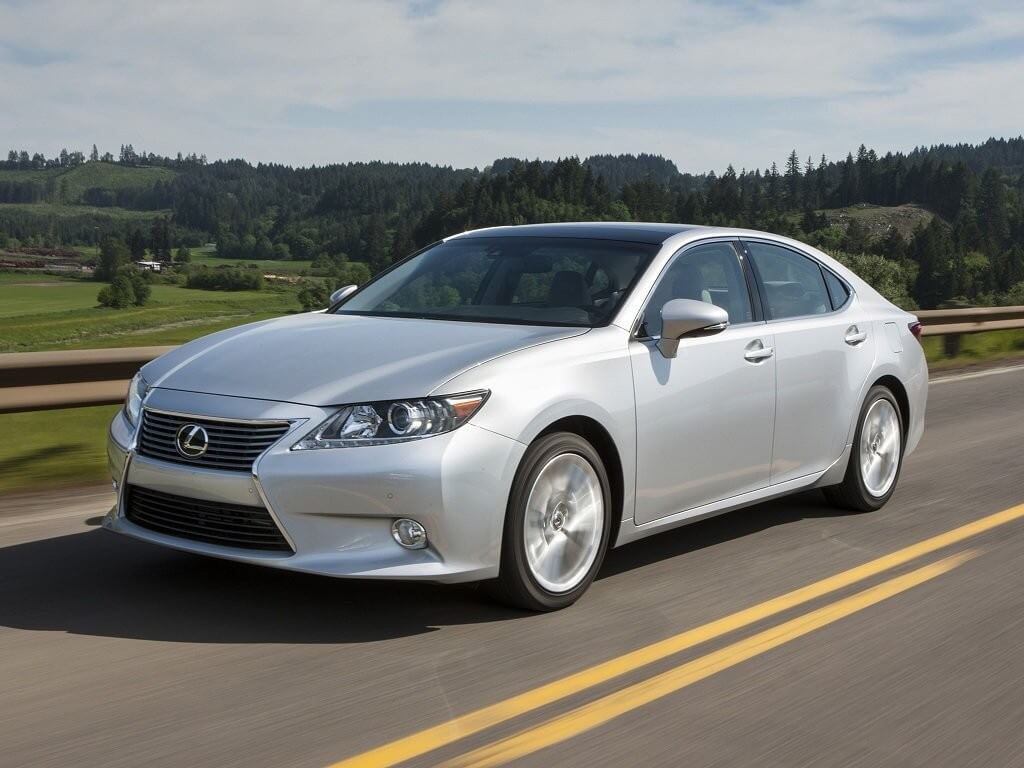
In January 2012 the fourth-generation Lexus GS introduced the spindle grille, the hourglass shape that has defined every Lexus face since. The NX of 2014 was the first Lexus with a turbocharged petrol engine, and the LC 500 coupé arrived in 2016 as a new halo car. Global sales set records of 582,000 in 2014 and 652,000 in 2015, while the 2011 earthquake and tsunami in Japan were the main setback of the decade.
Electrification and the SUV era (2019–2026)
The UX 300e, announced in October 2019, was the first battery-electric Lexus. The RZ, revealed in 2022 and on sale from 2023, was the first Lexus designed only as an EV, built at Toyota's Motomachi plant. In June 2023 the LBX opened a new segment for the brand: a small premium crossover for Europe, Japan, Australia and Southeast Asia.

Today the brand offers hybrids, plug-in hybrids and EVs in most of its range. Lexus-branded EVs are planned for production in Shanghai from 2027. The range has moved strongly towards SUVs: of the 13 model lines listed for 2026, nine are crossovers or SUVs.
Lexus timeline

| Year | Event |
|---|---|
| 1983 | Eiji Toyoda starts the F1 project |
| 1989 | LS 400 shown in Detroit (January); US sales start (September); recall of 8,000 cars (December) |
| 1991 | SC 400 coupé; best-selling premium import in the US |
| 1996 | LX 450, the first Lexus SUV |
| 1998 | RX 300 luxury crossover |
| 2003 | RX 330 production starts in Cambridge, Ontario |
| 2004 | RX 400h, the first luxury hybrid SUV |
| 2005 | Separation from Toyota completed; Japan launch in July |
| 2007 | F line and IS F; record sales of 518,000 |
| 2010–2012 | LFA supercar, 500 built |
| 2012 | Spindle grille on the GS; 500,000 hybrids sold |
| 2015 | Record 652,000 sales; ES production starts in Georgetown, Kentucky |
| 2016 | One million hybrids; LC 500 announced |
| 2019 | UX 300e, the first battery-electric Lexus |
| 2023 | LBX small crossover; RZ electric SUV |
| 2024 | Headquarters move to Shimoyama, Aichi |
Landmark Lexus models

| Model | Years | Why it matters |
|---|---|---|
| LS 400 | 1989–2000 | Quiet, reliable V8 flagship that started the brand |
| SC 400 / SC 430 | 1991–2010 | First coupé; later the first convertible |
| RX 300 | 1998–2003 | Early luxury crossover and long-time best-seller |
| RX 400h | 2005–2009 | First luxury hybrid SUV |
| IS | 1999– | Compact sports saloon, base for the IS F |
| LFA | 2010–2012 | V10 supercar, 500 built |
| LX | 1996– | Land Cruiser-based flagship SUV |
| LBX | 2023– | Smallest Lexus, aimed at Europe and Japan |
The Lexus line-up as of October 2026
According to the brand's 2026 line-up, Lexus sells 13 model lines in its main markets. The nine SUVs and crossovers are the LBX, UX, NX, RZ, RX, TZ, TX, GX and LX. The cars are the ES saloon, the IS saloon and the LC coupé and convertible, and the LM is a luxury MPV based on the Toyota Alphard. Not every model is sold in every country: the TX and GX are aimed at North America, while the LBX is a European and Asian model. All current models can be browsed in the Lexus catalogue.

Motorsport and technology
Team Lexus started racing in the US Motorola Cup in 1999 with the GS 400 and won its first race at Road Atlanta. In Japan's Super GT series, Lexus won the GT500 title with the SC 430 in 2006 and won both the GT500 and GT300 classes in 2009. A Lexus-Riley prototype won the Rolex 24 at Daytona in 2007, and the RC F GT3 took its first IMSA win at Mid-Ohio in 2018.

On the road, the brand's main technical contribution is the hybrid. The RX 400h/450h was the best-selling Lexus hybrid with about 335,000 cars by 2016, followed by the CT 200h compact with about 267,000. The design language moved from "L-finesse" in the mid-2000s to the spindle grille in 2012.
Which Lexus to choose: verdict
Lexus competes with Mercedes-Benz, BMW and Audi, and in Japan and the US with Infiniti and Acura. Its strength is reliability and hybrid experience, while the German brands offer wider ranges of diesel and performance models.

For a buyer who wants a quiet, efficient luxury SUV, the RX or NX hybrid is the obvious Lexus choice. For a used sports car with a future classic status, the IS F, RC F and LC 500 are the enthusiast picks. In the 1cars catalogue the LX 570 appears among the most powerful SUVs with 282 kW (383 PS), and the GS saloon's 530-litre boot puts it eighth in the biggest-boot saloons ranking, so the GS is the practical used choice for families. To see how Lexus models measure up against German rivals, use the 1cars comparison tool.

FAQ
Who owns Lexus?
Lexus is the luxury brand of Toyota Motor Corporation. It was launched in 1989 and became a separate division with its own design and production organisation in 2005, but it remains fully owned by Toyota.
Where does the name Lexus come from?
The agency Lippincott & Margulies made a list of 219 names. "Alexis" was a favourite, but it was linked to a television character, so the first letter was dropped and the spelling changed to Lexus.
What was the first Lexus car?
The LS 400 saloon, shown in Detroit in January 1989 and on sale in the US from September 1989. It had a 4.0-litre V8 and rear-wheel drive and was sold alongside the smaller ES 250.
Where are Lexus cars made?
Most are built in Japan, at Tahara and at Miyata in Fukuoka. The RX and NX are also built in Cambridge, Ontario, the ES in Georgetown, Kentucky, and the RZ at Motomachi in Japan.
When did Lexus start selling hybrids?
The RX 400h, revealed in 2004, was the first luxury-brand production hybrid SUV. Lexus passed 500,000 hybrid sales in November 2012 and one million in March 2016.
Which Lexus is the fastest?
Among road cars, the LFA supercar of 2010–2012 is the fastest Lexus, with a 4.8-litre V10 of 412 kW (560 PS). Only 500 were built, which makes it the rarest modern Lexus.
Photos (7)