
 Lexus IS
Specs, engines and history
Updated Published Sources (3) Report an error
By Felix Hartmann, Automotive Technology & EV Contributor Reviewed by Oleksandr Hnatiuk

- Built
- 1998–present
- Top power
- 352 kW (479 PS)
- New price
- from about €34,200 (2013)
- Used price today
- about €14,000–23,000 (AutoScout24, Nov 2026)
Which Lexus IS to buy
Our verdict · Felix Hartmann
- Lowest running costs: the IS 300h. It suits drivers who cover town and suburban miles and want an automatic with no charging. Ask for the hybrid system's service history.
- Driving enthusiasts on a budget: an XE20 IS 250 or IS 350 with full records. The V6 cars are smooth; the direct-injection 2.5 V6 is known for carbon deposits on the intake valves, so ask how it was serviced.
- Collector or weekend car: the IS F (2007–2014) or the IS 500 F Sport Performance. Both use the 5.0 V8, and the IS 500 has the newer cabin and safety kit.
- Snowy climates: an IS 300 AWD or IS 350 AWD from the North American market.
All Lexus models are listed in the Lexus catalogue.
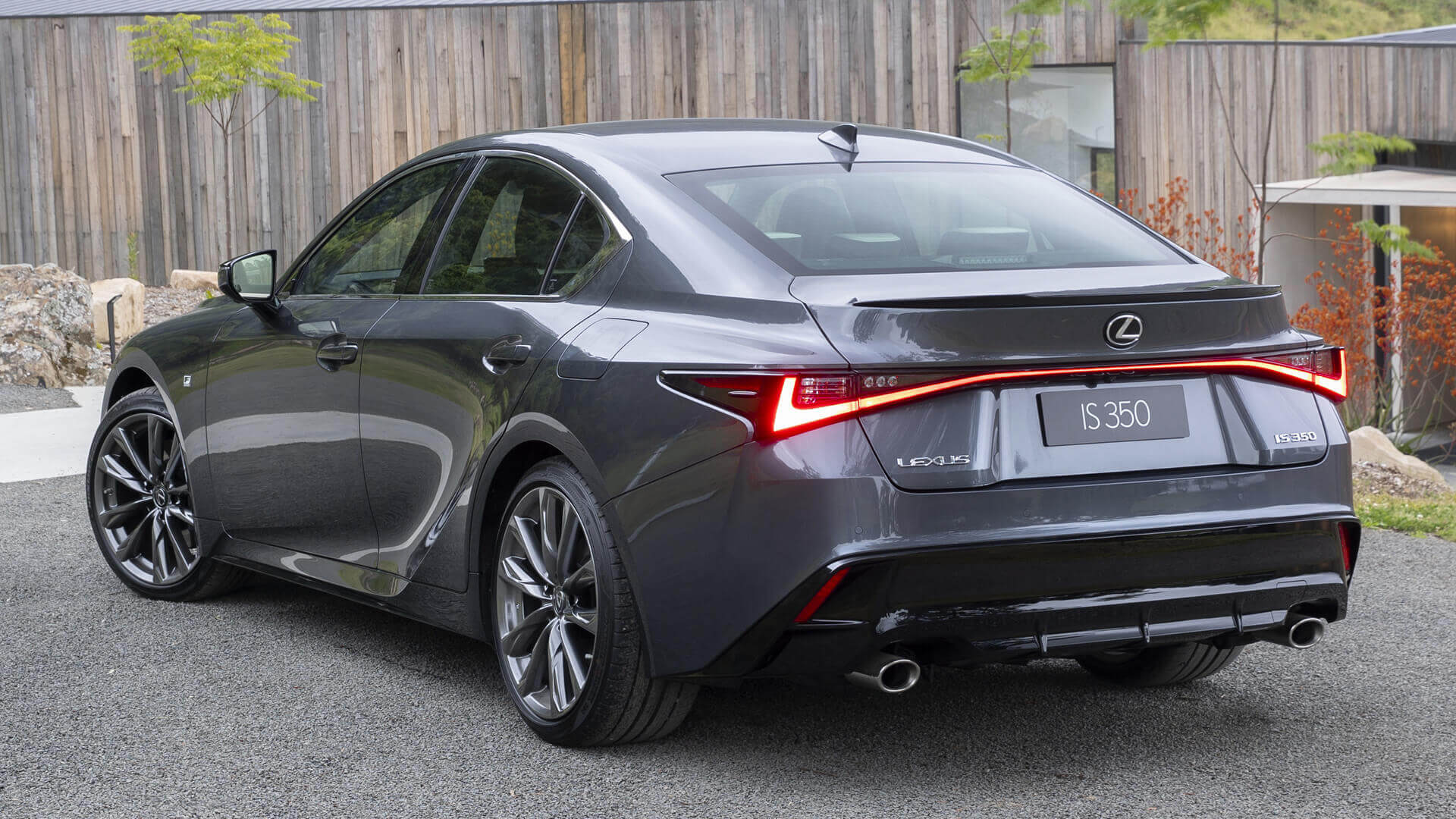
The Lexus IS is a rear-wheel-drive compact executive saloon, sold since 1998 as Lexus's rival to the BMW 3 Series. There have been three generations: XE10 (1998–2005), XE20 (2005–2013) and XE30 (2013–). The 2020 IS was a facelift of the XE30, not a fourth generation, and Lexus withdrew the IS from Europe that year.
In short
- Three generations; the first was sold in Japan as the Toyota Altezza until 2005.
- The current XE30 is built at Tahara, Japan, and has been offered as the IS 300h hybrid, a 2.0 turbo, V6 petrol versions and, from 2021 to 2025, the 352 kW (479 PS) V8 IS 500.
- The 2020 facelift added a stiffer body, new dampers and a longer 4,710 mm body; a second update followed in September 2025.
- Sales ended in Europe in 2020; North America and Japan remain the main markets.

Size at a glance
| Dimensions | Lexus IS XE30 |
|---|---|
| Length | 4,665 mm183.7 in |
| Width | 1,810 mm71.3 in |
| Height | 1,430 mm56.3 in |
Specs by version
Engines
| Version | Engine | Power | Torque | Gearbox | Drive | Production years |
|---|---|---|---|---|---|---|
| Hybrid · 1 version | ||||||
| IS 300h | 2.5 l · 4 cyl · Hybrid 2,494 cc | 164 kW 223 PS220 hp | - | CVT | Rear-wheel drive | 2013 |
| Petrol · 4 versions | ||||||
| IS 300 (2.0 turbo) | 2.0 l · 4 cyl · Petrol 1,998 cc | 179 kW 243 PS240 hp | 350 Nm258 lb-ft | 8-sp Automatic | Rear-wheel drive | - |
| IS 300 AWD (3.5 V6) | 3.5 l · 6 cyl · Petrol 3,456 cc | 190 kW 258 PS255 hp | 320 Nm236 lb-ft | 6-sp Automatic | All-wheel drive | - |
| IS 350 | 3.5 l · 6 cyl · Petrol 3,456 cc | 232 kW 315 PS311 hp | 380 Nm280 lb-ft | 8-sp Automatic | Rear-wheel drive | 2013 |
| IS 500 F Sport Performance | 5.0 l · 8 cyl · Petrol 4,969 cc | 352 kW 479 PS472 hp | 535 Nm395 lb-ft | 8-sp Automatic | Rear-wheel drive | 2021–2025 |
Dimensions and weight
Verified Manufacturer and type-approval data from our catalog · Sources and methodology
Lexus IS generations at a glance
| Generation | Code | Years | Body styles | Engines | Notable versions |
|---|---|---|---|---|---|
| First | XE10 | 1998–2005 | saloon, SportCross estate | 2.0 I4, 2.0 I6, 3.0 I6 | IS 200, IS 300, Toyota Altezza |
| Second | XE20 | 2005–2013 | saloon, IS C hardtop convertible | 2.2 diesel, 2.5–3.5 V6, 5.0 V8 | IS 220d, IS 250, IS 350, IS F |
| Third | XE30 | 2013– | saloon | 2.0 turbo I4, 2.5 hybrid, 2.5–3.5 V6, 5.0 V8 | IS 300h, IS 300, IS 350, IS 500 F Sport Performance |
The name stands for "Intelligent Sport". Until the CT hatchback arrived in 2011, the IS was the smallest Lexus. More on the brand is in our Lexus history.

How the Altezza became the first IS (XE10)
The first car went on sale in Japan in October 1998 as the Toyota Altezza, an Italian word for "height" or "highness". Europe received it as the Lexus IS 200 in 1999 and North America as the IS 300 in 2000. Tomoyasu Nishi drew the exterior in 1995, and chief engineer Nobuaki Katayama ran the programme from 1994. It was built on a shortened mid-size platform and was 4,400 mm long, and in Japan it was named Car of the Year for 1998–1999.
| XE10 engine | Code | Output | Torque | Market |
|---|---|---|---|---|
| 2.0 straight-six | 1G-FE | 114 kW (155 PS / 153 hp) | 195 Nm | IS 200 Europe, AS200 Japan |
| 2.0 four-cylinder | 3S-GE | 154 kW (210 PS / 207 hp) | 216 Nm | RS200, Japan only |
| 3.0 straight-six | 2JZ-GE | 162 kW (220 PS / 217 hp) | 295 Nm | IS 300 |
The European IS 200 reached 100 km/h in 9.3 seconds and 216 km/h flat out. The SportCross estate (the Altezza Gita in Japan) joined the XE10 range in 2001. North American IS sales peaked at 22,486 cars in 2001 and fell below 10,000 in 2004.
XE20: diesel, V6 power and the IS F
The second generation was previewed at Geneva in March 2005 and went on sale that autumn. With the Altezza name gone, it was sold as a Lexus in Japan as well. Its saloon body had a drag coefficient of 0.28, and European buyers could choose a 2.2-litre diesel, the IS 220d. The pre-collision system, which tightens the belts and prepares the brakes before an impact, was a first among entry-luxury sports saloons.

| XE20 version | Engine | Output | Torque | Years |
|---|---|---|---|---|
| IS 200d | 2.2 diesel (2AD-FTV) | 110 kW (150 PS) | 360 Nm | 2010–2012 |
| IS 220d | 2.2 diesel (2AD-FHV) | 130 kW (177 PS) | 400 Nm | 2005–2012 |
| IS 250 | 2.5 V6 (4GR-FSE) | 153 kW (208 PS) | 252 Nm | 2005–2013 |
| IS 300 | 3.0 V6 (3GR-FE) | 170 kW (231 PS) | 300 Nm | 2006–2013 |
| IS 350 | 3.5 V6 (2GR-FSE) | 228 kW (310 PS) | 375 Nm | 2005–2013 |
| IS F | 5.0 V8 (2UR-GSE) | 310 kW (421 PS) | 503 Nm | 2007–2014 |
The IS F, unveiled in Detroit in January 2007, was the first model of the Lexus F performance line. It reached 60 mph (97 km/h) in 4.2 seconds and was limited to 274 km/h. In 2008 Lexus added the IS C, a convertible with a folding metal roof, shown at the Paris show in October 2008. The best year for this generation was 2007, with 54,933 sales in the figures quoted by Wikipedia.
XE30: the long-running third generation
The XE30 premiered at the Detroit show in January 2013, and production at Tahara began on 25 April 2013. It grew to 4,665 mm and introduced the IS 300h, which became the main version in Europe and Japan. In Japan, about 5,500 of the first 7,600 orders were for the hybrid.

| XE30 version | Engine | Output | Torque | Gearbox | Years |
|---|---|---|---|---|---|
| IS 250 | 2.5 V6 | 152 kW (207 PS) | 250 Nm | automatic | 2013–2015 |
| IS 200t / IS 300 | 2.0 turbo I4 (8AR-FTS) | 179 kW (244 PS) | 350 Nm | 8-speed automatic | 2015–2025 |
| IS 300 AWD | V6 | 190 kW (259 PS) | 320 Nm | automatic | 2015–2025 |
| IS 300h | 2.5 I4 (2AR-FSE) + 105 kW motor | 164 kW (223 PS) combined | 221 Nm engine, 300 Nm motor | e-CVT | 2013– |
| IS 350 | 3.5 V6 | 232 kW (315 PS) | 380 Nm | automatic | 2013– |
| IS 500 F Sport Performance | 5.0 V8 (2UR-GSE) | 352 kW (479 PS) | 535 Nm | 8-speed automatic | 2021–2025 |
An April 2016 update brought new lamps and a 10.3-inch screen, and for 2018 the IS 200t became the IS 300. The hybrid pairs a 131 kW petrol engine with an electric motor through an e-CVT. The IS 500 used the old IS F engine, revving to 7,100 rpm, but kept the standard body width and brakes: Lexus called it the first "F Sport Performance" model, a step below a full F car. A run of 500 IS 500 Ultimate Edition cars with red six-piston Brembo calipers closed its production in 2025.
By our calculation, an IS 300h at 1,620–1,780 kg carries about 10–11 kg per kW, while the IS 500 has roughly twice the power for a similar body. Our power-to-weight calculator lets you check any version against its rivals.
What changed in the 2020 and 2025 facelifts
Lexus revealed the first big update of the XE30 on 16 June 2020, for the 2021 model year. Several older articles called it a fourth generation, but it keeps the 2013 structure. The body grew to 4,710 mm long and 1,840 mm wide, with a larger spindle grille and a full-width light bar at the rear. Underneath, the shell gained weld points, reinforced C-pillars and dampers with new swing valves. Lexus also quoted an 18 per cent weight saving from aluminium front control arms that replaced steel ones, plus lighter springs and anti-roll bars.

Inside, the IS gained Apple CarPlay and Android Auto, an electric parking brake with brake hold and standard blind-spot monitoring. The Lexus Safety System+ package, standard on the facelifted car, includes automatic emergency braking that detects pedestrians and cyclists, lane tracing and adaptive cruise control that can restart from a stop.
The second update, shown on 9 September 2025, brought a 12.3-inch display, digital instruments and variable-ratio steering, and the car grew to 4,720 mm. By then the range had shrunk: the US kept only the IS 350 in rear- and all-wheel-drive form, and Japan only the IS 300h.
Why the IS left Europe
Lexus stopped selling the IS in Europe in 2020, together with the CT and the RC coupé, because sales were weak against German rivals and buyers had moved to SUVs. In Australia the car was withdrawn in November 2021 after crash rules were tightened. Elsewhere IS sales held: 51,358 cars in 2014, a low of 13,600 in 2020 and 19,000–22,500 a year from 2021 to 2025.

In crash tests, ANCAP gave the second- and third-generation IS five stars, with 16 of 16 points in the side impact, and the first IS earned "Good" in all six IIHS frontal measurements.
Lexus IS against its rivals
| Model | Body | Drive | Hybrid offered | Strongest version |
|---|---|---|---|---|
| Lexus IS (XE30) | saloon | RWD or AWD | yes, IS 300h | IS 500, 352 kW |
| BMW 3 Series | saloon, estate | RWD or AWD | plug-in | M3, up to 390 kW |
| Mercedes-Benz C-Class | saloon, estate | RWD or AWD | mild and plug-in | C 63 S E Performance, 500 kW |
| Audi A4 | saloon, Avant | FWD or quattro | mild | RS 4 Avant, 331 kW |
The IS has fewer body styles than the German cars. Its strengths are naturally aspirated V6 and V8 engines and a self-charging hybrid that needs no plug; the size comparison tool shows how its length and width compare. Our pages on the Mercedes-Benz C-Class, the BMW 3 Series F30 and the Audi A4 generations cover the alternatives, and the Lexus GS was the larger rear-drive saloon in the same showrooms.

For reference, the 2021 model-year IS 300 started at about 39,000 US dollars in the United States (roughly €33,000 at the time).
Lexus IS in our rankings
- No. 6 of 130 · Most powerful Japanese cars (352 kW)
- No. 34 of 181 · Most powerful sedans (352 kW · top 19%)
- No. 237 of 1032 · Most powerful cars (352 kW · top 23%)
- No. 37 of 150 · Biggest engines: sedans (4,969 cc · top 25%)
- No. 170 of 655 · Biggest engines: cars (4,969 cc · top 27%)
- No. 25 of 88 · Most torque: sedans (535 Nm · top 29%)
More powerful than 95% of ranked Japanese cars in the 1CARS catalog (No. 6 of 130).
Lexus IS photos 17


Lexus IS videos 4

Lexus IS video 1

Lexus IS video 2

Lexus IS video 3

Lexus IS video 4
FAQ
How many generations of the Lexus IS are there?
Three: the XE10 from 1998, the XE20 from 2005 and the XE30 from 2013. The 2020 and 2025 versions are facelifts of the XE30, not new generations.
Is the Lexus IS available as a hybrid or with all-wheel drive?
Yes. The IS 300h hybrid has been offered since 2013 with 164 kW (223 PS), and all-wheel drive has been available on the hybrid and the V6 versions since 2015.
Is the Lexus IS still sold in Europe?
No. Lexus withdrew the IS from Europe in 2020, together with the CT and RC. It is still sold in North America, Japan and several Asian markets.
What is the most powerful Lexus IS?
The IS 500 F Sport Performance, built from 2021 to 2025, with a 5.0-litre V8 producing 352 kW (479 PS) and 535 Nm. The earlier IS F had 310 kW (421 PS).
What are the main rivals of the Lexus IS?
The BMW 3 Series, the Mercedes-Benz C-Class and the Audi A4 are the closest rivals. In some markets the Lexus IS also competes with the Alfa Romeo Giulia, Genesis G70 and Volvo S60.
Data sources
Data checked by an editor against the sources below.
- The text of this article (1cars archive)
- Wikipedia - Lexus IS
- Euro NCAP - Euro Ncap Releases Latest Round Of Crash Tests


