
 Dodge Charger Daytona
Specs, engines and history
Updated Published Sources (2) Report an error
By Felix Hartmann, Automotive Technology & EV Contributor Reviewed by Oleksandr Hnatiuk

- Built
- 1969
- Top power
- 280 kW (381 PS)
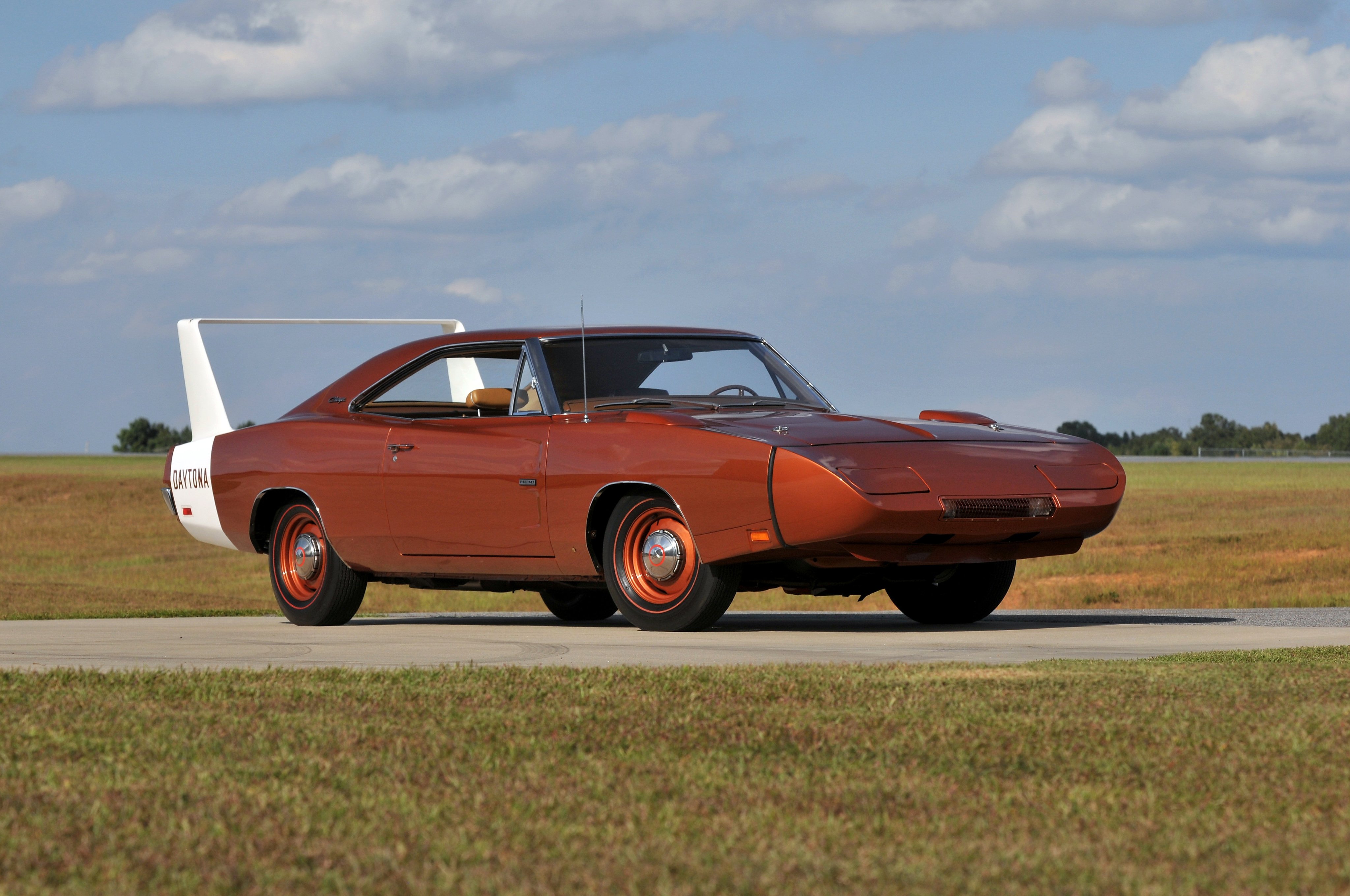
The 1969 Dodge Charger Daytona is a limited-production muscle car built to win NASCAR superspeedway races. Based on the Charger R/T, it added a sheet-metal nose cone, a flush rear window and a 584 mm (23-inch) rear wing on tall struts. Only 503 were built for homologation, 70 of them with the 426 Hemi. In 1970 Buddy Baker drove a Daytona to the first 200 mph lap in NASCAR history.
In short
- Created after the 1968 Charger 500 failed to beat Ford's aerodynamic cars in NASCAR.
- Engines: standard 440 Magnum with 280 kW (375 hp SAE gross), optional 426 Hemi rated at 317 kW (425 hp); four-speed manual or three-speed automatic.
- Won its first race, the inaugural Talladega 500 in 1969, and six NASCAR races in total in 1969–1970.
- Its corporate cousin was the 1970 Plymouth Superbird; NASCAR rules effectively banned the "aero cars" after 1970.

Specs by version
Verified Manufacturer and type-approval data from our catalog · Sources and methodology
Dodge Charger Daytona at a glance
The Charger Daytona belongs to the short era of the NASCAR "aero wars", when Chrysler, Ford and Mercury built road cars with special noses and wings so that they could race them on the fastest ovals. The name comes from Daytona Beach in Florida, home of the Daytona 500 and NASCAR. The brand's story is told in the history of Dodge, and Dodge models, including today's Dodge Charger SRT Hellcat, are in the Dodge catalogue.
| Fact | Value |
|---|---|
| Model year | 1969 |
| Base car | Dodge Charger R/T |
| Production | 503 cars (70 with the 426 Hemi) |
| Engines | 440 Magnum V8 (7.2 L), 426 Hemi V8 (7.0 L) |
| Rear wing | 584 mm (23 in) high |
| Length | about 5.8 m |
| Kerb weight | about 1,725 kg |
| Successor in racing | Plymouth Superbird (1970) |
Why the Daytona was built
In 1968 Dodge tried to make the Charger competitive on NASCAR's fast tracks with the Charger 500, which had a flush grille and rear window, but it failed to win the important superspeedway races, and Richard Petty, NASCAR's biggest star, left Plymouth for Ford in autumn 1968. Chrysler responded with a far more radical car. Engineers, helped by specialists from Chrysler's missile programme, added a pointed nose and a tall rear wing to the Charger. To race the car, NASCAR required a minimum number of road cars to be sold, so Dodge built 503 Daytonas for its dealers in 1969.

Design and aerodynamics
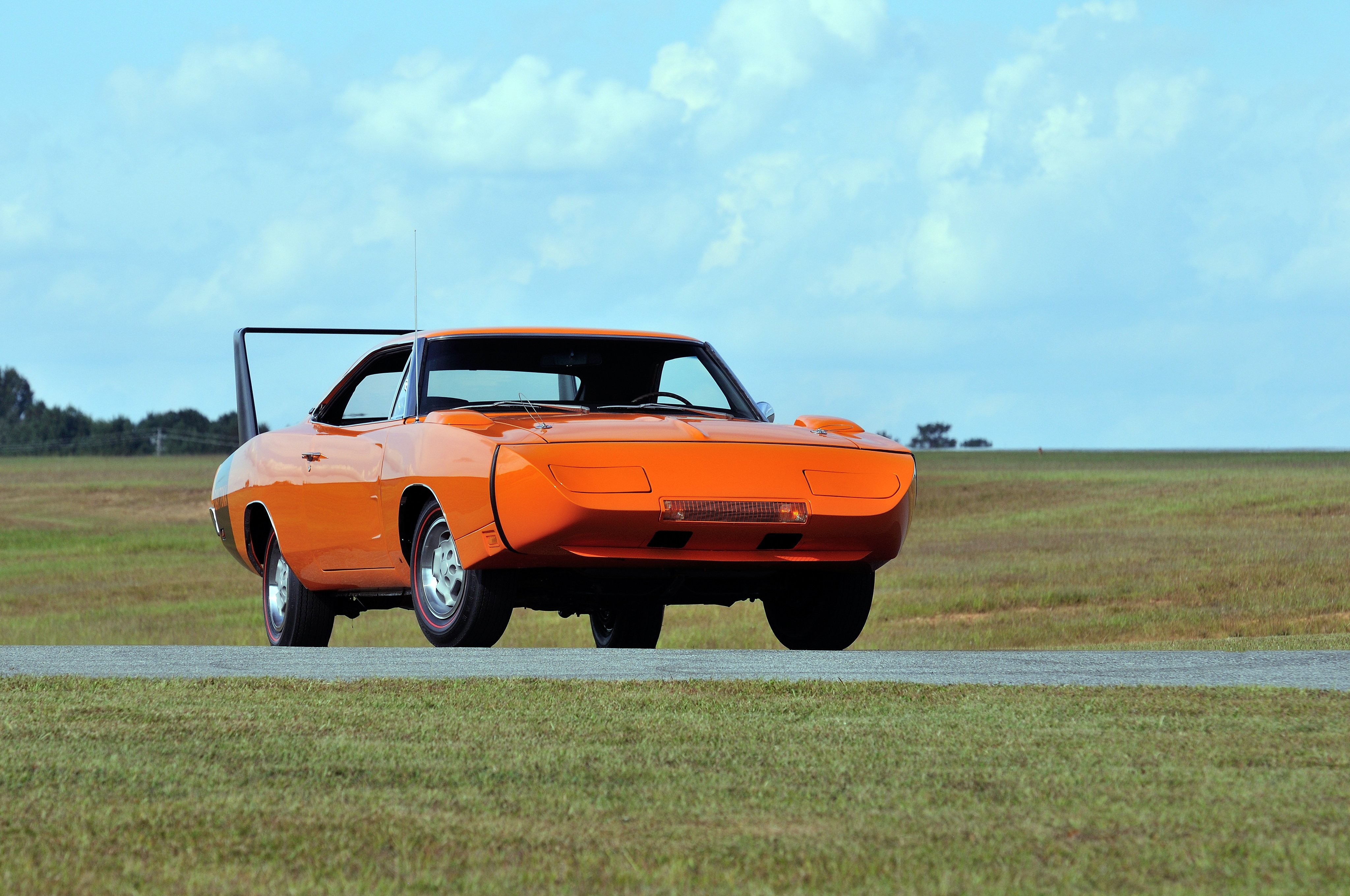
The Daytona's nose cone was made of sheet metal, not fibreglass, and replaced the Charger's upright grille and bumper. According to the old 1cars text, it added about 46 cm to the front, bringing the overall length to about 5.8 m, and the streamlined body cut aerodynamic drag by about 20%. At the rear, a flush window with a cap replaced the Charger's tunnelled backlight, and a 584 mm (23-inch) wing on tall struts sat above the roofline. The wing only became effective at high speeds, above about 150 km/h, where the nose and wing together gave the car stability and downforce. Scoops on the front wings ventilated the wheel wells.

Engines and drivetrain
| Engine | Displacement | Power | Built |
|---|---|---|---|
| 440 Magnum V8 (standard) | 7.2 L (440 cu in) | 375 hp (SAE gross) | 433 |
| 426 Hemi V8 (option) | 7.0 L (426 cu in) | 425 hp (SAE gross) | 70 |
The 426 Hemi's rating of 317 kW (425 hp) at 5,000 rpm and 664 Nm (490 lb-ft) is the figure quoted for the same engine in the 1970 Plymouth Superbird. Engines were paired with a four-speed manual gearbox or a three-speed automatic. The Daytona used the Charger R/T's heavy-duty suspension and brakes, with extra cooling for the brakes. Weighing about 1,725 kg, it was not the quickest muscle car from a standstill, but it had few rivals at very high speed.

Interior
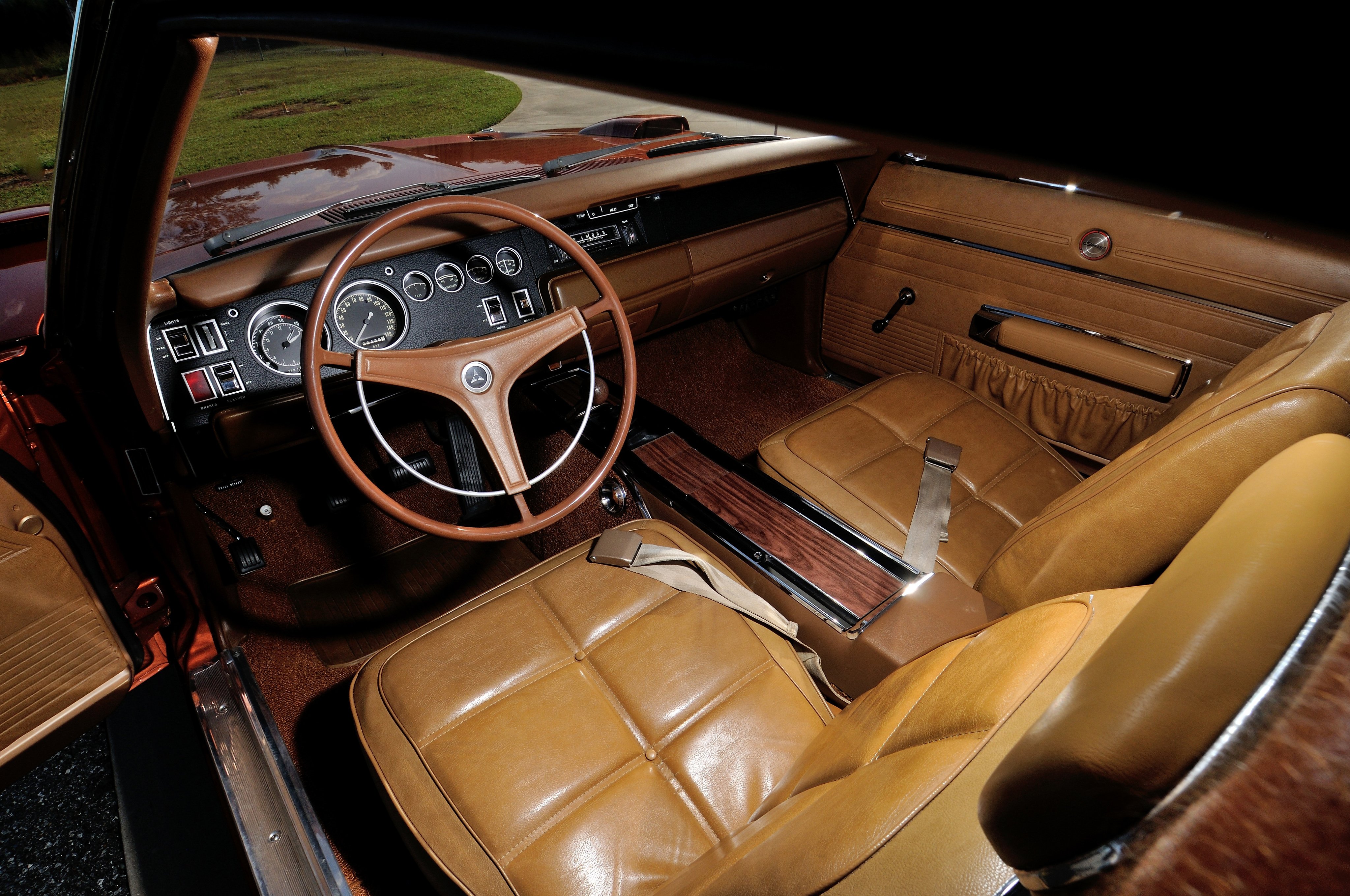
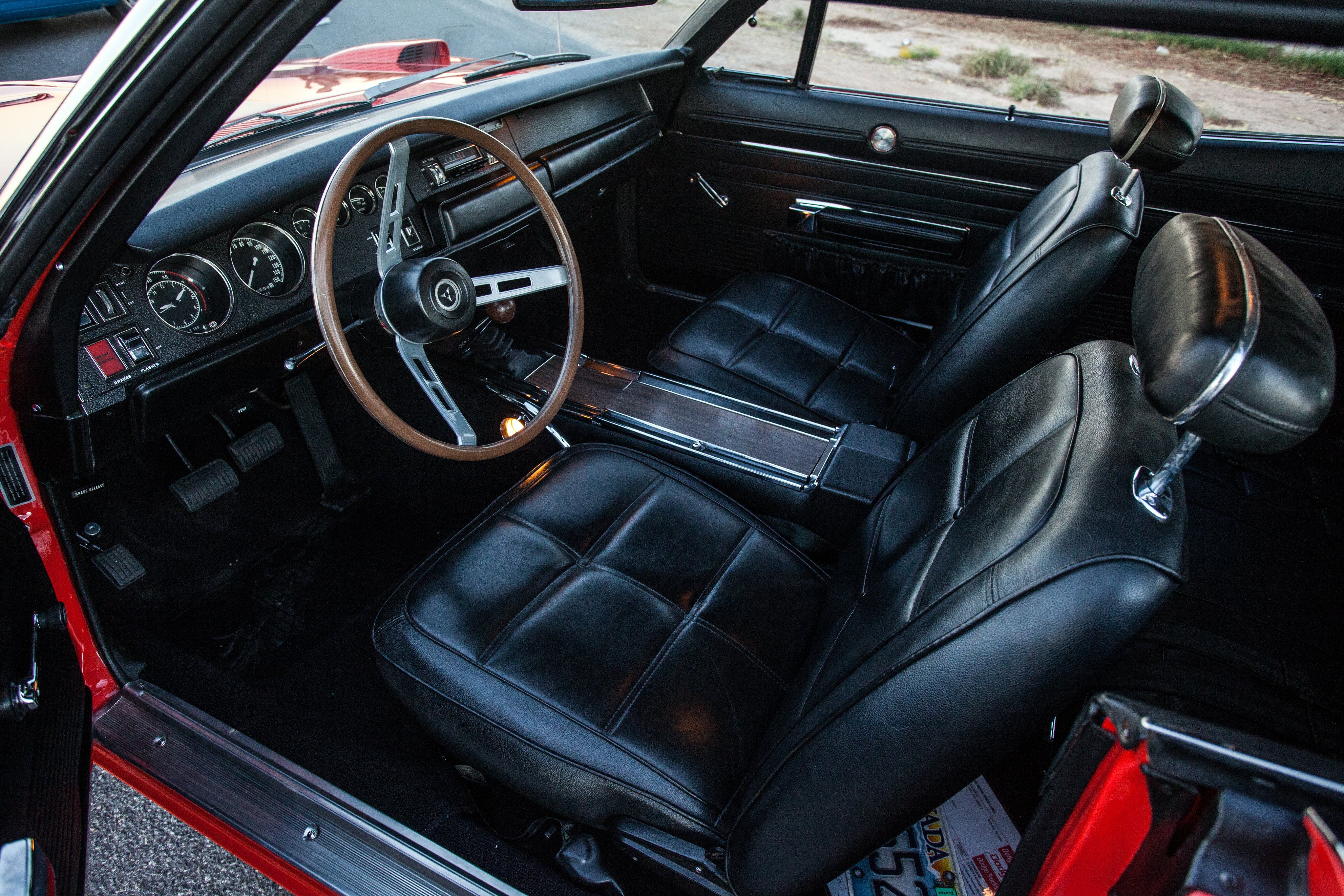
Inside, the Daytona is a regular Charger R/T: two front bucket seats, a floor-mounted gear lever and a dashboard with round gauges. The cabin is simple, as the car's purpose was homologation for racing rather than luxury.

Racing career
| Date | Event | Result |
|---|---|---|
| Autumn 1969 | Inaugural Talladega 500 | Daytona's first race and first win (many top drivers boycotted the event) |
| 1969 season | NASCAR Grand National | 2 wins |
| 24 March 1970 | Talladega test | Buddy Baker becomes the first NASCAR driver to exceed 200 mph |
| 1970 season | NASCAR Grand National | 4 wins |
| 1971 | Daytona 500 | Only one winged car (#22) started, finishing 7th |
Daytonas also won races in the USAC and ARCA series. Together with the Plymouth Superbird, which won eight NASCAR races in 1970, the winged Mopars were so fast that NASCAR changed its rules: from 1971, aerodynamic specials with engines over 305 cubic inches were penalised, which effectively ended the aero cars.

The Plymouth Superbird and later Daytonas
For 1970, NASCAR raised its homologation rule from 500 cars to one per two dealers, which meant about 1,920 cars for Plymouth. Plymouth built the Superbird on the Plymouth Road Runner, with a refined version of the Daytona's nose and wing, and lured Richard Petty back, who won 18 races in 1970. The Daytona name was later reused for a 1975–1977 package on the Charger, for the separate front-wheel-drive Dodge Daytona hatchback of 1984 based on Chrysler's K platform, and for Charger Daytona versions from 2006 onwards.

Daytona versus Superbird
The two winged cars look alike but differ in detail. The Superbird's nose and body were refined from the Daytona's design, and its wing, also mounted on tall struts, was set high enough to work in cleaner air above the roofline; the popular story that the wing height was chosen so the boot lid could open is considered a myth. The scoops on the Daytona's front wings vented air from the wheel wells, while on the Superbird they were mainly cosmetic. Plymouth built far more Superbirds, about 1,935 for the US market, because of the stricter 1970 homologation rule, which makes the 503 Daytonas much rarer today.
Rivals and collectability
On the track, the Daytona fought the aerodynamic specials from Ford and Mercury; on the road, it belonged to the same muscle-car generation as the Ford Gran Torino and Pontiac GTO. With only 503 built and just 70 with the Hemi, original Charger Daytonas are highly sought after by collectors. Value depends heavily on the engine, gearbox, originality and documented history.

Rivals
Compare with…
Compare Dodge Charger Daytona with
- Plymouth Road Runner quick spec comparison
- Ford Gran Torino quick spec comparison
- Chevrolet Chevelle SS quick spec comparison
-
Classic
- Years
- 1968–1980
- Body
- Coupe
- Fuel
- Petrol
- Power
- 108–317 kW (147–431 PS)
4 generations
- I
- II
- III
- IV
-
Classic
- Years
- 1972–1976
- Body
- Coupe
- Fuel
- Petrol
- Power
- 182 kW (247 PS)
-
Classic
- Years
- 1964–1973
- Body
- Coupe, Convertible
- Fuel
- Petrol
- Power
- 164–336 kW (223–457 PS)
3 generations
- I
- II
- III
-
Ended 2006
- Years
- 1964–2006
- Body
- Coupe, Convertible
- Fuel
- Petrol
- Power
- 149–298 kW (203–405 PS)
5 generations
- I
- II
- III
- IV
- V


Popular comparisons
Dodge Charger Daytona in our rankings
- No. 37 of 730 · Biggest engines: cars (7,200 cc · top 6%)
- No. 30 of 229 · Biggest engines: coupes (7,200 cc · top 14%)
- No. 362 of 1112 · Most powerful cars (280 kW · top 33%)
- No. 83 of 200 · Most powerful American cars (280 kW · top 44%)
- No. 186 of 373 · Most powerful coupes (280 kW · top 51%)
Bigger engine than 94% of ranked cars in the 1CARS catalog (No. 37 of 730).
Dodge Charger Daytona photos 14



FAQ
How many 1969 Dodge Charger Daytonas were built?
Dodge built 503 Charger Daytonas in 1969 to meet NASCAR's homologation rule. Only 70 had the 426 Hemi engine; the rest used the 440 Magnum V8.
Why does the Charger Daytona have a big wing?
The 584 mm (23-inch) rear wing and the pointed nose were designed for NASCAR superspeedways. Together they reduced drag and added stability and downforce at very high speeds.
How fast was the Dodge Charger Daytona?
On 24 March 1970 at Talladega, Buddy Baker drove a Daytona to become the first NASCAR driver to exceed 200 mph (about 322 km/h), a landmark for stock-car racing.
What engine did the Charger Daytona have?
The standard engine was the 7.2-litre 440 Magnum V8 with 280 kW (375 hp SAE gross). The optional 7.0-litre 426 Hemi was rated at 317 kW (425 hp) and fitted to 70 cars.
Why were winged NASCAR cars banned?
The Daytona and Superbird were so fast that NASCAR penalised aerodynamic specials with engines over 305 cubic inches from 1971, which effectively ended the aero-car era.
Data sources
Data checked by an editor against the sources below.
- The text of this article (1cars archive)
- Wikipedia - Dodge Charger Daytona


