Soviet All-Wheel Drive Cars: Four Decades from GAZ-61 to Niva
Soviet all-wheel drive passenger cars began with the GAZ-61 of 1938 and reached ordinary buyers only with the Lada Niva in 1977. In between came the GAZ-M72 and Moskvich-410, two of the world's first four-wheel-drive saloons, plus the LuAZ-969 and a string of prototypes. Most were built in small numbers for officials and rural services.
Key takeaways
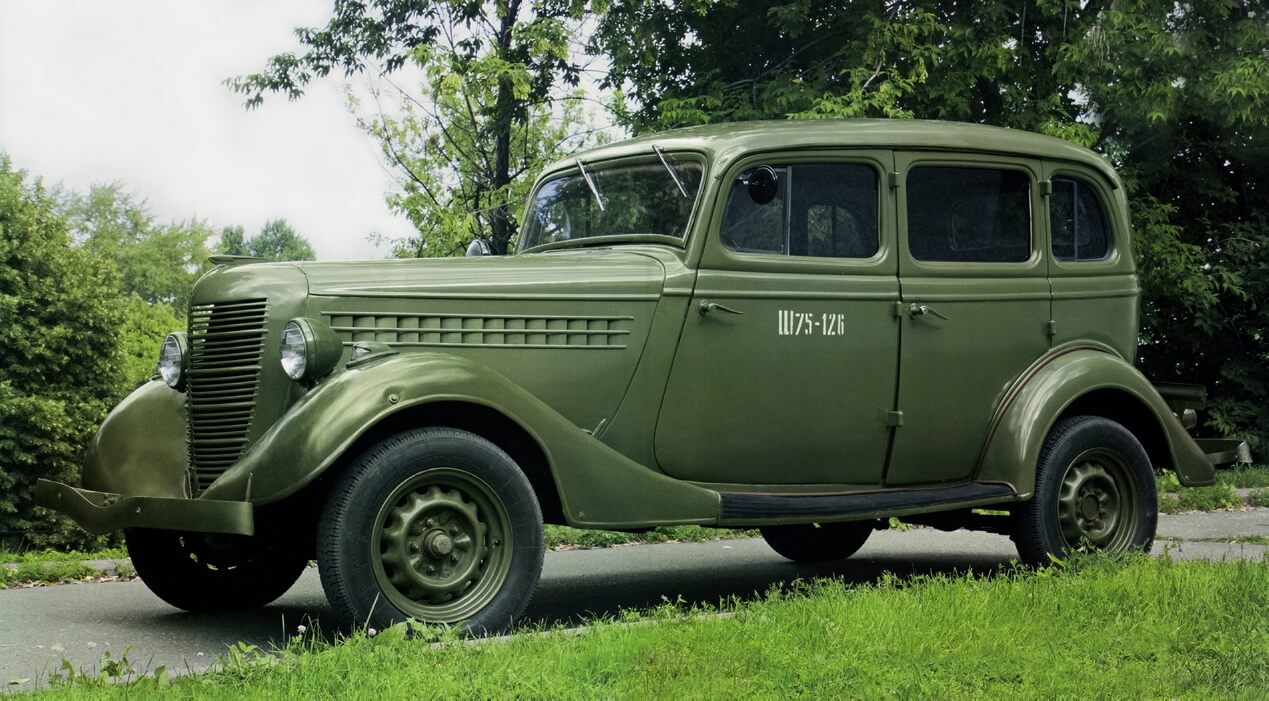
- GAZ-61 (1938–1945): a closed four-wheel-drive saloon on GAZ-M1 lines, built in a few hundred units.
- 1955–1961: the GAZ-M72 (4,677 built) and Moskvich-410/411 (about 9,100) put four-wheel drive into monocoque family saloons.
- LuAZ-969 (from 1967): a small front-drive, later four-wheel-drive utility car from Lutsk, Ukraine.
- Lada Niva (from 1977): the first Soviet 4x4 built in large numbers for private buyers, still made today.

Why Soviet all-wheel drive cars were needed
Outside the big cities, many Soviet roads were unsurfaced until the 1970s, and spring and autumn turned them into mud. Officials, doctors, agronomists and rural administrators needed cars that could reach villages and farms in any season. Off-road vehicles such as the GAZ-69 were rugged but spartan, so engineers repeatedly tried to combine a passenger-car body with off-road running gear.

| Model | Years | Built | Engine | Drive |
|---|---|---|---|---|
| GAZ-61 | 1938–1945 | about 180–240 | 3.5 l I6, 63 kW (85 hp) | Part-time 4x4, separate frame |
| ZIS-110 four-wheel-drive prototypes | 1949 | 4 | 6.0 l I8 | 4x4 |
| GAZ-M72 | 1955–1958 | 4,677 | 2.1 l I4, 40 kW (55 PS) | Part-time 4x4, two-speed transfer box |
| Moskvich-410 / 410N / 411 | 1957–1961 | about 9,100 | 1.2 l / 1.4 l I4, 26–34 kW | Part-time 4x4, two-speed transfer box |
| ZAZ-969V / LuAZ-969 | 1967 / 1971– | about 230,000 (all versions) | 0.9–1.2 l air-cooled V4 | FWD, then engageable rear axle |
| VAZ-2121 Niva | 1977– | large-scale series | 1.6 l I4, 56 kW (76 PS) | Permanent 4x4, lockable centre differential |
GAZ-61: the first four-wheel-drive saloon (1938–1945)
The GAZ-61 grew out of a 1938 brief for a passenger car able to drive where trucks went. Engineers led by Vitaly Grachev combined the closed body of the GAZ-M1 "Emka" saloon with a strengthened frame and a driven front axle. The engine was the 3.5-litre GAZ-11 six, derived from an American Dodge unit, with 63 kW (85 hp). Ground clearance reached about 210 mm, and in tests the car climbed slopes of up to 38 degrees.

Only a few hundred were made, mainly for high-ranking officials; sources give figures between about 180 and 240. Even so, the GAZ-61 is regularly listed among the world's first four-wheel-drive cars with a closed passenger body. Its full story is on our GAZ-61 page.
Post-war prototypes: the four-wheel-drive ZIS-110
After the war the ZIS factory in the capital tried to give its large ZIS-110 limousine all-wheel drive. In 1949 four prototypes of the ZIS-110Sh were built, two of them with components of the American Dodge WC51 and two with Soviet parts. The heavy eight-cylinder car proved thirsty and difficult to justify, and it never went into series production. Later four-wheel-drive versions of the limousine were also built only in very small numbers.

GAZ-M72: the Pobeda with GAZ-69 running gear (1955–1958)
The GAZ-M72 is the best-known Soviet all-wheel drive saloon. It combined the monocoque body of the GAZ-M20 Pobeda with the drivetrain, axles and suspension of the GAZ-69 off-roader. To carry the extra loads, engineers reinforced the floor, doors and roof with additional panels.

The 2.1-litre GAZ-20 four-cylinder engine produced 40 kW (55 PS) at 3,600 rpm and drove all four wheels through a three-speed gearbox and a two-speed transfer box. The car weighed 1,615 kg, had 210 mm of ground clearance and reached 90 km/h. Production ran from September 1955 to August 1958, with 4,677 cars built: 1,525 in 1955, 1,151 in 1956 and 2,001 in the remaining period. Its high price meant that buyers were almost entirely state organisations. Because it put a monocoque saloon on full four-wheel drive, the M72 is often described as an ancestor of today's crossovers.
Moskvich-410 and 411: the small four-wheel-drive family car (1957–1961)
The MZMA small-car factory took the same idea down a class. The Moskvich-410 of 1957 was a four-wheel-drive version of the Moskvich-402 saloon with a stronger engine and higher ground clearance. Its side-valve engine produced 26 kW (35 hp). In 1958 it was replaced by the 410N, which used the overhead-valve engine of the Moskvich-407 with 34 kW (45 hp).

Ground clearance was 220 mm under the axles, the car could ford about 0.3 m of water and climb a 33-degree slope in first gear, and top speed was 90 km/h. Until 1960 it had a three-speed gearbox plus a two-speed auxiliary box, later a four-speed. The Moskvich-411 estate on the same running gear followed in 1958. By the end of 1961 the factory had built 7,580 Moskvich-410s and 1,515 Moskvich-411s, about 9,100 in all, before it concentrated on the standard 407.
LuAZ-969: a small 4x4 from Ukraine (from 1967)
The next step came from Ukraine. The ZAZ-969V, designed with the Zaporizhzhia car plant and NAMI, entered series production at Lutsk in 1967 with an air-cooled V4 at the front and, at first, front-wheel drive only. From 1971 the LuAZ-969 had an engageable rear axle, portal axles, independent suspension and around 280 mm of ground clearance. The 969A of 1975 received a 1,197 cc V4 with about 29 kW (40 PS), and the 969M Volyn followed in 1979. About 230,000 were built across all versions.
The LuAZ was a utility vehicle rather than a saloon, but it was one of the few four-wheel-drive cars a private buyer could hope to get. Its history is covered in our LuAZ-969 article, and its figures are in the LuAZ-969 specifications.
One-offs and prototypes of the 1970s and 1980s
Several later all-wheel drive projects never reached the showroom. In the early 1970s GAZ built a handful of all-wheel drive GAZ-24-95 Volgas with the drivetrain of the UAZ-469 off-roader. Reportedly, one went to a regional party committee, one to the defence ministry and one to the country's leader for hunting trips. UAZ worked for about 15 years on a more comfortable off-roader, the UAZ-3172, which appeared in 1986 as a single prototype. By then the leadership could import foreign four-wheel-drive cars, and the project ended.
VAZ-2121 Niva: four-wheel drive for private buyers (from 1977)
The breakthrough came from the VAZ plant on the Volga. Development began in 1971, when the first prototype, the E-2121, was nicknamed the "crocodile" for its looks. Vladimir Solovyev led the early work; after his death in 1975, Pyotr Prusov completed the car. The hatchback body appeared on prototypes in 1973, and series production started on 5 April 1977.
The VAZ-2121 Niva was a compact unibody off-roader with permanent four-wheel drive, three differentials including a lockable centre differential, a two-speed transfer box, independent front suspension and coil springs all round. Its 1.6-litre overhead-camshaft engine produced 56 kW (76 PS) and 126 Nm. It is often called the world's first mass-produced off-roader with a unibody, and it was exported to Western Europe from 1978 under names such as Lada Niva, Lada Cossack and Lada Taiga. Renamed Lada 4x4 in 2006 and Niva Legend in 2021, the original design is still in production. Its later relative, the Chevrolet Niva, is a different car developed with General Motors.
Comparing Soviet all-wheel drive cars
Compared with the GAZ-61, the Niva used an engine less than half the size but had almost the same power. It made 56 kW from 1.6 litres, against 63 kW from 3.5 litres. The Niva was also the only model on this list built for private sale in large numbers. Most of the earlier cars survive mainly in museums; the GAZ-M72 and Moskvich-410 are rare finds even at classic-car events. For more models of the era, see the best Soviet classic cars and our Soviet classics collection.
Collecting Soviet four-wheel-drive cars today
For a usable classic, an early Niva or a LuAZ-969M is the realistic choice: parts are still made, the mechanicals are simple and both cope well with bad roads. A GAZ-M72 or Moskvich-410 is a collector's piece; check that the transfer box, front axle and body numbers are original, because many cars were rebuilt from standard saloons. Pre-war GAZ-61s are almost all in museums. With any of these cars, rust in the sills and floor is the main enemy, and a complete, original car is worth more than a shiny restoration with wrong parts.
FAQ
What was the first Soviet four-wheel-drive car?
The GAZ-61 of 1938 is regarded as the first Soviet four-wheel-drive passenger car. It used the closed body of the GAZ-M1 saloon on a strengthened chassis with a driven front axle and an 85 hp six-cylinder engine.
How many GAZ-M72 cars were built?
GAZ built 4,677 M72s between September 1955 and August 1958. The car combined the Pobeda body with GAZ-69 running gear and was sold almost entirely to state organisations, which makes surviving examples rare today.
Was the Moskvich-410 a real off-roader?
It was a family saloon with real four-wheel drive, a two-speed auxiliary gearbox and 220 mm of clearance under the axles. It could ford about 0.3 m of water, but its small engine of 26–34 kW limited it on steep ground.
When did the Lada Niva go into production?
Series production of the VAZ-2121 Niva started on 5 April 1977, after development that began in 1971. It is still built today as the Niva Legend, with the same basic body and permanent four-wheel drive.
Why did so few Soviet saloons get four-wheel drive?
Four-wheel-drive components went largely to military and agricultural vehicles, and the cars cost much more than standard saloons. Factories therefore built them in small batches for officials and rural services until the Niva changed this in 1977.
Videos 3

Video 1

Video 2

Video 3