 Bugatti Veyron Super Sport
Specs, engines and history
Updated Published Sources (2) Report an error
By Felix Hartmann, Automotive Technology & EV Contributor Reviewed by Oleksandr Hnatiuk

- Built
- 2010–2011
- Top power
- 883 kW (1,201 PS)
- New price
- from about €1,650,000 (2010)
Who the Super Sport suits: verdict
Our verdict · Felix Hartmann
The Super Sport is a collector's car first. It suits a buyer who wants the Veyron in its fastest and most complete form, and who values the history of the 431 km/h run as much as the driving. Compared with the regular 16.4, it has noticeably more power and a firmer, more precise chassis; compared with the Grand Sport Vitesse, it trades open-air driving for a fixed roof and the coupé's purer shape.
If the goal is a usable Bugatti with more modern technology, the Chiron is the newer choice. For history and value, the five World Record Edition cars are the most desirable of all, because they are the closest copies of the record car. The story of the brand, from Ettore Bugatti to Molsheim today, is in the history of Bugatti.
The Bugatti Veyron 16.4 Super Sport is the most powerful version of the Veyron coupé, built in Molsheim, France, in 2010 and 2011. Its 8.0-litre W16 makes 882 kW (1,200 PS), and on 4 July 2010 it averaged 431.072 km/h, a production-car record at the time. Only 48 were built, priced from €1,912,500.
In short
- 882 kW (1,200 PS) and 1,500 Nm, up from 736 kW and 1,250 Nm in the original Veyron 16.4.
- Record run at Ehra-Lessien: 427.933 km/h one way, 434.211 km/h the other, 431.072 km/h average.
- Customer cars are limited to 415 km/h to protect the tyres; five World Record Edition cars had the limiter removed.
- Guinness reviewed the record in April 2013 and confirmed it on 15 April 2013.
Size at a glance
Koenigsegg Agera R
The Bugatti Veyron Super Sport is 169 mm longer and 84 mm taller than the Koenigsegg Agera R.
| Dimensions | Bugatti Veyron Super Sport | Koenigsegg Agera R | Difference |
|---|---|---|---|
| Length | 4,462 mm175.7 in | 4,293 mm169.0 in | +169 mm+6.7 in |
| Width | 1,998 mm78.7 in | 1,996 mm78.6 in | +2 mm+0.1 in |
| Height | 1,204 mm47.4 in | 1,120 mm44.1 in | +84 mm+3.3 in |
| Wheelbase | 2,710 mm106.7 in | 2,662 mm104.8 in | +48 mm+1.9 in |
Lamborghini Veneno
The Bugatti Veyron Super Sport is 558 mm shorter, 77 mm narrower and 39 mm taller than the Lamborghini Veneno.
| Dimensions | Bugatti Veyron Super Sport | Lamborghini Veneno | Difference |
|---|---|---|---|
| Length | 4,462 mm175.7 in | 5,020 mm197.6 in | −558 mm−22.0 in |
| Width | 1,998 mm78.7 in | 2,075 mm81.7 in | −77 mm−3.0 in |
| Height | 1,204 mm47.4 in | 1,165 mm45.9 in | +39 mm+1.5 in |
| Wheelbase | 2,710 mm106.7 in | 2,700 mm106.3 in | +10 mm+0.4 in |
Specs by version
Engines
| Version | Engine | Power | Torque | Drive |
|---|---|---|---|---|
| 8.0 883 kW (1,201 PS) Coupe | 8.0 l · 16 cyl 8,000 cc | 883 kW 1,201 PS1,184 hp | 1,500 Nm1,106 lb-ft | All-wheel drive |
Performance
Show all 1 versions
| Version | 0–100 km/h | Fuel consumption |
|---|---|---|
| 8.0 883 kW (1,201 PS) Coupe | 2.5 s 0–62 mph | 14.0 l/100 km16.8 mpg US · 20.2 mpg UK |
Dimensions and weight
Show all 1 versions
| Version | Length | Width | Height | Wheelbase |
|---|---|---|---|---|
| 8.0 883 kW (1,201 PS) Coupe | 4,462 mm175.7 in | 1,998 mm78.7 in | 1,204 mm47.4 in | 2,710 mm106.7 in |
Verified Manufacturer and type-approval data from our catalog · Sources and methodology
What the Veyron Super Sport changed
The Super Sport was the answer to a lost title. The first Veyron had reached 408.47 km/h in 2005, but the SSC Ultimate Aero TT later recorded 412.28 km/h. Bugatti responded with a reworked coupé, shown in August 2010 at The Quail, the Monterey Historic races at Laguna Seca and the Pebble Beach Concours d'Elegance.
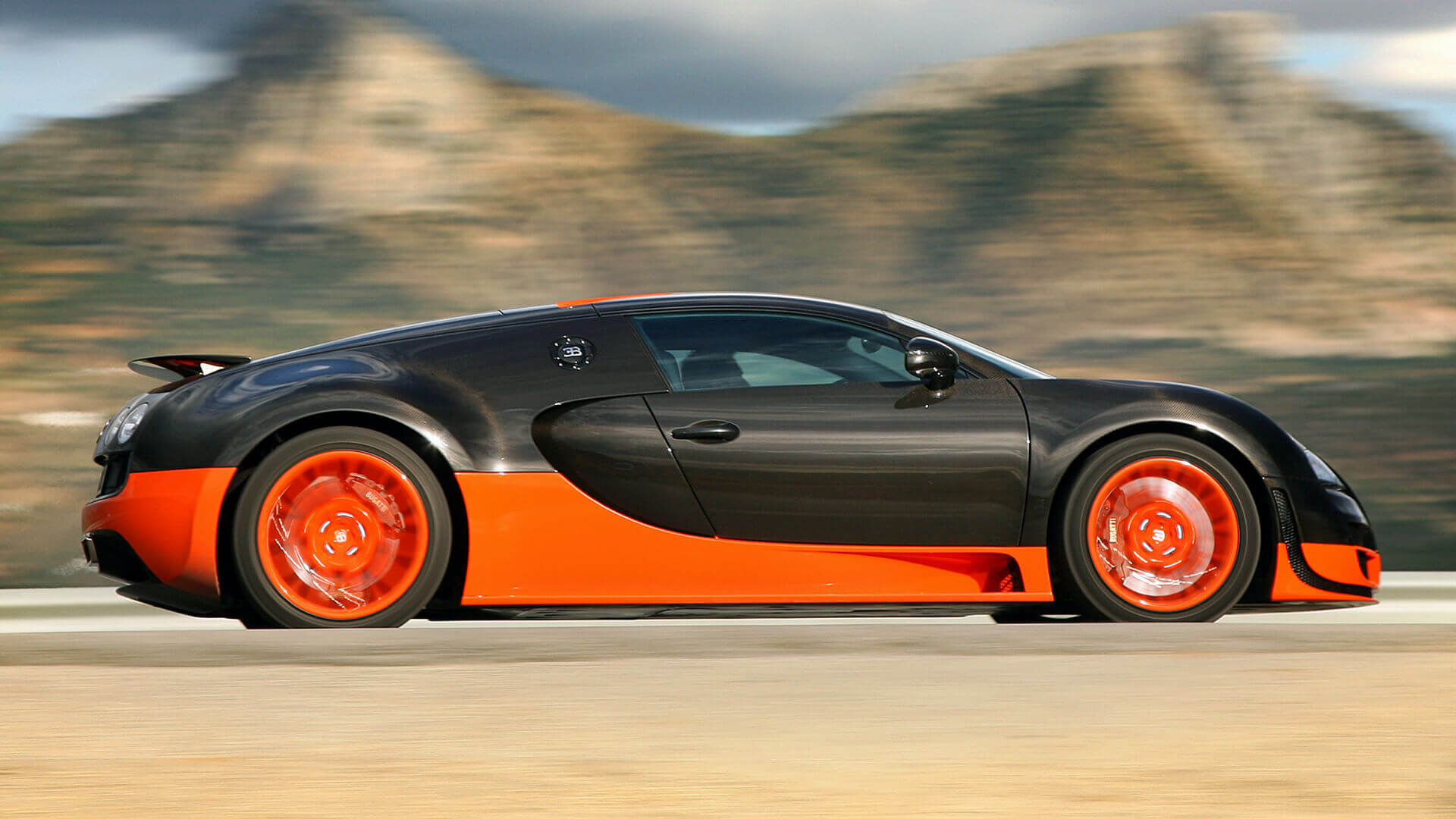
The changes went deeper than a software update. The engine received four larger turbochargers and bigger intercoolers. The carbon-fibre body was reshaped for lower drag and better balance at speed, and Bugatti said the new shell was both lighter and stiffer than before. The suspension gained more main-spring travel, stronger anti-roll bars and shock absorbers derived from motor racing.
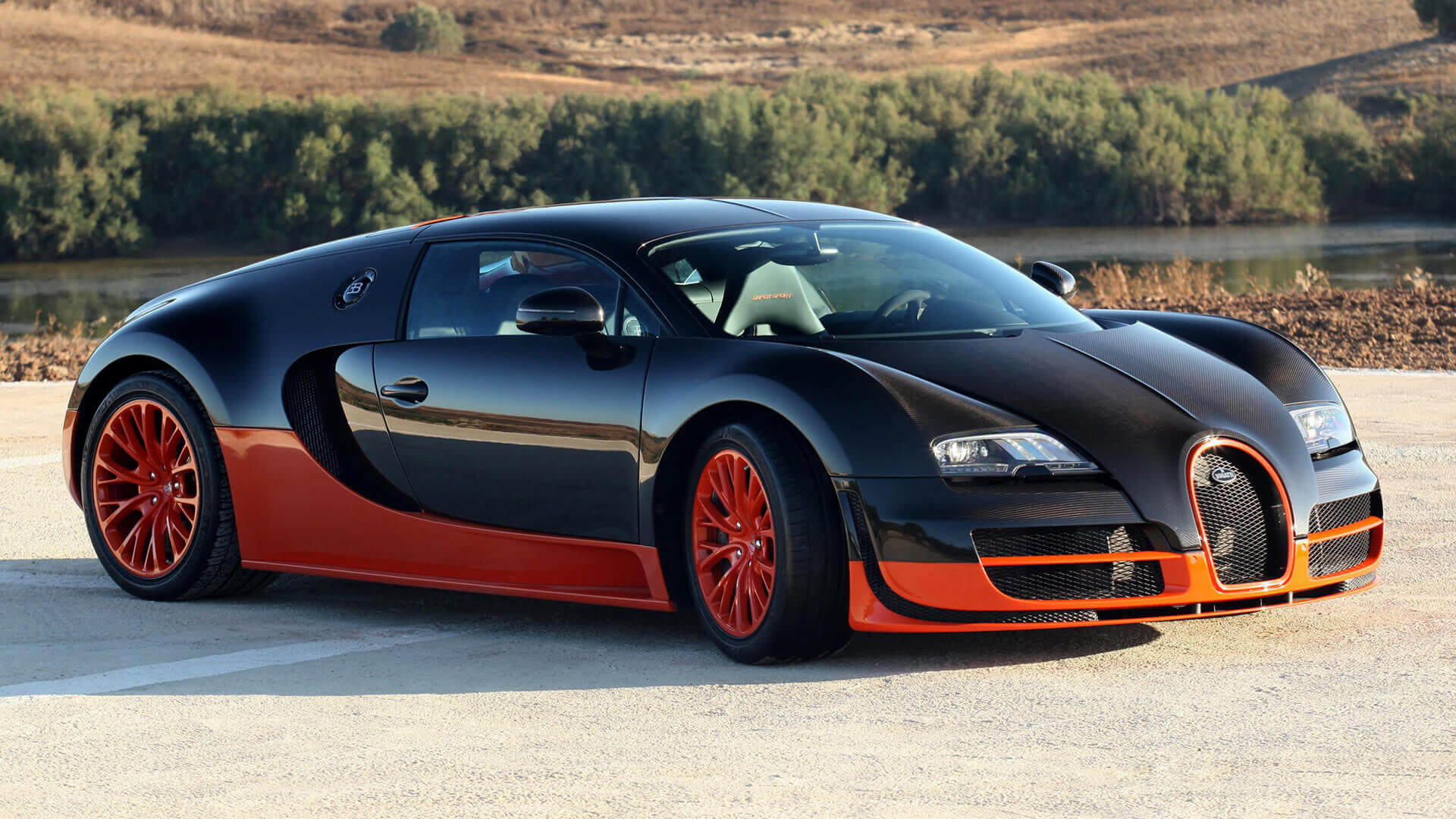
The basic recipe stayed the same as in the original Bugatti Veyron: a mid-mounted engine, a seven-speed dual-clutch gearbox and permanent all-wheel drive. Visually, the Super Sport is easiest to spot by its two-tone paint, the reshaped air intakes and the twin roof ducts that feed the engine.
| Parameter | Metric | Imperial |
|---|---|---|
| Engine | 7,993 cc W16, four turbochargers | 488 cu in |
| Power | 882 kW (1,200 PS) at 6,400 rpm | 1,183 hp |
| Torque | 1,500 Nm at 3,000–5,000 rpm | 1,106 lb-ft |
| Gearbox | 7-speed dual-clutch (Ricardo), all-wheel drive | – |
| Top speed (record car) | 431.072 km/h average | 267.856 mph |
| Top speed (customer car) | 415 km/h, electronically limited | 258 mph |
| Length / width / height | 4,462 / 1,998 / 1,204 mm | 175.7 / 78.7 / 47.4 in |
| Wheelbase | 2,710 mm | 106.7 in |
| Kerb weight (Veyron range) | 1,838–1,990 kg | 4,052–4,387 lb |
W16 engine, gearbox and acceleration
The 8.0-litre W16 is two narrow-angle V8 blocks sharing one crankshaft, with 64 valves and four turbochargers. In the Super Sport it delivers 882 kW (1,200 PS, 1,183 hp) at 6,400 rpm and a flat 1,500 Nm (1,106 lb-ft) between 3,000 and 5,000 rpm. That is 146 kW and 250 Nm more than the original Veyron.

Power reaches all four wheels through a seven-speed dual-clutch gearbox developed with Ricardo. Bugatti quoted about 2.5 seconds from 0 to 100 km/h for the Super Sport. Wikipedia's figures for the faster Veyron versions give 6.7 seconds to 200 km/h and 14.6 seconds to 300 km/h, while about 40 seconds to 400 km/h is an estimate rather than a measured figure.
A simple 1cars calculation shows why the car feels so violent: with about 1,840 kg and 882 kW, each kilowatt has only about 2.1 kg to move. You can try other cars in the power-to-weight calculator. In the 1cars catalogue, the Super Sport's 2.5 seconds puts it second in the quickest coupés ranking, behind only the Bugatti Divo.
The 431.072 km/h run and the 2013 Guinness review
On 4 July 2010, Bugatti test driver Pierre-Henri Raphanel took a Super Sport to Volkswagen's Ehra-Lessien test track in Germany, with Guinness World Records and the German testing body TÜV present. He recorded 427.933 km/h in one direction and 434.211 km/h in the other. The two-way average of 431.072 km/h (267.856 mph) became the production-car record. Earlier that day, Top Gear presenter James May reached 417.61 km/h in a Super Sport.

In April 2013 the record was questioned, because the record car ran without the 415 km/h limiter fitted to customer cars. On 5 April 2013, a Guinness spokesperson was quoted as saying the record was no longer valid. Five days later, Guinness said it had not been disqualified and was under review. On 15 April 2013 it confirmed the record, stating that a change to the speed limiter does not alter the car's basic design or engine.
The title lasted until November 2017, when the Koenigsegg Agera RS averaged 447.19 km/h on a closed public road in Nevada.
Cabin, space and daily use
Inside, the Super Sport follows the Veyron layout: two electrically adjustable sports seats with strong side bolsters, leather and Alcantara trim chosen by the buyer, and aluminium details on the centre console. Analogue dials sit behind a three-spoke steering wheel, with a central rev counter and a power gauge that shows how much of the engine's output is in use.

Space is that of a two-seat mid-engined coupé. There is a small luggage compartment in the nose, large enough for soft bags rather than suitcases. Ground clearance is low, so steep ramps and speed bumps need care. Despite the figures, the Super Sport is calm at normal speeds and was meant to be driven on ordinary roads as a grand tourer.
Fuel consumption and running costs
The Veyron family was rated by the US EPA at 29 l/100 km (8 mpg US) in the city and 17 l/100 km (14 mpg US) on the highway. At its top speed, consumption rises to about 78 l/100 km, more than three-quarters of a litre for every kilometre, which empties the 100-litre-class tank in minutes.

Running costs follow the same scale. Servicing is done by Bugatti, a set of the special Michelin PAX tyres is reported to cost a five-figure sum, and the tyres could only be fitted in France. These are the costs owners accept for the speed. Exact service prices in euros are not published, so we do not give them here.
Bugatti Veyron Super Sport editions and the Grand Sport Vitesse
Bugatti built 48 Super Sport coupés. Five of them are World Record Edition cars, which copy the record car with exposed black carbon fibre, orange details and orange wheels. Their limiter was removed, so they can reach the full speed.

| Version | Years | Built | Body | Key difference |
|---|---|---|---|---|
| Veyron 16.4 | 2005–2011 | 252 | Coupé | 736 kW (1,001 PS), 408.47 km/h |
| Veyron 16.4 Super Sport | 2010–2011 | 48 | Coupé | 882 kW (1,200 PS), 415 km/h limited |
| Super Sport World Record Edition | 2010–2011 | 5 (of the 48) | Coupé | No speed limiter, record-car livery |
| Grand Sport Vitesse | 2012–2015 | 92 | Targa roadster | Super Sport engine, 408.84 km/h roof off (2013) |
The Grand Sport Vitesse used the Super Sport engine in the open body and, on 6 April 2013, averaged 408.84 km/h, the fastest figure for an open production car at the time. All Veyron versions together reached 450 cars before production ended in 2015.
Safety and crash testing
Euro NCAP and the IIHS did not crash-test the Veyron Super Sport, which is normal for a car built in such small numbers. Its protection comes from the carbon-fibre monocoque, front and rear aluminium structures and front airbags. Large carbon-ceramic brakes and a rear wing that also works as an air brake help the car stop from high speed. The record car and the World Record Edition also depended on special tyres, which is why customer cars are limited to 415 km/h.

Rivals: how the Super Sport compares
In 2010 only a handful of cars were in the same speed class. The table uses each car's best verified speed figure.

| Model | Engine | Power | Top speed figure | Notes |
|---|---|---|---|---|
| Bugatti Veyron Super Sport | 8.0 W16, 4 turbos | 882 kW (1,200 PS) | 431.072 km/h (2010, two-way) | Record confirmed by Guinness in 2013 |
| SSC Ultimate Aero TT | Twin-turbo V8 | – | 412.28 km/h (2007) | Record holder before the Super Sport |
| Koenigsegg Agera R | 5.0 twin-turbo V8 | 838 kW on E85 | about 439 km/h (claimed) | Lighter, about 1,435 kg |
| Hennessey Venom GT | 7.0 twin-turbo V8 | – | 435.31 km/h (2014, one way) | Not a two-way record |
| Bugatti Chiron | 8.0 W16, 4 turbos | 1,103 kW (1,500 PS) | 420 km/h (limited) | Successor from 2016 |
More hypercars are ranked in the most powerful cars list and the most powerful supercars guide.
Rivals
Compare with…
Compare Bugatti Veyron Super Sport with
- Koenigsegg Agera R quick spec comparison
- Lamborghini Veneno quick spec comparison
-
Ended 2014
- Years
- 2011–2014
- Body
- Coupe
- Fuel
- Petrol
- Power
- 706–838 kW (960–1,139 PS)
-
Ended 2014
- Years
- 2013–2014
- Body
- Coupe
- Fuel
- Petrol
- Power
- 552 kW (751 PS)


Bugatti Veyron Super Sport in our rankings
- No. 2 of 143 · Quickest cars of the 2010s, 0–100 (2.5 s)
- No. 4 of 354 · Most powerful cars of the 2010s (883 kW)
- No. 4 of 68 · Quickest coupes, 0–100 (2.5 s)
- No. 4 of 33 · Quickest French cars, 0–100 (2.5 s)
- No. 5 of 117 · Most torque: coupes (1,500 Nm)
- No. 5 of 485 · Most torque: cars (1,500 Nm)
More powerful than 98% of ranked cars of the 2010s in the 1CARS catalog (No. 4 of 354).
Bugatti Veyron Super Sport photos 15


Bugatti Veyron Super Sport videos 2

Bugatti Veyron Super Sport video 1

Bugatti Veyron Super Sport video 2
FAQ
How fast is the Bugatti Veyron Super Sport?
The record car averaged 431.072 km/h (267.856 mph) at Ehra-Lessien on 4 July 2010, with a best one-way run of 434.211 km/h. Customer cars are electronically limited to 415 km/h (258 mph) to protect the tyres.
How much power does the Veyron Super Sport have?
Its 8.0-litre quad-turbo W16 produces 882 kW (1,200 PS, 1,183 hp) at 6,400 rpm and 1,500 Nm (1,106 lb-ft) of torque. That is 146 kW and 250 Nm more than the original Veyron 16.4.
What is the fuel consumption of the Bugatti Veyron Super Sport?
The US EPA rated the Veyron at 29 l/100 km in the city and 17 l/100 km on the highway. At full speed it uses about 78 l/100 km, so the tank empties in minutes.
Is the Veyron Super Sport all-wheel drive or hybrid?
It has permanent all-wheel drive and a seven-speed dual-clutch gearbox. There is no hybrid or electric assistance; the first electrified Bugatti came later with the Tourbillon, which pairs a V16 with electric motors.
How many Veyron Super Sports were made and what did one cost?
Bugatti built 48 Super Sports in 2010 and 2011, including five World Record Edition cars. The base price was €1,912,500 before options and individual specification.
Did the Veyron Super Sport lose its Guinness record?
No. In April 2013 Guinness reviewed the record because the limiter had been switched off for the run, then confirmed it on 15 April 2013. The Koenigsegg Agera RS beat the speed in November 2017.
Data sources
Data checked by an editor against the sources below.
- The text of this article (1cars archive)
- Wikipedia - Bugatti Veyron