
 Jaguar F-Pace
Specs, engines and history
Updated Published Sources (7) Report an error
By Felix Hartmann, Automotive Technology & EV Contributor Reviewed by Oleksandr Hnatiuk
- Built
- 2015–2025
- Top power
- 423 kW (575 PS)
- New price
- from about €43,500 (2016)
- Used price today
- about €13,000–28,500 (AutoScout24, Nov 2026)
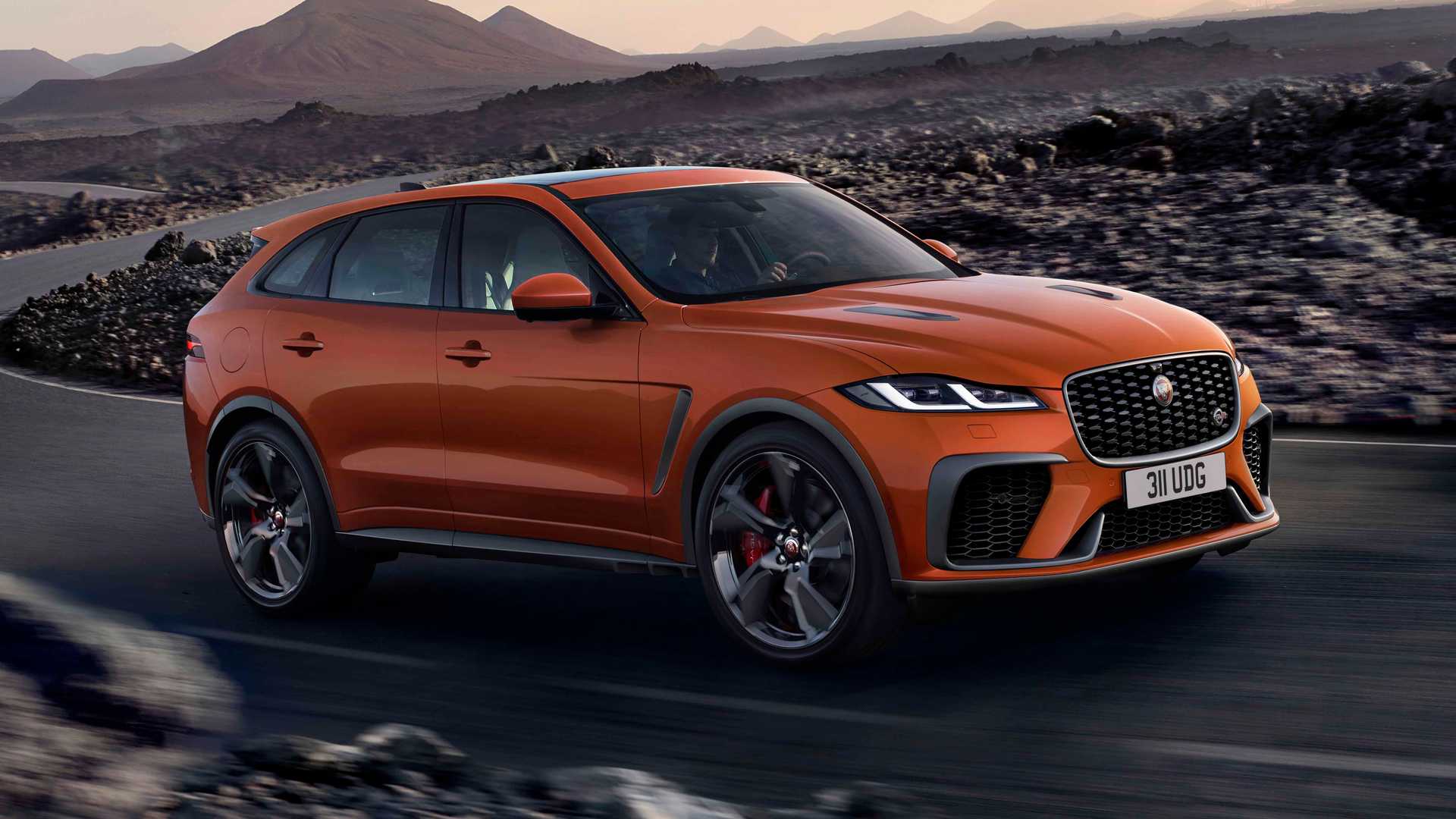
The Jaguar F-Pace is a mid-size premium SUV built at Solihull, England, from February 2016 to December 2025. It was Jaguar's first SUV, shared its aluminium-intensive platform with the XE, XF and Range Rover Velar, and offered engines from a 120 kW diesel to the 423 kW supercharged V8 of the SVR. The final car, a black SVR, was built on 19 December 2025.
In short
- Concept C-X17 in 2013, production SUV shown in Frankfurt in September 2015, sales from April 2016.
- Four- and six-cylinder petrol and diesel engines, a 297 kW plug-in hybrid and a 5.0-litre V8 in the SVR.
- World Car of the Year and World Car Design of the Year in 2017.
- 2020 facelift brought mild-hybrid six-cylinder engines and the P400e plug-in; production ended in December 2025.

Size at a glance
| Dimensions | Jaguar F-Pace X761 |
|---|---|
| Length | 4,747 mm186.9 in |
| Width | 2,071 mm81.5 in |
| Height | 1,664 mm65.5 in |
| Wheelbase | 2,874 mm113.1 in |
| Boot | 508 L17.9 cu ft |
Running cost
Fuel · F-Pace X761 2 L 4 cyl Automatic (S8) · 2019 (EPA)
about 2,000 EUR fuel a year at 15,000 km
8.1 l/100 km · diesel at 1.65 EUR/l · change mileage, fuel price or version
Specs by version
Engines
| Version | Engine | Gearbox | Drive | Production years |
|---|---|---|---|---|
| Plug-in hybrid · 1 version | ||||
| P400e plug-in hybrid (404 PS) | 2.0 l · 4 cyl · Plug-in hybrid 1,997 cc | - | All-wheel drive | 2020 |
| Diesel · 4 versions | ||||
| 2 L 4 cyl Automatic (S8) · 2019 (EPA) | 2.0 l · 4 cyl · Diesel 2,000 cc | 8-sp Automatic | All-wheel drive | 2019 |
| 2 L 4 cyl Automatic (S8) · 2018 (EPA) | 2.0 l · 4 cyl · Diesel 2,000 cc | 8-sp Automatic | All-wheel drive | 2018 |
| 2.0 diesel (163 PS) | 2.0 l · 4 cyl · Diesel 2,000 cc | - | - | - |
| D300 mild hybrid (300 PS) | 6 cyl · Diesel | - | All-wheel drive | 2020 |
| Petrol · 2 versions | ||||
| 3.0 V6 supercharged (340 PS) | 6 cyl · Petrol | - | All-wheel drive | - |
| P400 mild hybrid (400 PS) | 6 cyl · Petrol | - | All-wheel drive | 2020 |
| Other · 13 versions | ||||
| 2 L 4 cyl Automatic (S8) · 2025 (EPA) | 2.0 l · 4 cyl 2,000 cc | 8-sp Automatic | All-wheel drive | 2025 |
| 2 L 4 cyl Automatic (S8) · 2024 (EPA) | 2.0 l · 4 cyl 2,000 cc | 8-sp Automatic | All-wheel drive | 2024 |
| 2 L 4 cyl Automatic (S8) · 2023 (EPA) | 2.0 l · 4 cyl 2,000 cc | 8-sp Automatic | All-wheel drive | 2023 |
| 2 L 4 cyl Automatic (S8) · 2022 (EPA) | 2.0 l · 4 cyl 2,000 cc | 8-sp Automatic | All-wheel drive | 2022 |
| 2 L 4 cyl Automatic (S8) · 2021 (EPA) | 2.0 l · 4 cyl 2,000 cc | 8-sp Automatic | All-wheel drive | 2021 |
| 2 L 4 cyl Automatic (S8) · 2020 (EPA) | 2.0 l · 4 cyl 2,000 cc | 8-sp Automatic | All-wheel drive | 2020 |
| 2 L 4 cyl Automatic (S8) · 2019 (EPA) | 2.0 l · 4 cyl 2,000 cc | 8-sp Automatic | All-wheel drive | 2019 |
| 2 L 4 cyl Automatic (S8) · 2018 (EPA) | 2.0 l · 4 cyl 2,000 cc | 8-sp Automatic | All-wheel drive | 2018 |
| 3 L 6 cyl Automatic (S8) · 2020 (EPA) | 3.0 l · 6 cyl 3,000 cc | 8-sp Automatic | All-wheel drive | 2020 |
| 3 L 6 cyl Automatic (S8) · 2019 (EPA) | 3.0 l · 6 cyl 3,000 cc | 8-sp Automatic | All-wheel drive | 2019 |
| 3 L 6 cyl Automatic (S8) · 2018 (EPA) | 3.0 l · 6 cyl 3,000 cc | 8-sp Automatic | All-wheel drive | 2018 |
| 5 L 8 cyl Automatic (S8) · 2020 (EPA) | 5.0 l · 8 cyl 5,000 cc | 8-sp Automatic | All-wheel drive | 2020 |
| 5 L 8 cyl Automatic (S8) · 2019 (EPA) | 5.0 l · 8 cyl 5,000 cc | 8-sp Automatic | All-wheel drive | 2019 |
Performance
Show all 18 versions
| Version | Fuel consumption |
|---|---|
| Plug-in hybrid · 1 version | |
| P400e plug-in hybrid (404 PS) | - |
| Diesel · 4 versions | |
| 2 L 4 cyl Automatic (S8) · 2019 (EPA) | 8.1 l/100 km29.0 mpg US · 34.9 mpg UK |
| 2 L 4 cyl Automatic (S8) · 2018 (EPA) | 8.1 l/100 km29.0 mpg US · 34.9 mpg UK |
| 2.0 diesel (163 PS) | 6.4 l/100 km36.8 mpg US · 44.1 mpg UK |
| D300 mild hybrid (300 PS) | - |
| Other · 13 versions | |
| 2 L 4 cyl Automatic (S8) · 2025 (EPA) | 9.8 l/100 km24.0 mpg US · 28.8 mpg UK |
| 2 L 4 cyl Automatic (S8) · 2024 (EPA) | 9.8 l/100 km24.0 mpg US · 28.8 mpg UK |
| 2 L 4 cyl Automatic (S8) · 2023 (EPA) | 9.8 l/100 km24.0 mpg US · 28.8 mpg UK |
| 2 L 4 cyl Automatic (S8) · 2022 (EPA) | 9.8 l/100 km24.0 mpg US · 28.8 mpg UK |
| 2 L 4 cyl Automatic (S8) · 2021 (EPA) | 9.8 l/100 km24.0 mpg US · 28.8 mpg UK |
| 2 L 4 cyl Automatic (S8) · 2020 (EPA) | 9.8 l/100 km24.0 mpg US · 28.8 mpg UK |
| 2 L 4 cyl Automatic (S8) · 2019 (EPA) | 9.8 l/100 km24.0 mpg US · 28.8 mpg UK |
| 2 L 4 cyl Automatic (S8) · 2018 (EPA) | 9.8 l/100 km24.0 mpg US · 28.8 mpg UK |
| 3 L 6 cyl Automatic (S8) · 2020 (EPA) | 11.8 l/100 km19.9 mpg US · 23.9 mpg UK |
| 3 L 6 cyl Automatic (S8) · 2019 (EPA) | 11.8 l/100 km19.9 mpg US · 23.9 mpg UK |
| 3 L 6 cyl Automatic (S8) · 2018 (EPA) | 11.8 l/100 km19.9 mpg US · 23.9 mpg UK |
| 5 L 8 cyl Automatic (S8) · 2020 (EPA) | 13.1 l/100 km18.0 mpg US · 21.6 mpg UK |
| 5 L 8 cyl Automatic (S8) · 2019 (EPA) | 13.1 l/100 km18.0 mpg US · 21.6 mpg UK |
Dimensions and weight
Show all 5 versions
| Version | Boot |
|---|---|
| Plug-in hybrid · 1 version | |
| P400e plug-in hybrid (404 PS) | 508 l17.9 cu ft |
| Diesel · 2 versions | |
| 2.0 diesel (163 PS) | 508 l17.9 cu ft |
| D300 mild hybrid (300 PS) | 508 l17.9 cu ft |
| Petrol · 2 versions | |
| 3.0 V6 supercharged (340 PS) | 508 l17.9 cu ft |
| P400 mild hybrid (400 PS) | 508 l17.9 cu ft |
Verified Manufacturer and type-approval data from our catalog · Sources and methodology
Jaguar F-Pace at a glance

| Item | Data |
|---|---|
| Production | February 2016 – 19 December 2025 |
| Plant | Solihull, England |
| Platform | JLR iQ[Al] (D7a), about 80% aluminium body structure |
| Length / width / height | 4,747 / 2,071 / 1,664 mm |
| Wheelbase | 2,874 mm |
| Kerb weight | 1,690–2,230 kg |
| Boot (old 1cars data) | 508 l, 1,598 l with the rear seats folded |
| Gearbox | 8-speed ZF automatic; 6-speed manual on some early diesels |
| Drive | rear-wheel or all-wheel drive |
| Power | 120–423 kW (163–575 PS) |
From the C-X17 concept to Solihull
The F-Pace started as the C-X17 concept, shown at the Frankfurt Motor Show on 9 September 2013. Ian Callum's team kept the concept's long bonnet and short rear overhang for the production car. Jaguar announced the model in Detroit in January 2015, let a production prototype lead Team Sky at the start of the Tour de France in Utrecht on 4 July 2015, and unveiled it at Frankfurt that September.

Production began at Solihull in February 2016, in the plant that later also built the Range Rover Velar. European deliveries started in April 2016. The body uses aluminium for about 80% of its structure, with magnesium and a composite tailgate to save more weight. Front double wishbones and an Integral Link rear axle followed the layout of the XE and XF saloons, and torque vectoring was standard.
The F-Pace sold 45,973 cars in 2016, its first and partial year, and immediately became Jaguar's best-selling model. In April 2017 it won both the World Car of the Year and the World Car Design of the Year awards at the New York show.
Every F-Pace engine, 2016–2025
| Engine | Power | Torque | Years |
|---|---|---|---|
| 2.0 diesel four (base) | 120 kW (163 PS) | 380 Nm | 2017–2020 |
| 2.0 diesel four (20d) | 132 kW (180 PS) | 430 Nm | 2016–2020 |
| 2.0 twin-turbo diesel four (25d) | 177 kW (240 PS) | 500 Nm | 2017–2020 |
| 3.0 V6 twin-turbo diesel (30d) | 221 kW (300 PS) | 700 Nm | 2017–2020 |
| 2.0 diesel four mild hybrid (D200) | 150 kW (204 PS) | 430 Nm | 2020–2025 |
| 3.0 diesel six mild hybrid (D300) | 221 kW (300 PS) | 650 Nm | 2020–2025 |
| 2.0 petrol four (25t / P250) | 184 kW (250 PS) | 365 Nm | 2017–2024 |
| 2.0 petrol four (30t) | 221 kW (300 PS) | 400 Nm | 2017–2020 |
| 3.0 supercharged V6 (S) | 250–279 kW (340–380 PS) | 450 Nm | 2016–2020 |
| 3.0 petrol six mild hybrid (P400) | 294 kW (400 PS) | 550 Nm | 2020–2025 |
| 2.0 petrol plug-in hybrid (P400e) | 297 kW (404 PS) system | 640 Nm | 2020–2025 |
| 5.0 supercharged V8 (SVR) | 405 kW (550 PS) | 680–700 Nm | 2018–2023 |
| 5.0 supercharged V8 (SVR P575) | 423 kW (575 PS) | 700 Nm | 2023–2025 |
The lineup changed completely with the late-2020 facelift. The older Ingenium diesels and the supercharged V6 left, and Jaguar's new straight-six engines arrived with a 48-volt belt starter-generator. The P400 petrol six also has an electric supercharger that fills the gap before the turbocharger builds boost.

By our calculation the SVR P575 gets about 85 kW from each litre of its V8. The lightest F-Pace carries roughly 14 kg per kW, while even the heaviest quoted kerb weight of 2,230 kg would leave the SVR at about 5.3 kg per kW. Our power-to-weight calculator shows where those numbers sit among other SUVs.
The P400e plug-in hybrid
The P400e combines the 2.0-litre petrol engine with an electric motor of about 105 kW and a 17.1 kWh lithium-ion battery. System output is 297 kW and 640 Nm, enough for 0–100 km/h in 5.3 seconds and a top speed of 240 km/h. The old version of this page quoted an electric range of about 53 km, a 30-minute rapid charge on a 32 kW DC charger and about 2.2 l/100 km on the WLTP cycle. Those launch figures depend heavily on how often the battery is charged.
Our cost of ownership calculator helps decide whether the plug-in or a D200 diesel makes more sense for your daily distances.
The 2020 F-Pace facelift: new face, new cabin
Jaguar updated the F-Pace in late 2020 for the 2021 model year. The exterior changes were modest, with new lights and bumpers. Inside, the change was bigger: a redesigned dashboard and centre console around a larger touchscreen, which addressed the most common criticism of the original car's cabin.
The mild-hybrid diesels made the F-Pace cheaper to run for drivers covering long distances. For buyers who wanted the fastest version, the SVR got 700 Nm and, from late 2023, 423 kW as the SVR P575.
Safety and practicality
Euro NCAP tested the F-Pace in 2017, and Australia's ANCAP used the same results: 93% for adult occupant protection, 85% for children, 80% for pedestrians and 72% for safety assist. The old version of this page gave a ground clearance of 213 mm and a boot of 508 litres, which is large for a car of this length and helped the F-Pace sell to families.
The end of the F-Pace and what comes next
The last F-Pace left the Solihull line on 19 December 2025. It was a black SVR, and the Jaguar Daimler Heritage Trust keeps it for display at the British Motor Museum in Gaydon. Jaguar described the F-Pace as the most successful nameplate in its 90-year history. Production of every Jaguar with a combustion engine ended with it.
Remaining 2026-model-year cars were still being sold in some markets after that date. Jaguar's next product is a large electric four-door GT, previewed by the Type 00 concept of December 2024. The smaller E-Pace and the electric Jaguar I-Pace had already left the lineup.
Rivals and which F-Pace to choose
The F-Pace competed with the BMW X5, the Audi Q5, the Mercedes-Benz GLC, the Porsche Macan and the Range Rover Velar from its own factory. It was more sporting to drive than most of them, with less rear-seat and cabin technology at first.
Before buying a used F-Pace, check the full service history, ask whether software updates and recall work have been done, and test every electronic function. On a P400e, ask for the battery state of health and the charging cable history.
Who it suits: drivers who want an SUV that steers like a Jaguar saloon. The best used choice is a post-2020 car: a D200 or D300 for long distances, or a P400 petrol six for smooth performance. The SVR is a fast family car with a loud V8 and high fuel use. Early 2016–2020 cars are cheaper but have the older cabin. Use our car comparison tool to set it against your shortlist, and read the history of Jaguar for the brand background.
Jaguar F-Pace in our rankings
- No. 8 of 194 · Widest SUVs and crossovers (2,071 mm)
- No. 8 of 71 · Quickest diesel cars, 0–100 (6.4 s)
- No. 12 of 509 · Widest cars (2,071 mm · top 3%)
- No. 27 of 253 · Most powerful SUVs and crossovers (423 kW · top 12%)
- No. 19 of 175 · Most powerful diesel cars (221 kW · top 12%)
- No. 19 of 156 · Biggest engines: SUVs and crossovers (5,000 cc · top 15%)
Wider than 97% of ranked cars in the 1CARS catalog (No. 12 of 509).
FAQ
When did Jaguar stop making the F-Pace?
Solihull built its final F-Pace, a black SVR, on 19 December 2025, and the Jaguar Daimler Heritage Trust now keeps that car. Some markets kept selling remaining 2026-model-year cars after that date.
What engine does the F-Pace SVR have?
A 5.0-litre supercharged V8. It made 405 kW (550 PS) from 2018 and 423 kW (575 PS) as the SVR P575 from late 2023, with 700 Nm in later versions.
Is the F-Pace all-wheel drive?
Most versions are. Lower-powered early diesels and petrols were also sold with rear-wheel drive, while the plug-in hybrid, the SVR and the six-cylinder mild hybrids are all-wheel drive.
Which F-Pace engine is best?
For long distances, the D300 diesel six from 2020 onwards offers 650 Nm and lower fuel use. For mostly short trips with home charging, the P400e plug-in hybrid is the most economical choice.
What platform is the F-Pace built on?
Jaguar Land Rover's iQ[Al] aluminium platform, also used by the Jaguar XE, the second-generation XF and the Range Rover Velar. Around 80% of the body structure is aluminium.
Data sources
Data checked by an editor against the sources below.
- The text of this article (1cars archive)
- Wikipedia - Jaguar F Pace
- Euro NCAP - Fading Stars
- US EPA fueleconomy.gov - 47733.shtml
- US EPA fueleconomy.gov - 46724.shtml
- US EPA fueleconomy.gov - 45450.shtml
- EEA CO₂ monitoring (European Environment Agency, CC BY 4.0)


