The History of Jaguar: Sidecars, Le Mans and an Electric Restart
Jaguar began in 1922 as the Swallow Sidecar Company of William Lyons and William Walmsley in Blackpool and took the Jaguar name in 1945. It became famous for the XK engine, the E-Type and seven Le Mans wins, passed through British Leyland and Ford, and has belonged to Tata Motors since 2008. In 2026 it is restarting as an electric-only brand.

Key takeaways
- Founded in 1922 as a sidecar maker; "Jaguar" first appeared on an SS saloon in September 1935, and the company was renamed Jaguar Cars on 23 March 1945.
- Le Mans winner in 1951, 1953, 1955, 1956, 1957, 1988 and 1990, with the C-Type, D-Type and the TWR-run XJR cars.
- Owners: independent until 1966, then BMH and British Leyland, a listed company from 1984, Ford from 1990 and Tata Motors from June 2008.
- All petrol and diesel production ended in December 2025; the electric Type 01 GT was unveiled on 7 October 2026.

Jaguar at a glance
| Fact | Value |
|---|---|
| Founded | 1922, Blackpool, as Swallow Sidecar Company |
| Founders | William Lyons and William Walmsley |
| Name Jaguar | Model name from 1935, company name from 1945 |
| Headquarters | Whitley, Coventry, England |
| Parent company | Jaguar Land Rover (JLR), owned by Tata Motors since 2008 |
| Known for | XK six-cylinder engine, E-Type, XJ saloons, seven Le Mans wins |
| Emblems | The "Leaper" leaping cat and the "Growler" face |
Origins: sidecars, coachwork and SS Cars
William Lyons and William Walmsley started by building motorcycle sidecars in Blackpool in 1922. They soon added special bodies on small chassis such as the Austin Seven, and in 1928 moved the business to Holbrook Lane in Coventry. The city was then the heart of Britain's motor industry. In 1934 Walmsley sold his share, and Lyons formed SS Cars Ltd to take over the Swallow business.

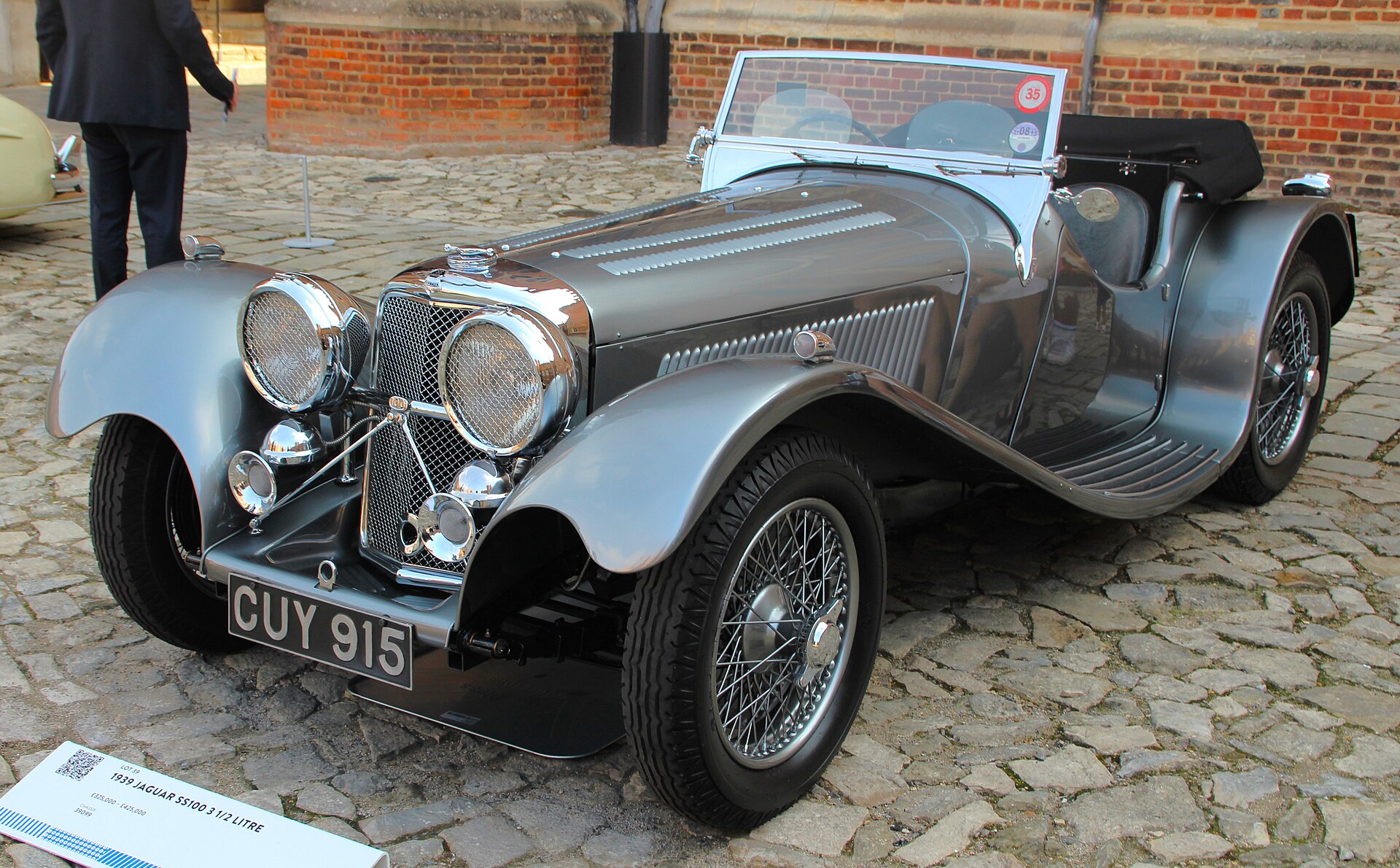
In September 1935 the name "Jaguar" appeared for the first time on the SS Jaguar 2½-litre saloon, followed by the SS Jaguar 100 sports car. After the Second World War the initials "SS" had become unusable, so on 23 March 1945 the shareholders renamed the company Jaguar Cars Limited.
The postwar boom: XK engine, Le Mans and the E-Type
In October 1948 Jaguar showed the XK120 roadster with a new 3.4-litre twin-overhead-camshaft six-cylinder engine. The XK engine went on to power Jaguars until 1992 and became the base of the company's racing success. Production moved to Browns Lane in Coventry in 1951, the year a C-Type won Le Mans. The C-Type won again in 1953, and the D-Type took the race in 1955, 1956 and 1957, the last two times with Ecurie Ecosse. The early sports cars are covered on the Jaguar XK120 page.

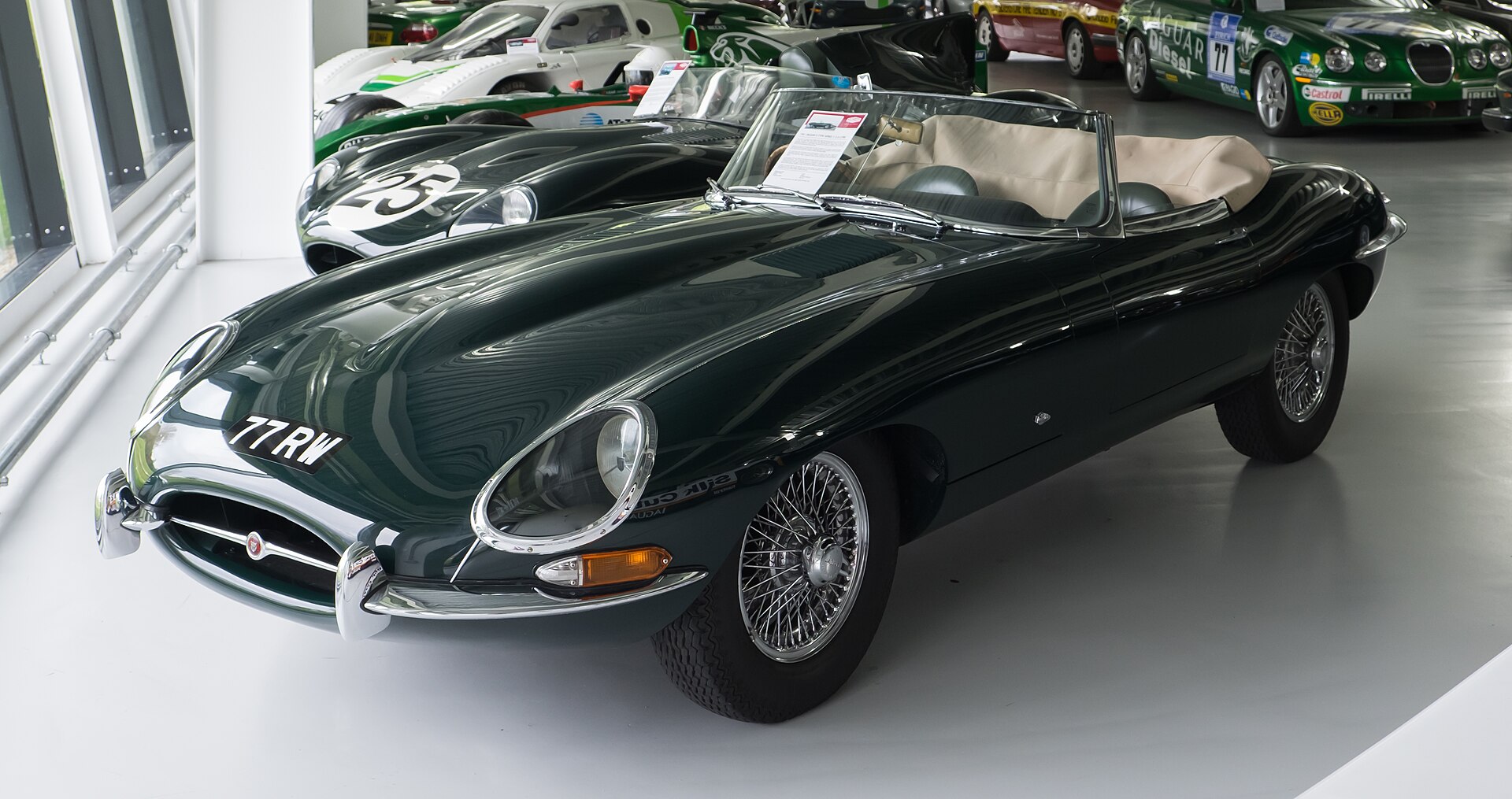
Saloons paid the bills. The Mark VII, VIII and IX, the compact Mark 1 and the Mark 2 of October 1959 gave Jaguar a reputation for comfort, speed and value. In 1960 Jaguar bought Daimler from BSA, and in 1961 it launched both the Mark X and the E-Type, the long-bonneted sports car that defined 1960s style. The best cars of that decade are ranked in the best classic cars of the 1960s.
| Model | Years | Why it matters |
|---|---|---|
| SS Jaguar 100 | 1936–1939 | First Jaguar-badged sports car |
| XK120 | 1948–1954 | Launched the XK engine; then one of the fastest production cars |
| C-Type and D-Type | 1951–1957 | Five Le Mans wins in seven years |
| Mark 2 | 1959–1967 | Compact sports saloon, a benchmark of its time |
| E-Type | 1961–1975 | Jaguar's best-known car |
| XJ Series I–III | 1968–1992 | Start of the XJ luxury saloon line, which ran to 2019 |
| XJR-9 / XJR-12 | 1988, 1990 | TWR-run Le Mans winners |
| F-Type | 2013–2024 | Return of the two-seat sports car; 87,731 built |
| I-Pace | 2018–2024 | First electric Jaguar |
Mergers, British Leyland and the road back to independence
On 11 July 1965 Lyons and BMC chairman George Harriman announced a merger with British Motor Corporation (BMC), which became British Motor Holdings (BMH) at the end of 1966. In 1968 BMH merged with Leyland to form British Leyland, the same year that the XJ6 saloon appeared. British Leyland was effectively nationalised in 1975, and quality suffered in the years that followed.

Under chairman John Egan, Jaguar recovered in the early 1980s and was floated on the London Stock Exchange in July 1984. In 1986 it bought the Whitley engineering centre in Coventry from Peugeot, which today houses the brand's design and engineering. The independence did not last: Ford made its offer to shareholders in November 1989, and Jaguar's shares were delisted on 28 February 1990.
The Ford years and the sale to Tata
The new owner invested heavily and widened the range. The retro S-Type saloon arrived in 1999, and in 2001 the compact X-Type, built at Halewood near Liverpool, brought four-wheel drive and a diesel engine to the brand. Ford closed the old Radford engine plant in 1997, and the aluminium X350 XJ was built at Castle Bromwich from 2003. Browns Lane ended its last trim operations in 2005.

On 26 March 2008 Ford agreed to sell Jaguar and Land Rover to the Indian Tata group, and the deal was completed on 2 June 2008. Tata merged the two brands into one company, Jaguar Land Rover, on 1 January 2013. The history of Land Rover tells the other half of that story.
Tata, aluminium and the SUV era
Under Tata, the company replaced the S-Type with the XF in 2008 (the Jaguar XF page covers both generations) and launched a new aluminium Jaguar XJ in 2009. The F-Type roadster appeared at Goodwood and then at the Paris Motor Show in 2012 and went on sale in 2013. That year the brand sold 76,668 cars, 42% more than in 2012. The XE compact saloon followed in 2015 on an aluminium-intensive architecture shared with the next XF.

The F-Pace, unveiled at Frankfurt in September 2015, was Jaguar's first SUV and became its best seller. The E-Pace followed in July 2017, built by Magna Steyr in Graz, Austria, and on 1 March 2018 the electric I-Pace arrived. The brand also returned to motorsport in Formula E from the 2016–2017 season and has committed to the series until 2030.
Electric reinvention and the Type 01
On 15 February 2021 JLR announced that every Jaguar would be fully electric. The old range was phased out step by step. The XE and XF ended in mid-2024 and the F-Type in 2024 after 87,731 cars, followed by the E-Pace and I-Pace in December 2024. The last F-Pace left the line on 19 December 2025, ending combustion-engined production. With almost nothing to sell, the brand's sales in 2025 fell by about 97.5%.

JLR revealed a new logo and identity on 19 November 2024, followed on 4 December 2024 by the Type 00 concept at Miami Art Week. Its production version, a four-door electric GT built on the dedicated Jaguar Electric Architecture, was unveiled on 7 October 2026 as the Type 01. Press reports give about 750 kW (1,000 hp) from three electric motors and a sales start in early 2027.
| Model | Segment | Body | Years |
|---|---|---|---|
| XE | Compact executive | Saloon | 2015–2024 |
| XF | Executive | Saloon, estate | 2007–2024 |
| XJ | Luxury | Saloon | 1968–2019 |
| F-Type | Sports car | Coupé, convertible | 2013–2024 |
| E-Pace | Compact SUV | SUV | 2017–2024 |
| F-Pace | Mid-size SUV | SUV | 2016–2025 |
| I-Pace | Electric SUV | SUV | 2018–2024 |
| Type 01 | Electric GT | Four-door GT | from 2027 |
Jaguar timeline

| Year | Event |
|---|---|
| 1922 | Swallow Sidecar Company founded in Blackpool |
| 1928 | Move to Coventry |
| 1935 | First SS Jaguar models |
| 1945 | Company renamed Jaguar Cars Limited |
| 1948 | XK120 and the XK engine |
| 1951–1957 | Five Le Mans wins with the C-Type and D-Type |
| 1961 | E-Type launched |
| 1968 | British Leyland formed; XJ6 launched |
| 1984 | Stock market listing |
| 1990 | Ford takeover completed |
| 2008 | Tata Motors buys Jaguar and Land Rover |
| 2013 | Jaguar Land Rover formed; F-Type on sale |
| 2018 | I-Pace, the first electric Jaguar |
| 2025 | End of combustion-engined production |
| 2026 | Type 01 electric GT unveiled |
Verdict: which Jaguar to choose today
For classic buyers, the XK models, the Mark 2 and the E-Type remain the heart of the brand. The XF, XE and F-Pace are good-value used executive cars with strong engines; set them against German rivals in the 1cars comparison tool. The new Type 01 aims much higher, at buyers of large luxury electric GTs. Every model Jaguar has listed is in the Jaguar catalogue.


FAQ
Who owns Jaguar today?
Jaguar is part of Jaguar Land Rover (JLR), which is owned by India's Tata Motors. Tata bought Jaguar and Land Rover from Ford in June 2008, and the two brands were merged into one company on 1 January 2013.
When was Jaguar founded and by whom?
William Lyons and William Walmsley founded the Swallow Sidecar Company in Blackpool in 1922. The Jaguar name first appeared on an SS saloon in 1935, and the business became Jaguar Cars Limited in March 1945.
Where are Jaguar cars made?
Jaguars were built at Browns Lane and Castle Bromwich in the West Midlands, at Halewood, at Solihull and, for the E-Pace, by Magna Steyr in Graz, Austria. Design and engineering are based at Whitley in Coventry.
What does the Jaguar logo mean?
The leaping cat, called the "Leaper", stands for speed and grace and first appeared as a bonnet mascot. The "Growler", a roaring jaguar's face, has been used on grilles and steering wheels. A new logo was introduced in November 2024.
What is the most famous Jaguar model?
The E-Type of 1961–1975 is the best-known Jaguar, admired for its long bonnet and performance. The XK120, the Le Mans-winning D-Type and the XJ saloon line are also central to the brand's history.
Did Jaguar win Le Mans?
Yes, seven times: in 1951 and 1953 with the C-Type, in 1955, 1956 and 1957 with the D-Type, and in 1988 and 1990 with the XJR-9 and XJR-12 prepared by Tom Walkinshaw Racing.
Photos (4)