
How to Choose the Right Winter Tyres for Your Car
Knowing how to choose winter tyres comes down to four checks. Buy the size, load index and speed rating listed for your car, insist on the three-peak mountain snowflake (3PMSF) symbol rather than M+S alone, match the tyre type to the winters you actually drive in, and confirm the tread depth and the rules of every country on your route.
Key takeaways
- The 3PMSF symbol means a tyre has passed a regulated snow test; M+S is only the manufacturer's own declaration.
- Winter compounds pay off once temperatures regularly fall below +7 °C (45 °F), an industry rule of thumb rather than a legal trigger.
- Many EU countries set the legal tread minimum at 1.6 mm (0.06 in), but Austria, Czechia and Latvia require 4 mm (0.16 in) on winter tyres.
- Since 1 October 2024 Germany accepts only 3PMSF-marked tyres as winter tyres in wintry conditions.

What to look for in a winter tyre
A suitable winter tyre for European roads carries the 3PMSF symbol, matches the size and indices in your vehicle documents, and suits the kind of winter you drive in. Brand, label classes and test results only help you choose between tyres that already meet those three conditions.
How winter tyres grip in the cold
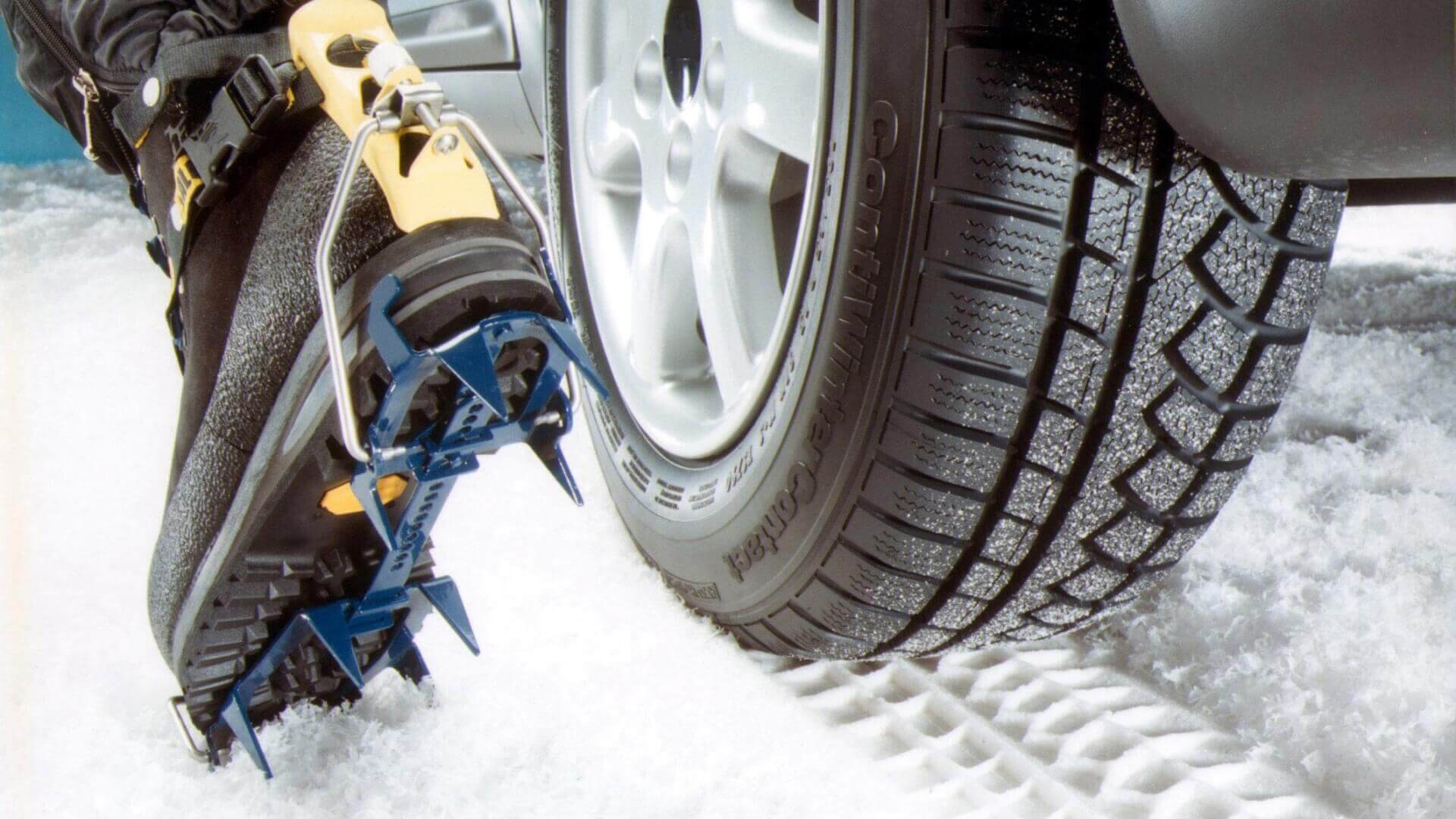
Winter tyres grip better than summer tyres in the cold because their compound stays soft at low temperatures and their tread is designed to bite into snow. A winter compound, usually rich in silica, stays flexible well below +7 °C (45 °F), where a summer compound hardens. Deep grooves hold snow, and thin slits called sipes add biting edges for slush.
The +7 °C figure is a tyre makers' rule of thumb, not a legal threshold. Even so, the rules for driving on ice that many drivers forget apply whatever is fitted.
3PMSF and M+S: the marking that now decides
The 3PMSF symbol, also called the Alpine symbol, shows that a tyre has passed a certified snow test under UN Regulation 117. A passenger-car tyre must reach a snow grip index of at least 1.07 in the braking test (1.10 in the traction test) against a standard reference tyre. M+S ("mud and snow") is applied by the manufacturer on the basis of tread design, without a certified test.
The difference became a legal one in 2024. Germany has counted only 3PMSF tyres as winter tyres since 1 October 2024, and the French mountain areas covered by winter rules have done the same since 1 November 2024. Sweden accepts tyres with the Alpine symbol or studded tyres. "All-season" is not a UN Regulation 117 category, so only the 3PMSF mark proves an all-season tyre's winter capability.
How to choose winter tyres step by step
Work from fixed constraints towards preferences: rules and vehicle data first, then marking and type, then label, tests and condition.
- Check the rules where you drive. In Germany, France and Sweden the shortlist starts with 3PMSF tyres (or studs in Sweden).
- Take the size from the car's documents, not from the tyres currently fitted: the handbook, the driver's door-frame label, the inside of the fuel flap or the Certificate of Conformity.
- Read the marking. In 225/45 R17 96 V, 225 is the width in millimetres (8.9 in), 45 the sidewall height as a percentage of the width, R17 a 17-inch rim, 96 the load index (710 kg / 1,565 lb per tyre) and V the speed symbol (240 km/h / 149 mph). Keep the load index at least equal to the original-equipment figure.
- Decide on the speed rating. Michelin states that a winter tyre rated below the original tyres, such as a T-rated tyre (190 km/h / 118 mph), is acceptable if it carries M+S and 3PMSF and a maximum-speed sticker sits in the driver's view. National rules vary.
- Pick the type for your climate from the comparison table, and for regular ice look for the ice-grip pictogram as well as 3PMSF.
- Compare the EU tyre labels of the shortlisted tyres.
- Check independent tests by clubs such as ADAC and ÖAMTC: a tyre that leads on ice can be average in the wet.
- Check the tyres on delivery. The DOT code on the sidewall ends in a four-digit date code for the week and year of manufacture: 3524 means week 35 of 2024.
- Fit four identical tyres: winter tyres on one axle only leave the front and rear with very different grip on snow.
Reading the EU tyre label for winter use
The EU tyre label under Regulation (EU) 2020/740, applied since 1 May 2021, shows fuel efficiency and wet grip in classes A to E, external rolling noise in dB, and pictograms for snow grip and ice grip. The snow pictogram appears only on tyres meeting the 3PMSF requirement; the ice-grip pictogram (ISO 19447) is found mainly on Nordic tyres. Studded tyres are outside the label rules.
Winter, all-season, Nordic or studded: options compared
The right type depends mostly on how often you meet snow and ice and whether studs are allowed where you drive.
| Option | Pros | Cons | Relative cost |
|---|---|---|---|
| Central European winter (studless, 3PMSF) | Strong on snow, slush and cold wet roads | Wears faster in warm weather; seasonal changeover | Medium (second set) |
| Nordic winter (studless, ice-grip) | Best studless grip on ice; usable where studs are banned | Michelin advises against them where winters are mild | Medium to higher |
| Studded | Highest grip on sheet ice | Noisy, wears roads, banned or date-limited in many countries | Higher |
| All-season with 3PMSF | One set all year; a legal winter tyre in Germany | A compromise in long, hard winters | Lower over the year |
| Snow chains or socks | Accepted in French mountain areas and on signed Italian roads | Snow-covered stretches only; not a substitute where winter tyres are compulsory | Lowest |
Michelin suggests an all-season tyre with 3PMSF for variable weather with occasional snow and a dedicated winter tyre for long, hard winters. See also tyre types and the parameters used to select them and, for spring, this overview of Bridgestone summer tyres.
Tread depth: legal minimum and practical limit
The legal minimum tread depth is 1.6 mm (0.06 in) in many EU countries, including Germany, Italy, Spain and Luxembourg, but several countries require more on winter tyres and many experts treat 4 mm (0.16 in) as the practical limit. Sweden, Finland, Estonia, Slovakia and Slovenia set 3 mm (0.12 in); Austria, Czechia and Latvia set 4 mm.
Snow grip falls away faster as a tyre wears. In a wear test published by Tyre Reviews, braking on snow from 48 km/h (30 mph) is usually quoted as about 14 m (46 ft) longer at 4 mm than with a new tyre, and about 26 m (85 ft) longer at 1.6 mm. The Austrian club ÖAMTC recommends around 6 mm (0.24 in) when winter tyres go on.
Winter tyre rules in Europe (as of October 2026)
There is no single EU-wide winter tyre law: each country sets its own requirement, period and minimum tread.
| Country | Requirement | Period | Minimum tread |
|---|---|---|---|
| Germany | Winter tyres in wintry conditions; 3PMSF only since 1 October 2024 | No fixed dates | 1.6 mm (0.06 in) |
| Austria | Winter tyres (M+S or 3PMSF) in winter conditions | 1 November–15 April | 4 mm (0.16 in); 5 mm (0.20 in) cross-ply |
| France | 3PMSF tyres, or chains or socks carried, in designated mountain areas | 1 November–31 March | No separate winter minimum |
| Sweden | Alpine symbol or studded tyres in wintry conditions | 1 December–31 March | 3 mm (0.12 in) |
| Czechia | Winter tyres on ice or snow, or where signed | 1 November–31 March | 4 mm (0.16 in) |
| Estonia | Winter tyres | 1 December–1 March (may be extended) | 3 mm (0.12 in) |
| Latvia | Winter tyres | 1 December–1 March | 4 mm (0.16 in) |
| Slovakia | Winter tyres in wintry conditions | 15 November–31 March | 3 mm (0.12 in) |
| Slovenia | Winter tyres (M+S or 3PMSF) | 15 November–15 March | 3 mm (0.12 in) |
Belgium, the Netherlands, Denmark, Ireland, Portugal, Spain, Greece, Hungary, Poland, Cyprus and Malta have no general obligation. Italy requires winter tyres or chains on board where signed.
What affects the price of winter tyres
The cost of winter tyres depends mainly on size, type and brand segment, plus fitting, changeovers and storage. Wider tyres and larger rims usually cost more, while an all-season tyre with 3PMSF replaces two sets with one. Reviews such as whether Hankook tyres justify their price help judge mid-range brands. A second set of wheels costs more up front but makes changeovers quicker; see this guide to choosing wheels for looks, price or reliability.
Common mistakes when buying winter tyres
The costliest mistakes are buying a tyre that does not legally count as a winter tyre where you drive, and running a good one long after its useful tread has gone.
- Buying M+S-only tyres, which no longer qualify in Germany or the French mountain areas.
- Accepting old stock without checking the DOT date code.
- Running winter tyres below 4 mm, or below the winter minimum of the country you are in.
- Taking studded tyres into a country that prohibits them.
- Skipping pressure checks: Continental notes that pressure falls by roughly 0.1 bar (1.5 psi) for every 10 °C drop in air temperature.
Tyres are only part of winter preparation: check how long it takes to charge a car battery, and consider liquid engine pre-heaters such as Webasto for cold starts.
FAQ
What is the difference between 3PMSF and M+S?
3PMSF shows that a tyre passed a certified snow test under UN Regulation 117 against a reference tyre. M+S is the manufacturer's own declaration based on tread design. Germany, and France in its mountain areas, now accept only 3PMSF tyres as winter tyres.
What tread depth should winter tyres have?
At least the legal minimum: 1.6 mm (0.06 in) in Germany, 3 mm (0.12 in) in Sweden and 4 mm (0.16 in) in Austria. Snow grip drops noticeably below 4 mm, so many experts replace winter tyres at that depth.
When should I fit winter tyres?
Tyre makers recommend fitting them once temperatures regularly fall below +7 °C (45 °F). Legal deadlines are separate: Austria applies its rule from 1 November to 15 April in winter conditions, while Germany ties the obligation to road conditions rather than dates.
Are all-season tyres good enough for winter?
An all-season tyre with the 3PMSF symbol is legal as a winter tyre in Germany and suits mild winters with occasional snow. For long periods of snow and ice, Continental and Michelin both recommend a dedicated winter tyre.
Are studded tyres legal in Europe?
It depends on the country. Studs are permitted within set dates in Sweden, Estonia, Latvia, Austria and Denmark, but prohibited in Poland and the Netherlands and not allowed in Czechia, Slovakia or Slovenia. Check every country on your route.
Safety note: use the tyre size, load index and speed rating listed in your vehicle documentation. National winter tyre rules differ and change, and the table above reflects October 2026, so check the current rules of each country before you travel.
Videos 2
Video 1

Video 2


