 Jaguar XK120
Specs, engines and history
Updated Published Sources (2) Report an error
By Felix Hartmann, Automotive Technology & EV Contributor Reviewed by Oleksandr Hnatiuk

- Built
- 1948–1954
- Top power
- 157 kW (213 PS)
The Jaguar XK120 is a two-seat sports car built in Coventry from 1948 to 1954, the first car with Jaguar's twin-cam XK straight-six. Planned as a short-run show car, it became a hit at the 1948 London Motor Show. Just over 12,000 were made as roadster, fixed-head and drophead coupé, and in 1949 it set a speed record of 132.6 mph (213 km/h).
In short
- Engine: 3.4-litre XK six with two overhead camshafts, 119 kW (160 bhp) as standard and up to 157 kW (210 bhp) with the C-Type head.
- Name: "120" stood for the target top speed of 120 mph (193 km/h), which road tests confirmed.
- Bodies: open two-seater (7,606 built), fixed-head coupé from 1951 (2,672) and drophead coupé from 1953 (1,767).
- Most cars were exported, mainly to the United States; about 86 % were left-hand drive.

The XK120 at a glance
| Fact | Value |
|---|---|
| Built | 1948–1954, Coventry (Holbrook Lane, then Browns Lane from 1951) |
| Body styles | Open two-seater (OTS), fixed-head coupé (FHC), drophead coupé (DHC) |
| Engine | 3,442 cc twin-cam XK straight-six, twin SU carburettors |
| Power | 119 kW (160 bhp) standard; 134 kW (180 bhp) SE; 157 kW (210 bhp) with C-Type head |
| Total production | about 12,045–12,055 (sources differ slightly) |
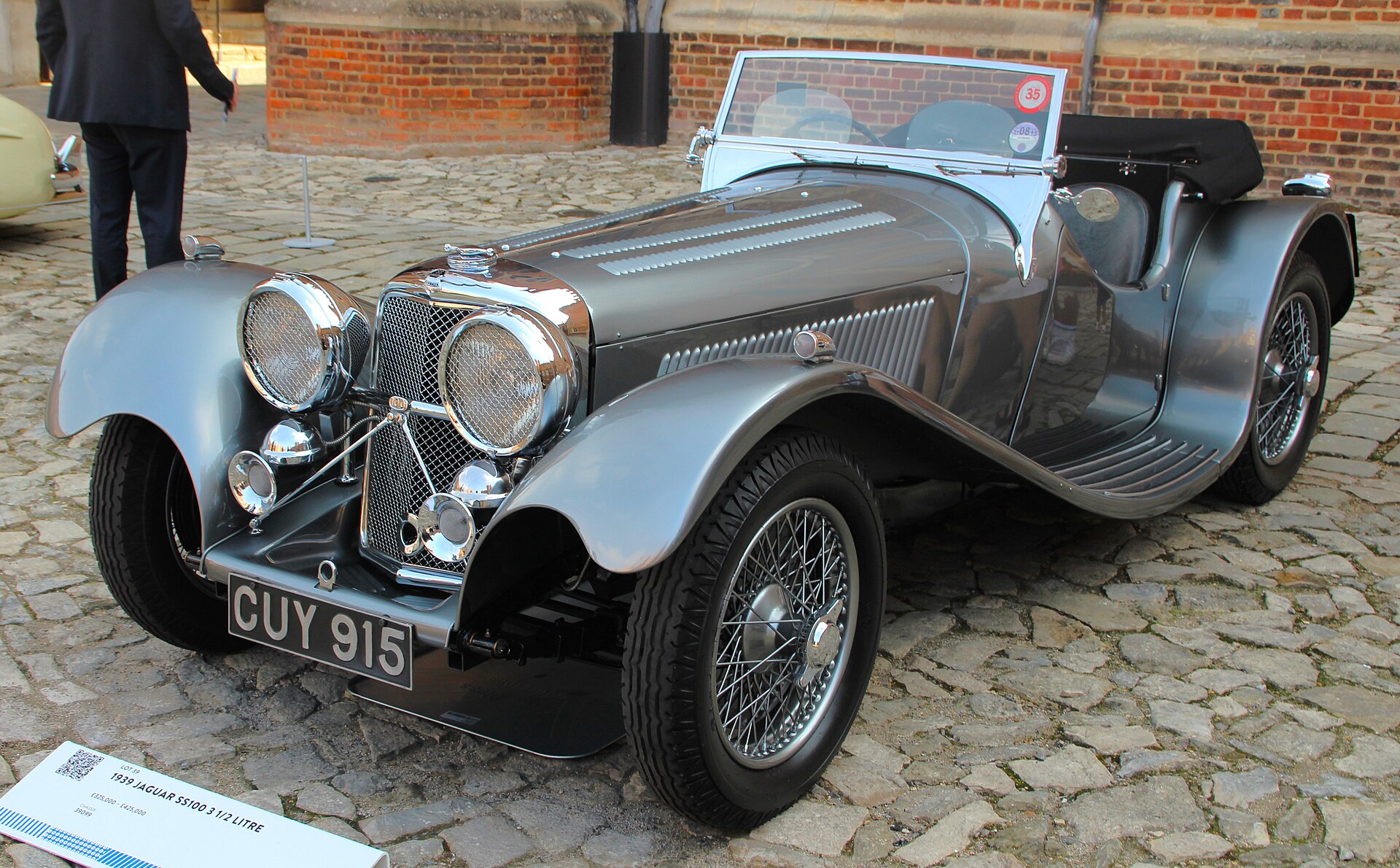
| Predecessor / successor | SS Jaguar 100 / XK140 (1954) |
From a show car to a production hit
During the war, Jaguar's chief engineer William Heynes and his team worked on a new family of engines. Among them was a 3.4-litre six with two overhead camshafts, a layout then found mainly in racing cars. To show off the engine, company chairman William Lyons had a low, flowing two-seat body built on a shortened saloon chassis. The car was meant as a limited-edition halo model of perhaps 200 units.

At the 1948 London Motor Show, the reaction of the public and dealers changed the plan. Orders far exceeded what the coachbuilt car could deliver. The first 242 cars, built from late 1948 to early 1950, had hand-formed aluminium panels over an ash frame. From the 1950 model year Jaguar switched to pressed-steel bodies, about 51 kg heavier, but kept aluminium doors, bonnet and boot lid. Only then did proper series production begin.
The history of the company behind it is told in Jaguar's history and in our story of how Jaguar was born.
Body styles and production numbers
The open two-seater came first and remained the best seller. A fixed-head coupé with a closed steel roof followed in 1951, and a drophead coupé with wind-up windows and a lined hood arrived in 1953.

| Body | From | Right-hand drive | Left-hand drive | Total |
|---|---|---|---|---|
| Open two-seater (roadster) | 1948 | 1,170 | 6,436 | 7,606 |
| Fixed-head coupé | 1951 | 195 | 2,477 | 2,672 |
| Drophead coupé | 1953 | 295 | 1,472 | 1,767 |
| All bodies | 1,660 | 10,385 | 12,045 |
The left-hand-drive share shows how much the car depended on exports. American buyers took a large part of the output, and the XK120 helped establish Jaguar as a premium sports brand in the US.
The XK engine and running gear
The XK straight-six measured 3,442 cc, with a bore and stroke of 83 × 106 mm. In standard form, with 8:1 compression on 80-octane fuel, it made 119 kW (160 bhp) at 5,000 rpm. UK cars initially ran 7:1 compression because of low-grade post-war petrol. From mid-1951 the Special Equipment (SE) version, sold as the "M" in the US, added higher-lift camshafts and twin exhausts for 134 kW (180 bhp) at 5,300 rpm. From 1953, a C-Type cylinder head with larger SU carburettors gave 157 kW (210 bhp) at 5,750 rpm.
The engine proved so sound that Jaguar used developments of it until 1992, in models from the E-Type to the XJ6. Many racing classes of the 1950s were won with it.
| Parameter | Metric | Imperial |
|---|---|---|
| Wheelbase | 2,591 mm | 102 in |
| Length | 4,394 mm | 173 in |
| Width | 1,562 mm | 61.5 in |
| Height | 1,334 mm | 52.5 in |
| Engine | 3,442 cc straight-six | 210 cu in |
| Brakes | 12-inch drums all round | 12-inch drums |
The chassis had independent front suspension with torsion bars, a live rear axle on semi-elliptic leaf springs and recirculating-ball steering. The drum brakes were the car's weak point: they faded quickly when driven hard, and some cars received finned Alfin drums to cope.
Performance and speed records
In its November 1949 road test, The Motor magazine recorded a top speed of 124.6 mph (200.5 km/h) and 0–60 mph in 10.0 seconds. Fuel consumption was 19.8 mpg (about 14.3 l/100 km). A US-market SE was timed from 0 to 60 mph in 8.7 seconds. That made the XK120 the fastest standard production car on sale at its launch.

Jaguar backed its claims with public record runs:
- 30 May 1949, Jabbeke (Belgium): a prototype averaged 132.6 mph (213.4 km/h) over the flying mile, with test driver Ron Sutton at the wheel.
- 1950–1951, Montlhéry (France): open cars averaged more than 100 mph (161 km/h) for 24 hours and over 130 mph (209 km/h) for one hour.
- 1952, Montlhéry: a fixed-head coupé averaged 100.31 mph (161.4 km/h) for seven days and nights, covering 16,851 miles (27,120 km).
- 21 October 1953, Jabbeke: Norman Dewis reached an average of 172.4 mph (277.5 km/h) in a modified car.
For a sense of scale, the 1cars fastest-cars ranking shows how far top speeds have climbed since: today's leaders are more than twice as fast.
Racing and rally results
The XK120 won its first race at Silverstone in 1949 with Leslie Johnson. In the 1950 Le Mans 24 Hours, three modified cars started. Johnson's car ran as high as second before clutch failure in the 21st hour, while the others finished 12th and 15th. Jaguar then built a dedicated racer, the XK120C or C-Type, which won Le Mans in 1951.

In rallying, Ian Appleyard and his wife Pat won the Alpine Rally twice in their white roadster NUB 120. On their third start they finished without a penalty point and took the first Coupe d'Or, and they also won the Tulip Rally. Stirling Moss led a 1–2–3 finish in the Tourist Trophy, and Johnson took fifth in the 1950 Mille Miglia. On 13 June 1954 Al Keller won the first NASCAR Grand National road race in an XK120 coupé.
Rivals and its place in sports-car history
The XK120 rivalled far more expensive cars on speed. The Mercedes-Benz 300 SL of 1954 was faster but cost much more and was built in smaller numbers. Compared with the 300 SL, the standard XK120 had 39 kW less power, yet it reached buyers six years earlier. Aston Martin's DB2 offered similar pace with a more exclusive image.

| Model | Years | Engine | Power | Character |
|---|---|---|---|---|
| Jaguar XK120 | 1948–1954 | 3.4 l DOHC I6 | 119–157 kW (160–210 bhp) | Fast, relatively affordable, big export success |
| Mercedes-Benz 300 SL | 1954–1963 | 3.0 l I6, direct injection | 158 kW (215 PS) | Gullwing coupé, much higher price |
| Aston Martin DB2 | 1950–1953 | 2.6 l DOHC I6 | lower than the XK120 | Coupé, small production |
Specialists later used Jaguar engines in their own racers, such as the Lister Jaguar Costin roadster. Other cars of the period are collected in the 1cars classics of the 1950s, and later Jaguar sports cars appear among the best sports cars.
Buying a Jaguar XK120 today
Early alloy roadsters are the rarest and most valuable, followed by steel roadsters with SE specification. Fixed-head and drophead coupés usually cost less, and they suit buyers who want a classic for touring rather than for shows. Matching chassis and engine numbers, documented history and a Jaguar Heritage certificate matter more than shine.

On a test drive, check for brake pull and fade, oil leaks from the twin-cam engine, and corrosion in the steel body and the chassis outriggers. Many cars have been upgraded with disc brakes, five-speed gearboxes and better cooling; these changes make touring easier but can lower the value for purist buyers. All Jaguar models in our database, old and new, are in the Jaguar catalogue.
Jaguar XK120 in our rankings
- No. 50 of 79 · Most powerful convertibles and roadsters (157 kW · top 64%)
- No. 568 of 859 · Most powerful cars (157 kW · top 67%)
- No. 548 of 912 · Longest-running car nameplates (6 years · top 69%)
- No. 88 of 109 · Most powerful British cars (157 kW · top 81%)
More powerful than 36% of ranked convertibles and roadsters in the 1CARS catalog (No. 50 of 79).
Jaguar XK120 photos 11


Jaguar XK120 videos 3

Jaguar XK120 video 1

Video overview

Test drive
FAQ
How fast was the Jaguar XK120?
Road tests in 1949 measured about 124.6 mph (200.5 km/h), and a prototype with an aeroscreen averaged 132.6 mph (213 km/h) at Jabbeke. That made it the fastest standard production car of its launch period.
How many Jaguar XK120s were built?
Just over 12,000 cars left the factory between 1948 and 1954: 7,606 roadsters, 2,672 fixed-head coupés and 1,767 drophead coupés. Only the first 242 roadsters had hand-built aluminium bodies.
What engine does the XK120 have?
It uses the 3,442 cc XK straight-six with two overhead camshafts and twin SU carburettors. Output was 119 kW (160 bhp) in standard form, 134 kW (180 bhp) as the SE and 157 kW (210 bhp) with the C-Type head.
What does "120" in XK120 mean?
The number referred to the car's target top speed of 120 mph, about 193 km/h. Road tests and the 1949 Jabbeke record run showed that the production car could exceed it comfortably.
What replaced the Jaguar XK120?
The XK140 replaced it in 1954, with more power, rack-and-pinion steering and more cabin space. The XK150 followed in 1957, and in 1961 the E-Type took over as Jaguar's sports car.
Data sources
Data checked by an editor against the sources below.
- The text of this article (1cars archive)
- Wikipedia - Jaguar XK120