 Jaguar XF
All generations, specs and history
Updated Published Sources (4) Report an error
By Felix Hartmann, Automotive Technology & EV Contributor Reviewed by Oleksandr Hnatiuk
- Built
- 2007–present
- Generations
- 2 · X250 to X260
- Top power
- 405 kW (551 PS)
Timeline
XF generations
Click a generation for its own page


Newest first · 2 generations since 2007
All generations by year: XF X260 (2015–now) · XF X250 (2007–2015)
Which one is mine?
Pick the year of first registration to see which generation it is.
Check by VINRivals and verdict
Our verdict · Felix Hartmann
Compared with the G30 5 Series, the XF offers similar driving quality and often lower used prices. Our verdict: for most buyers, a 2018–2024 X260 with the 2.0 diesel or P250 petrol and a documented service history is the best value; the 3.0 V6 S and the X250 XFR are the enthusiast choices. The smaller Jaguar XE and the Jaguar F-Pace SUV share its engines. Compare versions in the 1cars comparison tool or see all models in the Jaguar catalogue.
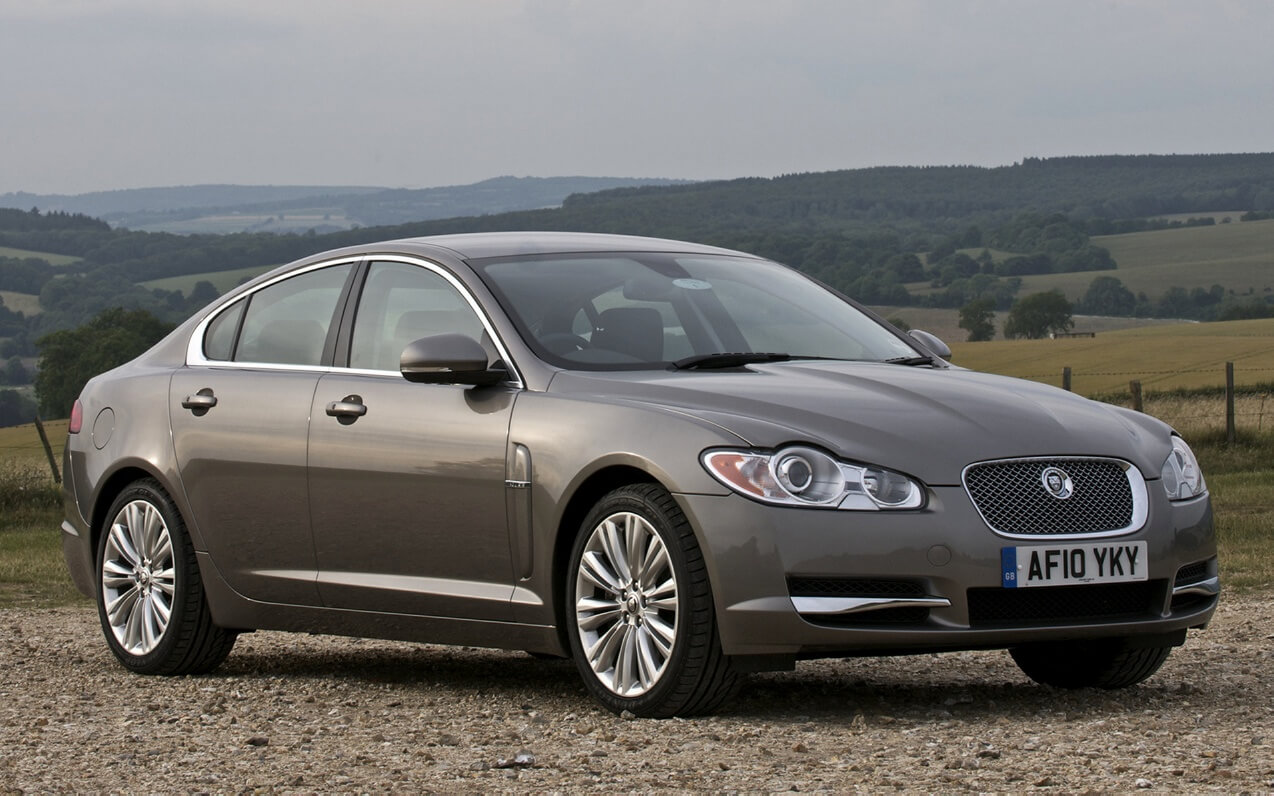
The Jaguar XF is a rear- or all-wheel-drive executive saloon and estate built at Castle Bromwich in Birmingham from November 2007 to mid-2024. The first generation, X250, replaced the S-Type with a coupé-like design by Ian Callum; the second, X260 of 2015, moved to an aluminium body and Ingenium engines. Power ranged from 120 kW (163 PS) diesels to the 405 kW (550 PS) XFR-S.
In short
- X250 (2007–2015): revealed at Frankfurt in September 2007, deliveries from March 2008, facelift in 2011, Sportbrake estate from 2012.
- X260 (2015–2024): debut at the 2015 New York show, aluminium-intensive body, 2.0 Ingenium petrol and diesel engines plus a 3.0 V6 with up to 280 kW (380 PS).
- Euro NCAP: four stars for the X250 in 2010, five stars for the X260 in 2015 with 92% for adult occupants.
- Production ended in mid-2024 without a direct successor, as Jaguar moved to electric cars.

Size at a glance
| Dimensions | Jaguar XF X250 |
|---|---|
| Length | 4,961 mm195.3 in |
| Width | 1,877 mm73.9 in |
| Height | 1,460 mm57.5 in |
| Wheelbase | 2,909 mm114.5 in |
Specs by version
Engines
Dimensions and weight
Verified Manufacturer and type-approval data from our catalog · Sources and methodology
Jaguar XF at a glance
The XF was the car that pulled Jaguar away from retro styling. Ian Callum's design, previewed by the C-XF concept in January 2007, introduced the mesh grille, the rising rotary JaguarDrive gear selector and air vents that open when the engine starts. It competed with the BMW 5 Series, Mercedes-Benz E-Class and Audi A6. The brand story is told in Jaguar's history.

| Generation | Code | Years | Body styles | Engines | Power (kW / PS) |
|---|---|---|---|---|---|
| First | X250 | 2007–2015 | Saloon, Sportbrake estate (2012) | 2.0–5.0 petrol, 2.2–3.0 diesel | 120–405 kW (163–550 PS) |
| Second | X260 | 2015–2024 | Saloon, Sportbrake (2017), long-wheelbase XFL (China) | 2.0 Ingenium petrol and diesel, 3.0 V6 | 120–280 kW (163–380 PS) |
First generation X250 (2007–2015)
Production began in November 2007 and customer deliveries in March 2008. Early engines were the 2.7 TDV6 diesel with 150 kW (204 PS), the 3.0 V6 petrol with 175 kW (238 PS) and the 4.2 V8 with 221 kW (300 PS) or, supercharged, 309 kW (420 PS). In 2009 Jaguar added the 5.0 V8 family with 283 kW (385 PS) and the XFR with 375 kW (510 PS), plus 3.0 diesels with 177 and 202 kW (240 and 275 PS).

The facelift, shown in New York in April 2011, brought slimmer headlights and the 2.2-litre four-cylinder diesel with 120, 140 or 147 kW (163, 190 or 200 PS). The old 1cars text gives about 4.5 l/100 km and 225 km/h for the 140 kW version. Over 2012–2013 the eight-speed ZF automatic with stop-start replaced the six-speed across the range, and a 2.0 turbo petrol with 177 kW (241 PS) arrived. The Sportbrake estate went on sale in October 2012 with 550 litres, or 1,675 litres with the rear seats folded. The fastest X250 was the XFR-S of 2012–2015 with 405 kW (550 PS).
| X250 engine | Fuel | Power | Years |
|---|---|---|---|
| 2.2 i4 diesel | Diesel | 120–147 kW (163–200 PS) | 2011–2015 |
| 2.7 TDV6 | Diesel | 150 kW (204 PS) | 2008–2009 |
| 3.0 TDV6 | Diesel | 177–202 kW (240–275 PS) | 2009–2015 |
| 2.0 i4 turbo | Petrol | 177 kW (241 PS) | 2012–2015 |
| 3.0 V6 | Petrol | 175 kW (238 PS) | early years |
| 4.2 V8 / 4.2 SC | Petrol | 221–309 kW (300–420 PS) | 2008–2009 |
| 5.0 V8 / XFR | Petrol | 283–375 kW (385–510 PS) | 2009–2015 |
| XFR-S | Petrol | 405 kW (550 PS) | 2012–2015 |
Jaguar recorded 202,678 X250 sales from 2009 to 2016, with a peak of 48,375 in 2014.
Second generation X260 (2015–2024)
The X260 made its debut at the New York International Auto Show in 2015. Aluminium makes up most of the body structure and chassis, including a single-piece aluminium bodyside, and 83% of the parts were new. Kerb weight ranges from 1,545 to 1,855 kg. All-wheel drive became available, the Sportbrake estate returned in 2017 and a long-wheelbase XFL, 140 mm longer between the axles, was built for China from 2016.

| X260 engine | Fuel | Power | Notes |
|---|---|---|---|
| 2.0 Ingenium diesel | Diesel | 120–177 kW (163–240 PS) | 20d and 25d; most common in Europe |
| 2.0 Ingenium petrol | Petrol | 184–221 kW (250–300 PS) | P250, P300 |
| 3.0 V6 supercharged | Petrol | 250–280 kW (340–380 PS) | XF S, XFL |
| 3.0 V6 diesel | Diesel | 221 kW (300 PS) | 30d |
The 2020 update concentrated on the interior, with new materials, screens and controls. Euro NCAP awarded five stars in 2015, with 92% for adult occupants, 84% for children, 80% for pedestrians and 83% for safety assistance. Jaguar quotes about 540 litres of boot space for the saloon.
Dimensions and practicality
| Parameter (X260 saloon) | Metric | Imperial |
|---|---|---|
| Kerb weight | 1,545–1,855 kg | 3,406–4,090 lb |
| Boot | about 540 l | 19.1 cu ft |
| Sportbrake boot (X250) | 550–1,675 l | 19.4–59.2 cu ft |
| Gearbox | 8-speed ZF automatic | – |
| Drive | Rear- or all-wheel drive | – |
The XF seats five, though the sloping roof limits rear headroom for tall passengers. Compare its boot with rivals in the biggest boot saloons ranking.

Common problems and reliability
On X250 cars, the most important checks concern the diesel engines: listen for timing-belt and turbo noise on the 2.7 and 3.0 TDV6, check that the particulate filter has not been clogged by short trips and look for oil leaks. The electronics, including the infotainment and the rising gear selector, should work without warning messages. On X260 cars, some early 2.0 Ingenium diesels were reported to suffer timing-chain wear, so a full Jaguar service history and evidence of software updates and recalls are important. On the Sportbrake, check the self-levelling rear suspension.

| Model | Years (generation) | Body styles | Strength |
|---|---|---|---|
| Jaguar XF X260 | 2015–2024 | Saloon, estate | Ride and handling balance |
| BMW 5 Series G30 | 2017–2023 | Saloon, estate | Engines, technology |
| Mercedes-Benz E-Class W213 | 2016–2023 | Saloon, estate, coupé | Comfort, range |
| Audi A6 C8 | 2018– | Saloon, Avant | Interior quality, quattro |
Jaguar XF in our rankings
- No. 18 of 149 · Most powerful sedans (405 kW · top 13%)
- No. 59 of 420 · Longest cars (4,961 mm · top 15%)
- No. 171 of 859 · Most powerful cars (405 kW · top 21%)
- No. 34 of 170 · Most powerful cars of the 2000s (375 kW · top 22%)
- No. 31 of 131 · Biggest engines: sedans (5,000 cc · top 25%)
- No. 139 of 557 · Biggest engines: cars (5,000 cc · top 27%)
More powerful than 87% of ranked sedans in the 1CARS catalog (No. 18 of 149).
Jaguar XF photos 15


Jaguar XF videos 2

Test drive

Video overview
FAQ
How many generations of the Jaguar XF are there?
There are two: the X250, built from November 2007 to June 2015, and the aluminium-bodied X260, built from 2015 until mid-2024. Both were offered as a saloon and as a Sportbrake estate.
Which Jaguar XF generation is the most reliable?
A later X260 from 2018 onwards with a full service history is generally the safest choice. Among first-generation cars, the facelifted 2011–2015 X250 with the 2.2 or 3.0 diesel and the eight-speed automatic is the most robust.
What is the fuel consumption of the Jaguar XF?
The 2.2-litre diesel X250 uses about 4.5 l/100 km on the official cycle, according to the old 1cars data, and the 2.0 Ingenium diesels of the X260 are similar. The V8 and supercharged V6 petrol models use far more.
Is the Jaguar XF available with all-wheel drive?
Yes. The X260 offered all-wheel drive with several diesel and petrol engines, and the long-wheelbase XFL built for China was all-wheel drive only. The first-generation X250 was mostly rear-wheel drive; all-wheel drive came only late in its life in some markets.
What replaced the Jaguar XF?
No direct successor followed. Production ended in mid-2024 as Jaguar stopped its old range to relaunch as an electric-only brand with the Type 01 four-door GT, unveiled in October 2026.
Data sources
Data checked by an editor against the sources below.
- The text of this article (1cars archive)
- Wikipedia - Jaguar XF
- Wikipedia - Jaguar XF (X250)
- Euro NCAP - Chinese Manufacturers Investing In Safety