 Ford Boss 429
Specs, engines and history
Published Sources (1) Report an error
By Sarah Whitmore, Senior Automotive Writer
- Built
- 1969–1970
- Top power
- 280 kW (381 PS)
Which Boss 429 to choose
Our verdict · Sarah Whitmore
- For originality: a 1969 car with an early S-code engine and full documentation.
- For the brighter look: a 1970 car in one of the Grabber colours with the black scoop.
- For driving rather than investing: a licensed continuation car, built new to the original design.
The road car's racing partner was the Talladega, and its small-block sister was the Boss 302. Both appear in the American muscle car guide, and every Mustang version is listed in our Ford catalogue; the car comparison tool sets the figures side by side.
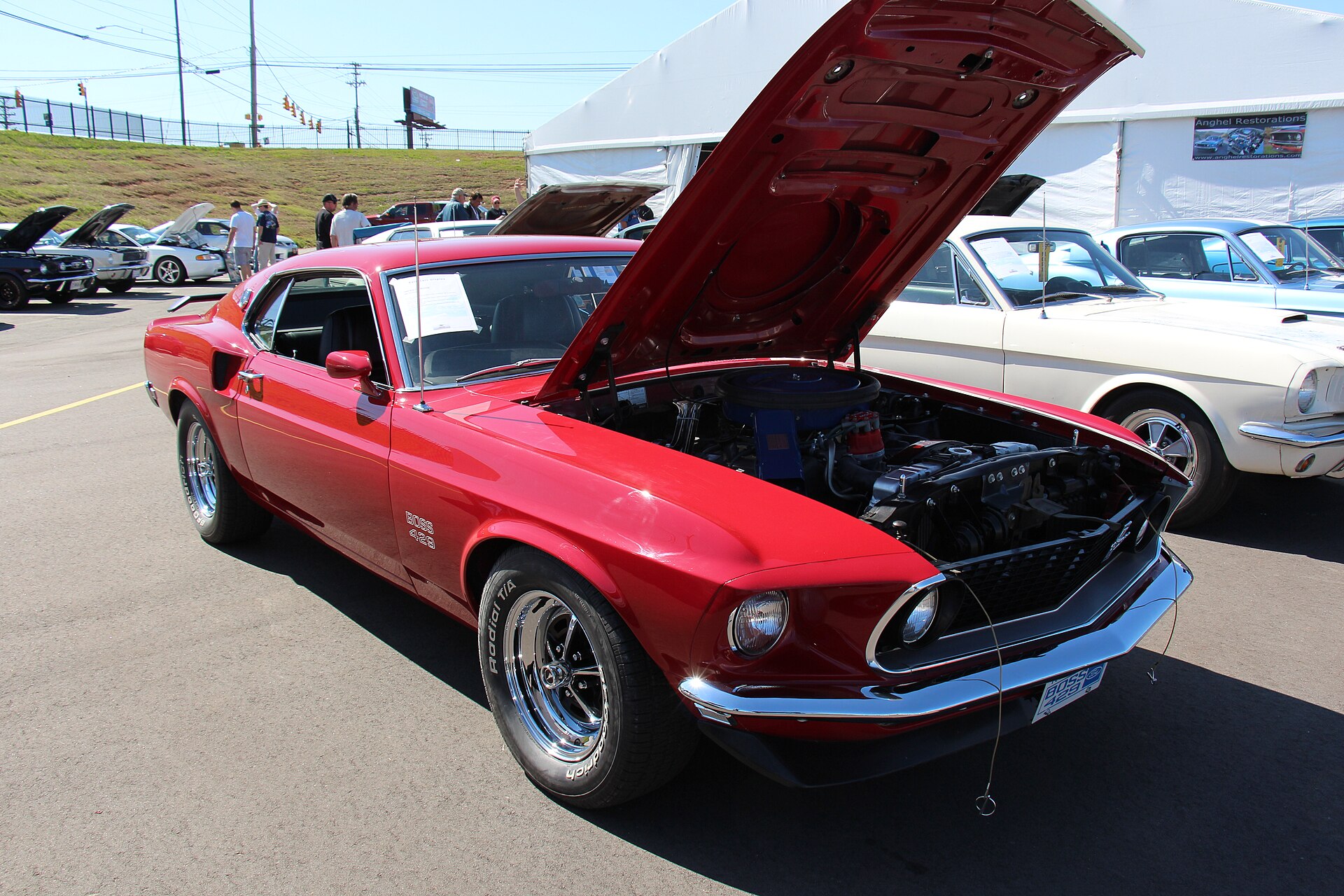
The Boss 429 was a Ford Mustang built in 1969 and 1970 to homologate a new racing engine. NASCAR required at least 500 road cars with the 429 cu in "semi-hemi" V8, so Ford had Kar Kraft fit it into the Mustang fastback at a plant in Brighton, Michigan. Ford built 859 cars in 1969 and 499 in 1970, and the Boss 429 is now one of the most valuable Mustangs of all.
In short
- A homologation special: the engine, not the Mustang, was the reason for the car; Ford raced it in Torino Talladegas and Cyclone Spoiler IIs.
- 429 cu in (7.0 l) V8 with aluminium semi-hemispherical heads, rated at 280 kW (375 hp, SAE gross) and 610 Nm.
- Four-speed manual only, a 3.91:1 Traction-Lok axle, battery in the boot and the first rear anti-roll bar on any Mustang.
- Each car carries a Kar Kraft "KK" number, from KK 1201 to KK 2558.
Specs by version
Verified Manufacturer and type-approval data from our catalog · Sources and methodology
Boss 429 at a glance
| Specification | Boss 429 |
|---|---|
| Model years | 1969–1970 |
| Built | 859 (1969) + 499 (1970); Wikipedia's total says 1,359 |
| Body | two-door SportsRoof fastback |
| Conversion | Kar Kraft, Brighton, Michigan |
| Engine | 429 cu in (7.0 l) V8, aluminium "semi-hemi" heads |
| Power | 280 kW (375 bhp) at 5,200 rpm, SAE gross |
| Torque | 610 Nm (450 lb-ft) at 3,400 rpm |
| Gearbox | four-speed manual; Hurst shifter standard in 1970 |
| Axle | 3.91:1 with Traction-Lok limited slip |
| Price new | about US$4,798 in 1969; "nearly US$5,000" per Wikipedia |
The Boss 429 belongs to the first Mustang generation, which is covered in full on our Ford Mustang page.
Why Ford built it
Ford wanted an answer to Chrysler's 426 Hemi in NASCAR's Grand National division. Its reply was a new big-block, the 429 with semi-hemispherical combustion chambers. To race it, Ford had to sell at least 500 cars with the engine to the public. After much discussion the company chose the Mustang, which also gave the small-block Boss 302 a big-block partner.
The choice brought a packaging problem: the engine was too wide for the standard engine bay, so Kar Kraft, Ford's special vehicle engineering shop in Dearborn, designed new front apron assemblies with reworked inner fenders and shock towers. The aprons were fitted at the Ford Rouge plant, and the cars then went to Kar Kraft's new plant in Brighton, Michigan, for the engine and the remaining changes.
The NASCAR plans changed during 1969, when Dodge homologated the 440-powered Charger Daytona. Ford still used the engine in the Ford Torino Talladega and the Mercury Cyclone Spoiler II; it won 26 races in 1969 before factory support was cut back, and stayed in NASCAR use until 1974.

The 429 semi-hemi engine
The racing pedigree showed in the details. The block had four-bolt main caps, a forged steel crankshaft and forged steel connecting rods. The aluminium heads had "crescent" combustion chambers. Cooling was dry-deck: the block and heads had separate coolant circuits, and each cylinder, oil passage and water passage was sealed by its own O-ring, backed by a head gasket. A 735 cfm Holley four-barrel carburettor sat on an aluminium intake. With 280 kW from 7.0 litres, the rated output works out at about 40 kW per litre, by our calculation.
| Item | 1969 | 1970 |
|---|---|---|
| Valve lifters | hydraulic | mechanical (solid) |
| Advertised output | 280 kW (375 bhp), 610 Nm | unchanged |
| Crane Cams dyno test, stock with tube headers | 262 kW (352.0 bhp) at 5,500 rpm | 273 kW (366.5 bhp) at 5,500 rpm |
| Engine codes | early "S" code with magnesium valve covers, then "T" and "A" | "T" and "A" |
The early S-code engines had NASCAR-style forged internals and little or no smog equipment; Wikipedia says they are stronger than the later T- and A-code engines with emission controls, without giving figures. The 1970 switch to solid lifters reduced valve float at high revs. Ford never used the name "Boss 429" officially for the engine, but everyone else did. Later it found work in tractor pulling and, in the 1980s, in NHRA Pro Stock.

Chassis and equipment
The heavy engine moved weight to the nose, and Ford compensated where it could. The battery went into the boot. A 19 mm (3/4 in) rear anti-roll bar was added, the first rear bar on any Mustang. An oil cooler, a manually controlled hood scoop and a shallower front spoiler than the Boss 302's completed the package. Every car had a four-speed manual and a 3.91:1 Traction-Lok axle. Equipment included colour-keyed racing mirrors, an 8,000 rpm tachometer and an AM radio; air conditioning was not available.
The outside was quiet by the standards of 1969: no rear spoiler, no window louvres, only Boss 429 decals on the front wings. The hood scoop, the largest Ford ever fitted to a production Mustang, was body-coloured in 1969 and matt black in 1970.
| Year | Exterior colours | Interior |
|---|---|---|
| 1969 | Raven Black, Wimbledon White, Royal Maroon, Candy Apple Red, Black Jade | black |
| 1970 | Grabber Orange, Grabber Green, Grabber Blue, Calypso Coral, Pastel Blue | black, or white and black |
In 1970 a dealer-installed "six-pack" induction with three two-barrel carburettors was offered, but very few were sold. The car cost close to twice as much as a base six-cylinder Mustang, and sales fell for 1970. Higher production costs and internal problems at Ford ended it after that year.

Values today
Wikipedia records bids above US$375,000 by 2008, an unrestored black 1969 car sold for US$417,000 at Mecum Kissimmee in 2013 and a restored black 1969 car for US$500,000 at Barrett-Jackson Palm Beach in 2016. Revology Cars lists US$517,000 at Barrett-Jackson Scottsdale in January 2026 and three Mecum Kissimmee results of US$319,000–374,000 the same year; the lowest sale it found was US$175,000 in November 2025.
The record came in 2026, when an unrestored 1969 car with 4,435 miles (7,137 km) sold for US$950,000 hammer price, US$1.04 million with fees, at Barrett-Jackson's first auction in Columbus, Ohio, according to autoevolution. Original, numbers-matching cars with documented histories bring by far the highest prices.

Boss 429 buying guide
With 2026 prices in six and seven figures, fakes are a real risk, so the paperwork matters as much as the metal:
- KK number: each car has a Kar Kraft number and a NASCAR identification inside the driver's door. The first was KK 1201, the last KK 2558.
- Build records: a Marti Report confirms the factory options, colour and build data for the VIN; the door data plate must match the VIN, colour and trim codes.
- Engine: look for the original 429 with its semi-hemi heads and the right code for the car's date; the S-code engines came first, with forged NASCAR-style internals.
- Kar Kraft details: the reworked shock towers, the boot-mounted battery and the rear anti-roll bar should all be present.
- Fraud risk: Revology warns of false VIN tags and rebodied cars; old photos, the window sticker or dealer invoice and service records help to confirm a history.
- Running costs: the same source quotes US$15,000–30,000 in 2026 for an engine rebuild, because parts are scarce.
Classic Recreations has built licensed 1969–1970 Boss 429 continuation cars since April 2018; these are new cars, not originals.
Ford Boss 429 in our rankings
- No. 32 of 557 · Biggest engines: cars (7,030 cc · top 7%)
- No. 24 of 173 · Biggest engines: coupes (7,030 cc · top 16%)
- No. 21 of 94 · Most powerful cars of the 1960s (280 kW · top 24%)
- No. 121 of 368 · Most torque: cars (610 Nm · top 34%)
- No. 310 of 859 · Most powerful cars (280 kW · top 37%)
- No. 65 of 154 · Most powerful American cars (280 kW · top 45%)
Bigger engine than 93% of ranked cars in the 1CARS catalog (No. 32 of 557).
FAQ
How many Boss 429 Mustangs were made?
859 in 1969 and 499 in 1970. Wikipedia's text gives a total of 1,359, one more than the sum of the yearly figures; two Boss 429 Cougars were also built as drag cars.
How much horsepower does a Boss 429 have?
Ford rated it at 280 kW (375 bhp, SAE gross) and 610 Nm. Dyno tests by Crane Cams in 1970 measured 262 to 273 kW for stock engines.
Why was the Boss 429 made?
To homologate Ford's 429 semi-hemi V8 for NASCAR, which required at least 500 road cars with the engine.
Who built the Boss 429?
Kar Kraft, Ford's special vehicle contractor, converted the cars at its plant in Brighton, Michigan.
What is a Boss 429 worth?
Most sales Revology lists for 2025–2026 fell between about US$175,000 and US$520,000, and an unrestored low-mileage 1969 car reached US$1.04 million in 2026.
Data sources
Data checked by an editor against the sources below.