 Ford Torino
All generations, specs and history
Published Sources (1) Report an error
By Sarah Whitmore, Senior Automotive Writer

- Built
- 1968–1976
- Generations
- 3
- Top power
- 280 kW (381 PS)
Timeline
Torino generations
Click a generation for its own page
- Torino I 1968–1969 · Sedan, Station wagon · 250 kW (340 PS)
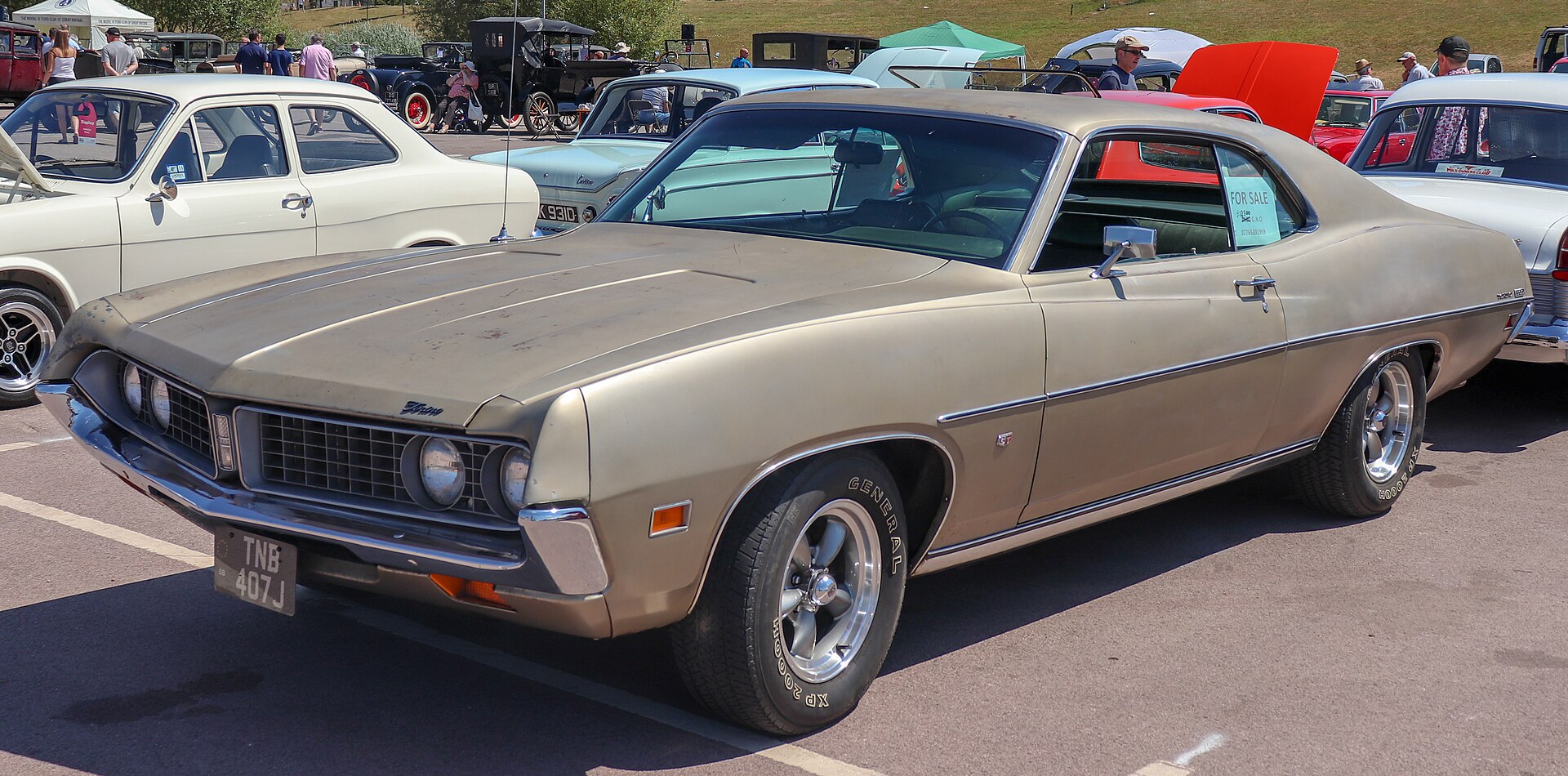
- Torino II 1970–1971 · Sedan, Station wagon · 280 kW (381 PS)
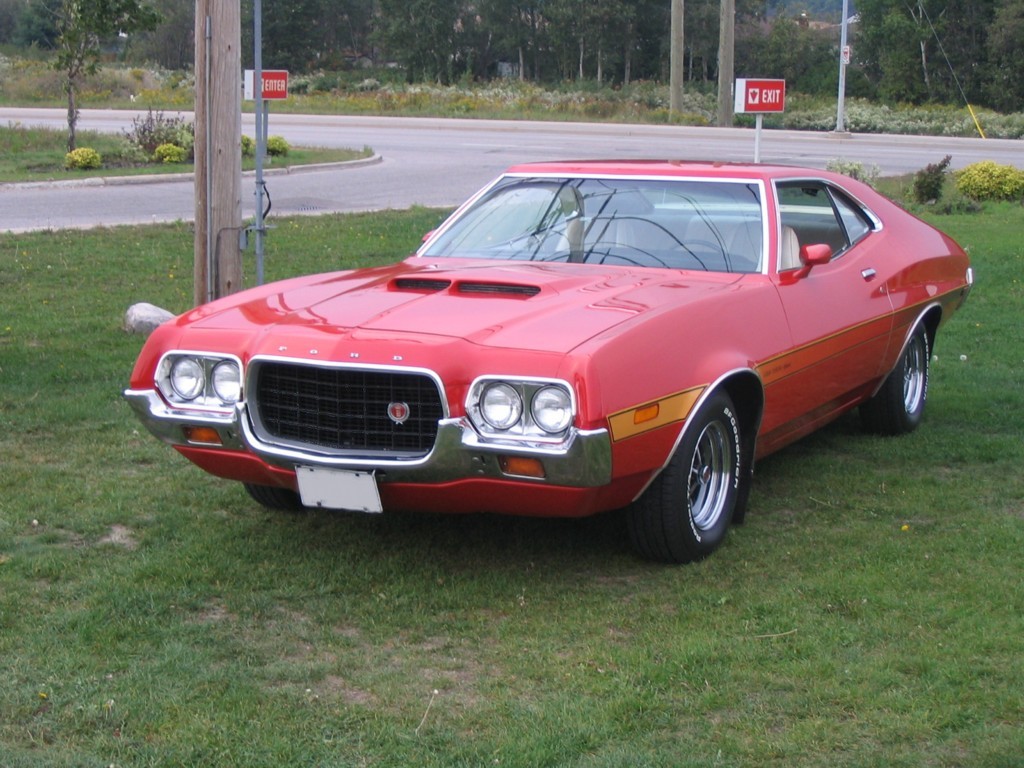
- Torino III 1972–1976 · Sedan, Station wagon
Newest first · 3 generations since 1968
-
1972
-
1970
-
1968
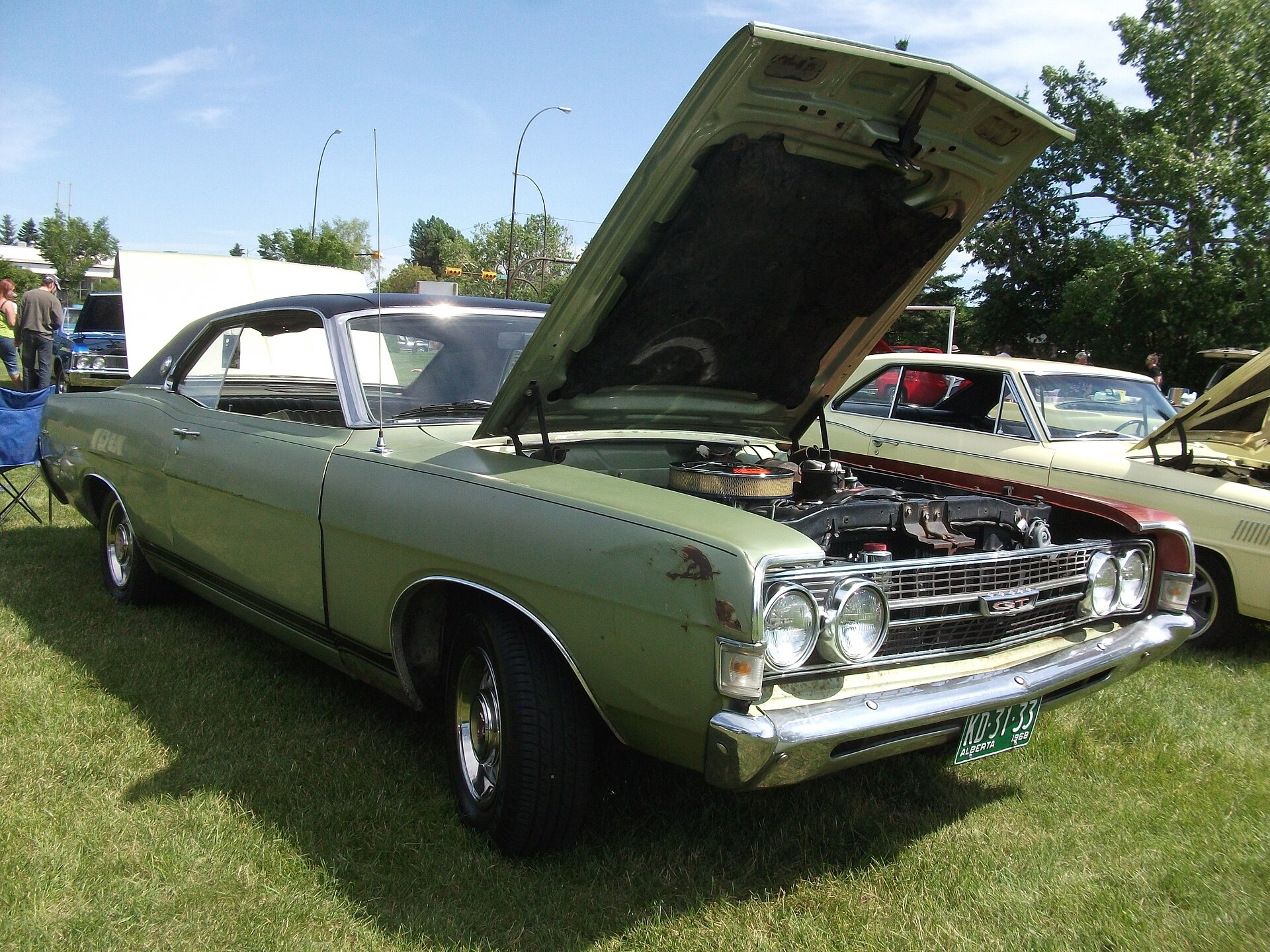


All generations by year: Torino III (1972–1976) · Torino II (1970–1971) · Torino I (1968–1969)
Which one is mine?
Pick the year of first registration to see which generation it is.
- Torino III 1972–1976
- Torino II 1970–1971
- Torino I 1968–1969
The Ford Torino was Ford's mid-size car from 1968 to 1976. It started as the top series of the Fairlane and took over the whole range by 1971. It was also the base of Ford's intermediate muscle cars: the Torino GT, the Cobra with the 428 and 429 Cobra Jet V8s, and the Talladega built for NASCAR. Motor Trend named it Car of the Year for 1970. After 1972 the Gran Torino turned into a larger, heavier car known from television and film.
In short
- 1968–1969 as the upscale Fairlane series, from 1970 the main name, from 1971 the only name of Ford's intermediates.
- Cobra (1969–1971) with the 428 Cobra Jet, 250 kW (335 hp), and in 1970 the 429 Super Cobra Jet, 280 kW (375 hp, SAE gross).
- 1969 Talladega for NASCAR: 743 built; Motor Trend Car of the Year 1970.
- Peak production 496,645 cars in 1972; body-on-frame Gran Torino from 1972 to 1976.
Ford Torino at a glance
| Specification | Ford Torino |
|---|---|
| Production | 1968–1976 model years (North America) |
| Generations | 1968–1969, 1970–1971, 1972–1976 |
| Body | two-door hardtop and SportsRoof fastback, convertible (to 1971), four-door sedan and hardtop, station wagon |
| Construction | unibody to 1971, body-on-frame from 1972 |
| Performance engines | 428 Cobra Jet; 429 Thunder Jet, Cobra Jet and Super Cobra Jet; 460 from 1974 |
| Most powerful | 1970 429 Super Cobra Jet, 280 kW (375 hp, SAE gross) |
| Drive | rear-wheel drive |
| Awards | Motor Trend Car of the Year 1970 |
The Torino is part of our Ford catalogue, and its later version has its own article on the Ford Gran Torino. Its rivals from Chevrolet, Dodge, Plymouth and Pontiac are ranked in the American muscle car guide.
From Fairlane to Torino
For 1968 Ford introduced the Torino as the upscale subseries of the intermediate Fairlane. The range included two-door hardtops, four-door sedans, station wagons such as the woodgrain Squire, a convertible and a new SportsRoof fastback. The sporty model was the Torino GT, with a 302 V8 as standard; in 1968 a UAW strike forced Ford to fit the 289 instead for part of the year.
The fastback had a clear purpose beyond looks. On the high-speed NASCAR superspeedways its shape gave Ford an aerodynamic advantage, and Wikipedia describes it as dominating that kind of racing. A Torino GT convertible also paced the 1968 Indianapolis 500.
Production reached 172,083 Torinos in 1968 and 129,054 in 1969. Together with the Fairlane, Ford built 371,787 and 366,911 intermediates in those years.

Torino Cobra and the 429
The Cobra appeared in 1969 as a performance package on the Fairlane 500 body. Its standard engine was the 428 Cobra Jet, advertised at 250 kW (335 hp); the Super Cobra Jet version carried the same rating.
For 1970 the Torino received a new "coke bottle" unibody that was longer, lower and wider, and the name Torino now headed the range, with Fairlane as a subseries. The Cobra switched to the 429 cu in engine family. The 429 Thunder Jet with 268 kW (360 hp) was standard, the 429 Cobra Jet had 276 kW (370 hp), and with the Drag Pack the 429 Super Cobra Jet reached 280 kW (375 hp). Motor Trend chose the Torino as its 1970 Car of the Year.
In 1971 the Fairlane name was dropped, and every Ford intermediate became a Torino. The Cobra now had a 351 four-barrel with 213 kW (285 hp) as standard, while the 429 Cobra Jets kept their 1970 ratings. Production rose to 326,463 cars.


Talladega and King Cobra
The 1969 Torino Talladega was built to improve Ford's results in NASCAR. It used the 428 Cobra Jet without Ram Air, and Wikipedia gives a production figure of 743 cars.
For 1970 Ford prepared another NASCAR prototype, the Torino King Cobra. It was never sold. Only three prototypes were built, one of them with the Boss 429 engine.

The Gran Torino years (1972–1976)
The 1972 Torino was a completely new car with body-on-frame construction, and the Gran Torino became the best-known version. With the 1972 model year Ford switched to SAE net ratings, which cannot be compared directly with the earlier gross figures. In 1974 the 429 four-barrel was replaced by a 460 four-barrel with more power and torque. A separate two-door hardtop, the Gran Torino Elite, appeared the same year.
Sales were the highest in the car's history: 496,645 in 1972, 496,581 in 1973 and 426,086 in 1974. They then fell to 195,110 in 1975 and 193,096 in 1976, the last year.
| Year | Torinos built |
|---|---|
| 1968 | 172,083 |
| 1969 | 129,054 |
| 1970 | 230,411 |
| 1971 | 326,463 |
| 1972 | 496,645 |
| 1973 | 496,581 |
| 1974 | 426,086 |
| 1975 | 195,110 |
| 1976 | 193,096 |
The Gran Torino also found fame on screen. 1975–1976 Gran Torinos starred in the television series Starsky & Hutch, and in the spring of 1976 Ford built 1,000 replicas. In 2008 Clint Eastwood directed and starred in the film Gran Torino, built around a 1972 Gran Torino Sport.

Torino performance engines
| Engine | Years | Advertised rating |
|---|---|---|
| 302 V8 (Torino GT standard) | 1968–1971 | not given by Wikipedia |
| 428 Cobra Jet / Super Cobra Jet | 1969 | 250 kW (335 hp), SAE gross |
| 429 Thunder Jet (Cobra standard) | 1970 | 268 kW (360 hp), SAE gross |
| 429 Cobra Jet | 1970–1971 | 276 kW (370 hp), SAE gross |
| 429 Super Cobra Jet (Drag Pack) | 1970–1971 | 280 kW (375 hp), SAE gross |
| 351 four-barrel (Cobra standard) | 1971 | 213 kW (285 hp), SAE gross |
| 460 four-barrel | 1974–1976 | net rating, not given by Wikipedia |
Which Torino to look for
The 1970 Torino Cobra with the 429 Super Cobra Jet is the strongest version, and the 1969 Talladega, with 743 built, is a rare one. The 1968–1969 Torino GT fastback is the original shape. The 1972–1976 Gran Torinos are larger cars with net-rated engines, better known from the screen than from the drag strip. Compare the Torino with other Ford performance cars in our car rankings.
Photo gallery

Ford Torino evolution in numbers
Did you know?
- The Ford Torino ran for 8 years, from 1968 to 1976, over 3 generations in our catalog.
- The longest-running generation is the Torino III (1972–1976): 4 years.
Image credits · Photos from Wikimedia Commons under free licences
- Ford Torino I · Photo: dave_7 from Lethbridge, Canada / Wikimedia Commons, CC BY 2.0
- Ford Torino II · Photo: Vauxford / Wikimedia Commons, CC BY-SA 4.0
Ford Torino in our rankings
- No. 14 of 88 · Most powerful cars of the 1970s (280 kW · top 18%)
- No. 311 of 859 · Most powerful cars (280 kW · top 37%)
- No. 34 of 94 · Most powerful cars of the 1960s (250 kW · top 40%)
- No. 66 of 154 · Most powerful American cars (280 kW · top 45%)
- No. 454 of 912 · Longest-running car nameplates (8 years · top 53%)
- No. 150 of 345 · Cars with the most generations (3 generations · top 68%)
More powerful than 82% of ranked cars of the 1970s in the 1CARS catalog (No. 14 of 88).
FAQ
What is the difference between the Torino and the Fairlane?
In 1968–1969 the Torino was the top series of the Fairlane. From 1970 Torino was the main name, and in 1971 the Fairlane name was dropped.
What was the most powerful Torino?
The 1970 Torino Cobra with the 429 Super Cobra Jet and Drag Pack, rated at 280 kW (375 hp, SAE gross).
How many Torino Talladegas were built?
743, according to Wikipedia.
Which Gran Torino was used in Starsky & Hutch?
1975–1976 Gran Torinos; Ford built 1,000 replicas in the spring of 1976.
Data sources
Data checked by an editor against the sources below.