 Ford Torino Talladega
Specs, engines and history
Published Sources (2) Report an error
By Sarah Whitmore, Senior Automotive Writer
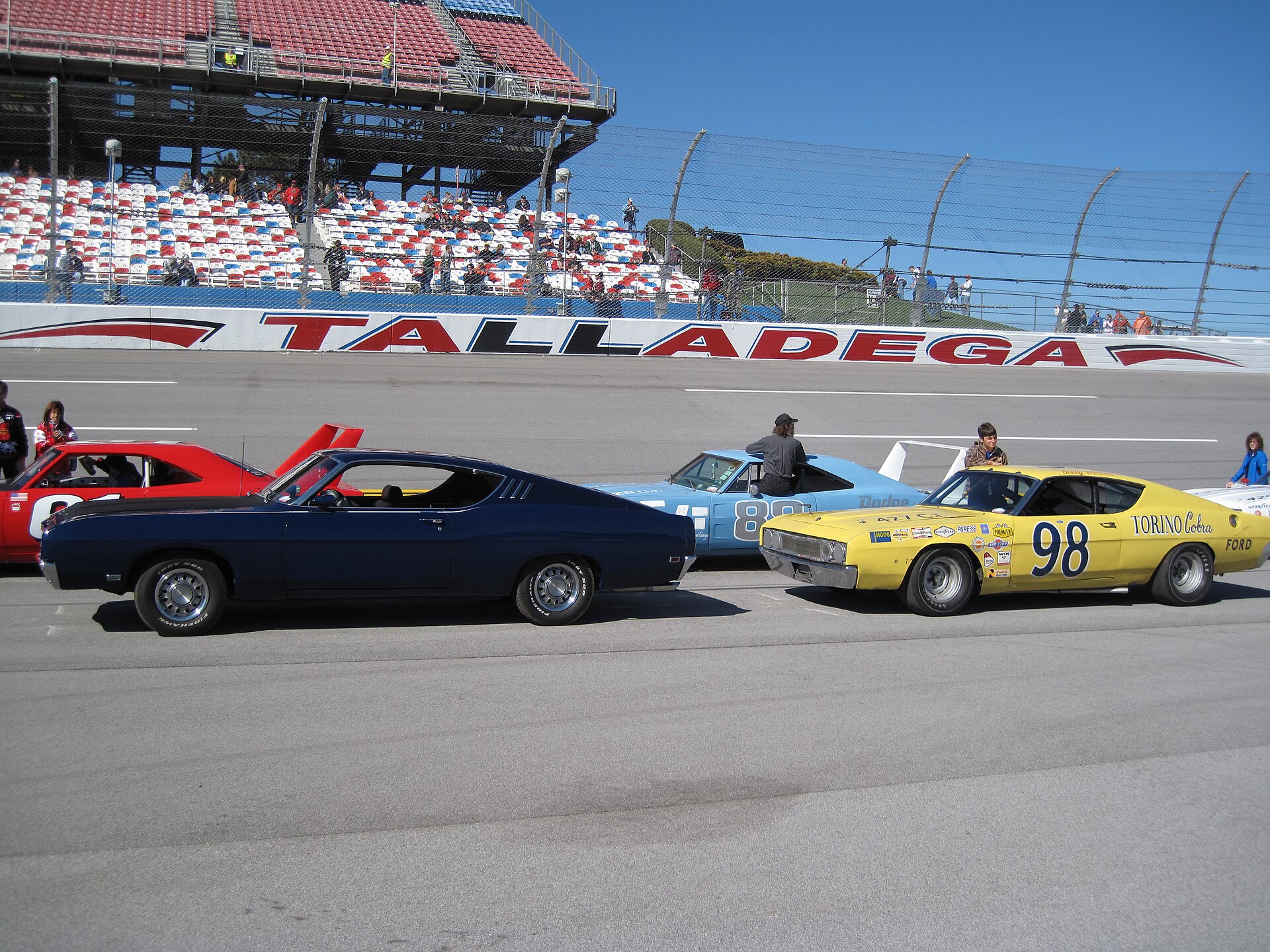
- Built
- 1969
- Top power
- 250 kW (340 PS)
Which aero car to choose
Our verdict · Sarah Whitmore
- For Ford history: a Talladega in one of the three colours, the car that won the 1969 title.
- For something rarer: its Mercury twin, the Cyclone Spoiler II.
- For a winged rival: the Dodge Charger Daytona of 1969 or the Plymouth Superbird of 1970.
Read our Dodge Charger Daytona article for the Mopar side of the aero war, and the Mercury Cyclone page for the twin's background. The Talladega is listed in our Ford catalogue and in the golden-age part of the American muscle car guide; its numbers can be matched against the Daytona's on our comparison page.
The Ford Torino Talladega was a limited-production fastback built in early 1969 so that Ford could race a more aerodynamic body in NASCAR. Named after the Talladega Superspeedway, it had a longer, smoother nose and reshaped sills, and every road car came with the 428 Cobra Jet V8 and an automatic gearbox. Ford built about 750, and the race cars won the 1969 manufacturers' championship, with David Pearson taking the drivers' title.
In short
- Built at Atlanta Assembly in January and February 1969 to meet NASCAR's rule of 500 road cars.
- Body: Fairlane/Torino SportsRoof fastback with a nose about 152 mm (6 in) longer and a flush grille.
- Engine: 428 Cobra Jet, rated at 250 kW (335 hp, SAE gross); C-6 automatic and 3.25:1 axle on every car.
- Colours: Wimbledon White (286 cars), Royal Maroon (258) and Presidential Blue (199).
Specs by version
| Version | Engine | Power | Gearbox | Drive | Production years |
|---|---|---|---|---|---|
| 428 Cobra Jet V8 (SAE gross) | 7.0 l · 8 cyl · Petrol 7,014 cc | 250 kW 340 PS335 hp | 3-sp Automatic | Rear-wheel drive | 1969 |
Verified Manufacturer and type-approval data from our catalog · Sources and methodology
Torino Talladega at a glance
| Specification | Ford Torino Talladega |
|---|---|
| Model year | 1969 |
| Built | about 750 per the Talladega/Spoiler Registry; up to 754 including prototypes and pilot cars |
| Plant | Atlanta Assembly (Knudsen's special car: Lorain, Ohio) |
| Body | two-door SportsRoof fastback, bench seat |
| Engine | 428 Cobra Jet V8, 7.0 l |
| Power | 250 kW (335 hp, SAE gross), per Hagerty |
| Gearbox | heavy-duty C-6 three-speed automatic, column shift |
| Axle | 3.25:1 conventional (code 9) |
| Price new | US$3,456 (1969, Hagerty) |
| Mercury twin | Cyclone Spoiler II |
The Talladega was a special version of the Ford Torino, Ford's mid-size range, which grew out of the Fairlane.
The aero war of 1969
In 1969 Ford and Chrysler fought over aerodynamics on NASCAR's fastest tracks. Dodge had started with the Charger 500, which Wikipedia calls aerodynamically inferior to the Talladega, especially on the fastest tracks; Dodge then developed the winged Charger Daytona. Ford's answer used no wing, only a cleaner nose on the existing fastback.
NASCAR's homologation rule required 500 road cars for 1969, so Ford sold the Talladega to the public only because it had to. Wikipedia notes that Ford may have lost money on every car it sold.
What made the body different
The standard Torino's inset grille and headlights had performed poorly in the wind tunnel. The new front section, often credited to the Holman-Moody race shop, moved the grille flush with the front and extended the car by about 152 mm (6 in). A rear bumper, cut, narrowed and V-shaped, was fitted at the front as a crude air dam.
The sills were reshaped and rolled. Under NASCAR's rules this let the race cars run about 25 mm (1 in) closer to the ground, which lowered the centre of gravity and reduced drag. Road cars had black hoods and black rear tail panels, a black vinyl and cloth interior and a front bench seat.

Engine and equipment
Every production Talladega used the 428 Cobra Jet, which Wikipedia describes as powerful and reliable, with strong torque at low revs for the street. Hagerty gives its rating as 250 kW (335 hp) and notes that some accounts consider this figure more than 75 kW (100 hp) too low. Hagerty also lists a Holley four-barrel carburettor, a 9-inch rear end with a 3.25:1 ratio, oil and power-steering coolers and a competition suspension with staggered shocks.
All production cars were equipped the same way. Wikipedia lists:
- a heavy-duty C-6 automatic with a cast-iron tailshaft, shifted on the column;
- power steering and power brakes;
- colour-keyed racing mirrors and an AM radio;
- argent styled steel wheels with F70-14 tyres.
The race cars began the season with Ford's FE 427 "side oiler", the company's main racing engine since 1963. Later in 1969 many teams switched to the Boss 429 after NASCAR president Bill France Sr. declared it homologated; Ford had homologated that engine separately, in the Mustang.
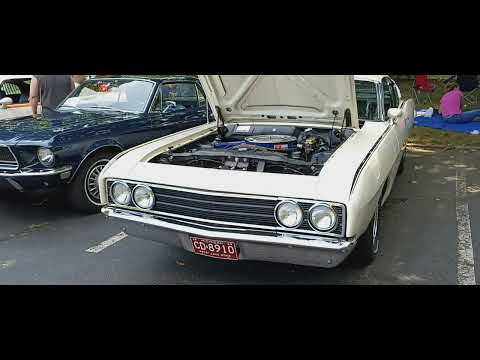
Production in eight weeks
Production ran at Ford's Atlanta Assembly plant in January and February 1969. The homologation cars were built between 21 January and 28 February. Car number 502 was finished on 31 January, which met the 500-car rule; after a two-week pause, the last 247 cars were built between 14 and 28 February. Wikipedia does not explain why Ford built the extra cars.
| Colour | Built |
|---|---|
| Wimbledon White | 286 |
| Royal Maroon | 258 |
| Presidential Blue | 199 |
| Total production cars | 743 |
The registry accounts for 750 cars in all, including prototypes, pilot cars and a special car built on 20 March 1969 at the Lorain, Ohio, plant for Ford president Semon "Bunkie" Knudsen. Hagerty quotes 738 identified production cars, and Wikipedia says about 754 may have been built; the exact number is not certain. Hagerty compares the price, US$3,456, with US$3,529 for a 1969 Mustang Boss 302. By our calculation Presidential Blue cars make up about 27 % of the colour total.

The 1969 NASCAR season
The Talladega and its Mercury twin, the Cyclone Spoiler II, won the 1969 NASCAR manufacturers' championship, and David Pearson won the drivers' title. Richard Petty, who had left Plymouth for Ford, won the season opener at Riverside, according to Hagerty, and finished second in the points in a Talladega. In ARCA the Talladega also took the manufacturers' title, and Benny Parsons won the drivers' championship.
Hagerty counts 26 Grand National wins for Ford in the Talladega in 1969. Wikipedia credits the model with 29 wins in 1969 and 1970 together, more than any other car of the period, against six for the Charger Daytona; that claim is marked as needing a citation. Hagerty notes that a Charger Daytona won the Talladega 500 on 14 September 1969.
After Congressional hearings about the cost of racing compared with spending on fuel economy and safety, Ford ended its factory racing programmes from the 1970 season. Many teams kept racing their 1969 Talladegas without factory support. A 1971 rule restricted these cars to 305 cu in (5.0 l) engines, and that ended the Talladega's competitive life.

Talladega buying guide
- Specification check: every production car had the 428 Cobra Jet, the C-6 automatic, the 3.25:1 axle, a bench seat and one of three colours. A four-speed car or a car in another colour is not an original road Talladega.
- Body: the extended nose, flush grille, bumper air dam and rolled sills are the real Talladega parts; a regular Torino with only stripes is a tribute.
- Registry: the Talladega/Spoiler Registry tracks the ownership history of the surviving cars, which helps to confirm a car's identity.
- Rarity: Presidential Blue, with 199 built, is the rarest colour.
Autoevolution describes the Talladega as worth "barely six figures", far below Hemi-powered winged Mopars. The sources give no dated sales results.

Ford Torino Talladega in our rankings
- No. 38 of 557 · Biggest engines: cars (7,014 cc · top 8%)
- No. 28 of 173 · Biggest engines: coupes (7,014 cc · top 17%)
- No. 35 of 94 · Most powerful cars of the 1960s (250 kW · top 40%)
- No. 366 of 859 · Most powerful cars (250 kW · top 44%)
- No. 86 of 154 · Most powerful American cars (250 kW · top 57%)
- No. 200 of 313 · Most powerful coupes (250 kW · top 65%)
Bigger engine than 92% of ranked cars in the 1CARS catalog (No. 38 of 557).
FAQ
How many Torino Talladegas were made?
About 750, according to the Talladega/Spoiler Registry, including prototypes and pilot cars; the colour figures add up to 743 production cars.
What engine did the Ford Talladega have?
The 428 Cobra Jet V8 with 250 kW (335 hp, SAE gross) in road cars. The race cars used the 427 and, later in 1969, the Boss 429.
Why was it called Talladega?
It was named after the Talladega Superspeedway, the NASCAR superspeedway.
Did the Talladega have a wing?
No. Unlike the Charger Daytona and the Superbird, it relied on an extended nose, a flush grille and rolled sills.
What did a Talladega cost new?
US$3,456 in 1969, according to Hagerty.
Data sources
Data checked by an editor against the sources below.
- Wikipedia — Ford Torino Talladega
- Hagerty — Media