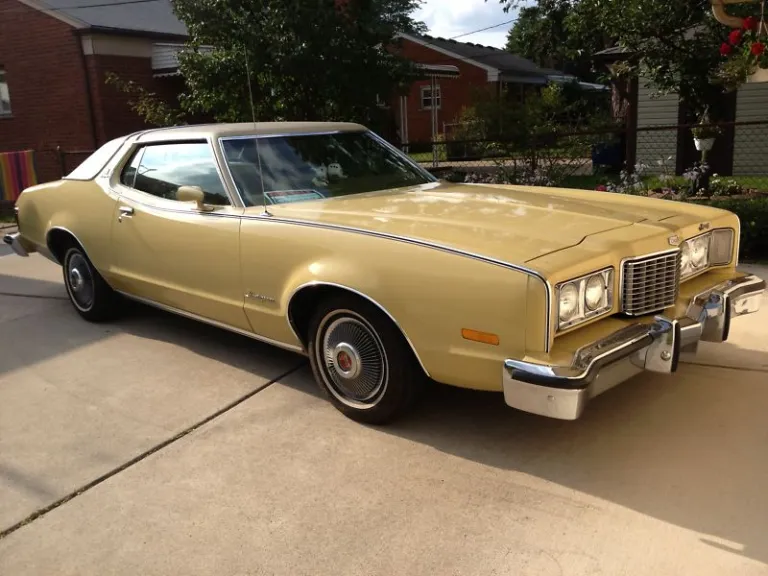
 Mercury Cyclone
Specs, engines and history
Updated Published Sources (2) Report an error
By Sarah Whitmore, Senior Automotive Writer Reviewed by Oleksandr Hnatiuk

- Built
- 1964–1971
- Top power
- 280 kW (381 PS)
The Mercury Cyclone is a mid-size American performance car that Ford's Mercury division sold from 1964 to 1971. It began as a sporty Comet with a 4.7-litre V8 of 157 kW (210 hp) and ended as a 429 Cobra Jet muscle car with up to 280 kW (375 hp). Cyclones also won in NASCAR, including first and second at the 1968 Daytona 500.
In short
- Started as the 1964 Comet Cyclone, moved to the larger Ford Fairlane body for 1966 and became a model of its own in 1968.
- Engines grew from the 289 cu in (4.7-litre) V8 to the 429 cu in (7.0-litre) Cobra Jet and Super Cobra Jet of 1970.
- About 74,000 cars were built across eight model years, with a peak of 13,628 in 1968.
- The aerodynamic Spoiler II of 1969 was built for NASCAR, and the name ended after 1971.
Specs by version
Verified Manufacturer and type-approval data from our catalog · Sources and methodology
Mercury Cyclone at a glance
| Fact | Detail |
|---|---|
| Maker | Mercury division of the Ford Motor Company |
| Model years | 1964–1971 (option package only in 1972) |
| Class | mid-size performance car, coupé and convertible |
| Related models | Mercury Comet and Montego, Ford Fairlane and Torino |
| Engines | 289 to 429 cu in V8 (4.7–7.0 litres) |
| Total built | about 74,000 by our count |
The Cyclone was Mercury's answer to the muscle car boom of the 1960s. Like the Pontiac GTO, it took a family car and added a bigger engine, firmer suspension and sporty trim. Mercury sat between Ford and Lincoln, so the Cyclone was a slightly more upmarket alternative to the equivalent Ford.

From Comet option to its own nameplate
For 1964, the Cyclone was the sporty version of the compact Mercury Comet. It had the 289 cu in V8 with 157 kW (210 hp), bucket seats, a spoked steering wheel and some chromed engine parts. The old 1cars page named the engine "Cyclone Super-289", a 4.7-litre unit with just over 200 hp. Mercury built 7,454 cars.

The 1965 car received stacked headlights, a blacked-out grille and a vinyl roof in black or white. A "Power-Pac" gauge cluster and a handling package were offered. Wikipedia gives 149 kW (200 hp) for the four-barrel 289, while the old 1cars text quoted 225 hp. Production rose to 12,347.
For 1966, the Comet moved to the body of the Ford Fairlane, with a longer wheelbase. The Cyclone GT got a 390 cu in V8 with 250 kW (335 hp), body stripes and a fibreglass bonnet with two scoops. In 1968, the "Comet" name was dropped, and the Cyclone became its own model with a fastback body.
Design and construction
Every Cyclone had a front-mounted V8 driving the rear wheels. Body styles were a two-door coupé and a two-door convertible; the 1967 range included 809 convertibles. From 1966, the car shared its basic structure with the Fairlane, and from 1968 with the Ford Torino.

The 1968 fastback mattered on the race track. Its sloping roof cut drag on NASCAR superspeedways. A Cyclone set a speed of 304.52 km/h (189.22 mph) at Daytona in 1968, and the car was named the fastest of the year.
For 1969, the Cyclone Spoiler II took the idea further. Its extended nose was designed to compete with the Dodge Charger Daytona and the Plymouth Superbird. The street version used a 351 Windsor engine, while the race car ran a Boss 429. In 1971, Mercury marketed the car as the Montego Cyclone.
Engines and drivetrain by year
| Model year | Main engines (cu in) | Power, gross | Notes |
|---|---|---|---|
| 1964 | 289 V8 | 157 kW (210 hp) | Comet Cyclone option |
| 1965 | 289 V8, four-barrel | 149 kW (200 hp) | Handling package available |
| 1966 | 390 V8 | 198–250 kW (265–335 hp) | GT: 250 kW (335 hp) |
| 1967 | 289 V8; 390 V8 (GT) | 149 kW (200 hp); 239 kW (320 hp) | 809 convertibles |
| 1968 | 302, 390, 428 Cobra Jet | 157–250 kW (210–335 hp) | Own nameplate, fastback |
| 1969 | 302, 351, 390, 428 CJ | 164–250 kW (220–335 hp) | Spoiler and Spoiler II |
| 1970 | 429, 429 CJ, 429 SCJ | 268–280 kW (360–375 hp) | Net: 186–250 kW (250–335 hp) |
| 1971 | 351 Cleveland, 429 | not stated | Montego Cyclone |
The power figures above are gross ratings, as American makers quoted them before 1972. For 1970, Wikipedia also lists net figures, which are between about 10 and 30 % lower. The 1970 Super Cobra Jet, with its Drag Pack, added an oil cooler and 3.91 or 4.30 axle ratios.

There was no factory 427 Cyclone in 1966. Andy Hotton of Dearborn Steel Tubing later fitted a few cars with 427 engines rated at 306 kW (410 hp). The 1cars power converter turns gross horsepower figures into kW.
| Parameter | Metric | Imperial |
|---|---|---|
| Smallest engine | 4.7-litre V8 (1964) | 289 cu in |
| Largest engine | 7.0-litre V8 (1968–1971) | 428 and 429 cu in |
| Highest power | 280 kW gross, 1970 429 SCJ | 375 hp |
| Drive | rear-wheel drive | - |
| Gearboxes | manual and automatic | - |
| Body | 2-door coupé or convertible | - |
GT, Spoiler and Cobra Jet versions
Mercury sold the Cyclone in several trim and engine levels, and the names changed almost every year. The 1968 GT came with an upper body stripe, bucket seats, wide whitewall tyres, special wheel covers, an all-vinyl interior and a handling package. The 390 four-barrel with 242 kW (325 hp) was standard on that car.
In 1969, the Cyclone Spoiler used the 390 "S" engine with a 735 cfm Holley carburettor. The Cobra Jet version had the 428 with 250 kW (335 hp) and an optional Ram Air intake. Wikipedia notes that Ram Air brought no change in the quoted power.
For 1970, the Spoiler came with the 429 Cobra Jet and Ram Air as standard, and the Super Cobra Jet was optional. The GT moved the other way: it had a 351 Cleveland two-barrel with a three-speed manual. Only 953 buyers ordered its Action Special Equipment Package. Compared with the 1964 car, the strongest 1970 Cyclone had 79 % more gross power, by our calculation.
Production by year
| Model year | Cars built | Of which |
|---|---|---|
| 1964 | 7,454 | - |
| 1965 | 12,347 | - |
| 1966 | 8,194 | - |
| 1967 | 6,910 | 809 convertibles |
| 1968 | 13,628 | 6,439 Spoilers |
| 1969 | 9,143 | 3,261 Cobra Jets |
| 1970 | 13,496 | 10,170 GTs, 1,631 Spoilers |
| 1971 | 3,084 | 2,287 GTs, 353 Spoilers |
By our count, the eight model years add up to 74,256 cars, or about 74,000. Output peaked in 1968 and 1970, then fell by 77 % for 1971. In 1972, the Cyclone name survived only as a Montego option, with 30 cars built.

NASCAR wins and legacy
In racing, the Cyclone did far more than its sales suggest. At the 1968 Daytona 500, Cyclones took first and second place. The Wood Brothers team's number 21 Cyclone of 1971 still holds a NASCAR record of 18 wins from 32 races. New rules for 1971 ended the era of special aerodynamic homologation cars.

On the road, the Cyclone lived in the shadow of its Ford cousins and the Dodge and Plymouth muscle cars. That makes it rarer today. Our page on the history of Mercury explains how the brand fitted between Ford and Lincoln until it closed in 2011.
Buying and collecting a Cyclone today
Values depend heavily on the engine. A 1969 Cobra Jet or a 1970 Spoiler with the 429 Super Cobra Jet is far more sought after than a small-block GT. Because many cars were rebuilt with different engines, check the engine code in the VIN and the factory build documents before you buy.

Rust is the main enemy of any 1960s American car, so inspect the floors, frame rails and lower body panels. Parts for the Ford intermediate platform are widely available, which helps restorations. Our golden-age muscle car section lists rivals of the same years, and the 1cars comparison tool helps set specifications side by side.
Mercury Cyclone in our rankings
- No. 166 of 627 · Biggest engines: cars (4,728 cc · top 27%)
- No. 346 of 1011 · Most powerful cars (280 kW · top 35%)
- No. 71 of 168 · Most powerful American cars (280 kW · top 43%)
- No. 90 of 181 · Biggest engines: coupes (4,728 cc · top 50%)
- No. 177 of 326 · Most powerful coupes (280 kW · top 55%)
- No. 151 of 162 · Most powerful V8 cars (157 kW · top 94%)
Bigger engine than 73% of ranked cars in the 1CARS catalog (No. 166 of 627).
Mercury Cyclone photos 12


Mercury Cyclone videos 3

Mercury Cyclone video 1
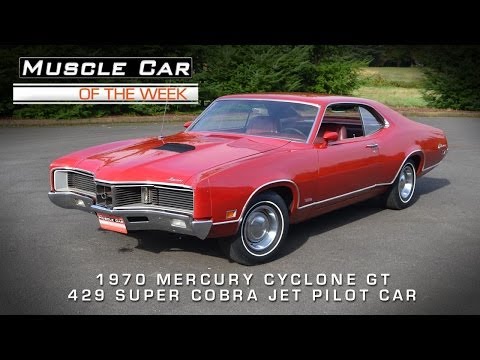
Test drive

Video overview
FAQ
What years was the Mercury Cyclone made?
The Cyclone was built for the 1964 to 1971 model years. It started as a version of the Comet, became its own model in 1968 and returned only as a Montego option package, with 30 cars, in 1972.
What engines did the Mercury Cyclone have?
The first car of 1964 had the 289 cu in (4.7-litre) V8 with 157 kW (210 hp). At the top end, the 1970 429 cu in (7.0-litre) Super Cobra Jet was rated at 280 kW (375 hp) gross.
How many Mercury Cyclones were built?
By our count of the yearly figures, about 74,000 Cyclones were built from 1964 to 1971. The best years were 1968 and 1970, with roughly 13,500 cars each.
Did the Mercury Cyclone race in NASCAR?
Yes. Cyclones took a one-two finish in the 1968 Daytona 500, and the Wood Brothers' number 21 car of 1971 won 18 of its 32 races, a NASCAR record.
What is a Mercury Cyclone Spoiler II?
The Spoiler II of 1969 was an aerodynamic Cyclone with an extended nose, built to qualify the shape for NASCAR. It competed against the winged Dodge Charger Daytona and Plymouth Superbird.
Data sources
Data checked by an editor against the sources below.
- The text of this article (1cars archive)
- Wikipedia - Mercury Cyclone