The History of Mercury: Ford's Middle Brand From 1938 to 2011
Mercury was a Ford Motor Company car brand that sat between the mass-market Ford and the luxury Lincoln. Edsel Ford launched it in November 1938 with the Mercury Eight, and the brand lasted 72 years. Ford announced its closure on 2 June 2010, and the last Mercury, a Grand Marquis, left the line in Ontario on 4 January 2011.

Key takeaways
- 1938–1949: a 71 kW (95 hp) V8 car priced above Ford, then a redesigned 1949 model that became a film and custom-car icon.
- 1950s–1970s: bigger cars, the Cougar and Marquis, and record sales in the late 1970s.
- 1980s–2000s: models increasingly shared with Ford, Mazda and Nissan, from the Sable to the Villager.
- 2010–2011: falling sales, an ageing customer base and closure during Ford's restructuring.

Mercury key facts

| Fact | Value |
|---|---|
| Founded | November 1938 (1939 model year) |
| Founder | Edsel Ford, son of Henry Ford |
| Parent company | Ford Motor Company |
| Position | medium-priced brand between Ford and Lincoln |
| First model | Mercury Eight, from 916 US dollars |
| Best sales years | late 1970s |
| Longest-running model | Grand Marquis (1975–2011, nearly 2.8 million built) |
| Closure announced | 2 June 2010 |
| Last car built | 4 January 2011, St. Thomas Assembly, Ontario |
Edsel Ford and the 1939 Mercury Eight
In the late 1930s Ford had a gap in its range. Buyers who wanted more than a Ford but could not afford a Lincoln went to rival makers. In 1938 Edsel Ford and sales manager Jack Davis decided to fill that gap with a new brand. Edsel chose the name of the Roman messenger god, Mercury.

The Mercury Eight was shown at the New York Auto Show in November 1938. It used a 71 kW (95 hp) version of the Ford flathead V8, and prices started at 916 US dollars. Body styles included two- and four-door sedans, a convertible and a town sedan. More than 65,000 cars were sold in the first model year, a strong start for an unknown name.
Sales rose to 90,556 for the 1941 model year. Then the United States entered the Second World War, and only 1,902 cars of the 1942 model year were built before civilian production stopped.
From Lincoln-Mercury to the 1949 icon
On 22 October 1945 Ford merged Mercury with Lincoln to form the Lincoln-Mercury Division. The two brands shared dealers for most of the following decades. The first postwar cars were lightly updated 1942 models, with 86,603 sold in 1946.
The 1949 Mercury changed the brand's image. It had a new body shared with Lincoln and a 255 cu in flathead V8 with 82 kW (110 hp). Sales grew by more than 250,000 cars over 1948, and the brand became the sixth most popular in the US.
The car soon gained a second life in popular culture. In 1949 Sam Barris lowered and smoothed one into the first "lead sled", a style that customisers copied for years. In 1955 James Dean drove a 1949 Mercury in the film Rebel Without a Cause.
The 1950s: Monterey, Montclair and the Turnpike Cruiser
The Monterey name appeared in 1950 and became a full model line in 1952, when the Eight name ended. In 1953 the brand reached its largest share of the US market, about 5 %. The 1954 Sun Valley had a tinted Plexiglas panel in its roof, an early form of the glass sunroof.

The premium Montclair followed in 1955. In 1957 the cars grew wider, longer and lower under a "Dream Car Design" theme, and the Turnpike Cruiser paced that year's Indianapolis 500. The same year brought the Colony Park station wagon, a name the old 1cars text says lasted until 1991.
The 1958 Park Lane sat on a 125-inch (3,175 mm) wheelbase. According to the old 1cars text, the Super Marauder V8 of about 7 litres reached 298 kW (400 hp) with three carburettors. By our calculation, engine output had roughly quadrupled since 1939, from 71 kW to 298 kW. In 1958 Ford also grouped Mercury, Edsel and Lincoln in one division, which lasted until the Edsel brand failed.
The 1960s: compacts, Cougar and Marquis
The brand entered the compact class with the Comet, launched in 1960 and badged as a Mercury from 1962. The range was split into price tiers, with names such as S-55 for the sporty full-size car. Larger cars returned to the centre of the range as buyers moved upmarket.

The Cougar of 1967 was Mercury's more luxurious version of the Ford Mustang. It had hidden headlights and sequential rear indicators, and it gave the brand a younger image. The full-size Marquis appeared the same year and became a whole range in 1969.
Performance arrived with the Cyclone, a sporty line from the mid-1960s to the early 1970s, and the Marauder of 1969. The Cyclone Spoiler II was homologated as Mercury's NASCAR entry for 1969, and its aerodynamic nose helped on the high-speed ovals. The Mercury Cyclone page covers that car in detail, and the wider era is in the 1cars muscle cars section.
The 1970s: imports, Grand Marquis and record sales
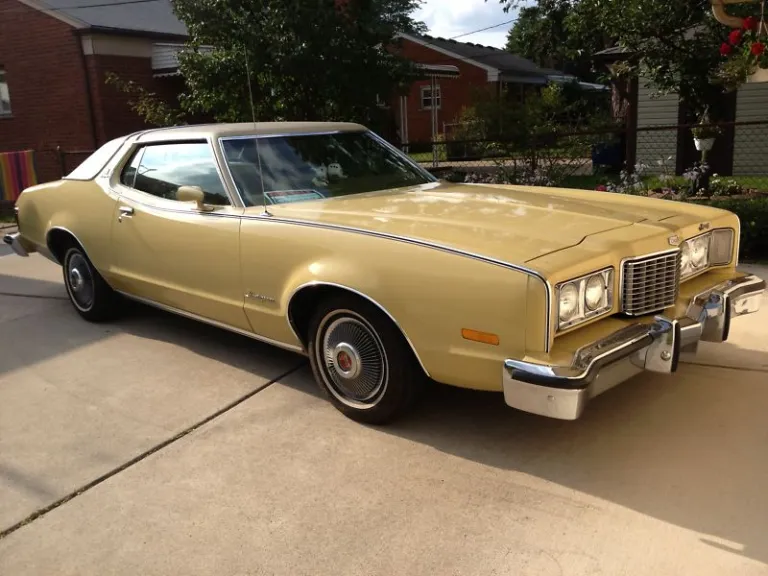
From 1970 Lincoln-Mercury dealers sold the German-built Ford Capri as a captive import. The Grand Marquis arrived in 1975 as the top Marquis and later became a separate line in 1983. It was Mercury's best-selling nameplate for decades.

Like every American maker, the brand shrank its cars and engines after the 1973 and 1979 fuel crises. Sales still peaked in this period. According to Ford, the record was about 580,000 sales in 1978, while other counts put 1979 at nearly 670,000. The old 1cars text adds that almost half of the 1978 total were Cougars.
The 1980s and 1990s: Sable, Tracer and shared models
In 1983 it was the fifth best-selling brand in the US, its highest finish. The 1986 Sable, a sister car of the Ford Taurus, replaced the Marquis and stayed on sale for more than two decades. Its smooth, aerodynamic shape set a style for American family cars.
The 1988 Tracer was the first Mercury built outside North America and was based on the Mazda 323. From 1991 to 1994 the Capri name returned on a small convertible from Australia. The Villager of 1993, developed with Nissan, was Lincoln-Mercury's first minivan, and the Mountaineer of 1997 was its first SUV.
More and more of the range were now Fords with a different grille. The front-wheel-drive Mercury Cougar of 1999 to 2002 was sold as a Ford in Europe. Critics argued that the brand had lost a clear identity, and in 1999 Ford stopped selling Mercury in Canada.
The 2000s: the final range
Ford reinstated Lincoln-Mercury as a separate division in 2002. The Marauder returned for 2003 as a high-performance Grand Marquis. New models followed quickly: the Monterey minivan in 2004, the Mariner SUV and Montego saloon in 2005, and the Milan saloon in 2006. The Montego took the Sable name for 2008.
| Year | Mercury US sales | Best seller |
|---|---|---|
| 2000 | 359,143 | Grand Marquis (122,572) |
| 2003 | 202,257 | Grand Marquis (79,147) |
| 2005 | 195,949 | Grand Marquis (64,716) |
| 2008 | 120,248 | Mariner (32,306) |
| 2010 | 93,195 | Mariner (29,912) |
By our calculation, sales fell by about 74 % between 2000 and 2010. In 2000 the Grand Marquis alone accounted for about a third of the total (122,572 of 359,143). Its customers were older than average, and a 2008 campaign aimed at women did not reverse the trend. The 2008–2009 financial crisis hit Ford hard, and the company chose to focus on the Ford and Lincoln brands.
Closure in 2010 and the last Mercury
Ford announced the end of Mercury on 2 June 2010. Production in all markets stopped in the last quarter of 2010. The final car, a 2011 Grand Marquis, was built at St. Thomas Assembly in Ontario on 4 January 2011.
No new brand replaced it. Lincoln took over the premium buyers, while Ford dealers absorbed the rest. The story of the sister brand is told in the history of Lincoln, and the wider company in the history of Ford.
Mercury timeline
| Year | Event |
|---|---|
| 1938 | Edsel Ford presents the Mercury Eight in New York |
| 1945 | Lincoln-Mercury Division formed (22 October) |
| 1949 | redesigned Mercury; sales rise by over 250,000 |
| 1957 | Turnpike Cruiser paces the Indianapolis 500 |
| 1960 | Comet compact launched |
| 1967 | Cougar and Marquis introduced |
| 1975 | Grand Marquis introduced |
| 1986 | Sable replaces the Marquis |
| 1997 | Mountaineer, the first Mercury SUV |
| 2010 | closure announced (2 June) |
| 2011 | last Grand Marquis built (4 January) |
Landmark models
| Model | Years | Why it matters |
|---|---|---|
| Mercury Eight | 1939–1951 | the first Mercury and the 1949 custom-car icon |
| Turnpike Cruiser | 1957–1958 | jet-age styling, Indianapolis pace car |
| Cougar | 1967–2002 | upmarket pony car, later a front-drive coupé |
| Cyclone | 1964–1971 | performance and NASCAR model |
| Grand Marquis | 1975–2011 | best-seller and the last Mercury built |
| Sable | 1986–2009 | aerodynamic family car, Taurus twin |
Logos and the Canadian side
The first logo showed the god Mercury in silhouette. In the mid-1950s came "The Big M", followed by a crest after 1959. The Cougar's cat appeared in 1967 and a cat's head in 1977. From 1984 the badge used three stacked angles, with the word "Mercury" added in 1999.
Canada had its own Mercury story. From 1946 to 1968 Lincoln-Mercury dealers there sold Mercury-badged versions of Ford's M-series trucks. The Meteor, a low-priced brand for the same dealers, ran from 1949 to 1976.
Is a classic Mercury worth buying?
Classic cars from the brand suit buyers who want a Ford-based car with more style and rarity. Parts for the flathead V8, the Cougar and the full-size cars are shared with Ford models, which keeps restoration costs reasonable. The 1949–1951 Eight and the 1967–1970 Cougar are the most sought-after, so expect to pay more for them. Set a Grand Marquis against a rival in the 1cars comparison tool. Period engine ratings were usually gross figures, and the 1cars power converter turns horsepower into kilowatts.
FAQ
Who founded Mercury?
Edsel Ford, the son of Henry Ford, created the brand in 1938 with sales manager Jack Davis. Its first car, the Mercury Eight, went on sale for the 1939 model year as a step up from the Ford V8.
Why did Ford stop making Mercury?
Sales fell from about 359,000 in 2000 to about 93,000 in 2010, and most models were close copies of Fords. During the 2008–2009 crisis, Ford decided to concentrate its money on the Ford and Lincoln brands.
When was the last Mercury made?
Production ended in January 2011, seven months after Ford announced the closure. The final car was a Grand Marquis saloon from the Canadian plant that had built the model for years.
What was the best-selling Mercury?
The Grand Marquis sold for 36 years, and nearly 2.8 million were built. In the 2000s it was usually the best-selling Mercury, and it was also the last model in production.
Was the Mercury Cougar a Mustang?
The first Cougar of 1967 shared its platform with the Mustang but had a longer wheelbase, hidden headlights and a more luxurious cabin. The 1999–2002 Cougar was a different front-wheel-drive coupé based on the Ford Mondeo.
Videos 2

Video 1

Video 2