 Ford Anglia
Specs, engines and history
Published Sources (2) Report an error
By Sarah Whitmore, Senior Automotive Writer
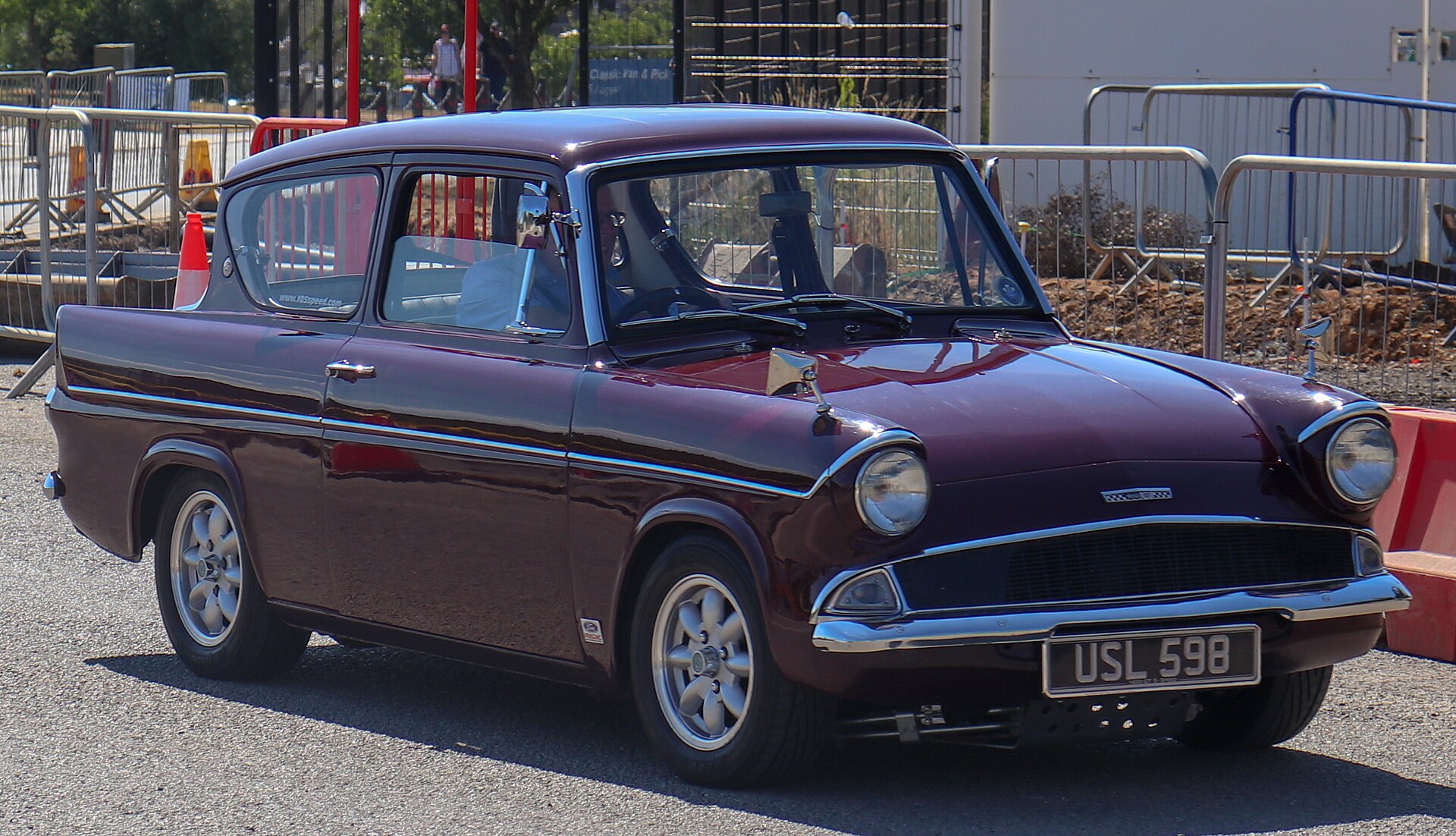
- Built
- 1959–1967
- Top power
- 36 kW (49 PS)
Which Anglia to choose
Our verdict · Sarah Whitmore
- For the original experience: a 997 cc Deluxe, which has the chrome trim and remains close to how most cars left the factory.
- For easier driving: a Super 123E or a car with the 1200 Package; the larger engine and the all-synchromesh gearbox make it more relaxed in traffic.
- For practicality: an estate, the least expensive body in the 2023 values.
- For investment: vans fetch the highest prices; check carefully for modifications, since 1,500 cc Ford engines and even V8 conversions are not unusual.
More cars from the same decade are gathered in our 1960s classics guide and our selection of the finest 1960s classic cars. The company background is in our history of Ford, and other models are listed in the Ford catalogue.
The Ford Anglia 105E was Ford of Britain's small family saloon from 1959 to 1967, recognisable at once by its rear window that slopes forward instead of back. It was the fourth and last car to carry the Anglia name and the first with the overhead-valve Kent engine and a four-speed gearbox. With roughly 1.08 million saloons and estates, it outsold all earlier Anglias combined. Its successor was the Ford Escort.
In short
- Built 1959–1967 at Dagenham and, from 1963, at Halewood near Liverpool; also assembled in Australia, New Zealand, South Africa, Rhodesia and elsewhere.
- 997 cc Kent four with 29 kW (39 bhp); the Super 123E of 1962 had 1,198 cc and 36 kW (48.5 bhp).
- Bodies: two-door saloon, estate (1961), van and a small number of pick-ups.
- A 1960s Anglia Deluxe played the flying car in the 2002 film Harry Potter and the Chamber of Secrets.
Specs by version
Engines
| Version | Engine | Power | Torque | Gearbox | Drive | Production years |
|---|---|---|---|---|---|---|
| 997 cc Kent (105E) | 1.0 l · 4 cyl · Petrol 997 cc | 29 kW 39 PS39 hp | 72 Nm53 lb-ft | 4-sp Manual | Rear-wheel drive | 1959–1967 |
| 997 cc Kent estate | 1.0 l · 4 cyl · Petrol 997 cc | 29 kW 39 PS39 hp | 72 Nm53 lb-ft | 4-sp Manual | Rear-wheel drive | 1961–1967 |
| Super 123E 1,198 cc | 1.2 l · 4 cyl · Petrol 1,198 cc | 36 kW 49 PS48 hp | 85 Nm63 lb-ft | 4-sp Manual | Rear-wheel drive | 1962–1967 |
Performance
Show all 2 versions
| Version | Top speed |
|---|---|
| 997 cc Kent (105E) | 127 km/h79 mph |
| Super 123E 1,198 cc | 135 km/h84 mph |
Dimensions and weight
Show all 1 versions
| Version | Length | Kerb weight |
|---|---|---|
| 997 cc Kent (105E) | 3,912 mm154.0 in | 737 kg1,625 lb |
Verified Manufacturer and type-approval data from our catalog · Sources and methodology
Ford Anglia at a glance
| Parameter | Metric | Imperial |
|---|---|---|
| Production | 1959–1967 | — |
| Body | two-door saloon, three-door estate, van | — |
| Engine (105E) | 997 cc straight-four, overhead valves | 60.8 cu in |
| Power (105E) | 29 kW at 5,000 rpm | 39 bhp |
| Torque (105E) | 72 Nm at 2,700 rpm | 53 lb-ft |
| Engine (Super 123E) | 1,198 cc, 36 kW | 48.5 bhp |
| Gearbox | four-speed manual, rear-wheel drive | — |
| Length | 3,912 mm | 154 in |
| Kerb weight | 737 kg | 1,625 lb |
| Top speed | 127 km/h (Super: 135 km/h) | 79 mph (Super: 84 mph) |
| Built | about 1.08 million (saloons and estates) | — |
Anglias before the 105E
The Anglia name began on 31 October 1939 with the E04A, Ford's smallest British car, powered by a 933 cc side-valve four. Production paused from early 1942 to mid-1945, and 55,807 were built. The E494A followed in 1949; The Motor tested one in 1948 at 92 km/h (57 mph) flat out, priced at £309 with taxes, and 108,878 were made. In 1953 came the 100E with a 27 kW (36 bhp) side-valve engine; The Motor measured 113 km/h (70.2 mph) in 1954, when it cost £511, and an estate arrived in 1955. Ford built 345,841 of the 100E.
Development and launch of the 105E
The 105E entered production in Britain in June 1959 and made its public debut at Earls Court that October. Its designers used wind-tunnel testing, and the backward-raked rear window was an idea taken from the 1958 Lincoln Continental.
Demand was strong from the first day: German Wikipedia reports more than 101,000 orders at the 1959 Motor Show and more than 200,000 cars sold in Britain in 1960. In September 1959 the Standard cost £589 and the Deluxe £610, including taxes. Ford sold the Anglia in almost every Western European market except West Germany.
Design and engineering
Under the bonnet sat a new short-stroke engine of 997 cc (bore 80.96 mm, stroke 48.41 mm, compression 8.9:1), the first of the Kent family, which later powered the Escort as well. Behind it was the first four-speed gearbox in a British Ford, with a central lever and synchromesh on the upper three gears. The front suspension used struts, and the Anglia kept rear-wheel drive.
The Standard model had no chrome and a grille of steel slats; the Deluxe added a full-width chrome grille, more brightwork, a temperature gauge and opening rear quarter windows. Small engineering changes followed: a new carburettor in 1960 to cure a flat spot at low revs and a timing-chain tensioner in 1961. Owners had to grease eleven points every 1,000 miles (1,600 km), an interval stretched to 5,000 miles with the Super.
The Motor's 1959 test of a 105E saloon recorded a top speed of 119 km/h (73.8 mph). That is modest by later standards, but at 737 kg the Anglia was light, about 25 kg lighter than the 100E. Owners who want to compare its output with modern cars can use our power converter.

Super 123E, estate, van and other versions
| Variant | Years | Body / purpose | Engine | Notes |
|---|---|---|---|---|
| 105E Standard and Deluxe | 1959–1967 | two-door saloon | 997 cc, 29 kW | Standard without chrome trim |
| 105E Estate | from autumn 1961 | three-door estate | 997 cc | about 600 Standard estates built |
| Thames 307E / Anglia Van | June 1961–1967 | light van | — | renamed Anglia Van in March 1965; 205,001 built |
| Super 123E | from October 1962 | saloon | 1,198 cc, 36 kW | all-synchromesh gearbox, two-tone paint |
| Anglia Torino | from April 1965 | Italian-bodied saloon | — | 10,007 sold in Italy |
| Pick-up | 1960s | light pick-up | — | about 1,000 built |
The Super was launched at £598 in October 1962. Classic & Sports Car notes twin chrome side strips, two-tone paint and a better interior, and 79,223 were built. From late 1962 the 1,198 cc engine was also offered on the Deluxe as the "1200 Package". Coachbuilders offered their own variants, such as the Friary Touring Saloon of 1961 and the Abbott Anglia Sports Saloon of 1962.

Production and plants
The first cars came from Dagenham, and in 1963 production moved to the new Halewood plant on Merseyside. Overseas assembly took place in Broadmeadows (Australia), Lower Hutt (New Zealand), Port Elizabeth (South Africa), Salisbury (Rhodesia), Belgium and Portugal. British production ended in November 1967, and the Escort took its place.
The two main sources count the output differently but agree on the size. Classic & Sports Car and English Wikipedia give 1,004,737 cars of the 105E and 79,223 of the 123E. German Wikipedia counts 954,426 saloons and 129,529 estates. Either way, about 1.08 million cars left the lines, plus the vans. All Anglias together, from 1939, came to 1,594,486 cars according to English Wikipedia.
Records, racing and the Harry Potter car
In October 1962 a 105E fitted with Ford's £13 Performance Kit set six International Class G records at the Montlhéry track near Paris, averaging 134.3 km/h (83.47 mph). Many survivors have since been prepared for motorsport, and Classic & Sports Car notes that the highest prices today are paid for expensively rally-prepared cars.
The car's fame among younger audiences comes from Harry Potter and the Chamber of Secrets (2002), in which an Anglia with the registration 7990 TD flies. The production used a genuine Anglia Deluxe mounted on a rotating crane. One of the film cars was stolen in 2005 from South West Film Studios in St Agnes, Cornwall, and later found.

Buying an Anglia today
Classic & Sports Car's buyer's guide of May 2023 treats rust as the main enemy. The chassis number is stamped on the right-hand front strut top, a common rot spot, so check the quality of any repair there and around the suspension mounts. In 2023 a new front wing cost more than £1,000.
Mechanically the Anglia is simple, but listen for bearing rumble, little-end or timing-chain rattle, and check for oil leaks; most engines have been rebuilt at least once, and the guide put a full rebuild at about £2,500 in 2023. Second gear can jump out on any car, and first-gear synchromesh wears on the 1200s. Spares supply is good, helped by the Ford Anglia 105E Owners' Club.
| Body (values in May 2023) | Restoration project | Average | Show condition |
|---|---|---|---|
| Saloon, 2023 | £1,500 | £6,500 | £16,000 |
| Estate, 2023 | £1,000 | £5,000 | £11,000 |
| Van, 2023 | £2,000 | £10,000 | £20,000 |
In May 2023 an average saloon was worth about £6,500, roughly €7,500, and a show-condition van about £20,000, roughly €23,000 at 2023 exchange rates. Prices follow condition rather than trim, so a Super costs little more than a Deluxe.

Photo gallery


Ford Anglia in our rankings
- No. 1 of 53 · Lightest sedans (737 kg)
- No. 1 of 16 · Smallest station wagons (3,912 mm)
- No. 2 of 86 · Smallest sedans (3,912 mm)
- No. 3 of 304 · Lightest cars (737 kg)
- No. 28 of 420 · Smallest cars (3,912 mm · top 7%)
- No. 41 of 48 · Fastest sedans (135 km/h · top 86%)
Lighter than 99% of ranked cars in the 1CARS catalog (No. 3 of 304).
FAQ
When was the Ford Anglia 105E made?
From June 1959 to November 1967 in Britain, at Dagenham and then Halewood.
How many Ford Anglia 105E were built?
Counting saloons and estates, roughly 1.08 million: English Wikipedia splits them into 1,004,737 cars of type 105E and 79,223 Supers, and 205,001 vans come on top.
What engine does the Ford Anglia have?
A 997 cc Kent four with overhead valves, rated at 29 kW (39 bhp) in the 105E. The Super 123E has the 1,198 cc version, rated at 36 kW (48.5 bhp).
Why does the Anglia's rear window slope forward?
The reverse-raked window, borrowed from the 1958 Lincoln Continental, was part of a design developed with wind-tunnel testing, and it gave the car its distinctive profile.
Which Ford Anglia was used in Harry Potter?
An Anglia 105E Deluxe built in the 1960s, registration 7990 TD, appeared as the flying car in Harry Potter and the Chamber of Secrets (2002).
Data sources
Data checked by an editor against the sources below.
- Wikipedia — Ford Anglia
- Wikipedia — Ford Anglia 105E