 Ford Tourneo Connect
All generations, specs and history
Published Sources (4) Report an error
By Oleksandr Hnatiuk, Automotive Editor & Used Car Specialist
- Built
- 2002–present
- Generations
- 3
- Top power
- 110 kW (150 PS)
Timeline
Tourneo Connect generations
Click a generation for its own page

II and III overlapped in 2021–2022, so III sits on a second lane
- Tourneo Connect I 2002–2013 · Minivan / MPV
- Tourneo Connect II 2013–2022 · Minivan / MPV · 55–110 kW (75–150 PS)
- Tourneo Connect III Current 2021–now · Minivan / MPV · 75–110 kW (102–150 PS)
Newest first · 3 generations since 2002
-
2021
- 2013 II 2013–2022 · Minivan / MPV · 55–110 kW (75–150 PS)
- 2002 I 2002–2013 · Minivan / MPV
All generations by year: Tourneo Connect III (2021–now) · Tourneo Connect II (2013–2022) · Tourneo Connect I (2002–2013)
Which one is mine?
Pick the year of first registration to see which generation it is.
- Tourneo Connect III 2021–present
- Tourneo Connect II 2013–2022
- Tourneo Connect I 2002–2013
Which Tourneo Connect to choose
Our verdict · Oleksandr Hnatiuk
Families who rarely need the third row will find the short body easier to park, with 1,213 litres of load space. The Grand is the version for seven seats or regular bulky loads. The PHEV makes sense with home charging and mostly short trips, while the 90 kW diesel suits long distances, towing and its 50-litre tank. Other van-based family cars are listed in the guide to the best MPVs, and the whole range is in the Ford catalogue.
The Ford Tourneo Connect is the passenger version of Ford's compact Transit Connect van, sold in Europe since 2002 as a five- or seven-seat MPV. The current third generation, launched in October 2021, is a rebadged Volkswagen Caddy built by Volkswagen in Poland on the MQB platform. Since August 2024 it has also been offered as a 110 kW (150 PS) plug-in hybrid with 117 km of WLTP electric range.
In short
- Three generations: 2002-2013 (Ford Otosan, Turkey), 2013-2022 (Valencia, Spain) and since 2021 (Volkswagen, Poland).
- Two lengths: 4,500 mm Tourneo Connect and 4,853 mm Grand Tourneo Connect with up to seven seats.
- 2025 engines in Germany: 1.5 EcoBoost petrol, 2.0 EcoBlue diesel with 75 or 90 kW, and the 1.5 EcoBoost plug-in hybrid with a 19.7 kWh battery.
- From EUR 32,450 in Germany (May 2025, ADAC); five Euro NCAP stars from the December 2021 test.
Size at a glance
| Dimensions | Ford Tourneo Connect III |
|---|---|
| Length | 4,500 mm177.2 in |
| Width | 1,855 mm73.0 in |
| Height | 1,833 mm72.2 in |
| Wheelbase | 2,755 mm108.5 in |
| Boot | 1,213 L42.8 cu ft |
Running cost
Fuel · Tourneo Connect 2.0 EcoBlue 122
about 1,400 EUR fuel a year at 15,000 km
5.6 l/100 km · diesel at 1.65 EUR/l · change mileage, fuel price or version
Specs by version
Engines
| Version | Engine | Power | Torque | Gearbox | Drive | Production years |
|---|---|---|---|---|---|---|
| Plug-in hybrid · 1 version | ||||||
| Tourneo Connect III · 1.5 EcoBoost PHEV | 1.5 l · 4 cyl · Plug-in hybrid 1,498 cc | 110 kW 150 PS148 hp | 350 Nm258 lb-ft | 6-sp Dual-clutch | Front-wheel drive | 2024 |
| Diesel · 2 versions | ||||||
| Tourneo Connect II · 1.5 EcoBlue 120 | 4 cyl · Diesel | 88 kW 120 PS118 hp | - | - | Front-wheel drive | 2018–2022 |
| Tourneo Connect III · 2.0 EcoBlue 122 | 4 cyl · Diesel | 90 kW 122 PS121 hp | 320 Nm236 lb-ft | 7-sp Dual-clutch | Front-wheel drive | 2022 |
| Petrol · 3 versions | ||||||
| Tourneo Connect II · 1.0 EcoBoost | 3 cyl · Petrol | 74 kW 101 PS99 hp | - | - | Front-wheel drive | 2013–2019 |
| Tourneo Connect III · 1.5 EcoBoost | 1.5 l · 4 cyl · Petrol 1,498 cc | 85 kW 116 PS114 hp | 220 Nm162 lb-ft | 6-sp Manual | Front-wheel drive | 2022 |
| Tourneo Connect III · Grand 1.5 EcoBoost | 1.5 l · 4 cyl · Petrol 1,498 cc | 85 kW 116 PS114 hp | 220 Nm162 lb-ft | 6-sp Manual | Front-wheel drive | 2022 |
Performance
Show all 4 versions
| Version | 0–100 km/h | Top speed | Fuel consumption | CO₂ |
|---|---|---|---|---|
| Plug-in hybrid · 1 version | ||||
| Tourneo Connect III · 1.5 EcoBoost PHEV | 10.1 s 0–62 mph | 180 km/h112 mph | 1.9 l/100 km123.8 mpg US · 148.7 mpg UK | 22 g/km |
| Diesel · 1 version | ||||
| Tourneo Connect III · 2.0 EcoBlue 122 | 11.4 s 0–62 mph | 186 km/h116 mph | 5.6 l/100 km42.0 mpg US · 50.4 mpg UK | 146 g/km |
| Petrol · 2 versions | ||||
| Tourneo Connect III · 1.5 EcoBoost | 11.9 s 0–62 mph | 182 km/h113 mph | 6.5 l/100 km36.2 mpg US · 43.5 mpg UK | 148 g/km |
| Tourneo Connect III · Grand 1.5 EcoBoost | 12.4 s 0–62 mph | 182 km/h113 mph | 6.7 l/100 km35.1 mpg US · 42.2 mpg UK | 152 g/km |
Dimensions and weight
Show all 4 versions
| Version | Length | Width | Height | Wheelbase | Kerb weight | Boot | Fuel tank |
|---|---|---|---|---|---|---|---|
| Plug-in hybrid · 1 version | |||||||
| Tourneo Connect III · 1.5 EcoBoost PHEV | 4,500 mm177.2 in | 1,855 mm73.0 in | 1,833 mm72.2 in | 2,755 mm108.5 in | 1,643 kg3,622 lb | 1,213 l42.8 cu ft | 33 l8.7 gal US |
| Diesel · 1 version | |||||||
| Tourneo Connect III · 2.0 EcoBlue 122 | 4,500 mm177.2 in | 1,855 mm73.0 in | 1,833 mm72.2 in | 2,755 mm108.5 in | 1,643 kg3,622 lb | 1,213 l42.8 cu ft | 50 l13.2 gal US |
| Petrol · 2 versions | |||||||
| Tourneo Connect III · 1.5 EcoBoost | 4,500 mm177.2 in | 1,855 mm73.0 in | 1,833 mm72.2 in | 2,755 mm108.5 in | 1,542 kg3,400 lb | 1,213 l42.8 cu ft | 50 l13.2 gal US |
| Tourneo Connect III · Grand 1.5 EcoBoost | 4,853 mm191.1 in | 1,855 mm73.0 in | 1,833 mm72.2 in | 2,970 mm116.9 in | 1,608 kg3,545 lb | 1,720 l60.7 cu ft | 50 l13.2 gal US |
Verified Manufacturer and type-approval data from our catalog · Sources and methodology
Ford Tourneo Connect at a glance
| Specification | Ford Tourneo Connect (third generation) |
|---|---|
| Segment and body | compact MPV, five doors with two sliding side doors |
| Production | since 2021, Volkswagen plant in Poland |
| Base | Volkswagen Caddy (2020), MQB platform |
| Seats | 5 (Tourneo Connect); 5 or 7 (Grand Tourneo Connect) |
| Drive | front-wheel drive; all-wheel drive with the 2.0 EcoBlue 90 kW until 2025 |
| Power | 75 to 110 kW (102 to 150 PS) |
| Plug-in hybrid | 19.7 kWh net battery, 117 km (73 miles) WLTP electric range |
| Charging (PHEV) | 11 kW AC, 40 kW DC |
| Length / wheelbase | 4,500 / 2,755 mm; Grand 4,853 / 2,970 mm |
| Load volume (ADAC) | 1,213 to 2,556 l; Grand 1,720 to 3,105 l |
| Towing, braked | 1,400 to 1,500 kg (3,086 to 3,307 lb) |
| Euro NCAP | five stars (tested December 2021) |
| Price from | EUR 32,450 in Germany (1.5 EcoBoost Trend, May 2025) |
Three generations of the Tourneo Connect
| Generation | Years (Europe) | Built in | Base | Main engines |
|---|---|---|---|---|
| First | 2002-2013 | Gölcük, Kocaeli (Turkey); Craiova (Romania) from 2009 | Ford Transit Connect, Focus-derived | 1.8 diesel |
| Second | 2013-2022 | Valencia (Spain) | Ford Transit Connect | 1.0 and 1.6 EcoBoost, 1.5 and 1.6 TDCi, 1.5 EcoBlue |
| Third | since 2021 | Poland (Volkswagen) | Volkswagen Caddy | 1.5 EcoBoost, 2.0 EcoBlue, 1.5 EcoBoost PHEV |
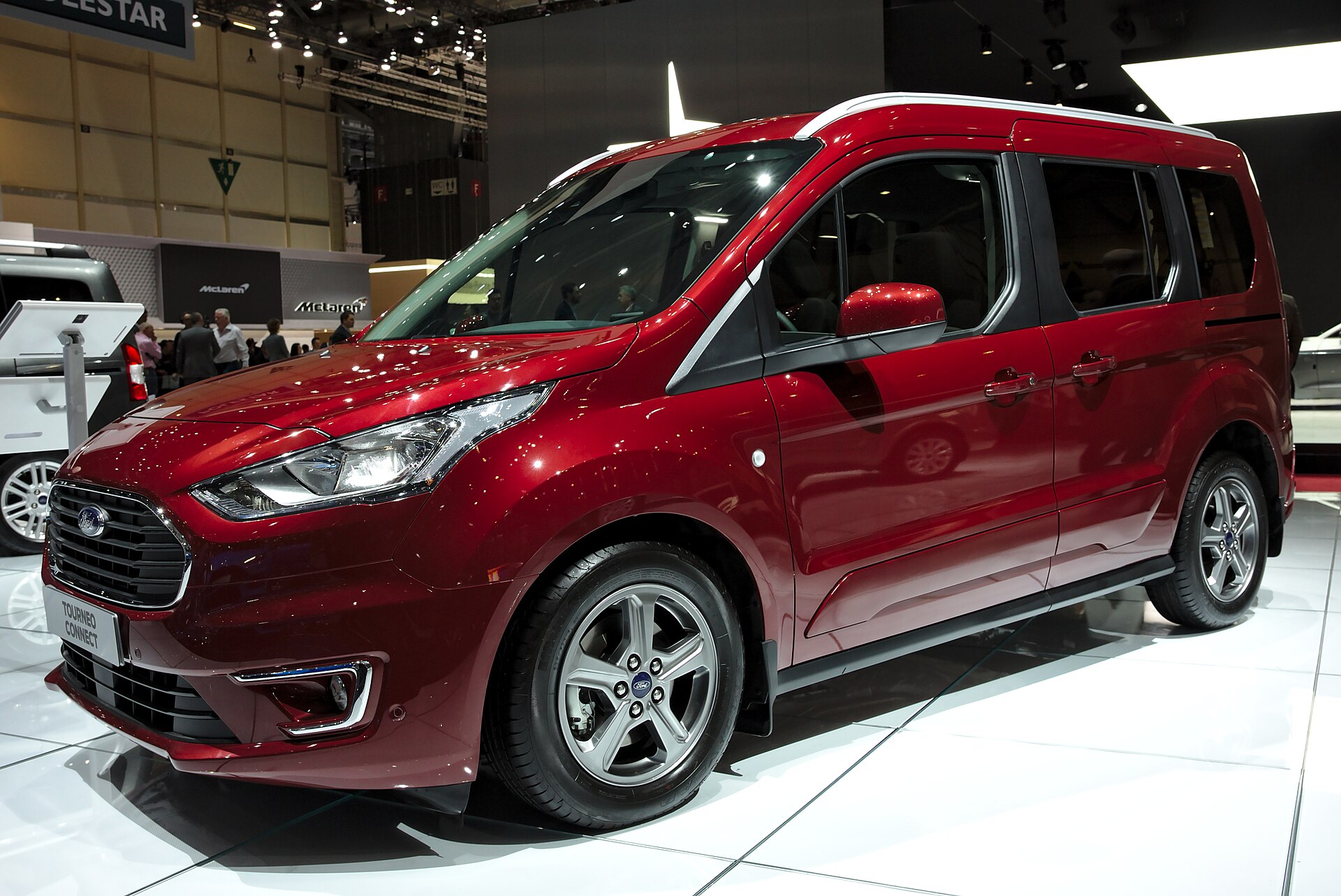
Ford introduced the first Transit Connect in October 2002, and the Tourneo Connect was its windowed passenger version from the start. The second generation was shown in Amsterdam on 6 September 2012 in Ford's Kinetic Design style, and ADAC dates German Tourneo Connect sales from December 2013. That generation also brought the long-wheelbase Grand Tourneo Connect to Europe.
German versions of the second generation ranged from 55 kW (75 PS) diesels to a 1.6 EcoBoost with 110 kW (150 PS) and an automatic gearbox. After the 2018 facelift Ford offered the 1.0 EcoBoost with 74 kW (100 PS) and the 1.5 EcoBlue diesel with 55, 74 or 88 kW (75, 100 or 120 PS); the last of these cars left the price list in March 2022.

Why the current car is a Volkswagen Caddy
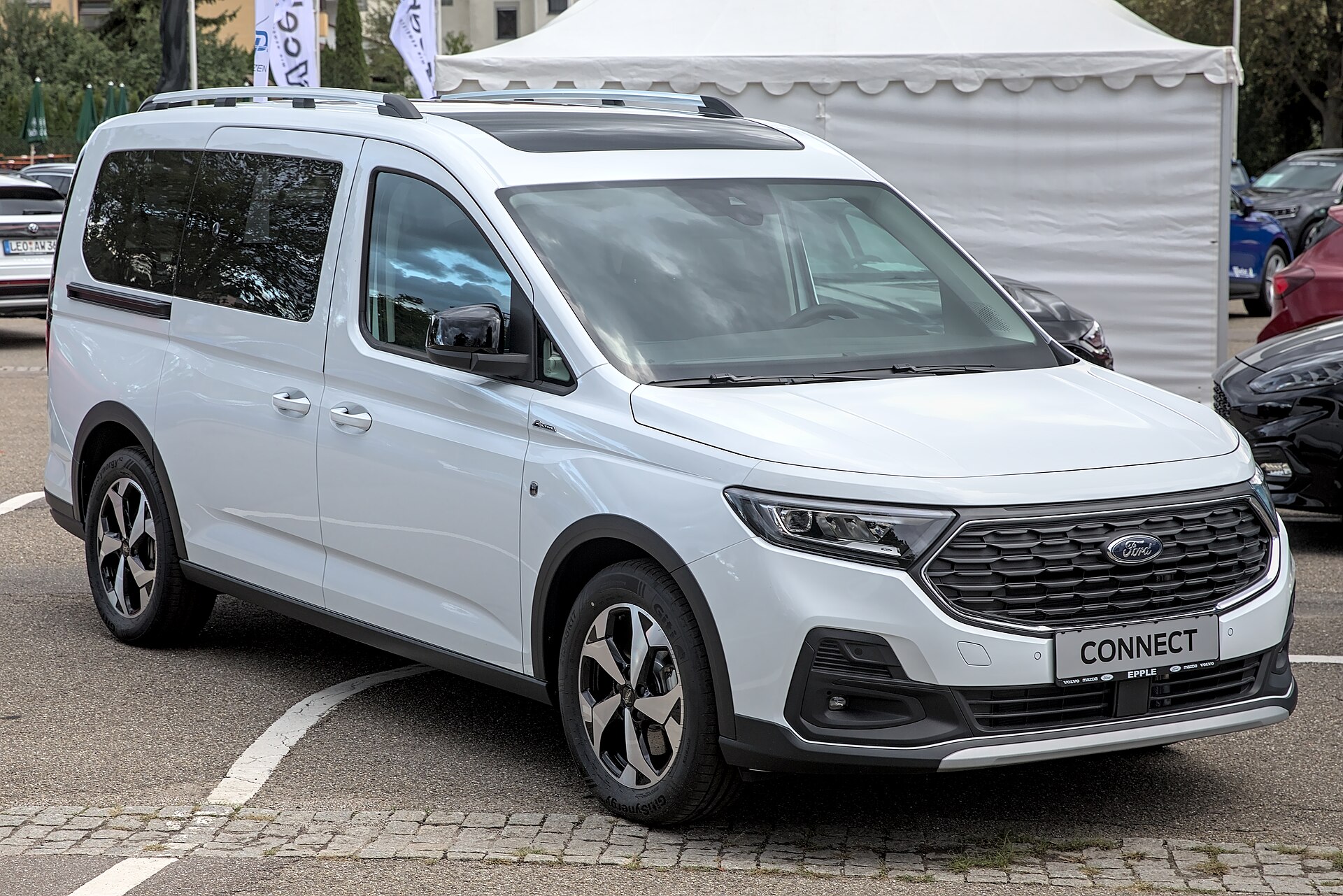
Volkswagen unveiled its new Caddy in February 2020 as the first Caddy on the MQB platform, and Ford announced in 2021 that the next Tourneo Connect would be a rebadged version. It became the first model developed under the Ford and Volkswagen partnership, and deliveries started in early 2022. The engines are Volkswagen units under Ford names: the EA288 evo diesel is sold as EcoBlue and the EA211 evo petrol as EcoBoost. The full Volkswagen story is in the Volkswagen Caddy overview.
The Active trim adds plastic cladding and 17-inch wheels for a crossover look. A Transit Connect van on the same base followed in the UK and Europe in late 2024.
Engines, gearboxes and the plug-in hybrid
| Version (Germany, 2025) | Engine | Power | Torque | Gearbox | WLTP | 0-100 km/h |
|---|---|---|---|---|---|---|
| 1.5 EcoBoost | 1,498 cc petrol | 85 kW (114 PS) | 220 Nm | 6-speed manual or automatic | 6.5 l/100 km | 11.9 s |
| 2.0 EcoBlue | diesel | 75 kW (102 PS) | not listed | not listed | not listed | not listed |
| 2.0 EcoBlue | diesel | 90 kW (122 PS) | 320 Nm | 7-speed dual-clutch | 5.6 l/100 km | 11.4 s |
| 1.5 EcoBoost PHEV | 1,498 cc petrol + motor | 110 kW (150 PS) | 350 Nm | 6-speed dual-clutch | 1.9 l/100 km, 117 km electric | 10.1 s |
ADAC lists the 1.5 EcoBoost at 84 kW (114 PS) until May 2024 and at 85 kW afterwards, with the PS figure unchanged. All-wheel drive was available with the 90 kW diesel from 2022 and disappeared from the German list in June 2025. Top speeds are 182 km/h for the petrol, 186 km/h for the 90 kW diesel and 180 km/h for the plug-in hybrid.
Plug-in hybrid: charging and range
The PHEV pairs the 1.5 EcoBoost, rated at 85 kW (116 PS) and 250 Nm in this application, with an electric motor for a system output of 110 kW (150 PS) and 350 Nm. Its 19.7 kWh net battery gives 117 km (73 miles) of WLTP electric range and 146 km in the city cycle. Charging runs at up to 11 kW AC, a full charge in 150 minutes, and 40 kW DC, which reaches 80 per cent in 26 minutes.
The price of the battery is a smaller tank of 32.5 litres instead of 50 litres. With an empty battery ADAC gives 6.3 l/100 km, so long motorway trips mean more frequent fuel stops. The payload stays high at 782 kg, and the towing limit of 1,500 kg (3,307 lb) braked equals the 90 kW diesel.

Space for five or seven
The standard Tourneo Connect is 4,500 mm (177.2 in) long, 1,855 mm wide without mirrors and 1,833 mm high on a 2,755 mm wheelbase. The Grand version stretches to 4,853 mm (191.1 in) on a 2,970 mm wheelbase and takes up to seven seats. Wikipedia gives 4,859 and 2,975 mm for the long body.
ADAC measures 1,213 litres behind the second row and 2,556 litres with the bench folded for the short car, both to the roof. The Grand reaches 1,720 and 3,105 litres. A height of 1,833 mm is worth checking against low garage doors. For comparison, the Peugeot Rifter comes in 4,403 and 4,753 mm lengths, so the short Ford is about 10 cm longer than the short Peugeot.

Euro NCAP five stars
ADAC lists a Euro NCAP test from December 2021 for the third generation, shown under the Volkswagen Caddy name on its page. The result is five stars with 84 per cent for adult occupants, 82 per cent for children, 69 per cent for vulnerable road users and 79 per cent for safety assist.
Prices in Germany
| Version (ADAC, list price) | Tourneo Connect | Grand Tourneo Connect |
|---|---|---|
| 1.5 EcoBoost Trend (from May 2025) | EUR 32,450 | EUR 35,400 |
| 2.0 EcoBlue 75 kW Trend (from May 2025) | EUR 34,050 | EUR 37,000 |
| 2.0 EcoBlue 90 kW Active automatic (from May 2025) | EUR 42,650 | EUR 45,600 |
| 1.5 EcoBoost PHEV Trend (from August 2025) | EUR 43,550 | EUR 45,950 |
| 1.5 EcoBoost PHEV Active (from August 2025) | EUR 47,050 | EUR 49,450 |
The long body adds about EUR 2,400 to EUR 3,000 in the 2025 price lists. The plug-in hybrid starts EUR 11,100 above the 1.5 EcoBoost Trend in the 2025 German list. When the third generation arrived in May 2022, the 1.5 EcoBoost Titanium cost EUR 31,140.
Photo gallery

Ford Tourneo Connect evolution in numbers
Did you know?
- The Ford Tourneo Connect has been around for 24 years: 3 generations in our catalog since 2002.
- The longest-running generation is the Tourneo Connect I (2002–2013): 11 years.
Ford Tourneo Connect in our rankings
- No. 139 of 1194 · Longest-running car nameplates (24 years · top 13%)
- No. 124 of 609 · Longest cars (4,853 mm · top 21%)
- No. 91 of 417 · Oldest car models still on sale (24 years · top 24%)
- No. 98 of 333 · Most economical cars (5.6 l/100 km · top 31%)
- No. 257 of 581 · Widest cars (1,855 mm · top 45%)
- No. 217 of 467 · Heaviest cars (1,643 kg · top 47%)
In production longer than 87% of ranked nameplates in the 1CARS catalog (No. 139 of 1194).
FAQ
Is the Ford Tourneo Connect a Volkswagen Caddy?
Yes, since the third generation. The Tourneo Connect launched in October 2021 is a rebadged Volkswagen Caddy built by Volkswagen in Poland, with Volkswagen engines sold under Ford's EcoBoost and EcoBlue names. Earlier generations were Ford designs built in Turkey, Romania and Spain.
How many seats does the Ford Tourneo Connect have?
The standard Tourneo Connect has five seats. The Grand Tourneo Connect, 4,853 mm long on a 2,970 mm wheelbase, has five as standard and up to seven, according to ADAC.
How far can the Tourneo Connect PHEV drive on electricity?
ADAC lists 117 km (73 miles) in the WLTP cycle and 146 km in the city cycle. The 19.7 kWh net battery charges at up to 11 kW AC or 40 kW DC, reaching 80 per cent in 26 minutes on DC.
What is the difference between the Tourneo Connect and the Transit Connect?
The Transit Connect is the van, and the Tourneo Connect is the passenger version with rear windows and seats. The current Transit Connect van on the Caddy base arrived in the UK and Europe in late 2024.
Data sources
Data checked by an editor against the sources below.
- Wikipedia - Ford Transit Connect
- ADAC - 2generation
- ADAC - 2generation Facelift
- ADAC