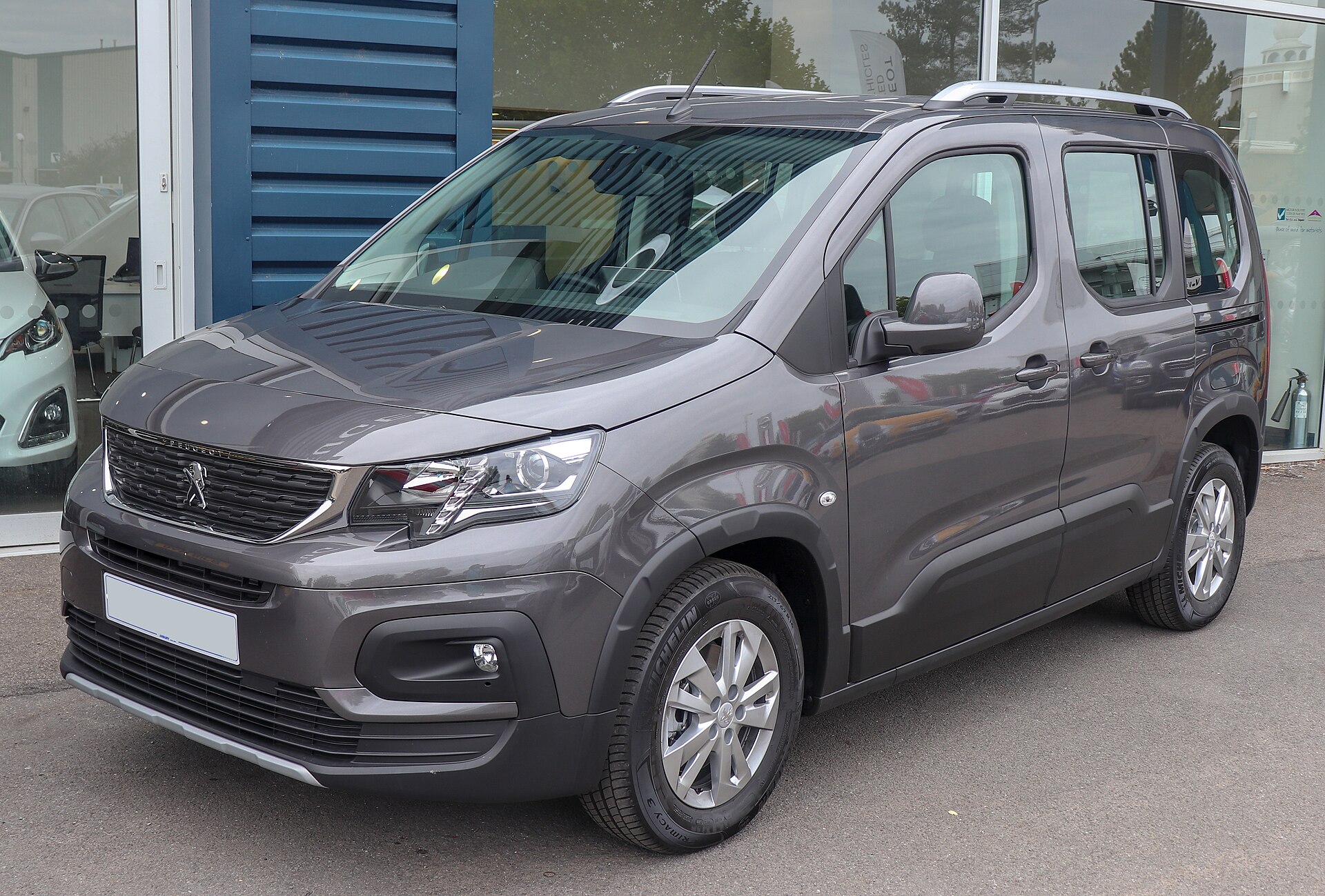
 Peugeot Rifter
Specs, engines and history
Published Sources (3) Report an error
By Felix Hartmann, Automotive Technology & EV Contributor
- Built
- 2018–present
- Top power
- 100 kW (136 PS)
Which Rifter to choose
Our verdict · Felix Hartmann
- For a family of five: the Standard length with the five-seat layout and its 775-litre boot.
- For seven seats in daily use: the Long, with its sliding third row.
- For high mileage: the 1.5 BlueHDi 100 or 130 diesel.
- For short trips and home charging: the e-Rifter, ideally from the 2024 facelift with about 320 km of range.
The Peugeot Rifter is the passenger version of Peugeot's third-generation compact van, sold since 2018 as a five- or seven-seat family MPV. It replaced the Partner Tepee and comes in two lengths, 4,403 and 4,753 mm. Engines range from 55 to 96 kW, and the battery-electric e-Rifter with 100 kW followed in 2021. For two years, from 2022 to 2024, it was sold only as an electric car in the EU.
In short
- First shown at Geneva in March 2018; built in Vigo (Spain) and Mangualde (Portugal).
- Standard (L1) and Long (L2) bodies, each with five or seven seats; up to 4,000 litres of load space.
- 1.2 PureTech petrol with 81 or 96 kW, 1.5 BlueHDi diesel with 55, 75 or 96 kW; e-Rifter with a 50 kWh battery.
- Euro NCAP 2018: four stars.
Running cost
Fuel · Rifter 1.5 BlueHDi 130
about 1,400 EUR fuel a year at 15,000 km
5.7 l/100 km · diesel at 1.65 EUR/l · change mileage, fuel price or version
Specs by version
Engines
| Version | Engine | Power | Gearbox | Drive | Production years |
|---|---|---|---|---|---|
| Electric · 1 version | |||||
| e-Rifter 50 kWh | Electric | 100 kW 136 PS134 hp | 1-sp Single-speed | Front-wheel drive | 2021 |
| Diesel · 3 versions | |||||
| 1.5 BlueHDi 75 | 4 cyl · Diesel | 55 kW 75 PS74 hp | — | Front-wheel drive | 2018 |
| 1.5 BlueHDi 100 | 4 cyl · Diesel | 75 kW 102 PS101 hp | — | Front-wheel drive | 2018 |
| 1.5 BlueHDi 130 | 4 cyl · Diesel | 96 kW 131 PS129 hp | — | Front-wheel drive | 2018 |
| Petrol · 2 versions | |||||
| 1.2 PureTech 110 | 3 cyl · Petrol | 81 kW 110 PS109 hp | 6-sp Manual | Front-wheel drive | 2018 |
| 1.2 PureTech 130 EAT8 | 3 cyl · Petrol | 96 kW 131 PS129 hp | 8-sp Automatic | Front-wheel drive | 2019 |
Performance
Show all 5 versions
| Version | Fuel consumption | CO₂ |
|---|---|---|
| Electric · 1 version | ||
| e-Rifter 50 kWh | 20.2 kWh/100 km32.5 kWh/100 mi | — |
| Diesel · 2 versions | ||
| 1.5 BlueHDi 100 | 5.4 l/100 km43.6 mpg US · 52.3 mpg UK | 141 g/km |
| 1.5 BlueHDi 130 | 5.7 l/100 km41.3 mpg US · 49.6 mpg UK | 151 g/km |
| Petrol · 2 versions | ||
| 1.2 PureTech 110 | 6.5 l/100 km36.2 mpg US · 43.5 mpg UK | 147 g/km |
| 1.2 PureTech 130 EAT8 | 7.1 l/100 km33.1 mpg US · 39.8 mpg UK | 160 g/km |
Dimensions and weight
Show all 6 versions
| Version | Length | Kerb weight |
|---|---|---|
| Electric · 1 version | ||
| e-Rifter 50 kWh | 4,403 mm173.3 in | 1,765 kg3,891 lb |
| Diesel · 3 versions | ||
| 1.5 BlueHDi 75 | 4,403 mm173.3 in | — |
| 1.5 BlueHDi 100 | 4,403 mm173.3 in | 1,505 kg3,318 lb |
| 1.5 BlueHDi 130 | 4,403 mm173.3 in | 1,627 kg3,587 lb |
| Petrol · 2 versions | ||
| 1.2 PureTech 110 | 4,403 mm173.3 in | 1,474 kg3,250 lb |
| 1.2 PureTech 130 EAT8 | 4,403 mm173.3 in | 1,595 kg3,516 lb |
Verified Manufacturer and type-approval data from our catalog · Sources and methodology
Peugeot Rifter at a glance
| Parameter | Value |
|---|---|
| Production | since 2018 |
| Plants | Vigo (Spain), Mangualde (Portugal) |
| Body | five-door MPV with two sliding side doors |
| Lengths | 4,403 mm (Standard) and 4,753 mm (Long) |
| Seats | 5 or 7 in both lengths |
| Boot | 775 / 1,050 litres with five seats; up to 3,000 / 4,000 litres |
| Engines | 1.2 PureTech 81–96 kW; 1.5 BlueHDi 55–96 kW |
| Electric | e-Rifter, 50 kWh, 100 kW |
| Predecessor | Peugeot Partner Tepee |
| Sister models | Citroën Berlingo, Opel Combo Life, Toyota ProAce City Verso, Fiat Doblò |
From Partner Tepee to Rifter
The third Partner and Berlingo family was revealed at the 88th Geneva Motor Show in March 2018. Peugeot used the moment to give its passenger version a name of its own. The van stayed the Partner, while families now bought the Rifter. The full history of the van line is in our Peugeot Partner article.
Technically the family uses the front end of the EMP2 platform and keeps the rear of the previous model. Sales started in June 2018, and the first cars reached customers in September 2018. In 2018 L'argus reported that base versions cost €1,800 to €2,200 more than the Partner Tepee they replaced.
Two lengths, five or seven seats
The Rifter is offered in two lengths. Parkers lists 4,403 mm for the Standard and 4,753 mm for the Long. Swiss magazine autosprint gave 4.45 m for the five-seater at the Geneva launch, so early figures differ slightly.
Both lengths can be ordered with five or seven seats. In the Long, the third row slides, while it is fixed in the Standard. Each side has a sliding rear door, which helps in narrow parking spaces.

Boot and everyday practicality
| Body | Boot with five seats | Maximum load space | Load length (front seat folded) |
|---|---|---|---|
| Standard (L1) | 775 litres (below the cover) | 3,000 litres | 2.70 m |
| Long (L2) | 1,050 litres | 4,000 litres | 3.00 m |
The maximum figures apply with the rear seats folded and the third row removed. The front passenger seat folds flat, so long items of up to 2.70 or 3 metres fit inside. L'argus measured these figures at the 2018 launch.

Cabin and equipment
An 8-inch touchscreen with navigation sat on top of the dashboard at launch. A double glovebox can hold a 15-inch laptop, and a 230-volt socket sits at the base of the centre console. Depending on the version, a colour head-up display was available.
Advanced Grip Control and hill descent control were offered as options from the start. Peugeot also showed a Rifter 4x4 Concept in 2018, a camper study with a 96 kW (130 PS) diesel, all-wheel drive and a two-person roof tent. It stayed a concept. The specialist Automobiles Dangel has also converted production Rifters.

Engines and gearboxes
| Engine | Power | Gearbox | Offered |
|---|---|---|---|
| 1.2 PureTech 110 | 81 kW (110 PS) | 6-speed manual | from 2018 |
| 1.2 PureTech 130 | 96 kW (131 PS) | 8-speed automatic (EAT8) | from May 2019 |
| 1.5 BlueHDi 75 | 55 kW (75 PS) | manual | from 2018, not in Germany |
| 1.5 BlueHDi 100 | 75 kW (102 PS) | manual | from 2018 |
| 1.5 BlueHDi 130 | 96 kW (131 PS) | manual or EAT8 | from 2018 |
All engines met the Euro 6d-TEMP standard at launch. Parkers quotes up to 57.6 mpg (about 4.9 l/100 km) for the BlueHDi 100 and up to 43.7 mpg (about 6.5 l/100 km) for the PureTech 130 automatic. Its 0–60 mph times run from 10.1 seconds for the strongest diesel to 16.5 seconds for the BlueHDi 75.

e-Rifter: the electric version
Peugeot presented the e-Rifter on 26 February 2021, and it went on sale in autumn 2021. It uses a 50 kWh battery and a 100 kW (136 PS) electric motor. Before the facelift its WLTP range was up to 280 km.
In January 2022 Stellantis stopped selling combustion versions of the Rifter, Berlingo and Combo Life in the EU, the United Kingdom and Norway. For about two years the Rifter was therefore available there only as the e-Rifter.
The 2024 facelift and the return of combustion engines
A facelift was revealed in autumn 2023, and sales began in early 2024. The battery and motor stayed the same, but efficiency improved. Carbuyer gave the updated range as up to 199 miles (about 320 km), against around 170 miles before. German Wikipedia lists 326 to 334 km on the WLTP cycle. A 100 kW DC charger fills the battery from 0 to 80 per cent in about 30 minutes, and an 11 kW wallbox needs about 5 hours. A 10-inch touchscreen became standard.
From March 2024 combustion engines returned to the range. Stellantis also planned a 1.2-litre mild hybrid with 90 kW (122 PS) for mid-2025.

Safety and sales
Euro NCAP tested the Rifter in 2018 and awarded four stars out of five. In Germany 20,624 Rifters were registered between 2018 and December 2024. The best year was 2019, with 6,379 cars.
Sister models and rivals
The Rifter shares its body and technology with the Citroën Berlingo, the Opel Combo Life and the Toyota ProAce City Verso, and since 2022 with the Fiat Doblò. Outside the group it competes with leisure MPVs such as the Renault Kangoo and the Volkswagen Caddy. Other Peugeot models are in the Peugeot catalogue.
Photo gallery

Peugeot Rifter in our rankings
- No. 61 of 256 · Most economical cars (5.4 l/100 km · top 25%)
- No. 158 of 420 · Smallest cars (4,403 mm · top 38%)
- No. 118 of 304 · Heaviest cars (1,765 kg · top 40%)
- No. 146 of 304 · Lightest cars (1,474 kg · top 49%)
- No. 474 of 912 · Longest-running car nameplates (8 years · top 53%)
- No. 28 of 48 · Heaviest electric cars (1,765 kg · top 61%)
More economical than 75% of ranked cars in the 1CARS catalog (No. 61 of 256).
FAQ
What is the difference between the Peugeot Rifter and the Partner?
They share the same body. Peugeot keeps the Partner name for the commercial van, while the Rifter is the passenger MPV with side windows and rear seats.
How long is the Peugeot Rifter?
The Standard measures 4,403 mm; the Long adds 350 mm, for 4,753 mm.
Does the Peugeot Rifter have seven seats?
Yes, in both body lengths. Only the Long has a third row that moves fore and aft.
What is the range of the e-Rifter?
Up to 280 km WLTP before the 2024 facelift and about 320–330 km after it, with a 50 kWh battery.
How big is the Rifter's boot?
775 litres in the Standard and 1,050 litres in the Long with five seats, and up to 3,000 or 4,000 litres with the seats removed.
Data sources
Data checked by an editor against the sources below.
- Wikipedia — Peugeot Rifter
- Co — Peugeot E Rifter Electric Mpv Gets 2024 Updates But Remains As Roomy As Ever
- EEA CO₂ monitoring (European Environment Agency, CC BY 4.0)