
 Peugeot 204
Specs, engines and history
Published Sources (1) Report an error
By Sarah Whitmore, Senior Automotive Writer
- Built
- 1965–1976
- Top power
- 43 kW (58 PS)
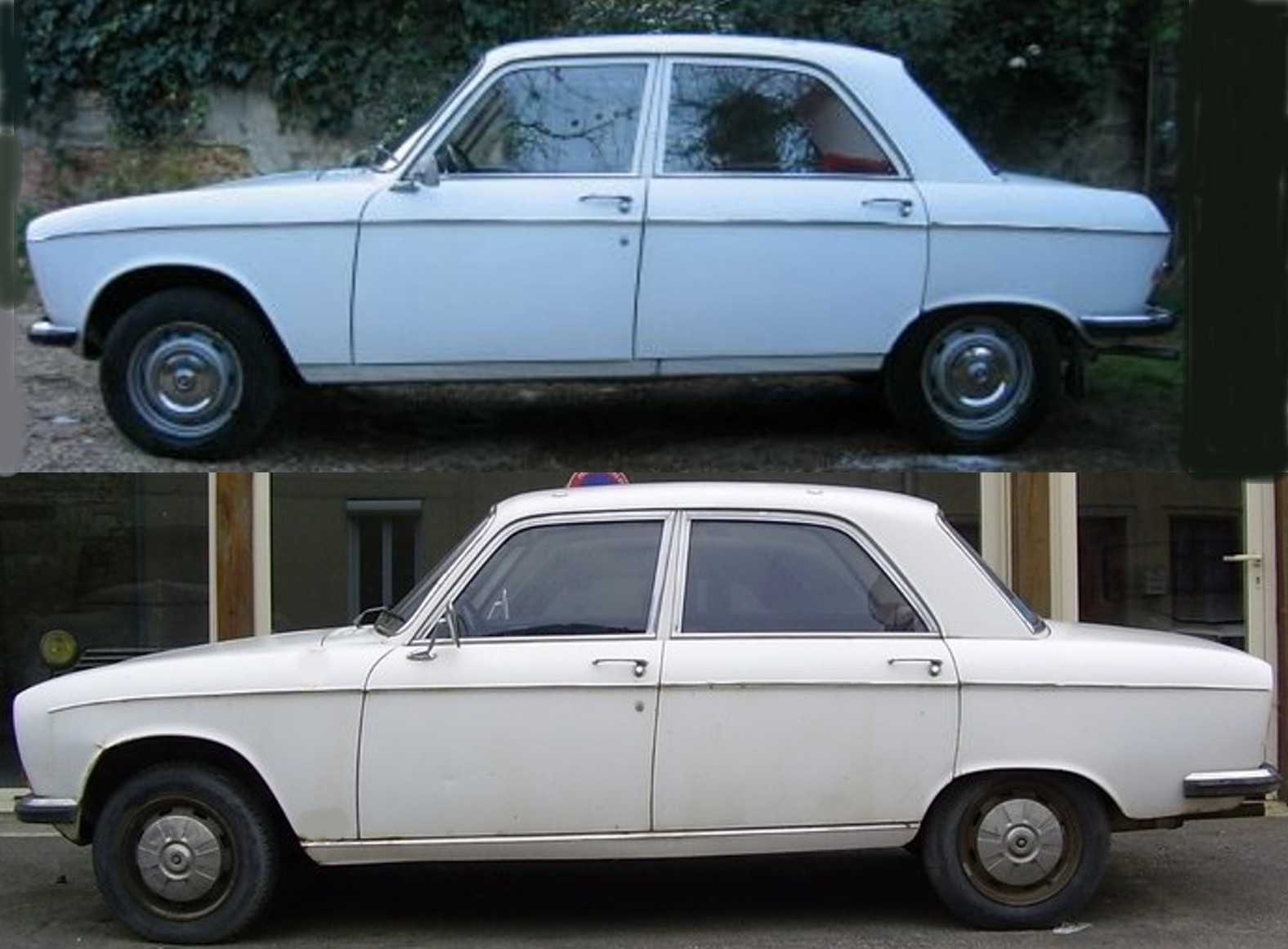
The Peugeot 204 is the compact family car Peugeot built from April 1965 to July 1976, the brand's first front-wheel-drive model. Its transverse 1,130 cc aluminium overhead-cam engine sat above the gearbox, it offered one of the smallest diesels in any series car, and it was France's best-selling car from 1969 to 1971. About 1.6 million were built as saloon, estate, coupé, cabriolet and van.
In short
- First front-wheel-drive Peugeot, first with an overhead camshaft and front disc brakes, four-wheel independent suspension.
- Petrol 1,130 cc (later 1,127 cc) four of 39-43 kW (53-59 PS); diesels of 1,255 and 1,357 cc with 29-33 kW (40-45 PS).
- 1,604,296 built (English Wikipedia); France's best-seller in 1969, 1970 and 1971.
- Styled by Peugeot's Paul Bouvot with finishing touches from Pininfarina.
Size at a glance
| Dimensions | Peugeot 204 I |
|---|---|
| Length | 3,990 mm157.1 in |
| Width | 1,560 mm61.4 in |
| Height | 1,400 mm55.1 in |
| Wheelbase | 2,595 mm102.2 in |
Running cost
Fuel · 204 Diesel 1357 (XL4D)
about 1,400 EUR fuel a year at 15,000 km
5.7 l/100 km · diesel at 1.65 EUR/l · change mileage, fuel price or version
Specs by version
Engines
| Version | Engine | Power | Gearbox | Drive | Production years |
|---|---|---|---|---|---|
| Diesel · 2 versions | |||||
| Diesel 1255 (XLD) | 1.3 l · 4 cyl · Diesel XLD | 29 kW 39 PS39 hp | 4-sp Manual | Front-wheel drive | 1968–1973 |
| Diesel 1357 (XL4D) | 1.4 l · 4 cyl · Diesel XL4D | 33 kW 45 PS44 hp | 4-sp Manual | Front-wheel drive | 1973–1976 |
| Petrol · 3 versions | |||||
| 1130 (XK) | 1.1 l · 4 cyl · Petrol XK | 39 kW 53 PS52 hp | 4-sp Manual | Front-wheel drive | 1965–1975 |
| Coupé 1130 | 1.1 l · 4 cyl · Petrol XK | 39 kW 53 PS52 hp | 4-sp Manual | Front-wheel drive | 1966–1970 |
| 1127 (XK5) | 1.1 l · 4 cyl · Petrol XK5 | 43 kW 58 PS58 hp | 4-sp Manual | Front-wheel drive | 1975–1976 |
Performance
Show all 3 versions
| Version | Top speed | Fuel consumption |
|---|---|---|
| Diesel · 1 version | ||
| Diesel 1357 (XL4D) | 130 km/h81 mph | 5.7 l/100 km41.3 mpg US · 49.6 mpg UK |
| Petrol · 2 versions | ||
| 1130 (XK) | 138 km/h86 mph | - |
| Coupé 1130 | 140 km/h87 mph | - |
Dimensions and weight
Verified Manufacturer and type-approval data from our catalog · Sources and methodology
Peugeot 204 at a glance
| Item | Peugeot 204 |
|---|---|
| Years | April 1965 to July 1976 |
| Production | 1,604,296 (figures vary between sources) |
| Plants | Sochaux and Mulhouse (France); SOMA, Saint-Bruno (Canada) |
| Body styles | Four-door saloon, five-door estate (Break), three-door coupé, two-door cabriolet, van |
| Design | Paul Bouvot (Peugeot), finished by Pininfarina |
| Layout | Transverse front engine, front-wheel drive |
| Engines | 1,130 / 1,127 cc petrol SOHC; 1,255 / 1,357 cc diesel |
| Power | 29-43 kW (40-59 PS) |
| Weight | 851 kg (saloon) |
| Top speed | 138 km/h (saloon, Autocar 1966); 140 km/h (coupé, Motor 1968) |
| 0-100 km/h | Not published; 0-60 mph 22 s (saloon) and 17.3 s (coupé) |
| Price new | GBP 903 (UK saloon, 1966); GBP 1,299 (UK coupé, 1968) |
Project D12: a small Peugeot under four metres
Design work on Project D12 began in 1960, and Driven to Write puts the whole gestation at eight years, counting front-drive studies from the late 1950s. The brief, as Lancaster Insurance's 2019 history puts it, was a car for five adults, shorter than four metres and with an engine inside the 6 CV fiscal class. Peugeot's design chief Paul Bouvot drew the body, Pininfarina added the finishing styling, and Pininfarina's 1961 Jacqueline concept had already shown the theme. Peugeot later described the 204 as the first car it developed with a project-based organisation.
The car was launched in Paris in April 1965. About 5,000 orders were placed before the official introduction, and 72 per cent of all 204s were eventually delivered in France, with West Germany the next-largest market. The estate (Break) followed in autumn 1965, the 2+2 coupé and the two-seat cabriolet in 1966 (the cabriolet in October) and the Fourgonnette van later that year.
Engineering firsts: transverse alloy engine and front drive
The 204 brought several firsts to Peugeot at once: front-wheel drive, a transverse engine, an overhead camshaft, front disc brakes and independent suspension on all four wheels. The all-alloy 1,130 cc four sat across the car with the four-speed gearbox directly below it, sharing its oil, and drove the front wheels through equal-length driveshafts. Gear changes were made with a column lever.
At the front, MacPherson struts and lower wishbones were mounted on a stout subframe with an anti-roll bar; at the rear, trailing arms on a transverse beam supported the rear struts. Peugeot designed and made its own dampers. The saloon measured 3,990 mm long on a 2,595 mm wheelbase and weighed 851 kg.
The diesel made the 204 unusual among small cars. A 1,255 cc Indenor diesel of 29 kW (40 PS) arrived in late 1968 for the Break and van, and contemporary sources called it the smallest diesel in a series-production car. It grew to 1,357 cc and 33 kW (45 PS) in April 1973 and reached the saloon in September 1975. About 150,000 diesel 204s were built, fewer than 30,000 of them saloons, with a claimed 5.7 l/100 km and 130 km/h. In June 1973 a 204 diesel prototype set eight endurance records at Montlhéry, with drivers including Jean Todt, Jean Guichet and Hannu Mikkola.
| Engine | Displacement | Power | Years |
|---|---|---|---|
| XK petrol | 1,130 cc | 39 kW (53 PS) | 1965 onwards |
| XK4 petrol | 1,130 cc | 40 kW (55 PS) | later XK version, until 1975 |
| XK5 petrol | 1,127 cc | 43 kW (59 PS) | September 1975-1976 |
| XLD diesel | 1,255 cc | 29 kW (40 PS) | 1968-1973 |
| XL4D diesel | 1,357 cc | 33 kW (45 PS) | 1973-1976 |

Road tests, rallies and the best-seller years
Autocar tested a 204 saloon in September 1966 and recorded 138 km/h (86 mph), 0-60 mph in 22 seconds and 8.8 l/100 km (32 mpg). In Britain it cost GBP 903, against GBP 835 for a Triumph 1300, and the magazine found the finish and equipment "austere and disappointing in relation to price". Motor's test of the coupé in October 1968 gave 140 km/h on the MIRA banked circuit, 0-60 mph in 17.3 seconds and 9.4 l/100 km, at GBP 1,299.
The 204 proved its toughness in Africa: all six cars entered in the East African Safari Rally finished, taking the first six places in the 1,101-1,300 cc class, and Peugeot also lists a 1-2-3 on the 1,000 Miles of Tanganyika. English Wikipedia dates the Safari result to 1966, Peugeot's 2015 release to 1967.
At home the 204 became France's best-selling car in 1969, 1970 and 1971, before the Simca 1100 took first place in 1972; that front-drive rival came from the Poissy firm covered in our Simca history. A 1968 update brought a revised tail and slightly larger bumpers. From 1969 the longer 304 used the 204's centre section, and in 1970 the coupé and cabriolet switched to 304 specification, leaving the 204 as saloon, estate and van.

Why the 204 ended
Production ended in July 1976 with no direct replacement. The 304 and, from 1977, the 305 covered its place in the range, while French Wikipedia names the 104 as the 6 CV successor for 1977. English Wikipedia counts 1,604,296 cars; Classic & Sports Car gives 1,387,473, and Peugeot's own anniversary release says over 1.6 million.
Peugeot 204 today: what to check when buying
Corrosion is the main concern. Octane's buying guide to the closely related 304 cabriolet, published in May 2024, advises checking the underside for structural rot and every panel for soundness, especially on cars that have spent their whole life in Britain, and warns that replacement panels are hard to find. Look closely at sills, floors, the subframe mountings and the lower edges of doors and wings. The cabriolet's rear lights are unique to that body, so check they are present and intact.
Octane rates the 204's mechanicals as durable but notes that parts can be hard to source outside France; French classified sites and owners' clubs are the usual route. Because engine and gearbox share their oil, ask for evidence of regular oil changes.
Coupés and cabriolets cost far more than saloons. In November 2026 Classic Trader listed a 1968 cabriolet at EUR 35,200 and a 1974 Break at EUR 13,500, while a 1967 cabriolet had been offered privately at EUR 17,650 earlier in 2026. Older expired listings on the same site show saloons at EUR 1,400 to 12,500, so condition and body style decide the price.
The 204 has its place in our Peugeot catalogue and in our history of Peugeot. It also belongs among the best classic cars of the 1960s, and more cars of the era are in the classic cars section.
Peugeot 204 in our rankings
- No. 3 of 23 · Smallest station wagons (3,990 mm)
- No. 6 of 122 · Smallest sedans (3,990 mm)
- No. 6 of 110 · Smallest coupes (3,990 mm)
- No. 6 of 79 · Lightest sedans (851 kg)
- No. 17 of 424 · Lightest cars (851 kg · top 5%)
- No. 61 of 565 · Smallest cars (3,990 mm · top 11%)
Shorter than 95% of ranked sedans in the 1CARS catalog (No. 6 of 122).
FAQ
Was the Peugeot 204 Peugeot's first front-wheel-drive car?
Yes. The 204 of April 1965 was Peugeot's first front-wheel-drive car and its first with a transverse engine, an overhead camshaft, front disc brakes and four-wheel independent suspension, according to Peugeot's own heritage material.
How many Peugeot 204s were built?
English Wikipedia gives 1,604,296 between 1965 and 1976, and Peugeot says over 1.6 million. Classic & Sports Car quotes a lower 1,387,473. About 150,000 were diesels, fewer than 30,000 of them saloons.
How powerful is a Peugeot 204?
The 1,130 cc petrol engine gave 39 kW (53 PS) at launch and the 1,127 cc unit of 1975 gave 43 kW (59 PS). The diesels produced 29 kW (40 PS) with 1,255 cc and 33 kW (45 PS) with 1,357 cc.
Which car replaced the Peugeot 204?
None directly. Production ended in July 1976, and the larger 304 and 305 took over its market position, while French Wikipedia names the smaller 104 as the 6 CV successor for 1977.
Data sources
Data checked by an editor against the sources below.
- Wikipedia - Peugeot 204


