 Peugeot 106
Specs, engines and history
Published Sources (3) Report an error
By Felix Hartmann, Automotive Technology & EV Contributor
- Built
- 1991–2003
- Top power
- 87 kW (118 PS)
Which Peugeot 106 to buy: verdict
Our verdict · Felix Hartmann
- Everyday classic: a Phase II 1.1 or 1.4 five-door, with airbags and simple mechanics.
- For fun: the Rallye (825 kg in Phase I form) or the 87 kW GTI/S16, both built in far smaller numbers than the everyday versions.
- Curiosity: the 106 Électrique, with only 6,400 made and a 100 km official range.
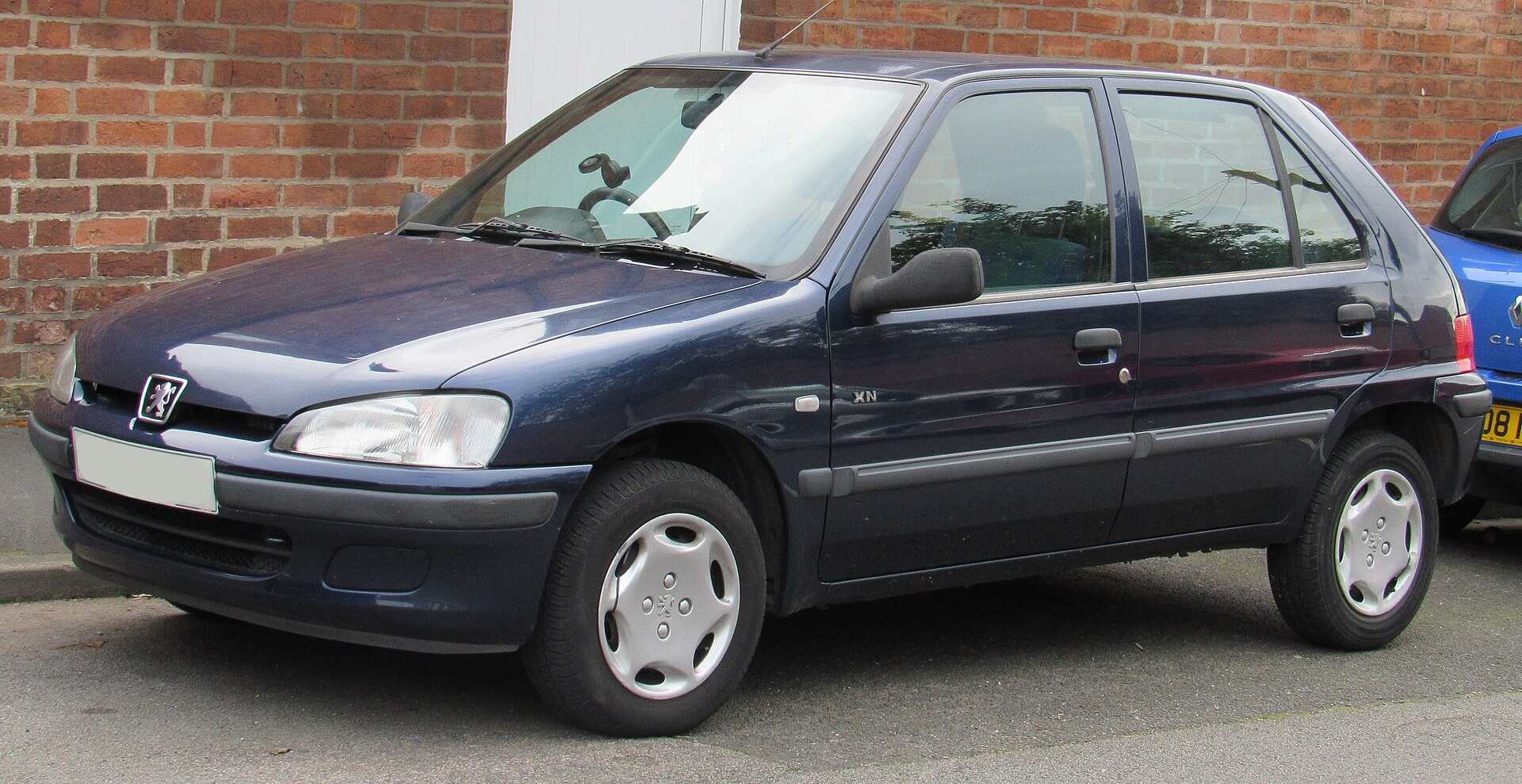
The Peugeot 106 is the small hatchback Peugeot built from 1991 to 2003, positioned below the 205 and later below the 206. Based on a heavily developed Citroën AX platform and closely related to the Citroën Saxo, it was sold as a three- and five-door hatchback with petrol engines from 1.0 to 1.6 litres, 1.4 and 1.5 diesels and, from 1995, as the battery-electric 106 Électrique. Peugeot built 2,798,200 cars in France and Tunisia.
In short
- Small hatchback (supermini), 3- and 5-door, built in Mulhouse and Aulnay-sous-Bois (France) and La Marsa (Tunisia).
- Phase I from September 1991, Phase II facelift in July 1996 with airbags, side impact bars and the 1.6 GTI.
- Engines from 33 kW (45 PS) to 87 kW (118 PS); the light Rallye and the 16-valve GTI (S16 in some markets) are the enthusiast versions.
- 6,400 electric 106 Électrique cars were built from 1995 to 2003.
Size at a glance
| Dimensions | Peugeot 106 I |
|---|---|
| Length | 3,678 mm144.8 in |
| Width | 1,620 mm63.8 in |
| Height | 1,376 mm54.2 in |
| Wheelbase | 2,385 mm93.9 in |
| Boot | 215 L7.6 cu ft |
Specs by version
Engines
| Version | Engine | Power | Gearbox | Drive | Production years |
|---|---|---|---|---|---|
| Diesel · 1 version | |||||
| 1.5 D | 1.5 l · 4 cyl · Diesel 1,527 cc | 40 kW 54 PS54 hp | 5-sp Manual | Front-wheel drive | 1994–2003 |
| Petrol · 3 versions | |||||
| 1.1 60 | 1.1 l · 4 cyl · Petrol 1,124 cc | 44 kW 60 PS59 hp | Manual | Front-wheel drive | 1991–2003 |
| 1.6 Rallye | 1.6 l · 4 cyl · Petrol TU5J2 | 76 kW 103 PS102 hp | 5-sp Manual | Front-wheel drive | 1997–2000 |
| 1.6 16V GTI / S16 | 1.6 l · 4 cyl · Petrol TU5J4 | 87 kW 118 PS117 hp | 5-sp Manual | Front-wheel drive | 1996–2003 |
Performance
Show all 1 versions
| Version | 0–100 km/h | Top speed |
|---|---|---|
| 1.6 16V GTI / S16 | 8.7 s 0–62 mph | 205 km/h127 mph |
Dimensions and weight
Show all 1 versions
| Version | Length | Width | Height | Wheelbase | Kerb weight | Boot |
|---|---|---|---|---|---|---|
| 1.6 16V GTI / S16 | 3,678 mm144.8 in | 1,620 mm63.8 in | 1,376 mm54.2 in | 2,385 mm93.9 in | 1,025 kg2,260 lb | 215 l7.6 cu ft |
Verified Manufacturer and type-approval data from our catalog · Sources and methodology
Peugeot 106 at a glance
| Specification | Peugeot 106 |
|---|---|
| Segment | B-segment supermini (small hatchback) |
| Production | 1991-2003 |
| Plants | Mulhouse, Aulnay-sous-Bois (France); La Marsa (Tunisia, STAFIM) |
| Platform | developed from the Citroën AX, front engine, front-wheel drive |
| Design | Laurent Rossi under Philippe Couvreur (exterior), Paul Bracq (interior) |
| Body styles | 3-door and 5-door hatchback |
| Sister models | Citroën AX, Citroën Saxo (from 1996) |
| Power range | 33-87 kW (45-118 PS); electric 20 kW peak |
| Predecessor / successor | Peugeot 205 / Peugeot 107 |
The 106 is listed with all its successors in our Peugeot catalogue.
Generations and model history
The 106 had one generation in two phases. Peugeot launched the three-door in continental Europe in September 1991 and in the UK two months later. The five-door followed in August 1992, together with a 1.4 diesel. After about a year the carburettor 1.0 and 1.1 engines gave way to fuel injection, and in late 1994 the 1.5 diesel replaced the 1.4.
| Generation | Code | Years | Body styles | Engines | Power (kW / hp) |
|---|---|---|---|---|---|
| 106 Phase I | - | 1991-1996 | 3-door, 5-door | 1.0-1.6 petrol, 1.4-1.5 diesel | 33-76 kW (44-102 hp) |
| 106 Phase II | - | 1996-2003 | 3-door, 5-door | 1.0-1.6 petrol, 1.5 diesel, electric | 33-87 kW (44-116 hp) |
The Phase II facelift of July 1996 added side impact bars and driver and passenger airbags, and made the car 114 mm longer. It arrived a few months after Citroën launched the Saxo in January 1996, which was nearly identical in size and appearance. When the 206 arrived at the end of 1998, Peugeot slimmed the 106 range and sold it with simpler, cheaper editions such as the Zest series. Production ended in July 2003, two years before the 107 was launched.

Engines, transmissions and performance
| Engine | Code | Power | Years | Notes |
|---|---|---|---|---|
| 1.0 (954 cc) | TU9 | 33-37 kW (45-50 PS) | 1991-2001 | carburettor, then injection |
| 1.1 (1,124 cc) | TU1 | 37-44 kW (50-60 PS) | 1991-2003 | the most common engine |
| 1.3 (1,294 cc) | TU2J2 | 72-74 kW (98-100 PS) | 1993-1996 | Rallye Phase I |
| 1.4 (1,360 cc) | TU3 | 55 kW (75 PS) | 1991-2001 | also with automatic |
| 1.4 XSi | TU3FJ2 | 70-74 kW (95-100 PS) | 1991-1996 | sporty Phase I |
| 1.6 8V | TU5 | 65-76 kW (88-103 PS) | 1994-2001 | XSi 1.6, Rallye Phase II |
| 1.6 16V GTI / S16 | TU5J4 | 87 kW (118 PS) | 1996-2003 | 145 Nm |
| 1.4 diesel | TUD3 | 37 kW (50 PS) | 1992-1994 | |
| 1.5 diesel | TUD5 | 40-43 kW (55-58 PS) | 1994-2003 |
The 1.0 and some early 1.1 cars had a four-speed manual gearbox; all others used a five-speed manual, and a few engines could be ordered with an automatic. ADAC lists the 1.6 16V S16 at 0-100 km/h in 8.7 seconds and 205 km/h, with a kerb weight of 1,025 kg. All 106s have independent suspension with MacPherson struts at the front and compact transverse torsion bars at the rear.
The Rallye and the GTI
The Rallye was built for the 1,300 cc rally class. The Phase I car used a high-revving 1.3 with Magneti Marelli multi-point injection and a short-ratio five-speed gearbox; Peugeot removed power steering, central locking and electric windows to bring the weight down to 825 kg. Steel wheels painted white and Rallye decals marked it out, and the slogan was "fewer frills, more thrills". The Phase II Rallye switched to an 8-valve 1.6 with 76 kW (103 PS).
The GTI joined the range with the 1996 facelift as the successor to the 205 GTI, which had ended in 1994. Its 16-valve 1.6 produces 87 kW (118 PS), and it gained a body kit and new wheels. Some European markets badged it S16 or Rallye.


106 Électrique
Developed and built with Heuliez, the 106 Électrique arrived in 1995. A Leroy Somer DC motor delivered 20 kW for short periods and 11 kW continuously, and twenty liquid-cooled Saft nickel-cadmium batteries gave an official range of 100 km and a top speed of 90 km/h. A diesel-fired heater helped preserve range in winter. Peugeot had hoped to sell 15,000-20,000 a year; in the end 6,400 were sold between 1995 and 2003, most of them to French public authorities. The Citroën AX and Saxo Électrique used the same motor.
Dimensions, space and boot
| Parameter | Metric | Imperial |
|---|---|---|
| Length (Phase I / Phase II) | 3,564 / 3,678 mm | 140.3 / 144.8 in |
| Width | 1,590-1,620 mm | 62.6-63.8 in |
| Height | 1,357-1,380 mm | 53.4-54.3 in |
| Wheelbase | 2,385-2,387 mm | 93.9-94.0 in |
| Kerb weight | 790-1,025 kg | 1,742-2,260 lb |
| Boot (S16, ADAC) | 215 l, 953 l with rear seat folded | 7.6 / 33.7 cu ft |
| Fuel tank (S16, ADAC) | 45 l | 11.9 US gal |
For comparison with a modern small car, the size comparison tool puts the 106 next to any model in our catalogue.
Fuel economy and running costs
ADAC lists the 1.6 16V S16 at 8.1 l/100 km on the NEDC cycle, a figure that reflects its sporty tuning. The 1.1 petrol and the 1.5 diesel were the economical choices, but the sources we used do not give reliable official consumption figures for them. Many mechanical parts are shared with the Citroën AX and Saxo.
Trims, equipment and prices
Early cars were basic, and a radio was optional on some versions. Trim levels included XN, XR, XT and XSi, with XND, XRD, XTD and XLD for diesels, and after 1998 the Zest, Zest 2 and Zest 3. Special editions included Kid, Graduate, Independence, Quiksilver, Color Line, Open, Equinoxe and Pop Art. On right-hand-drive cars power steering was not available on Phase I, and air conditioning was never offered because of packaging constraints.
ADAC's converted German list prices give an idea of the range: the 1.0 XN three-door with a four-speed gearbox cost EUR 8,610 (1992), the 1.6 XSi EUR 14,822 (1994) and the 1.6 16V S16 EUR 15,543 (1996). Classic small Peugeots are covered in our classic cars section.
Safety
The Phase I 106 had no airbags; driver and passenger airbags and side impact bars came with the Phase II update in July 1996. We found no Euro NCAP result for the 106 in the sources used for this article, so we do not quote a star rating.
Reliability and known issues
The sources used here do not document model-specific faults, so we do not list any. On any car of this age, a careful inspection of bodywork and suspension and a documented service history matter more than the badge, and Rallye and GTI models should be checked for signs of hard use.
Motorsport
The 106 raced in the British National Saloon Car Cup in the early 1990s; Olympic decathlete Daley Thompson won his class at Thruxton in 1993. It ran in the Nürburgring 24 Hours every year from 1993 to 2003 and in the Spa 24 Hours from 1997 to 1999, with 11th place in 1998 as its best result.
Rivals
| Model | Engines | Power (hp) | Boot (l) | Price from (EUR) |
|---|---|---|---|---|
| Peugeot 106 (1991-2003) | 1.0-1.6 petrol, 1.4-1.5 diesel | 44-116 | 215 | 8,610 (Germany, 1992) |
| Citroën Saxo (1996-2003) | 1.0-1.6 petrol, 1.5 diesel | - | - | - |
| Renault Twingo I (1993-2007) | 1.2 petrol | - | - | - |
| Volkswagen Polo III (1994-2001) | 1.0-1.6 petrol, 1.7-1.9 diesel | - | - | - |
Rival figures are approximate. Our comparison tool gives full data.
Photo gallery

Peugeot 106 in our rankings
- No. 21 of 531 · Smallest cars (3,678 mm · top 4%)
- No. 31 of 391 · Lightest cars (1,025 kg · top 8%)
- No. 13 of 76 · Lightest hatchbacks (1,025 kg · top 18%)
- No. 19 of 93 · Smallest hatchbacks (3,678 mm · top 21%)
- No. 346 of 1082 · Longest-running car nameplates (12 years · top 35%)
- No. 27 of 71 · Fastest hatchbacks (205 km/h · top 39%)
Shorter than 96% of ranked cars in the 1CARS catalog (No. 21 of 531).
FAQ
When was the Peugeot 106 built?
From September 1991 to July 2003, with a facelift (Phase II) in July 1996.
What is the difference between the Peugeot 106 and the Citroën Saxo?
They are close relatives on the same platform and nearly identical in size; the Saxo arrived in January 1996 with its own body styling and shared engines.
What engine does the Peugeot 106 GTI have?
A 1.6-litre 16-valve TU5J4 with 87 kW (118 PS) and 145 Nm. In some markets the same car was called S16 or Rallye.
How many Peugeot 106s were built?
2,798,200, including 6,400 electric 106 Électrique cars.
Was there an electric Peugeot 106?
Yes. The 106 Électrique (1995-2003) had a 20 kW motor, nickel-cadmium batteries and an official range of 100 km.
Data sources
Data checked by an editor against the sources below.
- Wikipedia - Peugeot 106
- ADAC - 1generation Facelift
- ADAC