
 Peugeot 308
All generations, specs and history
Published Sources (5) Report an error
By Felix Hartmann, Automotive Technology & EV Contributor
- Built
- 2007–present
- Generations
- 2
- Top power
- 165 kW (224 PS)
Timeline
308 generations
Click a generation for its own page

- 308 I T7 2007–2013 · Hatchback, Station wagon
- 308 III Current 2021–now · Hatchback, Station wagon · 81–165 kW (110–224 PS)
Newest first · 2 generations since 2007
- 2021 III In production 2021–now · Hatchback, Station wagon · 81–165 kW (110–224 PS)
-
2007
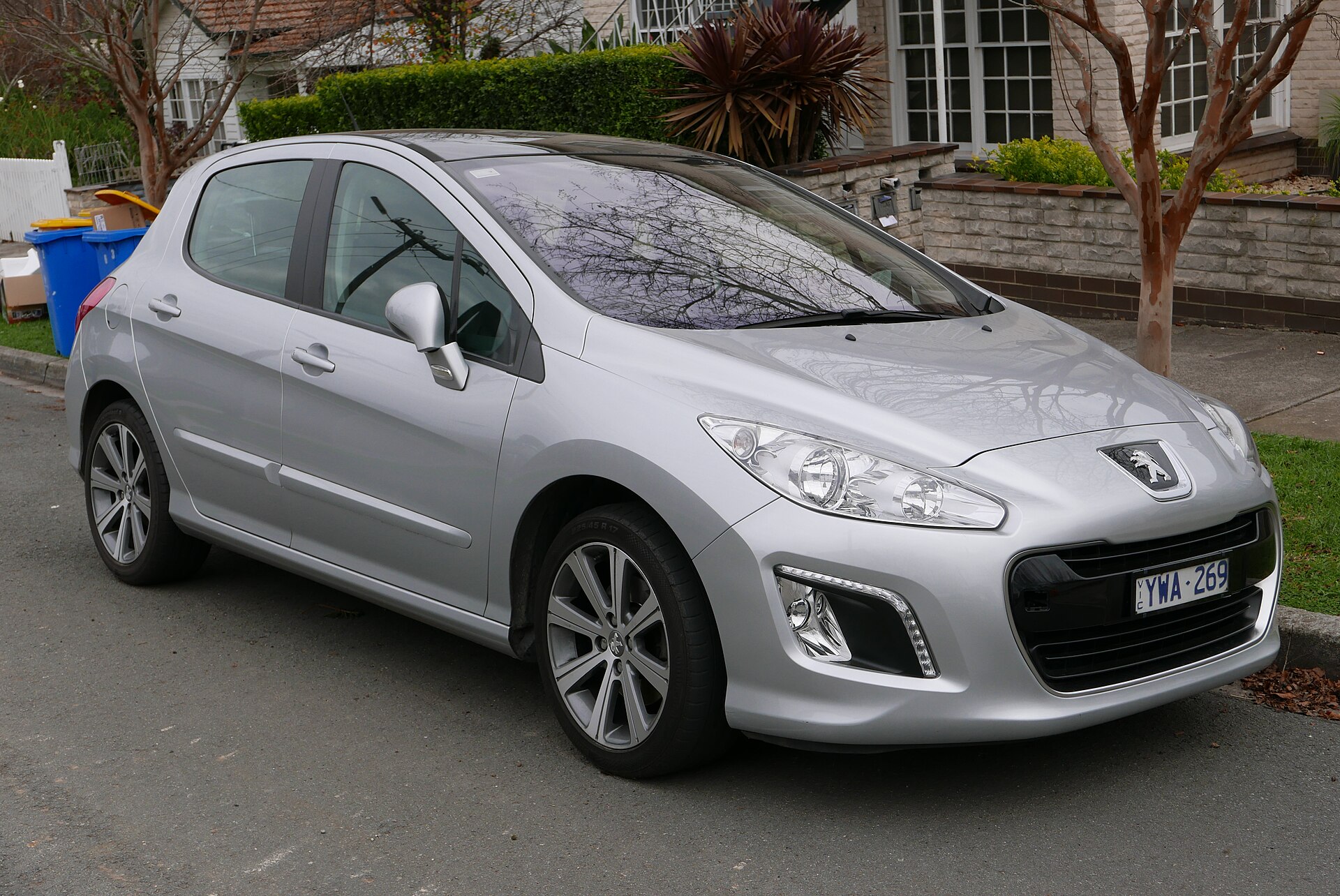
All generations by year: 308 III (2021–now) · 308 I T7 (2007–2013)
Which one is mine?
Pick the year of first registration to see which generation it is.
- 308 III 2021–present
- T7 2007–2013
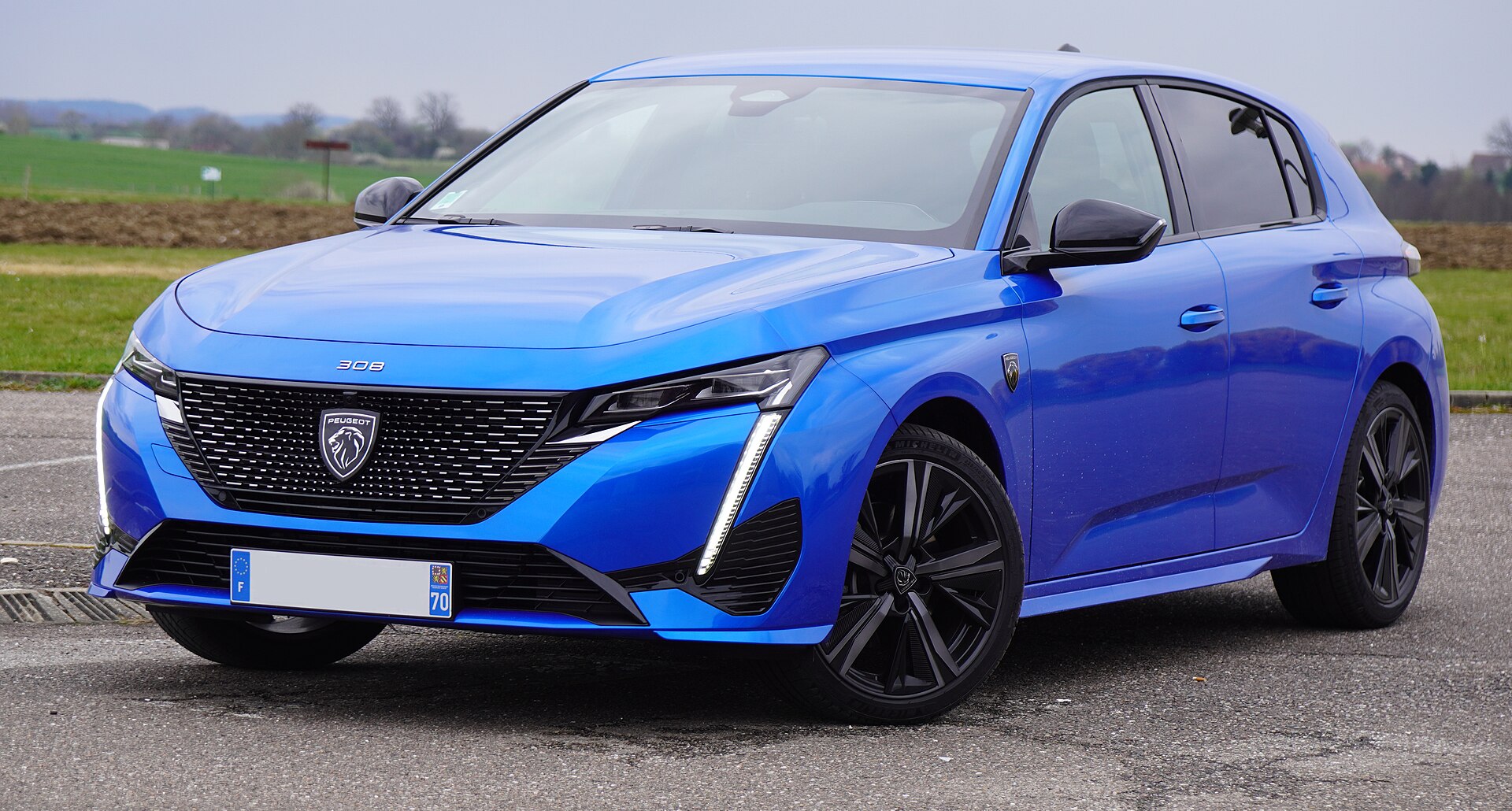
The Peugeot 308 is a compact hatchback and estate made since 2007 and now in its third generation, unveiled on 18 March 2021 and produced in Mulhouse, France, since September 2021. The current 308 uses the third version of Stellantis' EMP2 platform and is sold as a mild hybrid, plug-in hybrid, diesel and the electric E-308. A facelift revealed on 26 August 2025 gave the E-308 a larger battery.
In short
- Three generations: 308 I (2007), 308 II (2013, European Car of the Year 2014) and 308 III (2021).
- Current powertrains: Hybrid 145 at 107 kW (145 PS), Plug-in Hybrid 195 at 143 kW (195 PS), Diesel 130 and E-308 at 115 kW (156 PS).
- E-308 since the facelift: 55.4 kWh usable battery and up to 450 km WLTP range.
- German prices from EUR 34,310 for the Hybrid 145 Style in 2026 (ADAC, valid since October 2025).
Size at a glance
| Dimensions | Peugeot 308 III |
|---|---|
| Length | 4,367 mm171.9 in |
| Width | 1,852 mm72.9 in |
| Height | 1,438 mm56.6 in |
| Wheelbase | 2,675 mm105.3 in |
| Boot | 412 L14.5 cu ft |
Running cost
Fuel · 308 1.2 Hybrid 145 e-DSC6
about 1,250 EUR fuel a year at 15,000 km
4.8 l/100 km · petrol at 1.75 EUR/l · change mileage, fuel price or version
Specs by version
Engines
| Version | Engine | Power | Torque | Gearbox | Drive | Production years |
|---|---|---|---|---|---|---|
| Hybrid · 1 version | ||||||
| 308 III · 1.2 Hybrid 145 e-DSC6 | 1.2 l · 3 cyl · Hybrid 1,199 cc | 107 kW 145 PS143 hp | 230 Nm170 lb-ft | 6-sp Dual-clutch | Front-wheel drive | 2025 |
| Plug-in hybrid · 2 versions | ||||||
| 308 III · 1.6 Plug-in Hybrid 180 | 1.6 l · 4 cyl · Plug-in hybrid 1,598 cc | 133 kW 181 PS178 hp | - | - | Front-wheel drive | 2022–2025 |
| 308 III · 1.6 Plug-in Hybrid 195 e-DSC7 | 1.6 l · 4 cyl · Plug-in hybrid 1,598 cc | 143 kW 194 PS192 hp | 300 Nm221 lb-ft | 7-sp Dual-clutch | Front-wheel drive | 2025 |
| Electric · 1 version | ||||||
| 308 III · E-308 156 | Electric | 115 kW 156 PS154 hp | 270 Nm199 lb-ft | Single-speed | Front-wheel drive | 2025 |
| Diesel · 1 version | ||||||
| 308 III · 1.5 BlueHDi 130 EAT8 | 4 cyl · Diesel | 96 kW 131 PS129 hp | - | 8-sp Automatic | Front-wheel drive | 2022 |
| Petrol · 1 version | ||||||
| 308 III · 1.2 PureTech 130 | 3 cyl · Petrol | 96 kW 131 PS129 hp | - | - | Front-wheel drive | 2022–2024 |
Performance
Show all 4 versions
| Version | 0–100 km/h | Top speed | Fuel consumption | CO₂ |
|---|---|---|---|---|
| Hybrid · 1 version | ||||
| 308 III · 1.2 Hybrid 145 e-DSC6 | 9.0 s 0–62 mph | 210 km/h130 mph | 4.8 l/100 km49.0 mpg US · 58.9 mpg UK | 107 g/km |
| Plug-in hybrid · 1 version | ||||
| 308 III · 1.6 Plug-in Hybrid 195 e-DSC7 | 7.6 s 0–62 mph | 225 km/h140 mph | 2.2 l/100 km106.9 mpg US · 128.4 mpg UK | 50 g/km |
| Electric · 1 version | ||||
| 308 III · E-308 156 | 9.8 s 0–62 mph | 170 km/h106 mph | 14.9 kWh/100 km24.0 kWh/100 mi | - |
| Diesel · 1 version | ||||
| 308 III · 1.5 BlueHDi 130 EAT8 | - | - | 4.9 l/100 km48.0 mpg US · 57.6 mpg UK | 129 g/km |
Dimensions and weight
Show all 3 versions
| Version | Length | Width | Height | Wheelbase | Kerb weight | Boot | Fuel tank | Battery |
|---|---|---|---|---|---|---|---|---|
| Hybrid · 1 version | ||||||||
| 308 III · 1.2 Hybrid 145 e-DSC6 | 4,367 mm171.9 in | - | - | 2,675 mm105.3 in | 1,457 kg3,212 lb | 412 l14.5 cu ft | 52 l13.7 gal US | - |
| Plug-in hybrid · 1 version | ||||||||
| 308 III · 1.6 Plug-in Hybrid 195 e-DSC7 | - | - | - | - | 1,710 kg3,770 lb | 314 l11.1 cu ft | 42 l11.1 gal US | - |
| Electric · 1 version | ||||||||
| 308 III · E-308 156 | 4,367 mm171.9 in | 1,852 mm72.9 in | 1,438 mm56.6 in | 2,675 mm105.3 in | 1,749 kg3,856 lb | 361 l12.7 cu ft | - | 55 kWh |
Verified Manufacturer and type-approval data from our catalog · Sources and methodology
Peugeot 308 at a glance
| Specification | Peugeot 308 (third generation) |
|---|---|
| Segment and body | C-segment five-door hatchback and 308 SW estate |
| Production | Mulhouse (France), since 29 September 2021 |
| Platform | Stellantis EMP2, third version |
| Drive | front-wheel drive |
| Power | 96 kW (131 PS) to 143 kW (195 PS) |
| Battery (E-308) | 58.4 kWh gross, 55.4 kWh usable since 2025 |
| WLTP range (E-308) | up to 450 km (280 miles) |
| DC charging | 100 kW, 20-80% in about 32 minutes |
| Length / wheelbase | 4,367 mm (171.9 in) / 2,675 mm (105.3 in) |
| Boot | 412 l (Hybrid 145); 598 l for the 308 SW |
| Euro NCAP | 4 stars (2022) |
| Price from | EUR 34,310 in Germany (Hybrid 145 Style, 2026) |
From the 307 replacement to the third 308
The first 308, project T7, replaced the 307 in 2007. It reused the 307's chassis under new bodywork with a drag coefficient of 0.29, later 0.28, and was built in Mulhouse and Sochaux. Euro NCAP awarded it five stars, and cumulative production had reached 1,251,700 cars by 2012. Besides the hatchback there were the SW estate and the 308 CC coupe-convertible, and the range-topping 1.6 THP produced 149 kW (203 PS).
| Generation | Years | Platform | Notable facts |
|---|---|---|---|
| 308 I (T7) | 2007-2013 | 307-based chassis | hatchback, SW, CC; 5 Euro NCAP stars (2007) |
| 308 II (T9) | 2013-2021 | EMP2 | 140 kg lighter than the T7; Car of the Year 2014; GTi up to 201 kW (270 PS) |
| 308 III | since 2021 | EMP2, third version | plug-in hybrids, E-308 from 2022; facelift 2025 |
The second generation was unveiled on 13 May 2013 and won European Car of the Year in March 2014. Its buying guide, known faults and engines are covered in the Peugeot 308 II article, and the Peugeot Sport hot hatch has its own page on the 308 GTi.

Third-generation 308 on EMP2
The current 308 grew by 55 mm in wheelbase and became 20 mm lower than the T9, with a drag coefficient of 0.28. ADAC lists it at 4,367 mm long, 1,852 mm wide and 1,438 mm tall, on a 2,675 mm wheelbase. The 308 SW estate followed in June 2021, and the related 408 crossover was unveiled in June 2022. The Opel Astra L shares the platform too; the electric Astra is built in Rüsselsheim, while the E-308 comes from Mulhouse.
The facelift revealed on 26 August 2025 adopted the three-claw light signature first seen on the E-3008 and E-5008, a redesigned grille and bumper, new wheels and an illuminated front badge from GT trim upwards. Orders opened in autumn 2025, and ADAC lists the updated car from October 2025.
Peugeot 308 powertrains: hybrid, plug-in, diesel and E-308
Since the facelift the petrol-only engines have gone, and every petrol 308 has electric assistance.
| Version | Engine or battery | Power and torque | Gearbox | 0-100 km/h | WLTP |
|---|---|---|---|---|---|
| Hybrid 145 | 1.2 l 3 cyl., 48 V | 107 kW (145 PS), 230 Nm | 6-speed e-DSC6 dual-clutch | 9.0 s | 4.8 l/100 km |
| Plug-in Hybrid 195 | 1.6 l 4 cyl. 110 kW + 92 kW motor, 17.2 kWh gross | 143 kW (195 PS), 300 Nm | 7-speed e-DSC7 | 7.6 s | 81 km electric, 2.2 l/100 km |
| Diesel 130 | 1.5 l 4 cyl. | 96 kW (131 PS) | 8-speed EAT8 automatic | - | 4.9 l/100 km |
| E-308 | 55.4 kWh usable | 115 kW (156 PS), 270 Nm | single-speed | 9.8 s | 450 km, 14.9 kWh/100 km |
Before the facelift ADAC listed a PureTech 110 at 81 kW (110 PS) in 2022, the PureTech 130 at 96 kW (130 PS) until October 2024, the Hybrid 136 at 100 kW (136 PS), and plug-in hybrids with 133 kW (180 PS) and 165 kW (225 PS). The plug-in hybrid now reaches 81-82 km of electric range according to Peugeot.
E-308 battery, range and charging
The E-308 was announced in September 2022 and reached Germany in July 2023, followed by the E-308 SW in September 2023. Its first battery had 54 kWh gross and 51 kWh usable capacity and gave up to 412 km WLTP. The 2025 update kept the 400-volt architecture and the 115 kW Stellantis-Nidec motor, but raised capacity to 58.4 kWh gross and 55.4 kWh usable. Range rose to 450 km (280 miles).
DC charging peaks at 100 kW, and a 20-80% charge takes about 32 minutes. An 11 kW three-phase on-board charger is standard in Germany, where ADAC gives 215 minutes for a full AC charge. The facelift added a route planner that accounts for charging stops and elevation, vehicle-to-load output of up to 3.5 kW through an adapter, and Plug&Charge from spring 2026. ADAC records 14.9 kWh/100 km and a kerb weight of 1,749 kg for the E-308 Style.
Boot space, SW estate and weight
The powertrain decides the boot. ADAC measures 412 litres for the Hybrid 145 hatchback, 361 litres for the E-308 and 314 litres for the plug-in hybrid. The 308 SW offers 598 to 1,487 litres in Allure, GT and GT Exclusive trims according to Peugeot, with a two-level floor and a 40/20/40 split rear seat. Kerb weights run from 1,457 kg for the Hybrid 145 to 1,710 kg for the plug-in hybrid and 1,749 kg for the E-308.

Euro NCAP rating: four stars
Euro NCAP rated the 308 III at four stars in May 2022, the same result as the Opel Astra. The 308 scored 76% for adult occupants, 84% for child occupants, 68% for vulnerable road users and 65% for safety assist. Driver chest protection in the frontal test was rated poor, and car-to-car emergency braking scored 2.6 of 6 points. Both models lacked an active bonnet, rear-seat belt detection and reverse emergency braking for pedestrians.
Prices, trims and rivals
ADAC lists the facelifted 308 in Germany in Style, Business, Allure Plus, GT Plus and GT Exclusive trims. In 2026 the Hybrid 145 Style costs EUR 34,310, the Diesel 130 Style EUR 35,590 and the Plug-in Hybrid 195 Business EUR 41,545. Peugeot announced the E-308 Style at EUR 42,435 and the E-308 SW Style at EUR 43,435 in October 2025, while ADAC lists the E-308 Style at EUR 42,635 in 2026. In the UK the E-308 started at GBP 37,435 in 2025. A 308 PureTech 130 started at EUR 28,950 in Germany in 2022, so the entry price has risen as the range moved to hybrids.
The 308 competes with the Volkswagen Golf and with its platform sibling, the Opel Astra L, which also offers hybrid, plug-in and electric versions. For low running costs on longer trips the Diesel 130 at 4.9 l/100 km remains an option; for mixed use the Hybrid 145 is the cheapest 308. Company-car drivers with home charging will find the Plug-in Hybrid 195 the quickest at 7.6 seconds, and the E-308 suits those who want 450 km of range in a compact estate or hatchback. Other models are listed in the Peugeot catalogue.
Photo gallery

Peugeot 308 in our rankings
- No. 10 of 99 · Widest hatchbacks (1,852 mm)
- No. 11 of 85 · Heaviest hatchbacks (1,749 kg · top 13%)
- No. 53 of 324 · Most economical cars (4.8 l/100 km · top 17%)
- No. 15 of 82 · Fastest hatchbacks (225 km/h · top 19%)
- No. 14 of 74 · Biggest boot: hatchbacks (412 l · top 19%)
- No. 21 of 84 · Most powerful French cars (165 kW · top 27%)
Wider than 89% of ranked hatchbacks in the 1CARS catalog (No. 10 of 99).
FAQ
What is the range of the Peugeot E-308?
Since the 2025 facelift the E-308 has a 55.4 kWh usable battery and up to 450 km (280 miles) WLTP range. The earlier version, sold from 2023, had 51 kWh usable and up to 412 km. Both use a 115 kW (156 PS) motor and 100 kW DC charging.
Where is the Peugeot 308 built?
The third-generation 308 is built in Mulhouse, France, where production started on 29 September 2021. The first generation was also built in Sochaux, and its platform sibling Opel Astra L is produced in Rüsselsheim, Germany.
How many Euro NCAP stars does the Peugeot 308 have?
The third-generation 308 received four stars in May 2022, with 76% for adult occupants and 84% for child occupants. Poor driver chest protection in the frontal test and weak car-to-car emergency braking prevented five stars. The first generation had five stars in 2007.
Is the Peugeot 308 still available with a diesel engine?
Yes. The facelifted 308 is still sold with the 1.5-litre Diesel 130 producing 96 kW (131 PS) with an eight-speed EAT8 automatic. ADAC quotes 4.9 l/100 km, and it costs from EUR 35,590 in Germany in 2026.
Data sources
Data checked by an editor against the sources below.
- Wikipedia - Peugeot 308
- Euro NCAP - Be79548e 0b6f 4e98 Bc10 F0b2496ba796
- ADAC - 3generation
- ADAC
- Stellantis - Jetzt Bestellbar Neuer Peugeot 308 Und 308 Sw


