 Peugeot 107
Specs, engines and history
Published Sources (2) Report an error
By Felix Hartmann, Automotive Technology & EV Contributor
- Built
- 2005–2014
- Top power
- 51 kW (69 PS)
- Euro NCAP
- 3 stars · 2012
Which Peugeot 107 to buy: verdict
Our verdict · Felix Hartmann
- Best buy: a 2012-2014 car with the second facelift, ideally one built from July 2013 with ESC and side airbags as standard.
- Cheapest to run: any 1.0 petrol with the five-speed manual.
- For easy city driving: the 2-Tronic automated manual, which cost EUR 550-600 extra in Germany.
- Diesel: the 1.4 HDi is rare and was dropped in 2010; the petrol is the simpler choice.
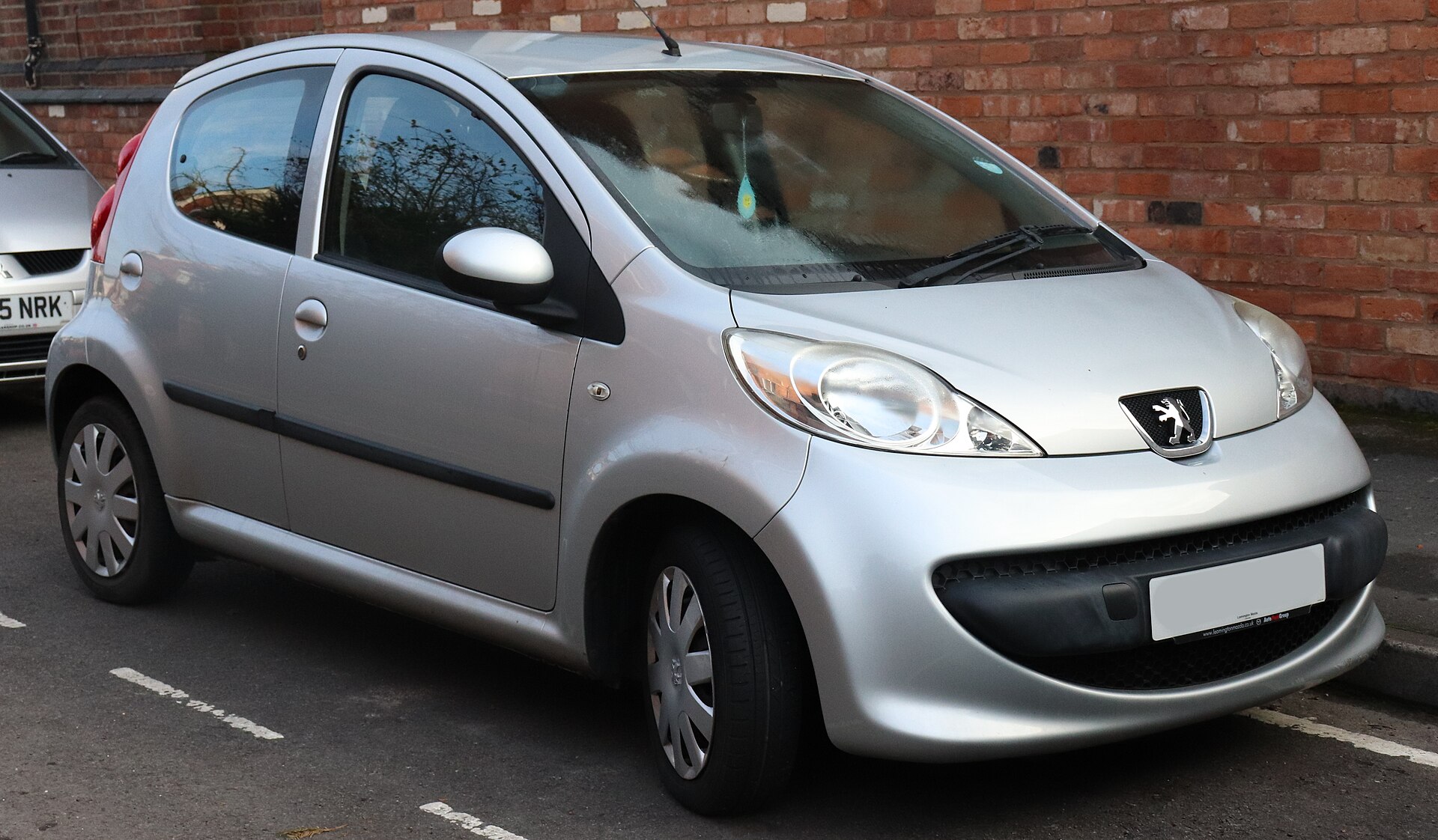
The Peugeot 107 is the city car Peugeot sold from 2005 to 2014, built alongside the Citroën C1 and Toyota Aygo by the TPCA joint venture in Kolín, Czech Republic. It came as a three- or five-door hatchback with four seats, a 1.0-litre three-cylinder Toyota petrol engine and, until 2010, a 1.4 HDi diesel. Light, short and cheap to run, it filled the gap left by the 106 and was replaced by the Peugeot 108 in 2014.
In short
- A-segment city car, 3,430 mm long, built in Kolín (Czech Republic) from June 2005 to 2014.
- Triplets: Citroën C1 and Toyota Aygo, all developed under PSA's B-Zero project with Toyota.
- 1.0-litre Toyota 1KR-FE petrol with 50-51 kW (68-69 PS); 1.4 HDi diesel with 41 kW (56 PS) until 2010.
- Facelifts in February 2009 and early 2012; Euro NCAP retest in 2012 gave three stars.
Size at a glance
| Dimensions | Peugeot 107 I |
|---|---|
| Length | 3,430 mm135.0 in |
| Width | 1,655 mm65.2 in |
| Height | 1,470 mm57.9 in |
| Wheelbase | 2,340 mm92.1 in |
| Boot | 130 L4.6 cu ft |
Specs by version
Engines
| Version | Engine | Power | Torque | Gearbox | Drive | Production years |
|---|---|---|---|---|---|---|
| Diesel · 1 version | ||||||
| 1.4 HDi | 1.4 l · 4 cyl · Diesel DV4TD | 41 kW 56 PS55 hp | 130 Nm96 lb-ft | 5-sp Manual | Front-wheel drive | 2005–2010 |
| Petrol · 1 version | ||||||
| 1.0 68 | 1.0 l · 3 cyl · Petrol 1KR-FE | 50 kW 68 PS67 hp | 93 Nm69 lb-ft | 5-sp Manual | Front-wheel drive | 2005–2014 |
Performance
Show all 2 versions
| Version | 0–100 km/h | Top speed |
|---|---|---|
| Diesel · 1 version | ||
| 1.4 HDi | 14.8 s 0–62 mph | 154 km/h96 mph |
| Petrol · 1 version | ||
| 1.0 68 | 13.7 s 0–62 mph | 157 km/h98 mph |
Dimensions and weight
Verified Manufacturer and type-approval data from our catalog · Sources and methodology
Safety
-
Euro NCAP 2012
Older protocol · Full Euro NCAP result
Stars from different years and organisations are not directly comparable: test protocols change every few years.
Peugeot 107 at a glance
| Specification | Peugeot 107 |
|---|---|
| Segment | A-segment city car |
| Production | June 2005 - 2014 |
| Plant | TPCA, Kolín (Czech Republic) |
| Designer | Donato Coco |
| Body styles | 3-door and 5-door hatchback, four seats |
| Layout | front engine, front-wheel drive |
| Engines | 1.0 three-cylinder petrol; 1.4 HDi diesel (2005-2010) |
| Power | 41-51 kW (56-69 PS) |
| Predecessor / successor | Peugeot 106 / Peugeot 108 |
The 107 is the smallest Peugeot of its era in our Peugeot catalogue, below the 207.
Generations and model history
The 107 had one generation. It was developed under PSA's B-Zero project together with Toyota, and the three versions differ mainly in their front ends, rear lights and badges; the Toyota Aygo has more detail differences than the two French cars. The 107 even shares its rear light clusters with the C1, but with a different red lens. Production started in June 2005, and the 107 effectively replaced both the 106, which had ended in July 2003, and the short-lived 1007 at the bottom of the range.
| Generation | Code | Years | Body styles | Engines | Power (kW / hp) |
|---|---|---|---|---|---|
| 107 (original) | B-Zero | 2005-2009 | 3-door, 5-door | 1.0 petrol, 1.4 HDi | 41-51 kW (55-68 hp) |
| 107 (first facelift) | B-Zero | 2009-2012 | 3-door, 5-door | 1.0 petrol, 1.4 HDi to 2010 | 41-51 kW (55-68 hp) |
| 107 (second facelift) | B-Zero | 2012-2014 | 3-door, 5-door | 1.0 petrol | 50-51 kW (68 hp) |
The February 2009 facelift brought a new front bumper, a wider grille with the number plate moved below it, two side vents, new interior trim and a revised clutch, and CO2 emissions fell from 109 to 106 g/km. The second update, premiered at the Brussels Motor Show in early 2012, added a new bonnet and front bumper with integrated daytime running lights, plus a leather steering wheel and new gear lever on higher trims. The Peugeot 108 replaced the 107 in July 2014.

Engines, transmissions and performance
| Engine | Power | Torque | 0-100 km/h | Top speed | Years |
|---|---|---|---|---|---|
| 1.0 VTi (Toyota 1KR-FE), 998 cc, 3 cyl | 50-51 kW (68-69 PS) | 93 Nm | 12.3-13.7 s | 157-158 km/h | 2005-2014 |
| 1.4 HDi (DV4), 1,398 cc, 4 cyl | 41 kW (56 PS) | 130 Nm | 14.8 s | 154 km/h | 2005-2010 |
Peugeot's international data give the petrol engine as 51 kW (69 PS) and 12.3 seconds to 100 km/h; ADAC lists the German five-door at 50 kW (68 PS) and 13.7 seconds. Both engines drive the front wheels through a five-speed manual gearbox. The petrol could also be ordered with the 2-Tronic automated manual, also a five-speed unit. The diesel was not offered in every market; in Germany the 107 was sold only with the petrol engine.
Dimensions, space and boot
| Parameter | Metric | Imperial |
|---|---|---|
| Length | 3,430 mm | 135.0 in |
| Width (without mirrors) | 1,630-1,655 mm | 64.2-65.2 in |
| Height | 1,470 mm | 57.9 in |
| Wheelbase | 2,340 mm | 92.1 in |
| Kerb weight | 790-880 kg | 1,742-1,940 lb |
| Boot | 130 l, 782 l with rear seat folded | 4.6 / 27.6 cu ft |
| Fuel tank | 35 l | 9.2 US gal |
The 107 is about 25 cm shorter than the 106 Phase II, and its 130-litre boot is small even by city-car standards: enough for shopping, not for a family holiday. In the city that compact footprint is the point.

Fuel economy and running costs
On the old NEDC cycle the petrol 107 used 4.3-4.6 l/100 km with CO2 emissions of 99-109 g/km; ADAC lists the 2005-2008 five-door at 4.6 l/100 km and 108 g/km. The 1.4 HDi was rated at 4.0 l/100 km and 109 g/km. With a kerb weight under 900 kg and a 35-litre tank, a full tank covers well over 700 km on the official figures. Our cost of ownership calculator helps estimate the full cost per year.

Trims, equipment and prices
German list prices (ADAC) began at EUR 9,750 for the three-door 1.0 70 Petit Filou in 2005; the five-door Filou cost EUR 10,700 and the 2-Tronic added EUR 600. After the 2012 update the entry Access three-door was still EUR 9,750 (2012), while the five-door Active 2-Tronic cost EUR 11,800. Across Europe the 107 was sold in around 15 trim levels and editions, among them Access, Active, Allure, Envy, Sportium, Urban, Urban Move and Verve.
Safety
When Euro NCAP first tested the triplets in 2005, they earned four stars for adult occupant protection. After the facelift Euro NCAP retested them in 2012 under stricter rules and gave the 107, C1 and Aygo three stars, with 68% for adult occupants, 73% for child occupants, 53% for pedestrians and 71% for safety assist. The test body criticised the lack of standard side airbags and electronic stability control; ESC was optional on some versions and PSA and Toyota committed to fitting it, side airbags and ISOFIX as standard from July 2013. See our safety section for how the rating system changed.
Reliability and known issues
ADAC data point to good reliability. In its breakdown statistics published in May 2010, the 107, C1 and Aygo ranked top of the smallest-car class for cars aged one to four years. In January 2010 PSA recalled under 100,000 Peugeot 107 and Citroën C1 cars after Toyota's worldwide accelerator pedal recall, because the pedal could stick partly depressed or return slowly. Used buyers should check that this work was carried out.
Sales
European sales rose from 19,610 in 2005 to a peak of 117,920 in 2009 and were still 85,858 in 2011. They fell to 24,356 in 2014, the last full year.
Rivals
| Model | Engines | Power (hp) | Boot (l) | Price from (EUR) |
|---|---|---|---|---|
| Peugeot 107 (2005-2014) | 1.0 petrol, 1.4 diesel | 55-68 | 130 | 9,750 (Germany, 2005) |
| Citroën C1 (2005-2014) | 1.0 petrol, 1.4 diesel | 55-68 | 130 | - |
| Toyota Aygo (2005-2014) | 1.0 petrol, 1.4 diesel | 54-68 | - | - |
| Fiat Panda II (2003-2012) | 1.1-1.4 petrol, 1.3 diesel | - | - | - |
| Volkswagen Fox (2005-2011) | 1.2-1.4 petrol, 1.4 diesel | - | - | - |
Rival figures other than the 107's are approximate. The comparison tool shows them side by side.

Peugeot 107 in our rankings
- No. 3 of 93 · Smallest hatchbacks (3,430 mm)
- No. 3 of 76 · Lightest hatchbacks (865 kg)
- No. 5 of 531 · Smallest cars (3,430 mm)
- No. 10 of 391 · Lightest cars (865 kg)
- No. 488 of 1082 · Longest-running car nameplates (9 years · top 49%)
- No. 70 of 91 · Biggest engines: hatchbacks (1,398 cc · top 79%)
Shorter than 99% of ranked cars in the 1CARS catalog (No. 5 of 531).
FAQ
Is the Peugeot 107 the same car as the Citroën C1 and Toyota Aygo?
Essentially yes. All three were built in the same plant in Kolín, Czech Republic, with the same platform and engines; they differ in styling details and equipment.
How big is the Peugeot 107 boot?
130 litres, or 782 litres with the rear seat folded and loaded to the roof, according to ADAC.
What engine does the Peugeot 107 have?
A 998 cc three-cylinder Toyota 1KR-FE petrol with 50-51 kW (68-69 PS) and 93 Nm. A 1.4 HDi diesel with 41 kW (56 PS) was available until 2010.
How safe is the Peugeot 107?
Euro NCAP gave it four stars for adult protection in 2005 and three stars overall in its 2012 retest.
What replaced the Peugeot 107?
The Peugeot 108, launched in July 2014 and again built in Kolín with the Citroën C1 and Toyota Aygo.
Data sources
Data checked by an editor against the sources below.