
 Peugeot 505
Specs, engines and history
Published Sources (1) Report an error
By Felix Hartmann, Automotive Technology & EV Contributor
- Built
- 1979–1992
- Top power
- 132 kW (179 PS)
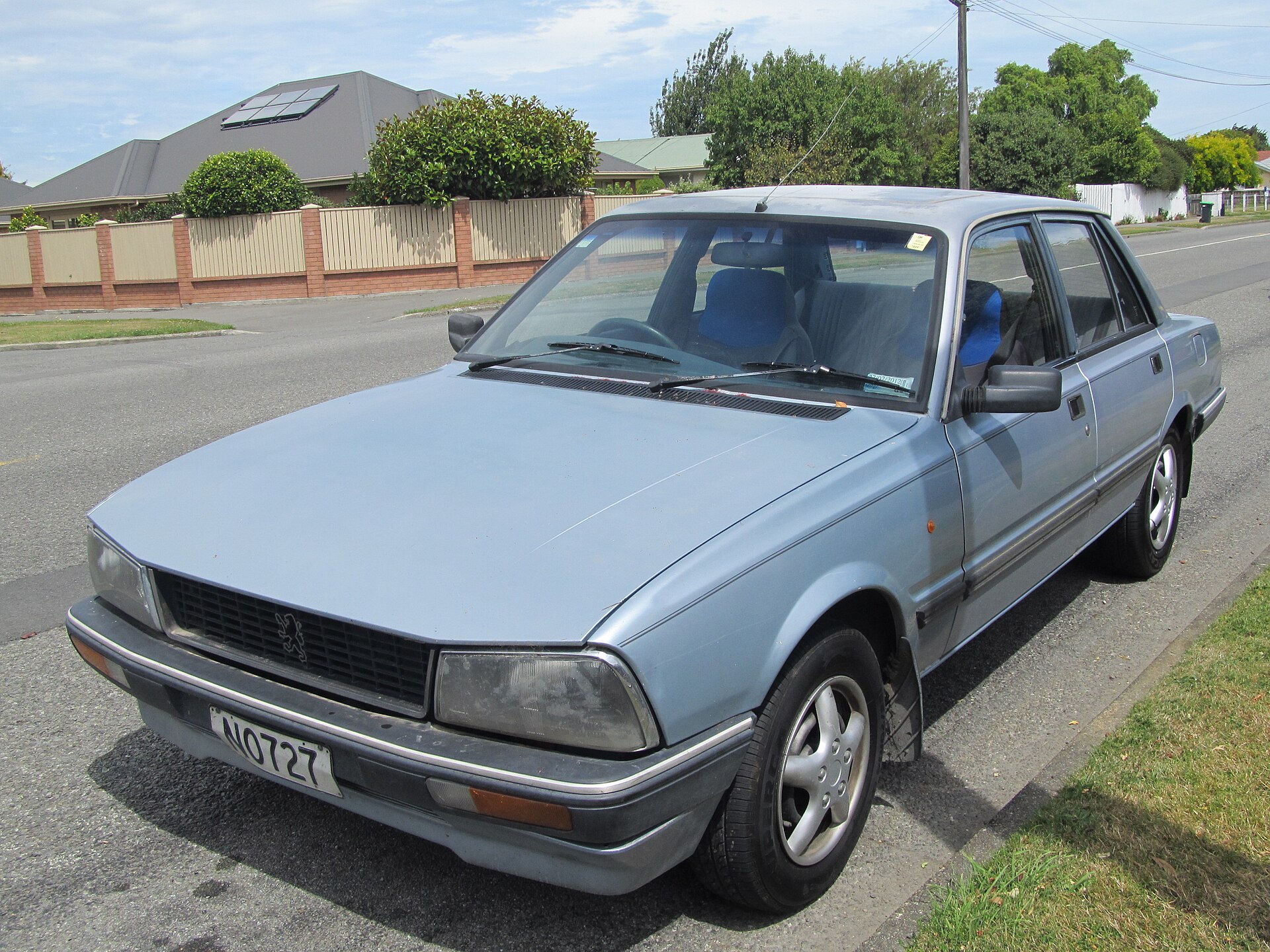
The Peugeot 505 is a rear-wheel-drive large family car that Peugeot built in Europe from 1979 to 1992 as a four-door saloon and a five-door Break estate. It replaced the 504, carried Pininfarina styling, and was Peugeot's last rear-wheel-drive car. Engines ran from a 51 kW (70 PS) diesel to a 132 kW (180 PS) turbo petrol, and Peugeot built 1,351,254 cars in all.
In short
- Presented to the press in Paris on 16 May 1979; European saloon production ended around 1989-1990, the estate in 1992.
- 1,351,254 built according to Peugeot's figure, of which 1,116,868 were saloons.
- Petrol engines from 1.8 to 2.8 litres (PRV V6), diesels of 2.3 and 2.5 litres with and without turbo.
- Assembled in Sochaux and abroad, from Vigo in Spain to Argentina and Guangzhou in China.
Specs by version
Engines
| Version | Engine | Power | Drive | Production years |
|---|---|---|---|---|
| Diesel · 2 versions | ||||
| 2.3 diesel (70 CV) | 2.3 l · 4 cyl · Diesel XD2 | 51 kW 69 PS68 hp | Rear-wheel drive | 1979 |
| 2.5 turbo diesel (110 CV) | 2.5 l · 4 cyl · Diesel XD3TE | 81 kW 110 PS109 hp | Rear-wheel drive | 1987 |
| Petrol · 4 versions | ||||
| 2.0 (108 CV) | 2.0 l · 4 cyl · Petrol XN1A | 79 kW 107 PS106 hp | Rear-wheel drive | - |
| 2.2 GTI (130 CV) | 2.2 l · 4 cyl · Petrol ZDJL | 96 kW 131 PS129 hp | Rear-wheel drive | - |
| 2.8 V6 (170 CV) | 2.8 l · 6 cyl · Petrol ZN3J | 125 kW 170 PS168 hp | Rear-wheel drive | 1986 |
| 2.2 Turbo Injection (180 CV) | 2.2 l · 4 cyl · Petrol N9TEA | 132 kW 179 PS177 hp | Rear-wheel drive | 1986 |
Performance
Show all 6 versions
| Version | 0–100 km/h | Top speed |
|---|---|---|
| Diesel · 2 versions | ||
| 2.3 diesel (70 CV) | - | 141 km/h88 mph |
| 2.5 turbo diesel (110 CV) | - | 178 km/h111 mph |
| Petrol · 4 versions | ||
| 2.0 (108 CV) | - | 175 km/h109 mph |
| 2.2 GTI (130 CV) | 10.0 s 0–62 mph | 185 km/h115 mph |
| 2.8 V6 (170 CV) | 9.2 s 0–62 mph | 205 km/h127 mph |
| 2.2 Turbo Injection (180 CV) | 8.4 s 0–62 mph | 210 km/h130 mph |
Dimensions and weight
Show all 6 versions
| Version | Length | Width | Wheelbase |
|---|---|---|---|
| Diesel · 2 versions | |||
| 2.3 diesel (70 CV) | 4,579 mm180.3 in | 1,737 mm68.4 in | 2,743 mm108.0 in |
| 2.5 turbo diesel (110 CV) | 4,579 mm180.3 in | 1,737 mm68.4 in | 2,743 mm108.0 in |
| Petrol · 4 versions | |||
| 2.0 (108 CV) | 4,579 mm180.3 in | 1,737 mm68.4 in | 2,743 mm108.0 in |
| 2.2 GTI (130 CV) | 4,579 mm180.3 in | 1,737 mm68.4 in | 2,743 mm108.0 in |
| 2.8 V6 (170 CV) | 4,579 mm180.3 in | 1,737 mm68.4 in | 2,743 mm108.0 in |
| 2.2 Turbo Injection (180 CV) | 4,579 mm180.3 in | 1,737 mm68.4 in | 2,743 mm108.0 in |
Verified Manufacturer and type-approval data from our catalog · Sources and methodology
Peugeot 505 at a glance
| Item | Peugeot 505 |
|---|---|
| Years | 1979-1992 (Europe); Argentina to the mid-1990s; China 1990-1997 |
| Production total | 1,351,254 (1,116,868 saloons) |
| Main plant | Sochaux, France |
| Body styles | 4-door saloon, 5-door Break estate, 8-seat Familiale |
| Design | Pininfarina with Peugeot's styling department; original interior by Paul Bracq |
| Layout | front longitudinal engine, rear-wheel drive |
| Engines | 1.8, 2.0, 2.2 petrol; 2.2 turbo; 2.8 V6; 2.3 and 2.5 diesel and turbo diesel |
| Power | 51 kW (70 PS) to 132 kW (180 PS) |
| Kerb weight | 1,210-1,410 kg |
| Top speed | 141 km/h (2.3 diesel) to 210 km/h (Turbo Injection, 132 kW (180 PS)) |
| 0-100 km/h | 8.4 s (Turbo Injection, 132 kW (180 PS)), Wikipedia EN |
| Price new | NLG 46,995 for the Turbo Injection in the Netherlands, March 1984 |
Why Peugeot kept rear-wheel drive in 1979
Work on the 504's successor began in 1974, and Peugeot ran four customer clinics with prototypes in 1977. More than half of the people asked recognised the car as a Peugeot straight away, which suited a brand that wanted continuity. The 505 slotted between the 504 and the flagship 604, and for four years it was sold alongside the 504, which stayed in French production until 1983.
Under the new body sat much of the 504's hardware. The saloon used MacPherson struts at the front and semi-trailing arms with coil springs at the rear. The estate and most Argentine saloons had a live rear axle located by a Panhard rod, which gave the Break its load capacity: the eight-seat Familiale offered 1.94 m³ of space and a 590 kg payload. The saloon measured 4,579 mm on a 2,743 mm wheelbase; the estate stretched to 4,898 mm on 2,900 mm.
Diesels arrived in July 1979, right-hand drive in October 1979, and the estate at the Geneva show in 1982. The 505 kept rear-wheel drive while rivals in the class were moving to front-wheel drive, a layout the Audi 100 had used since its first generation, as our Audi 100 history explains.
From diesel taxi to Turbo Injection
The 505 covered a wide spread of buyers. In 1980 Peugeot sold 1,200 diesel taxis to New York and Los Angeles, and North American sales peaked at around 20,000 cars in 1984. At the other end, the Turbo Injection used a 2,155 cc engine of Chrysler-Simca origin with a Garrett turbocharger. Wikipedia EN dates it to October 1982 with 110 kW (150 PS); Dutch sales began on 15 March 1984 at NLG 46,995.
An intercooler in early 1984 raised output to 118 kW (160 PS), and the 1986 update brought 132 kW (180 PS) with ABS. The same year Peugeot added the 2,849 cc PRV V6 at 125 kW (170 PS), priced level with the Turbo. Diesel buyers got a 2.5-litre turbo diesel with intercooler in 1987, rated at 81 kW (110 PS).
| Engine | Code | Displacement | Power | Top speed |
|---|---|---|---|---|
| 1.8 petrol | XM7 | 1,796 cc | 59 kW (80 PS) | 165 km/h |
| 2.0 petrol | XN1A | 1,971 cc | 71-79 kW (96-108 PS) | 175 km/h |
| 2.0 petrol | ZEJK | 1,995 cc | 81 kW (110 PS) | - |
| 2.2 petrol | ZDJK | 2,165 cc | 86 kW (117 PS) | 178 km/h |
| 2.2 petrol (GTI) | ZDJL | 2,165 cc | 96 kW (130 PS) | 185 km/h |
| 2.2 turbo petrol | N9T / N9TE / N9TEA | 2,155 cc | 110-132 kW (150-180 PS) | 200-210 km/h |
| 2.8 V6 | ZN3J (PRV) | 2,849 cc | 125 kW (170 PS) | 205 km/h |
| 2.3 diesel | XD2 | 2,304 cc | 51 kW (70 PS) | 141 km/h |
| 2.3 turbo diesel | XD2S | 2,304 cc | 59 kW (80 PS) | 160 km/h |
| 2.5 diesel | XD3 | 2,498 cc | 56 kW (76 PS) | 150 km/h |
| 2.5 turbo diesel | XD3T / XD3TE | 2,498 cc | 70-81 kW (95-110 PS) | 170-178 km/h |
Power figures vary between sources because catalysed engines lost output: Secret Classics lists 112 kW (150 hp) for the catalysed Turbo Injection of 1987 and 107 kW (143 hp) for the catalysed V6. The power converter handles the CV, PS and hp figures found in period brochures.

Estates, Dangel 4x4 and a Tour d'Europe win
The Break and Familiale were the versions that outlived the saloon. Dangel converted the estate to four-wheel drive from 1986 with a raised ride height, and Peugeot Vintage puts output at more than 5,500 cars. The conversion used either the 81 kW (110 PS) turbo diesel or the 2.2 petrol at 96 kW (130 PS), with shorter gearing.
In competition, an STI driven by Holger Bohne and Peter Diekmann won the 1981 Tour d'Europe. Jean-Pierre Beltoise raced 505s in French production racing from 1980, and from 1983 turbo cars ran in the Superproduction class with far more power than any road version.

Facelift, the 405 and the long goodbye
The facelift of 1985-1986 (sources differ on the year) gave the 505 new bumpers, grille and tail lights and a completely new dashboard, while the platform stayed unchanged. A four-speed automatic replaced the three-speed in 1987. By then the front-wheel-drive 405 was on sale, and from 1988 it took over the 505's European customers. The 605 arrived in 1989, the saloon ended soon after, and the last 505 registered in the Netherlands, on 9 March 1992, was a 2.5 D Commercial.
Assembly continued abroad. SEVEL built 91,920 cars in Argentina, Vigo produced 146,216 between 1987 and 1995 according to Wikipedia FR, and Guangzhou Peugeot built the car until 1997. The last French-built 505, a Familiale, went to the Musée de l'Aventure Peugeot. Peugeot's wider story is in our history of Peugeot.
Peugeot 505 today: what to check when buying
Rust is the main enemy. Auto Express lists the wheel arches, floor pans and sunroof surrounds as the usual problem areas, and cars kept in damp climates often need welding. Body panels and trim are getting harder to find, and a donor car is sometimes the only source.
Mechanical checks:
- Fuse boxes on pre-1982 cars can cause intermittent electrical faults through oxidised contacts; later fuse boxes are the cure.
- The cooling system must be free of air, because hot spots have cracked cylinder heads.
- On automatics, the oil and filter mesh should be changed every 18,000 miles (about 29,000 km).
- A creaking clutch pedal usually means a worn linkage, a simple repair.
- On a Turbo Injection, check that boost pressure has not dropped or been raised.
The XD diesels and the Douvrin petrol engines are known for high mileages when oil changes have been regular, while Turbo Injection and V6 cars have narrower parts supply. Peugeot owners' clubs, specialist parts suppliers and the international 505 forum are the main support network.
Values stay modest. Five auction sales listed by Classic.com between January and September 2026 ranged from USD 3,650 to USD 7,605, about EUR 3,100 to EUR 6,500 at an approximate 0.86 rate, plus one car sold at EUR 5,000. More French classics of the period are in our classic cars section, and the current range is in the Peugeot catalogue.
Peugeot 505 in our rankings
- No. 339 of 1141 · Longest-running car nameplates (13 years · top 32%)
- No. 40 of 116 · Smallest sedans (4,579 mm · top 35%)
- No. 28 of 78 · Most powerful French cars (132 kW · top 36%)
- No. 15 of 40 · Fastest French cars (210 km/h · top 40%)
- No. 34 of 82 · Fastest sedans (210 km/h · top 42%)
- No. 77 of 172 · Biggest engines: sedans (2,849 cc · top 45%)
In production longer than 68% of ranked nameplates in the 1CARS catalog (No. 339 of 1141).
FAQ
When was the Peugeot 505 built?
Peugeot presented the 505 to the press on 16 May 1979. European saloon production ended around 1989-1990 and the estate in 1992, while assembly in Argentina ran to the mid-1990s and in China to 1997.
How many Peugeot 505s were made?
Peugeot's figure is 1,351,254 cars, including 1,116,868 saloons. Wikipedia FR gives a slightly different 1,350,798, and the totals depend on whether foreign assembly is counted.
What is the fastest Peugeot 505?
The Turbo Injection with 132 kW (180 PS), introduced in 1986, reached 210 km/h and 0-100 km/h in 8.4 seconds. The 2.8 V6 with 125 kW (170 PS) was close behind at 205 km/h.
Was the 505 Peugeot's last rear-wheel-drive car?
Yes. Every Peugeot saloon after it, starting with the 405 of 1987, used front-wheel drive, so the 505 estate that ended in 1992 closed Peugeot's rear-drive era in Europe.
Data sources
Data checked by an editor against the sources below.
- Wikipedia - Peugeot 505


