Audi 100: History of the C1, C2, C3 and C4
The Audi 100 is the executive car that turned Audi from a small maker into a rival for Mercedes-Benz and BMW. Built in West Germany from 1968 to 1994 across four generations - known by their platform codes C1, C2, C3 and C4 - it was sold in the United States as the Audi 5000 until 1988 and spawned the more luxurious Audi 200, which came only with five-cylinder engines, including turbocharged ones. In 1994 the line continued under a new name, the A6.
Key takeaways
- Four generations: C1 (1968–1976), C2 (1976–1984), C3 (1982–1991) and C4 (1990–1994).
- The C1 was developed in secret by engineer Ludwig Kraus and became a commercial success, with more than 827,000 built.
- The aerodynamic C3 (drag coefficient 0.30) brought galvanised bodies and, from 1985, quattro four-wheel drive.
- Engines grew from a 59 kW (80 PS) 1.8 to turbocharged five-cylinders with up to 162 kW (220 PS).
Audi 100 at a glance: maker, production years and purpose
The Audi 100 was a front-engined, water-cooled business sedan from Audi, then part of the Volkswagen group. Over its life it was offered as a two- and four-door sedan, a coupé and, from 1977, a wagon. The name was later replaced by the A6. More models from Ingolstadt are listed in our Audi catalogue, and the background of the brand is told in the history of Audi.
Development and production history
C1 (1968–1976): the car built against orders
The first Audi 100 was a remarkable story. Volkswagen's chairman Heinrich Nordhoff had banned Auto Union (Audi) from developing new models, but engineer Ludwig Kraus designed the car in secret. Nordhoff only learned about the project when he was shown a prototype that was ready for production - and he had little choice but to approve it. The decision paid off: the C1 was a commercial success, and more than 827,000 were built.
It was offered from 1968 as a two- and four-door sedan and as a coupé. The front end had round headlights on each side, linked by a thin chrome strip across the grille with the four rings in the middle, and the front bumper protruded prominently. The interior had a thin-rimmed four-spoke steering wheel and a compact instrument panel with two large round dials (speed and revs) and two small gauges for temperature and fuel.
Engines started with a 1.8-litre unit of 59 kW (80 PS); the 100 S had 66 kW (90 PS) and the 100 LS 74 kW (100 PS) from the same displacement, while the coupé used a 1.9-litre engine with 85 kW (115 PS). From April 1970 a three-speed automatic supplied by Volkswagen was available, and after 1975 the 100 L received a 1.6-litre four-cylinder.
C2 (1976–1984): five cylinders and the first Avant
The second generation appeared in June 1976 as a two- and four-door sedan, followed in autumn 1977 by a wagon. The coupé was dropped. Its styling, influenced by the NSU Ro 80, replaced the round lamps with rectangular headlights and rectangular fog lamps. A 1980 update brought larger lights and a revised interior.
Four-cylinder engines of 1.6 and 2.0 litres were joined by a new fuel-injected 2.1-litre in-line five-cylinder, plus diesel engines. The upmarket Audi 200 used a 2.1-litre five-cylinder with 100 kW (136 PS) or a turbocharged version with 125 kW (170 PS). Gearboxes were a five-speed manual or a three-speed automatic. The front suspension used struts; at the rear was a torsion-beam axle with trailing arms, a Panhard rod and coil springs.
C3 (1982–1991): the aerodynamic breakthrough
The C3 did more than any earlier Audi to raise the brand's prestige, putting it close to Mercedes-Benz and BMW. Its long, smooth body achieved a drag coefficient of 0.30, outstanding for the time. From 1983 the wagon was called the Avant - a name Audi has used for its estates ever since. From 1985 the bodies were galvanised and covered by a ten-year anti-perforation warranty.
A 1988 facelift brought flush door handles, bumpers without the chrome strip, the boot lock moved into a tail light, no chrome on the light surrounds and side mouldings, and engine-size badges instead of trim badges on the boot. Inside there was a redesigned instrument panel; expensive versions had warning displays for power-steering fluid, brake fluid and washer fluid. The number of air vents rose from six to seven for better ventilation and less misting, and new door trims and an adjustable driver's seat cushion were added. The sedan's boot holds 570 litres.
Design and engineering
The C3 introduced quattro four-wheel drive to the Audi 100 in 1985. Early systems used lockable centre and rear differentials; later cars received a Torsen self-locking centre differential. Gearboxes were four- or five-speed manuals and three- or four-speed automatics.
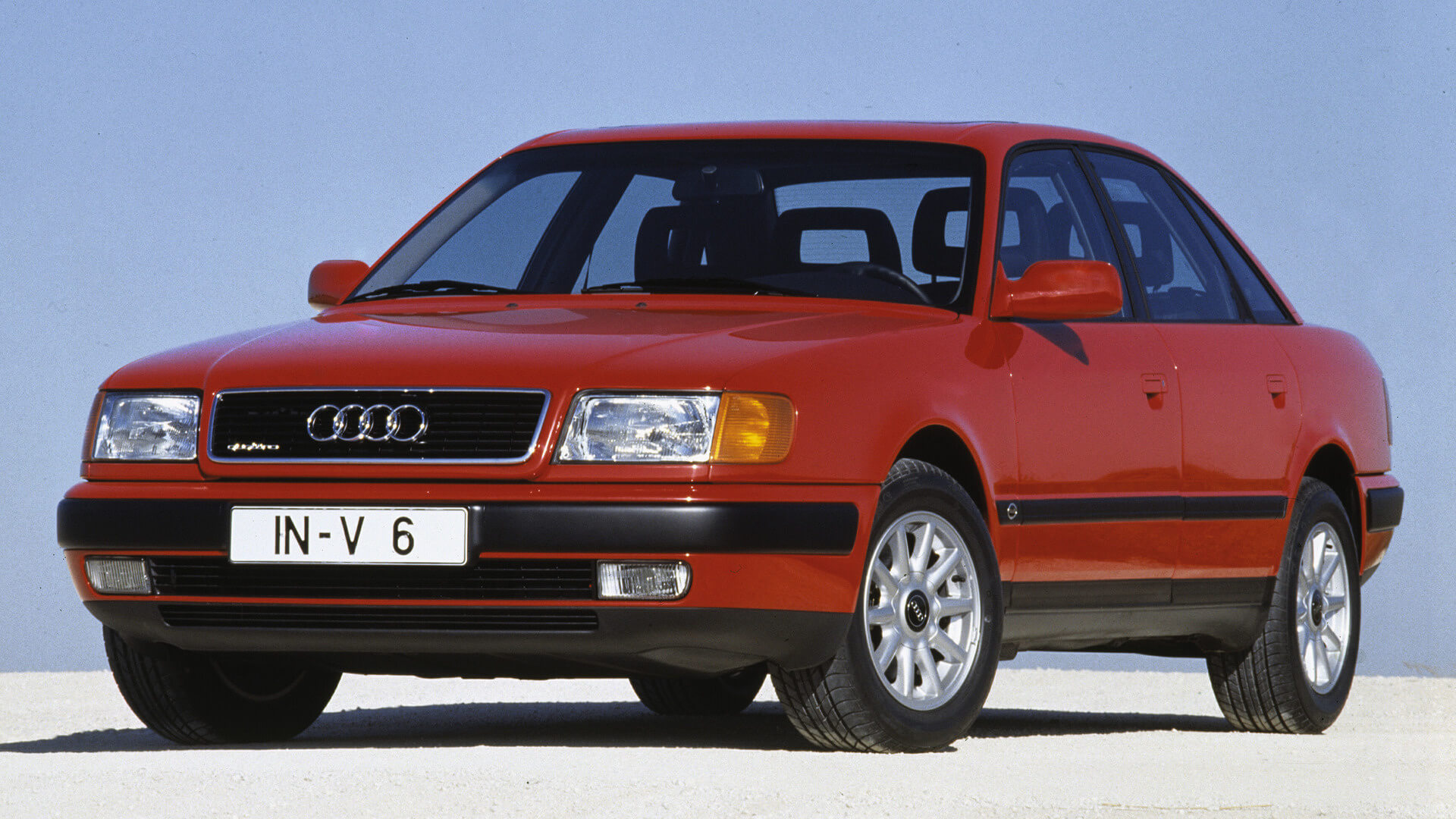
The C4 of 1990–1994 was a deep rework of the C3 and the last Audi 100. Built as a sedan and an Avant, it had a galvanised body whose structure was 35% stiffer than before, plastic cladding on the bumpers and doors, rectangular headlights with a chrome-framed grille and large tail lights with the boot lock in the right-hand lamp. Quattro versions have independent suspension front and rear; front-wheel-drive cars use a semi-independent rear axle. The chassis absorbs bad roads well and stays composed at high speed.
Safety was a priority. The C4 used Audi's procon-ten system: steel cables connect the engine, the steering column and the front seat-belt reels. In a severe frontal impact the engine moves backwards, pulling the steering column away from the driver and tightening the front belts at the same time. In lower-speed crashes energy is absorbed by crumple zones, while side protection comes from stiff sills, a cross-member behind the dashboard, larger B-pillars tied into the roof and sills, door beams and airbags.
Inside, the C4 offered comfortable seats front and rear, good-quality plastics and noise insulation that was excellent for its era. The four-spoke leather steering wheel is telescopic, and the long instrument binnacle stretches towards the centre of the dashboard. The boot holds 510 litres.
Engine and drivetrain
| Generation | Petrol engines | Diesel engines | Power (kW / PS) |
|---|---|---|---|
| C1 (1968–1976) | 1.6 (from 1975), 1.8, 1.9 | - | 59–85 kW / 80–115 PS |
| C2 (1976–1984) | 1.6, 2.0 four-cylinder; 2.1 five-cylinder (Audi 200 also turbo) | yes | up to 125 kW / 170 PS (Audi 200 turbo) |
| C3 (1982–1991) | 1.8 four-cylinder; 2.0–2.3 five-cylinder; 2.2 turbo | 2.0 five-cylinder, 2.5 turbodiesel | 51–162 kW / 69–220 PS |
| C4 (1990–1994) | 2.0–2.8 (incl. 2.8 V6) | 4- and 5-cylinder TDI | 73–128 kW / 99–174 PS (diesel 66–103 kW / 90–140 PS) |
The C3's workhorses were the 1.8-litre four-cylinder engines coded DR (55 kW / 75 PS) and DS (66 kW / 90 PS, with a Pierburg carburettor, renamed NP after 1988). The five-cylinders comprised a 2.0 with 74 kW (100 PS), a 2.1 and a 2.2 with 85 kW (115 PS) each, a 2.3 with 98 kW (133 PS) and the 2.2-litre KU with 101 kW (138 PS). From 1986 there were 2.0-litre five-cylinder diesels and turbodiesels with 51–74 kW (69–100 PS), later a 2.5-litre turbodiesel with 88 kW (120 PS). From early 1989 turbocharged 2.2-litre engines delivered 121 kW (165 PS) and 162 kW (220 PS).
The C4 used engines from 2.0 to 2.8 litres with 73–128 kW (99–174 PS), largely shared with the Audi 80, plus four TDI diesels with four and five cylinders and 66–103 kW (90–140 PS). A five-speed manual was standard and a four-speed automatic optional.
Audi 100 C4 specifications
| Parameter | Value |
|---|---|
| Body styles | Sedan, Avant (wagon) |
| Petrol power range | 73–128 kW / 99–174 PS |
| 0–100 km/h, 2.0 (74 kW / 101 PS and 85 kW / 116 PS) | 11.0–12.6 s |
| 0–100 km/h, 2.3 | 10.2 s (9.5 l/100 km combined) |
| 0–100 km/h, 2.8 V6 (128 kW / 174 PS) | 8.0 s |
| Gearboxes | 5-speed manual; 4-speed automatic optional |
| Boot | 510 l |
| Body structure | Galvanised; 35% stiffer than the C3 |
Variants and derivatives
| Variant | Years | Body / purpose | Notes |
|---|---|---|---|
| Audi 100 Coupé | C1 era | Coupé | 1.9 litre, 85 kW (115 PS) |
| Audi 100 Avant | from 1977 (named Avant from 1983) | Wagon | The C3 gave the Avant name to all Audi wagons |
| Audi 200 | from the C2 | Luxury sedan | Five-cylinder engines only, including turbos |
| Audi 5000 | C3, to 1988 | Sedan, wagon | Name of the 100 in the United States |
| Audi 100 quattro | from 1985 | Sedan, Avant | Four-wheel drive, later with Torsen centre differential |
In service: operation, reliability and legacy
Standard C4 equipment included ABS, a driver's airbag, child locks, side-impact door beams, electric front windows, power steering, electric mirrors and halogen headlights. Options included air conditioning, a sunroof, remote central locking, a passenger airbag, quattro drive, electric rear windows, heated electric front seats, a leather steering wheel, a trip computer, heated mirrors, fog lamps, tinted glass and 15-inch alloy wheels.
Owners rate the C4's engines as reliable and praise its sound insulation, suspension, roomy cabin and large boot. Many cars are still on the road in good condition - evidence of durable construction and good build quality. The quattro system, high safety standards and comfort win particular praise. The drawbacks are the cost of parts, the cars' age and high fuel consumption. In its day the C4 competed with the BMW 5 Series (E34) and the Mercedes-Benz E-Class (W124).
Preservation and collecting today
Well-preserved Audi 100s are increasingly valued: the galvanised C3 and C4 bodies survive well, so the condition of the mechanicals, electrics and interior matters most. Buyers should budget for parts that are no longer cheap and for maintenance that befits a premium German car.
FAQ
When was the Audi 100 produced?
From 1968 to 1994, in four generations: C1 (1968–1976), C2 (1976–1984), C3 (1982–1991) and C4 (1990–1994).
How many first-generation Audi 100s were built?
More than 827,000 examples of the C1 were produced.
What is the difference between the Audi 100, Audi 200 and Audi 5000?
The Audi 200 was a more expensive, better-equipped version with five-cylinder engines only, including turbocharged units. The Audi 5000 was the name used for the 100 in the United States until 1988.
When did the Audi 100 get quattro four-wheel drive?
Quattro versions of the C3 were offered from 1985; later cars used a Torsen self-locking centre differential.
What is procon-ten?
A mechanical safety system on the C4: in a heavy frontal crash, cables linked to the engine pull the steering column away from the driver and tighten the front seat belts.