
 Audi Q7
All generations, specs and history
Updated Published Sources (4) Report an error
By Felix Hartmann, Automotive Technology & EV Contributor Reviewed by Oleksandr Hnatiuk

- Built
- 2005–present
- Generations
- 2 · 4L to 4M
- Top power
- 373 kW (507 PS)
Timeline
Q7 generations
Click a generation for its own page


- Q7 4L 2005–2015 · SUV · 177–368 kW (241–500 PS)
- Q7 4M Current 2015–now · SUV · 160–373 kW (218–507 PS)
Newest first · 2 generations since 2005
-
2015

-
2005

All generations by year: Q7 4M (2015–now) · Q7 4L (2005–2015)
Which one is mine?
Pick the year of first registration to see which generation it is.
Check by VINWhich Audi Q7 to buy
Our verdict · Felix Hartmann
The 4M is far more efficient and modern than the 4L. A facelifted 4M (2019–) with the 50 TDI or the 55 TFSI e plug-in hybrid suits most families. On used cars, check the air suspension if fitted, the AdBlue and diesel particulate filter systems on TDIs and the service history of the eight-speed gearbox.
The Audi Q7 is a full-size luxury SUV with quattro all-wheel drive and up to seven seats, built mainly in Bratislava, Slovakia, since 2005. The first generation (4L) offered a 6.0-litre V12 TDI with 368 kW (500 PS); the second (4M), revealed in Detroit in January 2015, was up to 325 kg lighter; and a third generation was revealed on 9 June 2026.
In short
- 4L (2005–2015): Frankfurt 2005 premiere, 3.0 and 4.2 TDI, 3.6 and 4.2 FSI petrol, V12 TDI with 1,000 Nm.
- 4M (2015–2026): MLB platform, 2.0 and 3.0 TFSI, 3.0 TDI, e-tron and TFSI e plug-in hybrids, SQ7 with up to 373 kW (507 PS).
- Boot of the 4M: 890 litres with five seats in use and up to 2,075 litres; 295 litres with all seven seats up.
- Facelifts in 2019 (mild hybrids, two touchscreens) and 2024 (new headlights, OLED tail lights).

Size at a glance
| Dimensions | Audi Q7 4M |
|---|---|
| Length | 5,050 mm198.8 in |
| Width | 1,970 mm77.6 in |
| Height | 1,741 mm68.5 in |
| Wheelbase | 2,994 mm117.9 in |
| Boot | 890 L31.4 cu ft |
Running cost
Fuel · Q7 4M 274 kW (373 PS) SUV
about 450 EUR fuel a year at 15,000 km
1.7 l/100 km · petrol at 1.75 EUR/l · change mileage, fuel price or version
Specs by version
Engines
| Version | Engine | Power | Drive |
|---|---|---|---|
| Plug-in hybrid · 2 versions | |||
| 4M · 274 kW (373 PS) SUV | Plug-in hybrid | 274 kW 373 PS367 hp | All-wheel drive |
| 4M · 60 TFSI e quattro | Plug-in hybrid | 335 kW 455 PS449 hp | All-wheel drive |
| Diesel · 3 versions | |||
| 4M · 45 TDI | Diesel | 170 kW 231 PS228 hp | All-wheel drive |
| 4M · 3.0 183 kW (249 PS) SUV | 3.0 l · Diesel 3,000 cc | 183 kW 249 PS245 hp | All-wheel drive |
| 4M · 50 TDI | Diesel | 210 kW 286 PS282 hp | All-wheel drive |
| Petrol · 4 versions | |||
| 4M · 185 kW (252 PS) SUV | Petrol | 185 kW 252 PS248 hp | All-wheel drive |
| 4M · 245 kW (333 PS) SUV | Petrol | 245 kW 333 PS329 hp | All-wheel drive |
| 4M · 55 TFSI | 3.0 l · Petrol 3,000 cc | 250 kW 340 PS335 hp | All-wheel drive |
| 4M · SQ7 TFSI | Petrol | 373 kW 507 PS500 hp | All-wheel drive |
Performance
Show all 1 versions
| Version | Fuel consumption |
|---|---|
| 4M · 2015 | |
| 4M · 274 kW (373 PS) SUV | 1.7 l/100 km138.4 mpg US · 166.2 mpg UK |
Dimensions and weight
Show all 4 versions
| Version | Length | Width |
|---|---|---|
| Plug-in hybrid · 1 version | ||
| 4M · 274 kW (373 PS) SUV | 5,050 mm198.8 in | 1,970 mm77.6 in |
| Diesel · 1 version | ||
| 4M · 3.0 183 kW (249 PS) SUV | 5,050 mm198.8 in | 1,970 mm77.6 in |
| Petrol · 2 versions | ||
| 4M · 185 kW (252 PS) SUV | 5,050 mm198.8 in | 1,970 mm77.6 in |
| 4M · 245 kW (333 PS) SUV | 5,050 mm198.8 in | 1,970 mm77.6 in |
Verified Manufacturer and type-approval data from our catalog · Sources and methodology
Audi Q7 at a glance
The Q7 was Audi's first SUV and the last of the big German premium brands to enter the segment. It sold best in Europe in 2007, with 41,064 cars, and in the USA in 2017, with 38,346. The second generation is also assembled in India and Malaysia. The brand's story is told in the history of Audi, the coupé-styled sister model is the Audi Q8, and the range is in the Audi catalogue.

| Generation | Years | Platform | Main engines | Gearbox |
|---|---|---|---|---|
| Q7 4L | 2005–2015 | PL71 (Touareg, Cayenne) | 3.0/4.2 TDI, 3.6/4.2 FSI, 6.0 V12 TDI | 6-speed Tiptronic; 8-speed from 2010 |
| Q7 4M | 2015–2026 | MLB | 2.0/3.0 TFSI, 3.0 TDI, PHEV, SQ7 | 8-speed ZF automatic |
| Q7 (third generation) | 2026– | Premium Platform Combustion | 2.9 V6 twin-turbo, 4.0 V8 (SQ7) | – |
First-generation Audi Q7 (4L, 2005–2015)
Shown at the Frankfurt Motor Show in September 2005, the first Q7 went into production in Bratislava in November 2005. It was offered with two or three rows of seats and permanent quattro drive, with a six-speed Tiptronic automatic as standard; the 3.6 petrol could be ordered with a six-speed manual in Europe. The 2010 model-year facelift brought LED lights, the third-generation MMI system and an eight-speed automatic. Euro NCAP tested the Q7 in 2006 and gave it four stars.

| Engine | Power | Torque |
|---|---|---|
| 3.6 FSI V6 petrol | 206 kW (280 PS) | 360 Nm |
| 4.2 FSI V8 petrol | 257 kW (350 PS) | 440 Nm |
| 3.0 TDI V6 diesel | 177 kW (240 PS) | 550 Nm |
| 4.2 TDI V8 diesel | 240 kW (326 PS) | 760 Nm |
| 6.0 V12 TDI twin-turbo diesel | 368 kW (500 PS) | 1,000 Nm |
With 1,000 Nm, the V12 TDI made the Q7 one of the most powerful diesel SUVs ever built.
Second-generation Audi Q7 (4M, 2015–2026)
Lighter body and design
Revealed at the Detroit motor show in January 2015, the second Q7 moved to the MLB platform. It is up to 325 kg lighter than its predecessor, 71 kg of that in the body, thanks to hot-formed high-strength steel and aluminium doors, bonnet, front wings and tailgate. A 3.0 TFSI weighs about 1,970 kg and a 3.0 TDI about 1,995 kg. The body is 5,050 mm long, 1,970 mm wide and 1,740 mm high, with a drag coefficient quoted at 0.32. The wide Singleframe grille has horizontal chrome bars, and buyers could choose xenon, LED or Matrix LED headlights, with 18- to 21-inch wheels.

Interior and boot
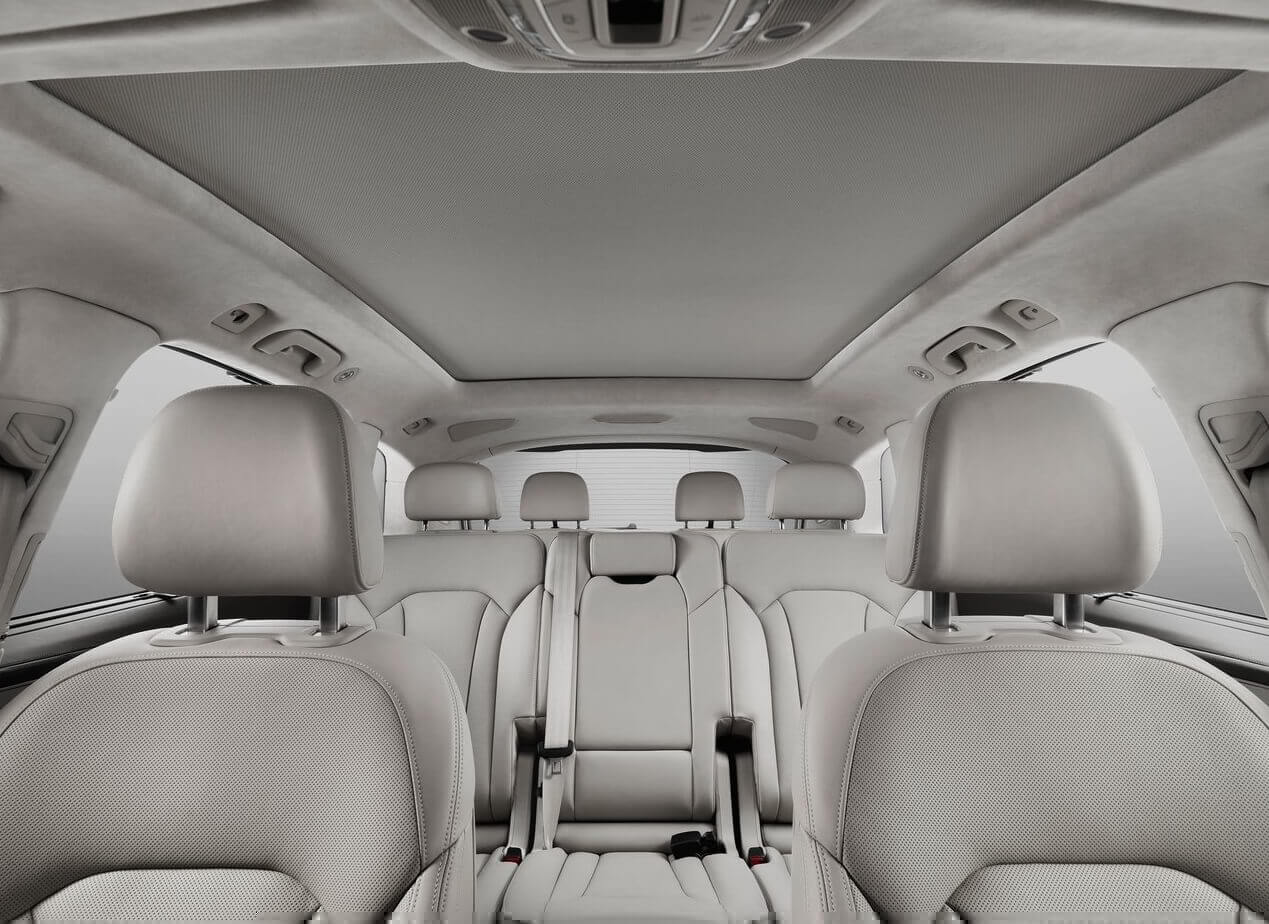
The cabin was completely redesigned, with a horizontal dashboard, air vents across its width and an optional 12.3-inch Virtual Cockpit and head-up display. Rear legroom grew by 21 mm and headroom by 41 mm. The MMI screen of 7 or 8.3 inches rises out of the dashboard, and options included a Bang & Olufsen sound system, a panoramic roof and four-zone climate control. The power tailgate can open with a foot movement under the bumper, and the loading lip is 46 mm lower than before.
| Seats in use | Boot volume |
|---|---|
| 7 seats | about 295 L (10.4 cu ft) |
| 5 seats | 890 L (31.4 cu ft) |
| Rear seats folded | 2,075 L (73.3 cu ft) |
Audi Q7 4M engines
| Engine | Years | Power | Torque |
|---|---|---|---|
| 2.0 TFSI (45 TFSI) | 2015– | 185 kW (252 PS) | 370 Nm |
| 3.0 TFSI | 2016–2019 | 245 kW (333 PS) | 440 Nm |
| 55 TFSI 3.0 V6 | 2019– | 250 kW (340 PS) | 450 Nm |
| 3.0 TDI | 2015–2018 | 200 kW (272 PS) | 600 Nm |
| 45 TDI | 2019– | 170 kW (231 PS) | 500 Nm |
| 50 TDI | 2019– | 210 kW (286 PS) | 600 Nm |
| SQ7 TDI 4.0 V8 | 2016–2020 | 320 kW (435 PS) | 900 Nm |
| SQ7 TFSI 4.0 V8 | 2020– | 373 kW (507 PS) | 770 Nm |
All 4M versions use the ZF eight-speed automatic and quattro with a self-locking centre differential and a default 40:60 front-to-rear torque split.
Plug-in hybrids
The 2015 Q7 e-tron combined the 3.0 TDI with a 94 kW electric motor and a 17.3 kWh battery for 190 kW system output, 600 Nm and about 54–56 km of electric range. In 2019 it was replaced by the 55 TFSI e, which uses a 3.0 V6 petrol engine with a 17.3 kWh battery, 280 kW (381 PS) and 600 Nm, and reaches 100 km/h in 5.6 seconds; the 60 TFSI e has 335 kW (456 PS) and 700 Nm.
Safety, facelifts and equipment
Driver aids include adaptive cruise control with traffic-jam assist, cross-traffic assist, lane assist, night vision and a 360-degree camera. In the 2019 Euro NCAP test, the 50 TDI scored 92% for adult occupants, 86% for children, 71% for pedestrians and 72% for safety assist. The 2019 facelift added mild-hybrid systems, a dual-touchscreen MMI and optional HD Matrix LED and laser headlights, and a second update in January 2024 brought revised headlights and OLED tail lights.
Third-generation Audi Q7 (from 2026)
The third Q7 was revealed on 9 June 2026 on the Premium Platform Combustion, and in July 2026 Audi placed the larger Q9 above it. It uses a 2.9-litre twin-turbo V6 rated at 429 hp (SAE) and 599 Nm, while the SQ7 has a 4.0-litre twin-turbo V8 with 591 hp (SAE) and 800 Nm; Australia also gets a 3.0-litre diesel V6. European kW ratings were not confirmed in our sources at the time of writing.

Rivals: how the Audi Q7 compares
The Q7 competes with the BMW X5 and X7, Mercedes-Benz GLE and GLS, Volvo XC90, Range Rover Sport, Porsche Cayenne and Toyota Land Cruiser. Its strengths are a quiet, high-quality cabin, seven seats, quattro drive and efficient diesels; its weaknesses are a tight third row, high option prices and the complexity of air suspension and electronics on used cars.

Audi Q7: first vs latest generation
| Spec | Q7 4L | Q7 4M | Change |
|---|---|---|---|
| Years | 2005–2015 | 2015 | 10 years apart |
| Most powerful version | 368 kW (500 PS) | 373 kW (507 PS) | +5 kW (+1%) |
Oldest and newest generation in the 1cars catalog. Power is the strongest version of each; other rows are shown only when both generations have the figure.
Popular comparisons
Audi Q7 in our rankings
- No. 10 of 198 · Longest SUVs and crossovers (5,050 mm)
- No. 39 of 531 · Longest cars (5,050 mm · top 8%)
- No. 68 of 509 · Widest cars (1,970 mm · top 14%)
- No. 23 of 175 · Most powerful diesel cars (210 kW · top 15%)
- No. 40 of 253 · Most powerful SUVs and crossovers (373 kW · top 16%)
- No. 36 of 194 · Widest SUVs and crossovers (1,970 mm · top 19%)
Longer than 94% of ranked SUVs and crossovers in the 1CARS catalog (No. 10 of 198).
Audi Q7 photos 38




Audi Q7 videos 5

Audi Q7 video 1

Audi Q7 video 2

Audi Q7 video 3

Audi Q7 video 4
Audi Q7 video 5
FAQ
How many generations of the Audi Q7 are there?
There are three: the 4L from 2005 to 2015, the 4M from 2015, facelifted in 2019 and 2024, and a third generation revealed on 9 June 2026. All of them have quattro all-wheel drive.
Does the Audi Q7 have seven seats?
Yes, as an option. The third row seats two, mainly suited to children. With all seven seats up, the second-generation Q7's boot holds about 295 litres, compared with 890 litres with five seats.
Was there a V12 Audi Q7?
Yes. The first-generation Q7 V12 TDI had a 6.0-litre twin-turbo diesel V12 producing 368 kW (500 PS) and 1,000 Nm, one of the most powerful diesel engines ever fitted to an SUV.
Is the Audi Q7 available as a plug-in hybrid?
Yes. The Q7 e-tron of 2015 used a 3.0 TDI with a 17.3 kWh battery and 54–56 km of electric range, and from 2019 the 55 and 60 TFSI e use a petrol V6 with up to 335 kW (456 PS).
Where is the Audi Q7 built?
The Q7 is built mainly at the Volkswagen Group plant in Bratislava, Slovakia. The second generation is also assembled in Aurangabad, India, and Pekan, Malaysia, for local markets.
Data sources
Data checked by an editor against the sources below.
- The text of this article (1cars archive)
- Wikipedia - Audi Q7
- Co
- Euro NCAP - Best In Class Battle Heats Up In Latest Batch Of Results


