 Peugeot 108
Specs, engines and history
Published Sources (3) Report an error
By Felix Hartmann, Automotive Technology & EV Contributor
- Built
- 2014–2022
- Top power
- 60 kW (82 PS)
Which 108 to buy: verdict
Our verdict · Felix Hartmann
- Quickest: a 2014-2018 1.2 PureTech 82, with 11.0 seconds to 100 km/h and 171 km/h.
- Cheapest to run: a 2018-2022 1.0 VTi 72 with start-stop, at 3.8-4.1 l/100 km (NEDC).
- For sunshine: the 108 TOP! with the fabric roof, which ADAC lists in 59 versions.
- For town traffic without a clutch: the ETG5 automated manual, available with the 1.0 engine.
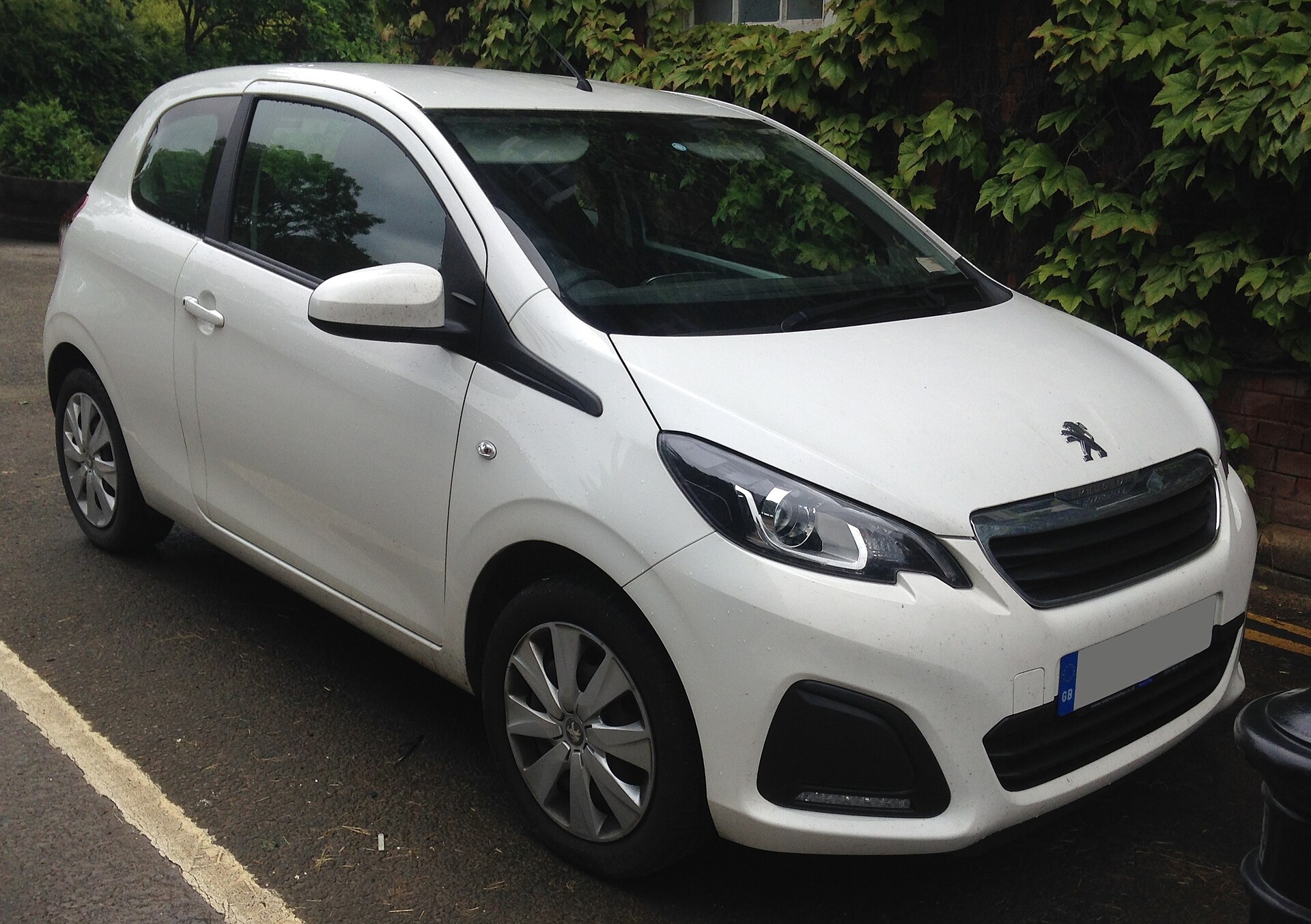
The Peugeot 108 is the city car Peugeot sold from 2014 to early 2022, built by Toyota and PSA in Kolín, Czech Republic, alongside its near-identical twins, the Citroën C1 and Toyota Aygo. It was 3.48 m long, came with three or five doors and a TOP! version with a fabric roof, and used one of two three-cylinder petrol engines with 51 to 60 kW. When Toyota took over the Kolín plant in 2021, Peugeot let the 108 die without a successor.
In short
- One generation, built July 2014 to January 2022 in Kolín (TPCA), replacing the Peugeot 107.
- Engines: Toyota 1.0 VTi with 51 kW (69 PS), later 53 kW (72 PS), and PSA 1.2 PureTech with 60 kW (82 PS) until 2018.
- Five-speed manual or ETG5 automated manual; boot 196 litres, kerb weight from 840 kg.
- Euro NCAP 2014: four stars (adult 80%, child 80%).
Size at a glance
| Dimensions | Peugeot 108 I |
|---|---|
| Length | 3,475 mm136.8 in |
| Width | 1,615 mm63.6 in |
| Height | 1,460 mm57.5 in |
| Wheelbase | 2,340 mm92.1 in |
| Boot | 196 L6.9 cu ft |
Running cost
Fuel · 108 1.0 VTi 68
about 1,100 EUR fuel a year at 15,000 km
4.1 l/100 km · petrol at 1.75 EUR/l · change mileage, fuel price or version
Specs by version
Engines
| Version | Engine | Power | Torque | Gearbox | Drive | Production years |
|---|---|---|---|---|---|---|
| 1.0 VTi 68 | 1.0 l · 3 cyl · Petrol 1KR-FE | 51 kW 69 PS68 hp | 95 Nm70 lb-ft | 5-sp Manual | Front-wheel drive | 2014–2018 |
| 1.0 VTi 72 | 1.0 l · 3 cyl · Petrol 1KR | 53 kW 72 PS71 hp | 93 Nm69 lb-ft | 5-sp Manual | Front-wheel drive | 2018–2022 |
| 1.2 PureTech 82 | 1.2 l · 3 cyl · Petrol EB2-F | 60 kW 82 PS80 hp | 117 Nm86 lb-ft | 5-sp Manual | Front-wheel drive | 2014–2018 |
Performance
Show all 3 versions
| Version | 0–100 km/h | Top speed | Fuel consumption | CO₂ |
|---|---|---|---|---|
| 1.0 VTi 68 | 13.0 s 0–62 mph | 160 km/h99 mph | 4.1 l/100 km57.4 mpg US · 68.9 mpg UK | 90 g/km |
| 1.0 VTi 72 | 13.8 s 0–62 mph | 160 km/h99 mph | 4.1 l/100 km57.4 mpg US · 68.9 mpg UK | 93 g/km |
| 1.2 PureTech 82 | 11.0 s 0–62 mph | 171 km/h106 mph | 4.3 l/100 km54.7 mpg US · 65.7 mpg UK | 99 g/km |
Dimensions and weight
Show all 1 versions
| Version | Length | Width | Height | Wheelbase | Kerb weight | Boot | Fuel tank |
|---|---|---|---|---|---|---|---|
| 1.0 VTi 72 | 3,475 mm136.8 in | 1,615 mm63.6 in | 1,460 mm57.5 in | 2,340 mm92.1 in | 915 kg2,017 lb | 196 l6.9 cu ft | 35 l9.2 gal US |
Verified Manufacturer and type-approval data from our catalog · Sources and methodology
Peugeot 108 at a glance
| Specification | Peugeot 108 |
|---|---|
| Segment | A-segment city car |
| Production | July 2014 - January 2022 |
| Plant | TPCA, Kolín, Czech Republic |
| Body styles | three- and five-door hatchback; TOP! with folding fabric roof |
| Layout | front engine, front-wheel drive |
| Twins | Citroën C1 (second generation), Toyota Aygo (second generation) |
| Length / wheelbase | 3,475 / 2,340 mm |
| Kerb weight | 840-956 kg |
| Power | 51-60 kW (69-82 PS) |
| Designer | Sébastien Criquet |
The 108 is listed in our Peugeot catalogue, where it sits below the Peugeot 208.
Generation and model history
| Generation | Code | Years | Body styles | Engines | Power (kW / hp) |
|---|---|---|---|---|---|
| 108 | - | 2014-2018 | 3-door, 5-door, TOP! | 1.0 VTi (1KR-FE), 1.2 PureTech (EB2-F) | 51-60 kW (69-82 PS) |
| 108 (update) | - | 2018-2022 | 3-door, 5-door, TOP! | 1.0 VTi 72 (1KR-B52) | 53 kW (72 PS) |
The 108 was never replaced by a second generation. Peugeot revealed it at the Geneva Motor Show in March 2014; sales began in mainland Europe in June 2014 and in the UK in July 2014. The car came from the Toyota and PSA joint venture TPCA in Kolín, which also built the C1 and Aygo. The three cars share the floorpan, engines, gearboxes and electrics and differ mainly in styling.
In spring 2018 Peugeot updated the interior with new seat upholstery and left the exterior unchanged. At the same time the 1.0 VTi 68 and the 1.2 PureTech 82 gave way to a revised 1.0 VTi with 53 kW (72 PS). ADAC dates the PureTech's end to February 2018 and the new 1.0 to March 2018.


Engines, transmissions and performance
| Engine | Years | Displacement | Power | Torque | 0-100 km/h | Top speed |
|---|---|---|---|---|---|---|
| 1.0 VTi 68 (1KR-FE) | 2014-2018 | 998 cc, 3 cyl. | 51 kW (69 PS) | 95 Nm | 13.0 s | 160 km/h |
| 1.2 PureTech 82 (EB2-F) | 2014-2018 | 1,199 cc, 3 cyl. | 60 kW (82 PS) | 117 Nm | 11.0 s | 171 km/h |
| 1.0 VTi 72 (1KR-B52) | 2018-2022 | 998 cc, 3 cyl. | 53 kW (72 PS) | 93 Nm | 12.6-13.8 s | 160 km/h |
Both 1.0 engines came from Toyota's 1KR family, the 1.2 from PSA's PureTech range. A five-speed manual was standard, and the 1.0 could be ordered with the ETG5, a five-speed automated manual gearbox; the 1.2 PureTech came only with the manual in the ADAC listings. Wikipedia gives 61 kW for the PureTech, ADAC 60 kW; both quote 82 PS. For the 1.0 VTi 72, Wikipedia gives 12.6 seconds to 100 km/h, while ADAC lists 13.8 seconds for the five-door Active.
Dimensions, space and boot
| Parameter | Metric | Imperial |
|---|---|---|
| Length | 3,475 mm | 136.8 in |
| Width (without mirrors) | 1,615 mm | 63.6 in |
| Height | 1,460 mm | 57.5 in |
| Wheelbase | 2,340 mm | 92.1 in |
| Kerb weight | 840-956 kg | 1,852-2,108 lb |
| Boot, seats up / folded | 196 / 780 l | 6.9 / 27.5 cu ft |
| Fuel tank | 35 l | 9.2 US gal |
The boot is small even by city-car standards: 196 litres against 251 litres in the Volkswagen up! of the same period. The 108's strength is its footprint: at 3.48 m it is about 12 cm shorter than an up!. Check how it fits a tight space with our size comparison tool.
Fuel economy and running costs
| Engine | Consumption (NEDC) | CO2 |
|---|---|---|
| 1.0 VTi 68 | 4.1 l/100 km | 90 g/km |
| 1.2 PureTech 82 | 4.3 l/100 km | 99 g/km |
| 1.0 VTi 72 | 3.8-4.1 l/100 km | 86-93 g/km |
These are official NEDC figures; the range for the VTi 72 reflects the Wikipedia value (3.8 l/100 km) and ADAC's figure for the 2018-2019 five-door Active (4.1 l/100 km). In US terms, 4.1 l/100 km is about 57 mpg.
Trims and equipment
The 108 used Peugeot's usual ladder. Access was the base version; Active added air conditioning, Bluetooth, a DAB radio and a touchscreen and later became the entry trim. Allure brought keyless entry, a reversing camera and electrically heated mirrors. Collection added automatic air conditioning, Feline was the high-spec version with leather seats and the 1.2 engine, GT Line replaced the Feline Nav, and Roland Garros was a special edition with climate control. ADAC also lists a Style version from 2016.
German prices (ADAC list prices):
- 1.0 VTi 68, three doors: EUR 8,890 (07/2014-10/2016)
- 1.2 PureTech 82 Allure, five doors: EUR 14,050 (03/2015-02/2018)
- 1.0 VTi 72 Stop&Start Active, five doors: EUR 14,570 (06/2020-01/2022)
- 1.0 VTi 72 Stop&Start Collection, five doors: EUR 16,270 (06/2020-01/2022)
Safety
Euro NCAP rated the 108 in 2014, with the same result as its C1 and Aygo twins, and awarded four stars: 80% for adult occupants, 80% for child occupants, 62% for vulnerable road users and 56% for safety assist. ADAC states the overall result as 71 out of 100. Ratings of other city cars are in our safety section.
Reliability and known issues
We found no documented 108-specific fault pattern in the sources used for this guide, so we do not list one. The mechanical layout is shared with the Aygo and C1, which keeps parts widely available. The ETG5 is an automated manual rather than a conventional automatic, so test-drive it before buying if you expect torque-converter smoothness.
Sales and the end of the 108
| Year | European sales |
|---|---|
| 2014 | 31,087 |
| 2015 | 68,522 |
| 2016 | 63,561 |
| 2017 | 55,831 |
| 2018 | 57,257 |
| 2019 | 54,230 |
| 2020 | 43,629 |
| 2021 | 34,689 |
| 2022 | 3,875 |
The 108 peaked in 2015 with 68,522 European sales. When Toyota took full ownership of the Kolín plant on 1 January 2022, the 108 and C1 ended; only the Aygo name continued, later as the Aygo X crossover.

Rivals
| Model | Engines | Power (kW / hp) | Boot (l) | Price from (EUR) |
|---|---|---|---|---|
| Peugeot 108 | 1.0 VTi, 1.2 PureTech | 51-60 kW (69-82 PS) | 196 | 8,890 (2014) |
| Citroën C1 II | 1.0 VTi, 1.2 PureTech | 51-60 kW (69-82 PS) | 196 | 8,890 (2014) |
| Toyota Aygo II | 1.0 (1KR-FE) | 51 kW (69 PS) | 168 | 9,950 (2014) |
| Volkswagen up! (2016 update) | 1.0, 1.0 TSI, 1.0 CNG | 44-66 kW (60-90 PS) | 251 | 9,975 (2016) |
The 108 and C1 were priced identically at launch in Germany, while the up! offered more boot space and, from 2016, a turbo engine. The comparison tool lines up all city cars.
Photo gallery


Peugeot 108 in our rankings
- No. 5 of 93 · Smallest hatchbacks (3,475 mm)
- No. 6 of 76 · Lightest hatchbacks (915 kg)
- No. 7 of 531 · Smallest cars (3,475 mm)
- No. 17 of 391 · Lightest cars (915 kg · top 5%)
- No. 22 of 297 · Most economical cars (4.1 l/100 km · top 8%)
- No. 15 of 54 · Most economical hatchbacks (4.1 l/100 km · top 28%)
Shorter than 98% of ranked cars in the 1CARS catalog (No. 7 of 531).
FAQ
How many generations of the Peugeot 108 are there?
One. The 108 was built from 2014 to 2022 with an update in 2018 and was not replaced.
Is the Peugeot 108 the same as the Toyota Aygo and Citroën C1?
Mechanically, yes. All three were built in Kolín, Czech Republic, and share the floorpan, engines, gearboxes and electrics, with different styling.
Why was the Peugeot 108 discontinued?
Toyota took full ownership of the Kolín plant on 1 January 2022 and did not continue the Peugeot and Citroën versions.
What engine does the Peugeot 108 have?
A Toyota 1.0-litre three-cylinder with 51 or 53 kW, or until 2018 a PSA 1.2 PureTech three-cylinder with 60 kW (82 PS).
How big is the Peugeot 108's boot?
196 litres with the rear seats up and 780 litres with them folded, according to ADAC.
Data sources
Data checked by an editor against the sources below.
- Wikipedia - Peugeot 108
- ADAC - 1generation
- ADAC