 Peugeot 408
Specs, engines and history
Published Sources (3) Report an error
By Felix Hartmann, Automotive Technology & EV Contributor
- Built
- 2022–present
- Top power
- 165 kW (224 PS)
Which 408 to choose
Our verdict · Felix Hartmann
- For low running costs on short trips: the Plug-in Hybrid 225 with up to 64 km electric range, if it can be charged at home.
- For long distances without charging: the 1.2 Hybrid 145 with the dual-clutch gearbox.
- For a used buy: an early 1.2 PureTech 130 or Plug-in Hybrid 180 from 2023.
- For the most luggage space: a non-plug-in version with 536 litres.
The 408's platform sister is described in our guide to the Peugeot 308, and the SUV models in the articles on the Peugeot 3008 and the Peugeot 2008. All versions are in the Peugeot catalogue.
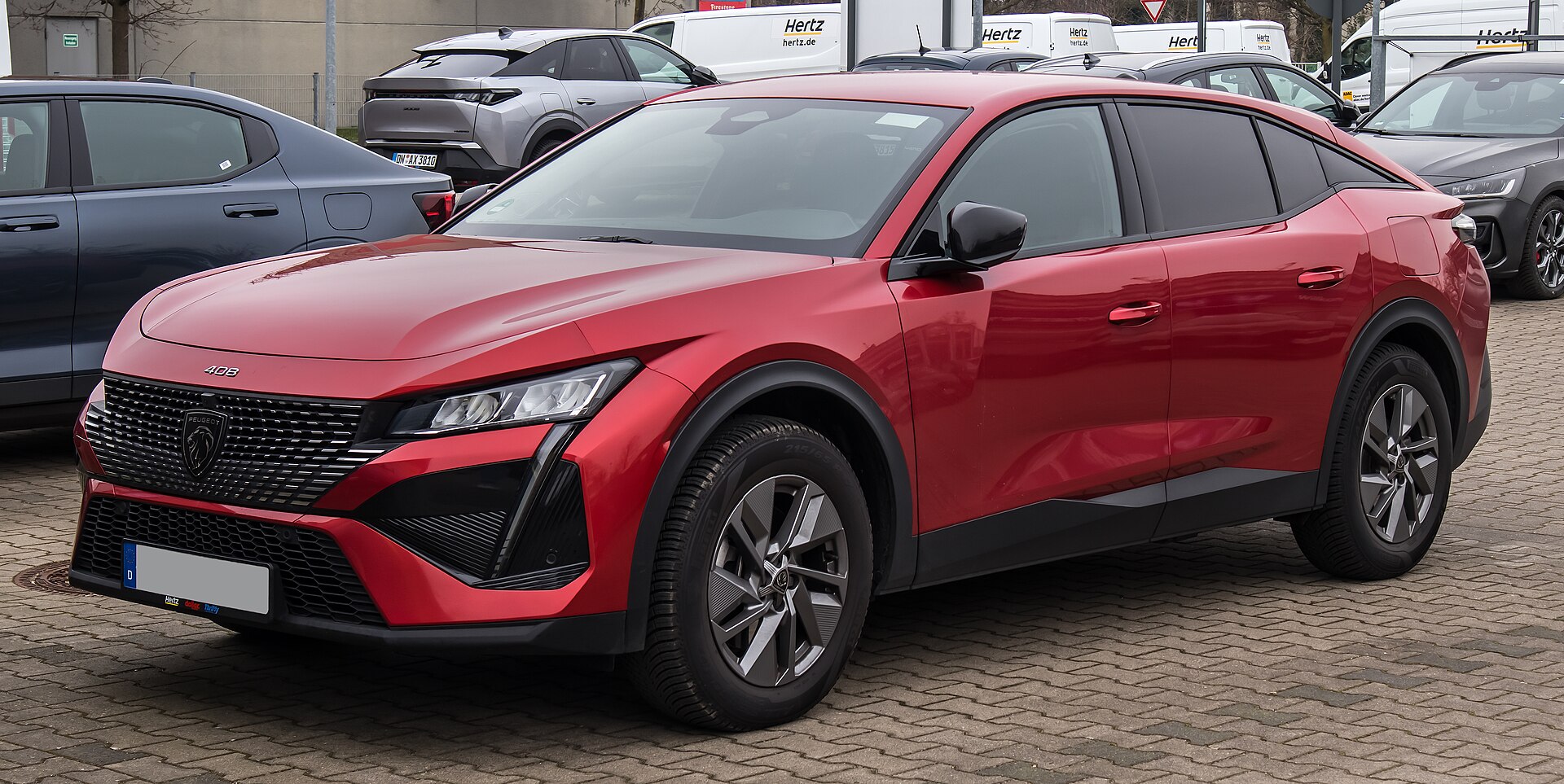
The Peugeot 408 is a five-door fastback crossover unveiled in June 2022 and built in Mulhouse, France, since 2022. It sits between the 308 and the 3008 in the Peugeot range and uses the long-wheelbase EMP2 platform shared with the 308 and the Citroën C5 X. The 408 is sold only with automatic or dual-clutch gearboxes and with petrol, hybrid, plug-in hybrid and electric drives. In China it is called the 408 X, to set it apart from the older 408 saloon.
In short
- One generation (model code P54) since 2022; plants in Mulhouse, Chengdu (since January 2023) and Gurun, Malaysia (since 2024).
- Powertrains from the 96 kW (131 PS) 1.2 PureTech to the 165 kW (225 PS) plug-in hybrid with up to 64 km WLTP electric range.
- 4,687 mm long on a 2,787 mm wheelbase, drag coefficient 0.28; boot 536 litres, 471 litres in the plug-in hybrid.
- German list price from €40,970 for the Hybrid 145 Allure, valid from March 2025 (ADAC).
Size at a glance
| Dimensions | Peugeot 408 P54 |
|---|---|
| Length | 4,687 mm184.5 in |
| Width | 1,848 mm72.8 in |
| Height | 1,478 mm58.2 in |
| Wheelbase | 2,787 mm109.7 in |
| Boot | 471 L16.6 cu ft |
Specs by version
Engines
| Version | Engine | Power | Torque | Gearbox | Drive | Production years |
|---|---|---|---|---|---|---|
| Plug-in hybrid · 2 versions | ||||||
| 1.6 Plug-in Hybrid 180 | 1.6 l · 4 cyl · Plug-in hybrid 1,598 cc | 133 kW 181 PS178 hp | 360 Nm266 lb-ft | 8-sp Automatic | Front-wheel drive | 2023–2024 |
| 1.6 Plug-in Hybrid 225 | 1.6 l · 4 cyl · Plug-in hybrid 1,598 cc | 165 kW 224 PS221 hp | 360 Nm266 lb-ft | 8-sp Automatic | Front-wheel drive | 2022 |
| Petrol · 3 versions | ||||||
| 1.2 PureTech 130 | 1.2 l · 3 cyl · Petrol 1,199 cc | 96 kW 131 PS129 hp | 230 Nm170 lb-ft | 8-sp Automatic | Front-wheel drive | 2023–2024 |
| 1.2 Hybrid 136 | 1.2 l · 3 cyl · Petrol 1,199 cc | 100 kW 136 PS134 hp | — | 6-sp Dual-clutch | Front-wheel drive | 2023–2025 |
| 1.2 Hybrid 145 | 1.2 l · 3 cyl · Petrol 1,199 cc | 107 kW 145 PS143 hp | — | 6-sp Dual-clutch | Front-wheel drive | 2025 |
Performance
Show all 1 versions
| Version | 0–100 km/h | Top speed | Range |
|---|---|---|---|
| 1.6 Plug-in Hybrid 225 | 7.9 s 0–62 mph | 233 km/h145 mph | 64 km40 mi |
Dimensions and weight
Show all 5 versions
| Version | Length | Width | Height | Wheelbase | Battery |
|---|---|---|---|---|---|
| Plug-in hybrid · 2 versions | |||||
| 1.6 Plug-in Hybrid 180 | 4,687 mm184.5 in | 1,848 mm72.8 in | 1,478 mm58.2 in | 2,787 mm109.7 in | 12 kWh |
| 1.6 Plug-in Hybrid 225 | 4,687 mm184.5 in | 1,848 mm72.8 in | 1,478 mm58.2 in | 2,787 mm109.7 in | 12 kWh |
| Petrol · 3 versions | |||||
| 1.2 PureTech 130 | 4,687 mm184.5 in | 1,848 mm72.8 in | 1,478 mm58.2 in | 2,787 mm109.7 in | — |
| 1.2 Hybrid 136 | 4,687 mm184.5 in | 1,848 mm72.8 in | 1,478 mm58.2 in | 2,787 mm109.7 in | — |
| 1.2 Hybrid 145 | 4,687 mm184.5 in | 1,848 mm72.8 in | 1,478 mm58.2 in | 2,787 mm109.7 in | — |
Verified Manufacturer and type-approval data from our catalog · Sources and methodology
Peugeot 408 at a glance
| Specification | Peugeot 408 (P54) |
|---|---|
| Production | since 2022; Mulhouse (France), Chengdu (China), Gurun (Malaysia) |
| Platform | EMP2, long-wheelbase version shared with 308 III and C5 X |
| Body | five-door fastback crossover (liftback) |
| Drive | front-wheel drive |
| Powertrains | 1.2 PureTech, 1.2 Hybrid, 1.6 plug-in hybrid, E-408 electric |
| Power | 96 to 165 kW (131 to 225 PS) |
| Length / wheelbase | 4,687 mm / 2,787 mm |
| Height | 1,478–1,487 mm |
| Kerb weight | 1,393 to 1,706 kg |
| Drag coefficient | 0.28 |
Design and development
Development took seven years under project manager Aurélie Bresson. The design by Kevin Gonçalves goes back to an internal "2015 Advanced Design manifesto", and the dichroic paint was inspired by the 2017 Instinct concept. The 408 shares its headlights, rear lights and dashboard with the third-generation 308. Peugeot unveiled it in June 2022 and showed it publicly at the Paris Motor Show that October.
The earlier 408 was a different car: a saloon sold mainly in China, South-East Asia and Latin America since 2010, in three generations. The crossover is mechanically unrelated to it.

Powertrains
| Version | Engine | System power | Torque | Gearbox | Years in the ADAC list |
|---|---|---|---|---|---|
| 1.2 PureTech 130 | 1,199 cc 3-cyl. turbo | 96 kW (131 PS) | 230 Nm | 8-speed EAT8 | 2023–2024 |
| 1.2 Hybrid 136 | 1,199 cc 3-cyl. hybrid | 100 kW (136 PS) | — | 6-speed e-DSC6 | 2023–2025 |
| 1.2 Hybrid 145 | 1,199 cc 3-cyl. hybrid | 107 kW (145 PS) | — | 6-speed e-DSC6 | from 2025 |
| 1.6 Plug-in Hybrid 180 | 1,598 cc 4-cyl. + motor | 133 kW (180 PS) | 360 Nm | 8-speed e-EAT8 | 2023–2024 |
| 1.6 Plug-in Hybrid 225 | 1,598 cc 4-cyl. + motor | 165 kW (225 PS) | 360 Nm | e-EAT8, later e-DSC7 | 2022–2026 |
The plug-in hybrids use an 81 kW electric motor and a 12.4 kWh lithium-ion battery. Outside Europe a 1.6 PureTech THP with 160 kW (218 PS) is offered. The electric E-408 followed in 2024; ADAC lists three versions but shows no prices or data for them.
The Plug-in Hybrid 225 in the test
Autonotizen.de drove the GT Hybrid 225 in November 2022. Peugeot quotes 0–100 km/h in 7.9 seconds and a top speed of 233 km/h, or 135 km/h on electric power alone. The WLTP electric range is 62 to 64 km; in the test drive the car covered 43 km on electricity. Standard consumption figures are 14.4 to 14.7 kWh/100 km plus 1.2 l/100 km. The battery reduces the boot from 536 to 471 litres.
By our calculation, the 12.4 kWh gross battery corresponds to about 19.4 kWh per 100 km of WLTP electric range, compared with the standard electric consumption figure of 14.4 to 14.7 kWh/100 km quoted for the car. For drivers with a short daily commute, the 62 to 64 km electric range covers most trips without starting the petrol engine.


Plug-in hybrid compared with the petrol 408
| Figure | 1.2 PureTech 130 | 1.6 Plug-in Hybrid 225 |
|---|---|---|
| System power | 96 kW (131 PS) | 165 kW (225 PS) |
| Torque | 230 Nm | 360 Nm |
| Gearbox | 8-speed EAT8 | e-EAT8 / e-DSC7 |
| Boot | 536 l | 471 l |
| German price (ADAC) | €37,000 (Allure, 2023) | €47,600 (Allure, 2024–2025) |
- The PHEV 225 has 69 kW more than the 1.2 PureTech, a 72 percent increase, and 130 Nm more torque.
- Its battery costs 65 litres of boot space.
- Weight per kW: 10.3 kg per kW for the heaviest version (1,706 kg) with 165 kW, by our calculation.
- The 408 shares its platform and height with the Citroën C5 X and sits between the 308 and the 3008 or 508 in the Peugeot range.
Safety
ANCAP tested the 408 in 2022 under the same protocol as Euro NCAP and published 79 percent for adult occupants, 86 percent for children, 78 percent for vulnerable road users and 82 percent for safety assistance. The star rating is not given in the source used here.
Sales and markets
Wikipedia gives 1,047 European sales for the first months of 2022 but no later European totals. Turkey is a strong market, with 9,729 sales in 2023, 11,986 in 2024 and 15,035 in 2025. Malaysian cars are assembled in Gurun from SKD kits and exported to Thailand (since 2024), Cambodia (2025) and Taiwan (2026). A facelift was presented in January 2026; ADAC lists it as "408 1. Generation (1. Facelift)" from 2026.
Prices in Germany
| Version | List price (ADAC) | Valid |
|---|---|---|
| 1.2 PureTech 130 Allure EAT8 | €37,000 | February 2023 – January 2024 |
| 1.6 Plug-in Hybrid 180 Allure | €44,750 | February 2023 – January 2024 |
| 1.2 Hybrid 136 Allure e-DSC6 | €40,050 | August 2023 – March 2025 |
| 1.2 Hybrid 145 Allure e-DSC6 | €40,970 | March 2025 – March 2026 |
| 1.6 Plug-in Hybrid 225 Allure | €47,600 | October 2024 – June 2025 |
| 1.6 Plug-in Hybrid 225 GT Exclusive e-DSC7 | €56,000 | October 2025 – March 2026 |
Photo gallery


Peugeot 408 in our rankings
- No. 4 of 49 · Biggest boot: hatchbacks (471 l)
- No. 7 of 23 · Fastest French cars (233 km/h)
- No. 8 of 66 · Widest hatchbacks (1,848 mm)
- No. 8 of 23 · Quickest French cars, 0–100 (7.9 s)
- No. 9 of 67 · Longest hatchbacks (4,687 mm)
- No. 11 of 46 · Fastest hatchbacks (233 km/h · top 24%)
Bigger boot than 91% of ranked hatchbacks in the 1CARS catalog (No. 4 of 49).
FAQ
Is the Peugeot 408 an SUV or a saloon?
It is a five-door fastback crossover, between a hatchback and an SUV. The older 408 saloon is a different car.
Is there a manual Peugeot 408?
No. All versions use an automatic or dual-clutch gearbox.
What is the electric range of the 408 plug-in hybrid?
62 to 64 km in the WLTP cycle with the 12.4 kWh battery.
Where is the Peugeot 408 built?
In Mulhouse, France, as well as in Chengdu, China, and Gurun, Malaysia.
How big is the 408 boot?
536 litres, or 471 litres in the plug-in hybrid.
Data sources
Data checked by an editor against the sources below.
- Wikipedia — Peugeot 408 (crossover)
- ADAC — 1generation
- Autonotizen — Peugeot 408 Hybrid 225 Test Fahrt Video Review