
 Peugeot 2008
All generations, specs and history
Published Sources (3) Report an error
By Felix Hartmann, Automotive Technology & EV Contributor
- Built
- 2013–present
- Generations
- 2
- Top power
- 115 kW (156 PS)
- New price
- from about €20,958 (2020)
Timeline
2008 generations
Click a generation for its own page


Newest first · 2 generations since 2013
All generations by year: 2008 II (2019–now) · 2008 I (2013–2019)
Which one is mine?
Pick the year of first registration to see which generation it is.
- 2008 II 2019–present
- 2008 I 2013–2019
The Peugeot 2008 is a front-wheel-drive small crossover from the French brand Peugeot, positioned as a global model. It was the brand's first subcompact SUV and replaced the Peugeot 207 SW estate. Two generations have been built so far: the original from 2013 and the second from 2019, which is also available as the all-electric e-2008.
In short
- The first 2008 was unveiled at the Geneva motor show in 2013 and facelifted at Geneva in March 2016; the second generation was revealed online on 19 June 2019.
- The 2008 II uses the CMP platform shared with the Peugeot 208, DS 3 Crossback and Opel Corsa.
- Engines include 1.2 PureTech petrol units from 74 to 114 kW (100–155 PS), 1.5 BlueHDi diesels and an electric e-2008 with 100 kW (136 PS).
- The boot holds 434 litres, or 1,467 litres with the rear seats folded.
Size at a glance
| Dimensions | Peugeot 2008 II |
|---|---|
| Length | 4,300 mm169.3 in |
| Width | 1,770 mm69.7 in |
| Height | 1,530 mm60.2 in |
| Wheelbase | 2,605 mm102.6 in |
| Boot | 405 L14.3 cu ft |
Running cost
Fuel · 2008 PureTech 130
about 1,200 EUR fuel a year at 15,000 km
4.5 l/100 km · petrol at 1.75 EUR/l · change mileage, fuel price or version
Known problems
-
Critical 2008 I (2013–2019)
Wet timing belt breaking up (1.2 PureTech 110, 130, 155) 2013–2022
Oil pressure warning at idle, rubber particles in the oil, a soft brake pedal, rising oil use; the engine can seize from oil starvation.
Fix: Belt, tensioner and pulley replaced, oil strainer and circuit cleaned, oil and vacuum pumps checked.
Verified Source: Kfz-Meisterbetrieb Dietrich: 1.2 PureTech Zahnriemen im Olbad (2026) -
Critical 2008 I (2013–2019)
Brake vacuum pump damaged by belt debris (PureTech recall) 2013–2017
A hard brake pedal and reduced servo assistance; recall for turbo PureTech built March 2013 to April 2017.
Fix: Under the recall the dealer inspects the belt and vacuum pump and replaces parts.
Verified Source: Gebrauchtwagenberater.de: Peugeot 2008 Probleme Krankheiten -
High 2008 I (2013–2019)
Excessive oil consumption (1.2 PureTech) all years
The oil level falls between services and the oil warning appears; Stellantis covers it under extended goodwill.
Fix: Diagnosis at a dealer; piston rings or engine parts replaced under the goodwill scheme where eligible.
Verified Source: Stellantis press release: extended goodwill for 1.0 and 1.2 PureTech engines (16 May 2025) -
Medium 2008 I (2013–2019)
Coked injectors and intake deposits (PureTech turbo) all years
Loss of power and higher fuel consumption at higher mileage.
Fix: Injectors are cleaned or replaced; intake deposits are removed mechanically.
Verified Source: Gebrauchtwagenberater.de: Peugeot 2008 Probleme Krankheiten -
Medium 2008 I (2013–2019)
ETG5 automated manual: slow, jerky gear changes 2013–2016
Hesitant engagement, jerky shifts and gears that will not engage at times.
Fix: Adaptation and clutch or actuator repair; many buyers choose a manual or EAT6 instead.
Verified Source: Gebrauchtwagenberater.de: Peugeot 2008 Probleme Krankheiten -
Low 2008 I (2013–2019)
Lights, brake discs and oil leaks flagged at TUV (2008 I) all years
Failed headlight or rear light checks, worn discs and oil leaks from the second inspection onwards.
Fix: Lights adjusted or replaced, discs and pads renewed, leaks traced and sealed.
Verified Source: AUTO BILD: Peugeot 2008 im TUV-Check 2026 (30 June 2026) -
Medium 2008 II (2019–present)
Front lower ball joints and axle mounts worn early (2008 II) all years
Knocks from the front axle; inspectors flag axle mounts about ten times more often than average at the first test.
Fix: Ball joints or wishbone bushes are replaced.
Verified Source: AUTO BILD: Peugeot 2008 im TUV-Check 2026 (30 June 2026) -
Low 2008 II (2019–present)
Digital instruments, infotainment and damp rear lights (2008 II) all years
Blank or flickering digital instruments, infotainment crashes and moisture in the rear lights causing warnings.
Fix: Software updates; affected lights or units are replaced.
Verified Source: AUTO BILD: Peugeot 2008 im TUV-Check 2026 (30 June 2026)
Specs by version
Engines
| Version | Engine | Power | Torque | Gearbox | Drive | Production years |
|---|---|---|---|---|---|---|
| Electric · 2 versions | ||||||
| 2008 II · e-2008 | Electric | 100 kW 136 PS134 hp | 260 Nm192 lb-ft | Single-speed | Front-wheel drive | 2019–2023 |
| 2008 II · e-2008 (2023 update) | Electric | 115 kW 156 PS154 hp | - | Single-speed | Front-wheel drive | 2023 |
| Diesel · 1 version | ||||||
| 2008 II · BlueHDi 130 | Diesel | 96 kW 131 PS129 hp | 300 Nm221 lb-ft | Automatic | Front-wheel drive | 2019 |
| Petrol · 3 versions | ||||||
| 2008 II · PureTech 100 | Petrol | 74 kW 101 PS99 hp | 205 Nm151 lb-ft | - | Front-wheel drive | 2019 |
| 2008 II · PureTech 130 | Petrol | 96 kW 131 PS129 hp | 230 Nm170 lb-ft | - | Front-wheel drive | 2019 |
| 2008 II · PureTech 155 | Petrol | 114 kW 155 PS153 hp | 240 Nm177 lb-ft | Automatic | Front-wheel drive | 2019 |
Performance
Show all 6 versions
| Version | 0–100 km/h | Top speed | Fuel consumption | CO₂ |
|---|---|---|---|---|
| Electric · 2 versions | ||||
| 2008 II · e-2008 | - | - | 15.7 kWh/100 km25.3 kWh/100 mi | - |
| 2008 II · e-2008 (2023 update) | - | - | 15.8 kWh/100 km25.4 kWh/100 mi | - |
| Diesel · 1 version | ||||
| 2008 II · BlueHDi 130 | 9.3 s 0–62 mph | 195 km/h121 mph | 3.8 l/100 km61.9 mpg US · 74.3 mpg UK | 100 g/km |
| Petrol · 3 versions | ||||
| 2008 II · PureTech 100 | 10.9 s 0–62 mph | 185 km/h115 mph | 4.6 l/100 km51.1 mpg US · 61.4 mpg UK | 105 g/km |
| 2008 II · PureTech 130 | 8.9 s 0–62 mph | 196 km/h122 mph | 4.5 l/100 km52.3 mpg US · 62.8 mpg UK | 103 g/km |
| 2008 II · PureTech 155 | 8.2 s 0–62 mph | 208 km/h129 mph | 5.0 l/100 km47.0 mpg US · 56.5 mpg UK | 113 g/km |
Dimensions and weight
Show all 6 versions
| Version | Kerb weight | Boot | Fuel tank | Battery |
|---|---|---|---|---|
| Electric · 2 versions | ||||
| 2008 II · e-2008 | 1,623 kg3,578 lb | - | - | 50 kWh |
| 2008 II · e-2008 (2023 update) | 1,623 kg3,578 lb | - | - | 54 kWh |
| Diesel · 1 version | ||||
| 2008 II · BlueHDi 130 | 1,310 kg2,888 lb | 405 l14.3 cu ft | 41 l10.8 gal US | - |
| Petrol · 3 versions | ||||
| 2008 II · PureTech 100 | 1,263 kg2,784 lb | 405 l14.3 cu ft | 44 l11.6 gal US | - |
| 2008 II · PureTech 130 | 1,267 kg2,793 lb | 405 l14.3 cu ft | 44 l11.6 gal US | - |
| 2008 II · PureTech 155 | 1,280 kg2,822 lb | 405 l14.3 cu ft | 44 l11.6 gal US | - |
Verified Manufacturer and type-approval data from our catalog · Sources and methodology
Peugeot 2008 at a glance
The story of the 2008 began with a concept called HR1, shown at the Paris motor show in 2010. The production model arrived in 2013, built on PSA's PF1 platform and sharing much of its electronics with the 208. In spring 2016 Peugeot facelifted it, with a fresher look and new equipment but almost unchanged technology, and added the sportier GT Line with its own exterior and interior details.
As the small-SUV market boomed, Peugeot moved quickly, and on 19 June 2019 it presented the second-generation 2008 online, with bold styling, an eye-catching cabin and modern technology. A facelift followed on 4 May 2023, bringing a new front end, LED lights as standard and a larger battery for the e-2008. More of the brand's range is in our Peugeot catalogue, and its background is covered in Peugeot's history.
Generations
| Generation | Years | Platform | Notes |
|---|---|---|---|
| First | 2013–2019 (Europe) | PF1 | Replaced the 207 SW; facelift 2016; five stars in Euro NCAP (2013) |
| Second | from 2019 | CMP | i-Cockpit with 3D display; e-2008 electric version; facelift 2023 |
Exterior of the second generation
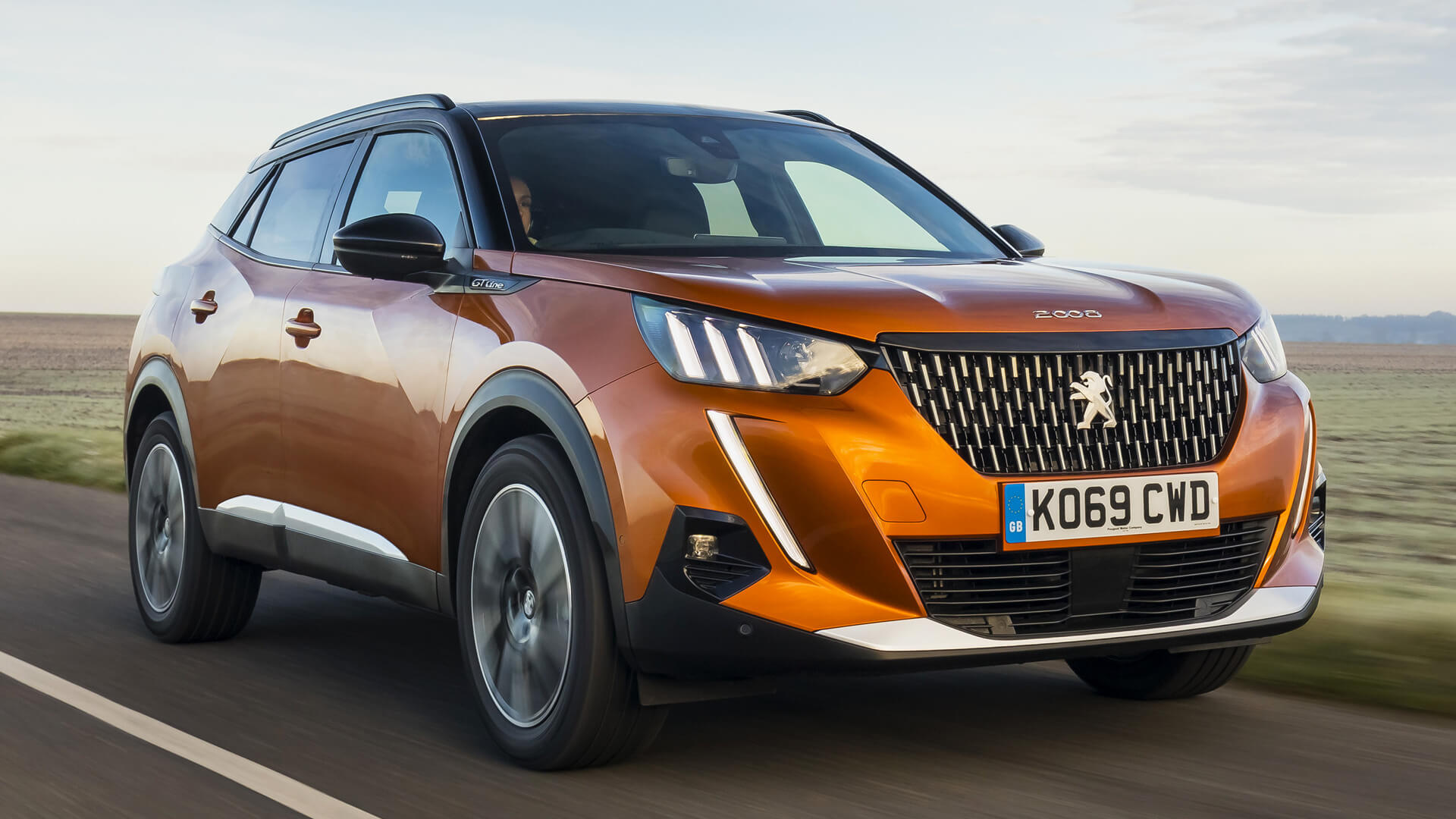
The new body transformed the 2008's appearance, with distinctive shapes and modern details found on no other car. Most changes are at the front, which is taller, shorter and slightly wider than before. The bonnet is almost horizontal, with pronounced ridges at the sides and a stepped central section; it looks strong, though it can make the front edge harder to judge for shorter drivers. The headlights below the ridges are larger and new in shape, with halogen or LED units depending on the version.
Between them is a large trapezoidal grille with a big mesh and the chrome Peugeot badge, finished mainly in gloss black. The lower bumper has a smaller intake echoing the main grille and, on each side, a long, slim, angled vertical daytime running light - the "fang" signature that looks striking. Square recesses with fog lights and plastic cladding to protect the body complete the front.
From the side, the upper part of the body is finished in gloss black, and long rectangular windows taper towards the rear, framed by thin black strips. The flanks combine stepped and flowing surfaces, with chrome trim and unpainted protective plastic lower down. Base versions ride on 16- or 17-inch wheels and sportier ones on 18-inch wheels. Ground clearance is 200–219 mm depending on the version, according to published figures. The GT Line looks especially sporty, with a contrasting black roof and 17-inch alloys of its own design.
At the rear, a long spoiler continues the roofline above a large window and a black band joining the tail lights, which widen at the sides into the full light clusters with Peugeot's claw-like signature; the brand name runs across the middle. The tailgate has light sculpting and chrome badges, and the plastic-clad bumper has a chrome insert, fog lights, a diffuser-style insert and two square exhaust trims.
Interior and practicality
The cabin follows the style of other Peugeot models but is still unusual. Materials include good plastics, cloth seats and some leather inserts, with ambient lighting, bright stitching and carbon-look trim - not real carbon, of course. It seats five and has near-ideal ergonomics.
The front seats are new, with good lateral support and electric adjustment on the top-spec version. The driver's area uses Peugeot's i-Cockpit layout: the instrument display sits above a small steering wheel rather than being viewed through it. The instruments are digital, and a 3D display that creates a hologram-like effect is optional. The compact two-spoke steering wheel is flattened at top and bottom and carries buttons for many functions.
The infotainment screen measures 5, 7 or 10 inches depending on the version, with large air vents below and toggle switches for the climate control that look modern and stylish. Where the console meets the tunnel there is a storage area with wireless charging. The tunnel holds the automatic gear selector, also found in the Opel Grandland X, two cupholders, the electronic parking brake and other buttons. The rear bench has recessed seats; space is not abundant in a car of this size, but it is better than in the previous generation, and adults will not feel cramped.
The boot grew by about 45 litres to 434 litres, with an extra 29-litre compartment under the floor. Folding the 60/40 split rear seat raises the capacity to 1,467 litres.
Engines and transmissions (second generation)
| Engine | Power (kW / PS) | Torque | Gearbox |
|---|---|---|---|
| 1.2 PureTech 100 petrol | 74 kW / 100 PS | 205 Nm | 6-speed manual or 8-speed automatic |
| 1.2 PureTech 130 petrol | 96 kW / 130 PS | 230 Nm | 6-speed manual or 8-speed automatic |
| 1.2 PureTech 155 petrol | 114 kW / 155 PS | 240 Nm | 8-speed automatic |
| 1.5 BlueHDi 100 diesel | 75 kW / 102 PS | 250 Nm | 6-speed manual |
| 1.5 BlueHDi 130 diesel | 96 kW / 130 PS | 300 Nm | 8-speed automatic |
| e-2008 (electric, to 2023) | 100 kW / 136 PS | 260 Nm | single-speed |
| e-2008 (electric, from 2023) | 115 kW / 156 PS | - | single-speed |
The 1.2 PureTech is a three-cylinder petrol engine with an aluminium block and head, a turbocharger, direct injection, variable timing on both camshafts and 12 valves. The most powerful version uses about 6.1 l/100 km, reaches 100 km/h in 8.2 seconds and has a top speed of 208 km/h. The four-cylinder 1.5 BlueHDi diesels are popular in Europe for their low consumption and good performance.
The original e-2008 has a 50 kWh battery (46.2 kWh usable) and a WLTP range of about 310 km, and can charge at up to 100 kW at suitable stations. After the 2023 facelift it gained a 54 kWh battery and a range of about 406 km. All versions are front-wheel drive; Grip Control, or Advanced Grip Control, adjusts the traction control for different surfaces and partly compensates for the lack of four-wheel drive.
Chassis
The second-generation 2008 uses the CMP Common Modular Platform with a transverse engine and a monocoque body with plenty of high-strength steel. Suspension consists of MacPherson struts at the front and a twist-beam rear axle, with anti-roll bars. Steering is rack-and-pinion with electric assistance, and the brakes are discs all round, ventilated at the front, with ABS, EBD and other aids.
Safety and equipment
Equipment includes autonomous emergency braking, lane-keeping assistance, driver-fatigue monitoring, speed-limit sign recognition, adaptive cruise control with Stop & Go, a parking assistant, six airbags, rain and light sensors, a reversing camera, Advanced Grip Control and LED lights. Depending on the market, base versions have four airbags, ABS and ESP, air conditioning, the 7-inch infotainment system, heated front seats, cruise control, rear parking sensors, 16-inch wheels and electric windows all round; mid-range versions add digital instruments, part-leather seats, six airbags, automatic climate control, a reversing camera and 17-inch alloys, and higher trims get LED headlights, ambient lighting and front parking sensors.
Strengths and weaknesses
The 2008 offers a striking design, good ground clearance, a comfortable ride and an interesting cabin. Owners praise the roomy interior, large boot, build quality, suspension and economical engines, and the car suits long trips and active lifestyles. On the other hand, there is no four-wheel drive, so rough tracks are best avoided, and some owners are not satisfied with the sound insulation. Rivals include the Renault Captur, Nissan Juke, Volkswagen T-Roc, Ford Puma, Opel Mokka, Toyota Yaris Cross, Hyundai Kona and Skoda Kamiq.
Owning a Peugeot 2008
Common problems, best and worst years, maintenance and running costs - only data checked by our editors, with sources.
Best years
- 2018–2019 2008 I (2013–2019) - From April 2018 the 2008 I got the 1.5 BlueHDi diesel, and ADAC records 7.2-8.6 breakdowns per 1,000 cars for 2018-2019 against 13.4-17.7 for 2015-2017. Verified Source: ADAC Pannenstatistik 2025
- 2020–2023 2008 II (2019–present) - The 1.5 BlueHDi versions avoid the PureTech belt problem, and ADAC records 3.5-6.8 breakdowns per 1,000 cars for 2020-2022 2008s. Verified Source: ADAC Pannenstatistik 2025
Years to avoid
- 2015–2018 2008 I (2013–2019) - Turbo PureTech 110 and 130 engines built March 2013 to autumn 2018 fall under belt-debris recalls, and ADAC names oil pressure faults on 2017 cars. Verified Source: L'argus: Moteur 1.2 PureTech, quand remplacer la courroie de distribution (updated 5 April 2024)
- 2013–2015 2008 I (2013–2019) - ADAC recommends the early automated manual and four-speed automatic only for relaxed drivers, because performance and fuel use suffer. Verified Source: ADAC Gebrauchtwagen-Info Peugeot 2008 (2013-2019), status 30 July 2025
Questions and answers
What are the most common Peugeot 2008 problems?
Wet timing belt breaking up (1.2 PureTech 110, 130, 155) (2013–2022): Oil pressure warning at idle, rubber particles in the oil, a soft brake pedal, rising oil use; the engine can seize from oil starvation.; Brake vacuum pump damaged by belt debris (PureTech recall) (2013–2017): A hard brake pedal and reduced servo assistance; recall for turbo PureTech built March 2013 to April 2017.; Excessive oil consumption (1.2 PureTech) (all years): The oil level falls between services and the oil warning appears; Stellantis covers it under extended goodwill.; Coked injectors and intake deposits (PureTech turbo) (all years): Loss of power and higher fuel consumption at higher mileage.; ETG5 automated manual: slow, jerky gear changes (2013–2016): Hesitant engagement, jerky shifts and gears that will not engage at times..
What are the best years for the Peugeot 2008?
2018–2019: From April 2018 the 2008 I got the 1.5 BlueHDi diesel, and ADAC records 7.2-8.6 breakdowns per 1,000 cars for 2018-2019 against 13.4-17.7 for 2015-2017.; 2020–2023: The 1.5 BlueHDi versions avoid the PureTech belt problem, and ADAC records 3.5-6.8 breakdowns per 1,000 cars for 2020-2022 2008s..
Which Peugeot 2008 years should you avoid?
2015–2018: Turbo PureTech 110 and 130 engines built March 2013 to autumn 2018 fall under belt-debris recalls, and ADAC names oil pressure faults on 2017 cars.; 2013–2015: ADAC recommends the early automated manual and four-speed automatic only for relaxed drivers, because performance and fuel use suffer..
Data checked November 12, 2026 Used Peugeot 2008 buying guide
Image credits · Photos from Wikimedia Commons under free licences
- Peugeot 2008 I · Photo: M 93 / Wikimedia Commons, CC BY-SA 3.0 de
- Peugeot 2008 II · Photo: Alexander-93 / Wikimedia Commons, CC BY-SA 4.0
Popular comparisons
Peugeot 2008 in our rankings
- No. 4 of 113 · Most economical SUVs and crossovers (3.8 l/100 km)
- No. 15 of 332 · Most economical cars (3.8 l/100 km · top 6%)
- No. 19 of 165 · Lightest SUVs and crossovers (1,263 kg · top 12%)
- No. 45 of 221 · Smallest SUVs and crossovers (4,300 mm · top 21%)
- No. 126 of 464 · Lightest cars (1,263 kg · top 28%)
- No. 180 of 606 · Smallest cars (4,300 mm · top 30%)
More economical than 96% of ranked SUVs and crossovers in the 1CARS catalog (No. 4 of 113).
FAQ
How many generations of the Peugeot 2008 are there?
Two: the first from 2013 and the second, presented on 19 June 2019 and facelifted in 2023.
Is there an electric Peugeot 2008?
Yes. The e-2008 originally had 100 kW (136 PS) and about 310 km of WLTP range; from 2023 it has 115 kW (156 PS) and about 406 km.
Does the Peugeot 2008 have four-wheel drive?
No. It is front-wheel drive only, but Grip Control helps on slippery surfaces.
How big is the Peugeot 2008 boot?
434 litres, plus a 29-litre underfloor compartment, and 1,467 litres with the rear seats folded.
What is the Peugeot i-Cockpit?
A layout with a small steering wheel and an instrument display placed above it, so the driver looks over the wheel rather than through it.
Data sources
Data checked by an editor against the sources below.
- Wikipedia - Peugeot 2008
- Wikipedia - Peugeot 2008 II
- EEA CO₂ monitoring (European Environment Agency, CC BY 4.0)


