 Peugeot 504
Specs, engines and history
Published Sources (1) Report an error
By Felix Hartmann, Automotive Technology & EV Contributor
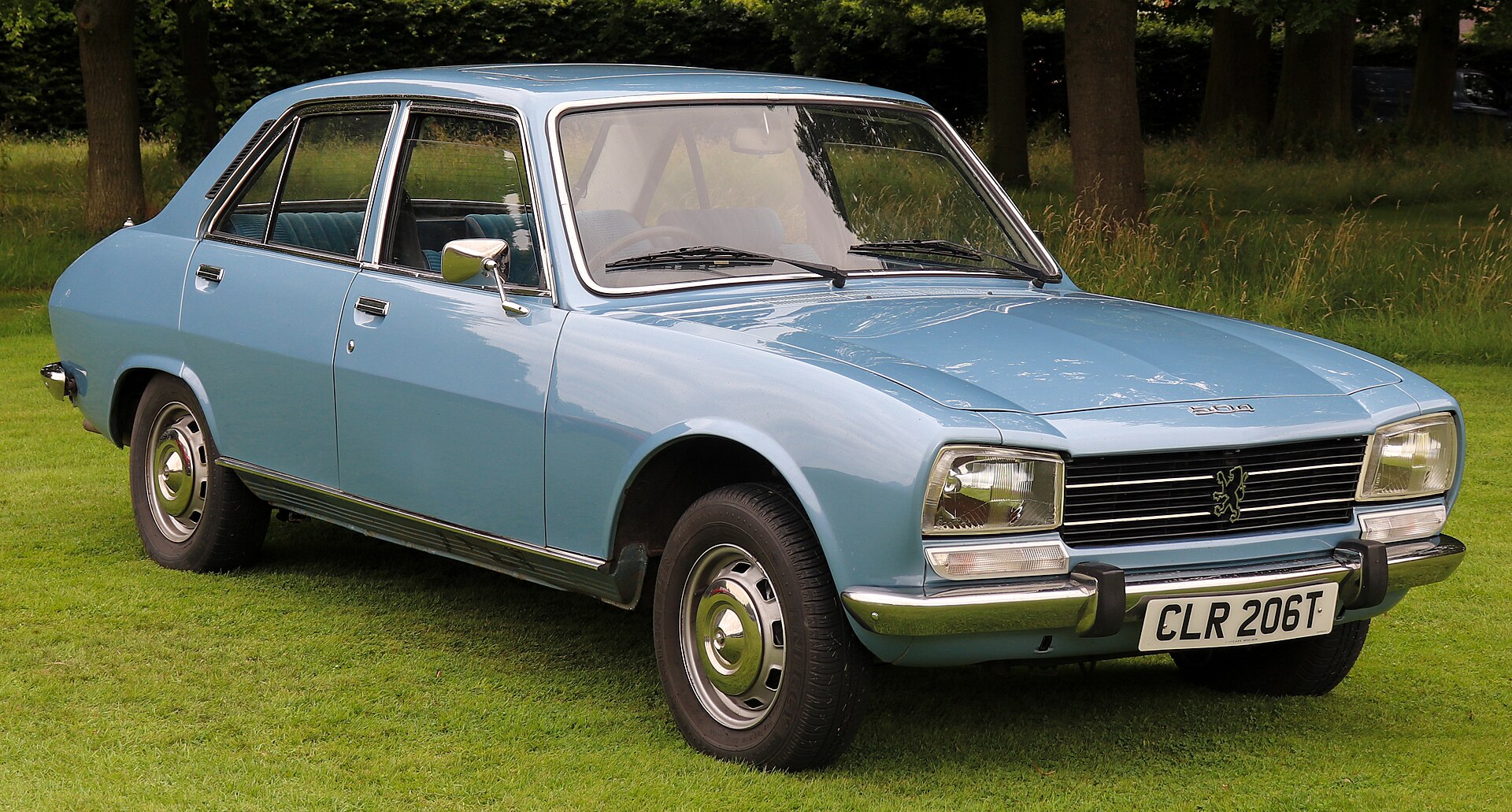
- Built
- 1968–2006
- Top power
- 106 kW (144 PS)
Which 504 to buy
Our verdict · Felix Hartmann
- For the classic experience: a saloon from the late 1970s with the 2.0 injection engine, the most powerful four-cylinder petrol version at 76 kW (104 PS).
- For style: the Pininfarina coupé or cabriolet; only 31,163 were made, so expect to pay more and to search longer. The V6 cabriolet is the rarest, with 970 built.
- For practicality: a Break or seven-seat Familiale with the long 2,900 mm wheelbase.
- For working use: the pickup, built in France until 1993 and abroad even longer.
Whichever you choose, condition beats specification: the 504 was built in many countries and in large numbers, so a well-kept car is a better buy than a rare version that needs restoration.
The Peugeot 504 is the rear-wheel-drive saloon that Peugeot launched at the Paris Motor Show on 12 September 1968 and built in France until 1983, with pickups continuing there until 1993. It was European Car of the Year 1969, came as a saloon, estate, coupé, cabriolet and pickup, and then lived on for decades in Africa and South America: assembly in Nigeria ran until 2006, in Argentina until 1999.
In short
- One generation, 1968-1983 in France for passenger cars; pickups in France to 1993; Kenya to 2004, Nigeria to 2006.
- Petrol engines from 1.6 to the 2.7-litre PRV V6, diesels from 1.9 to 2.3 litres; power from 39 kW (53 PS) to 106 kW (144 PS).
- Saloon styled at Pininfarina by Aldo Brovarone; coupé and cabriolet by Franco Martinengo.
- Two Safari Rally wins (1975 and 1978) and the nickname "Africa's workhorse".
Peugeot 504 at a glance
| Item | Peugeot 504 |
|---|---|
| Segment | large family car (D-segment) |
| Body styles | 4-door saloon, 5-door Break estate, 7-seat Familiale, Commerciale, 2-door coupé, 2-door cabriolet, pickup |
| Layout | front longitudinal engine, rear-wheel drive, torque tube driveshaft |
| Main plant | Sochaux, France |
| Other plants | Argentina (Sevel, Buenos Aires), Kenya (Mombasa), Nigeria (Kaduna), South Africa, Spain (Vigo), Taiwan, China (Guangzhou) and others |
| Predecessor | Peugeot 404 |
| Successor | Peugeot 505; Peugeot 406 Coupé for the coupé |
The 504 slotted in above the 404. Peugeot's other models, old and new, are in our Peugeot catalogue, and the 504 sits among the cars covered in our classic cars section.
Generations and body styles
The 504 never had a second generation. Peugeot kept the same basic car from 1968 to the end of French saloon production in 1983 and added body styles along the way, while licence and kit assembly abroad kept it alive far longer.
| Generation | Code | Years | Body styles | Engines | Power (kW / hp) |
|---|---|---|---|---|---|
| 504 | - | 1968-1983 (France, passenger cars); to 2006 abroad | saloon, estate, coupé, cabriolet, pickup | 1.6, 1.8, 2.0 petrol; 2.7 V6; 1.9, 2.1, 2.3 diesel | 39-106 kW (53-144 PS) |
Saloon (from 1968). The four-door was the core of the range and the car that won European Car of the Year 1969.
Break, Familiale and Commerciale (from 1970). The estate was presented in September 1970 and went on sale in April 1971. It used a longer 2,900 mm wheelbase and a live rear axle instead of the saloon's independent rear. The Familiale had seven seats, and the Commerciale was the utility version.
Coupé and cabriolet (1969-1983). Both were shown at the Geneva show in March 1969, on a shorter 2,550 mm wheelbase. Together they reached 31,163 cars, and production ended at the beginning of August 1983. The cabriolet ended with only 970 V6 cars built over three years.
Pickup (from 1979). Introduced in September 1979 for the 1980 model year, with leaf-spring rear suspension. In France it outlived the saloon by ten years.


Production around the world
| Country | Years |
|---|---|
| France | 1968-1983 (pickups to 1993) |
| Argentina | 1969-1999 (saloon) |
| South Africa | 1970-1985 |
| Kenya | 1975-2004 |
| Nigeria | 1975-2006 |
| Spain | 1977-1980 |
| Taiwan | 1979-1984 |
| China | 1989-1997 |
Peugeot built more than three million 504s. Nigeria assembled 425,000 from knock-down kits and Kenya 27,000. In China the car was also sold as the Guangzhou-Peugeot GP 7200. In South Africa it was built by PACSA until late 1978, after which Sigma took over in 1979.

Engines, transmissions and performance
All engines were four-cylinders except the PRV V6, which went into the coupé and cabriolet. The 2.0 was offered with Kugelfischer mechanical fuel injection carried over from the 404; the V6 switched to Bosch K-Jetronic injection in 1977.
| Engine | Code | Displacement | Power |
|---|---|---|---|
| 1.6 petrol (pickup only) | XC5 | 1,618 cc | 46 kW (62 PS) |
| 1.8 petrol, carburettor | XM | 1,796 cc | 60 kW (82 PS) |
| 1.8 petrol, fuel injection | XM | 1,796 cc | 71 kW (97 PS) |
| 2.0 petrol, carburettor | XN | 1,971 cc | 68 kW (93 PS) |
| 2.0 petrol, fuel injection | XN | 1,971 cc | 76 kW (104 PS) |
| 2.7 V6 petrol | ZM (PRV) | 2,664 cc | 100 kW (136 PS); later 106 kW (144 PS) |
| 1.9 diesel (Commerciale) | XD88 | 1,948 cc | 39 kW (53 PS) |
| 2.1 diesel | XD90 | 2,112 cc | 48 kW (65 PS) |
| 2.3 diesel (from 1976) | XD2 | 2,304 cc | 51 kW (70 PS) |
The standard gearbox was the four-speed BA7 manual. A five-speed manual arrived in the V6 coupé for 1977-78 and later in the pickups. From February 1969 the carburettor cars could be ordered with a three-speed ZF 3HP automatic, and the V6 had a three-speed GM automatic as an option. The power converter translates the period DIN figures into other units.
Chassis, dimensions and space
The 504 used MacPherson struts at the front and semi-trailing arms at the rear on the saloon, coupé and cabriolet. The estates had a live rear axle, and the pickups leaf springs. The saloon had disc brakes front and rear, although some simpler later versions used rear drums, and rack-and-pinion steering. A dashboard light warned of worn brake pads.
| Parameter | Metric | Imperial |
|---|---|---|
| Length (saloon) | 4,486 mm | 176.6 in |
| Length (Break) | 4,800 mm | 189.0 in |
| Width | 1,690 mm | 66.5 in |
| Height | 1,460 mm | 57.5 in |
| Wheelbase (saloon) | 2,740 mm | 107.9 in |
| Wheelbase (Break, pickup) | 2,900 mm | 114.2 in |
| Wheelbase (coupé, cabriolet) | 2,550 mm | 100.4 in |
| Kerb weight | 1,200-1,300 kg | 2,646-2,866 lb |
Running costs today
There are no official modern consumption figures for the 504; period figures were measured on old national norms and are not comparable with NEDC or WLTP values. What keeps running costs down in the regions where the car is still used is its simple mechanical layout and the long production life of the four-cylinder petrol and diesel engines. If you know your own car's consumption, the fuel cost calculator gives a yearly figure.
Trims and equipment
Peugeot used equipment and engine designations rather than separate model names. Typical European badges were GL and Ti on the saloon, and V6 Ti on the later coupé. Argentine production kept its own trims into the 1990s, for example an SX with the 2.3 diesel and a five-speed gearbox in 1995. Equipment by modern standards was sparse: the 504 predates airbags, ABS and electronic aids.
Safety
The 504 was designed long before crash testing by Euro NCAP, which started in 1997, so there is no star rating. Its strengths for its time were front and rear disc brakes on the saloon and the brake-wear warning light. Any 504 on the road today has no airbags, no ABS and no stability control, and buyers should treat it as a classic in that respect.
Reliability and reputation
The 504 earned its reputation on bad roads rather than in brochures. It became one of the most common bush taxis in Africa; in Kenya it stayed on sale until 2007 and was called the "King of the African road", and in 2013 the Los Angeles Times described it as "Africa's workhorse". The car was also popular across rough-terrain regions of Latin America.
Motorsport backed that up. The 504 won five World Rally Championship events, including the gruelling Safari Rally twice:
| Rally | Year | Crew | Car |
|---|---|---|---|
| Safari Rally | 1975 | Ove Andersson / Arne Hertz | 504 saloon |
| Rallye du Maroc | 1975 | Hannu Mikkola / Jean Todt | 504 saloon |
| Rallye du Maroc | 1976 | Jean-Pierre Nicolas / Michel Gamet | 504 saloon |
| Safari Rally | 1978 | Jean-Pierre Nicolas / Jean-Claude Lefèbvre | 504 V6 Coupé |
| Bandama Rally | 1978 | Jean-Pierre Nicolas / Michel Gamet | 504 V6 Coupé |
We have no sourced data on specific recurring faults, so none are listed here. As with any car of this age, rust and the condition of the brakes and suspension matter more than the model's general reputation.
Rivals
In its time the 504 competed with other large family saloons and estates from France, Germany and Italy. Inside Peugeot, it overlapped first with the 404 it was meant to replace and later with the 505, which took over the saloon role in Europe while the 504 carried on elsewhere.
| Model | Engines | Power (hp) | Boot (l) | Price from (EUR) |
|---|---|---|---|---|
| Peugeot 504 | 1.6-2.0 petrol, 2.7 V6, 1.9-2.3 diesel | 39-106 kW (53-144 PS) | - | - |
| Peugeot 404 (predecessor) | petrol, diesel | - | - | - |
| Peugeot 505 (successor) | petrol, diesel | - | - | - |
Period list prices are not converted, because they were set in francs and other national currencies before the euro existed.
Photo gallery


FAQ
When was the Peugeot 504 made?
It was launched at the Paris Motor Show on 12 September 1968. French production of passenger cars ended in 1983 and of pickups in 1993; assembly continued in Kenya until 2004 and in Nigeria until 2006.
How many Peugeot 504s were built?
More than three million. Nigeria assembled 425,000 from kits and Kenya 27,000; the coupé and cabriolet together reached 31,163.
Who designed the Peugeot 504?
The saloon was styled by Aldo Brovarone at Pininfarina. Franco Martinengo styled the coupé and cabriolet.
What is the most powerful Peugeot 504?
The later coupé with the 2.7-litre PRV V6 and fuel injection, with 106 kW (144 PS).
Did the Peugeot 504 win any awards?
Yes. It was European Car of the Year 1969 and won the Safari Rally in 1975 and 1978.
Data sources
Data checked by an editor against the sources below.