 Peugeot 405
Specs, engines and history
Published Sources (2) Report an error
By Felix Hartmann, Automotive Technology & EV Contributor
- Built
- 1987–1997
- Top power
- 147 kW (200 PS)
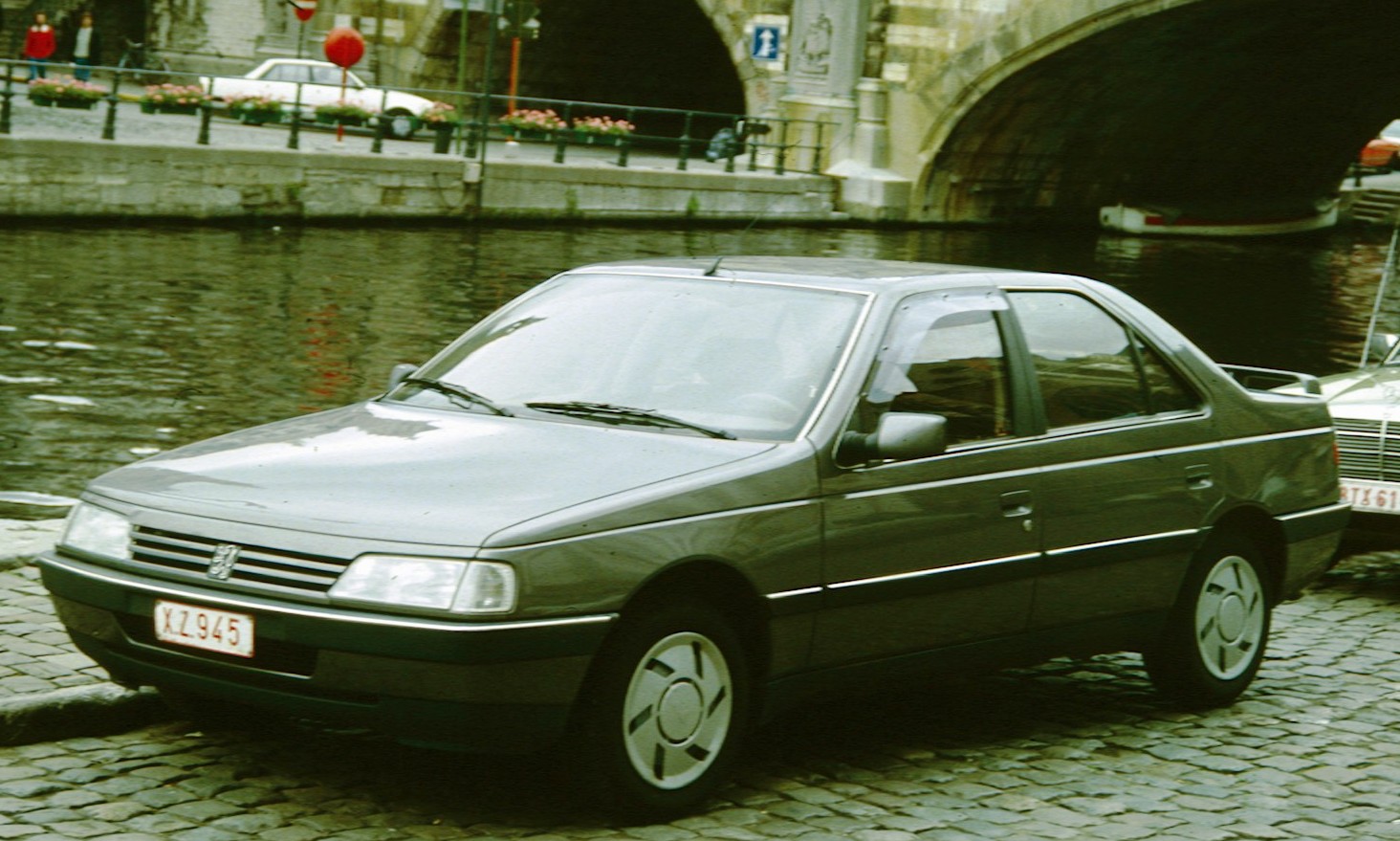
The Peugeot 405 is the Pininfarina-styled large family car that Peugeot built in Europe from 1987 to 1997 as a four-door saloon and a five-door estate. It won European Car of the Year 1988 with the largest number of votes in the contest's history, sold about 2.5 million cars worldwide and stayed in production in Iran, Egypt and elsewhere long after the 406 replaced it in Europe. Its range stretched from a 1.4 petrol with 51 kW (70 hp) to the four-wheel-drive 405 T16 with 147 kW (200 hp).
In short
- Large family car (D-segment), saloon and Break estate, designed by Giuseppe Randazzo of Pininfarina.
- European production 1987-1997 at Sochaux (France) and Ryton (UK); assembly or production also in Argentina, Chile, Egypt, Indonesia, Iran, Taiwan, Zimbabwe and other countries.
- Phase II facelift in 1992 with a new dashboard, a new boot lid and redesigned rear lights.
- Sporting versions: Mi16 (from 1988) and the turbocharged, four-wheel-drive T16 of 1993, of which 1,061 were built.
Size at a glance
| Dimensions | Peugeot 405 I |
|---|---|
| Length | 4,408 mm173.5 in |
| Width | 1,716 mm67.6 in |
| Height | 1,406 mm55.4 in |
| Wheelbase | 2,669 mm105.1 in |
| Boot | 470 L16.6 cu ft |
Specs by version
Engines
| Version | Engine | Power | Torque | Gearbox | Drive | Production years |
|---|---|---|---|---|---|---|
| Diesel · 1 version | ||||||
| 1.9 Turbodiesel | 1.9 l · 4 cyl · Diesel 1,905 cc | 66 kW 90 PS89 hp | 196 Nm145 lb-ft | 5-sp Manual | Front-wheel drive | 1992–1995 |
| Petrol · 2 versions | ||||||
| 1.9 Mi16 | 1.9 l · 4 cyl · Petrol 1,905 cc | 108 kW 147 PS145 hp | 166 Nm122 lb-ft | 5-sp Manual | Front-wheel drive | 1988–1992 |
| 2.0 T16 x4 | 2.0 l · 4 cyl · Petrol XU10J4TE | 144 kW 196 PS193 hp | 288 Nm212 lb-ft | 5-sp Manual | All-wheel drive | 1993–1995 |
Performance
Show all 3 versions
| Version | 0–100 km/h | Top speed |
|---|---|---|
| Diesel · 1 version | ||
| 1.9 Turbodiesel | 12.7 s 0–62 mph | 181 km/h112 mph |
| Petrol · 2 versions | ||
| 1.9 Mi16 | 9.0 s 0–62 mph | 214 km/h133 mph |
| 2.0 T16 x4 | 7.1 s 0–62 mph | 235 km/h146 mph |
Dimensions and weight
Show all 3 versions
| Version | Length | Width | Height | Wheelbase | Kerb weight | Boot |
|---|---|---|---|---|---|---|
| Diesel · 1 version | ||||||
| 1.9 Turbodiesel | - | - | - | - | 1,150 kg2,535 lb | - |
| Petrol · 2 versions | ||||||
| 1.9 Mi16 | 4,408 mm173.5 in | 1,716 mm67.6 in | 1,406 mm55.4 in | 2,669 mm105.1 in | - | 470 l16.6 cu ft |
| 2.0 T16 x4 | - | - | - | - | 1,340 kg2,954 lb | 470 l16.6 cu ft |
Verified Manufacturer and type-approval data from our catalog · Sources and methodology
Peugeot 405 at a glance: maker, production years (1987-1997), purpose
| Specification | Peugeot 405 |
|---|---|
| Maker | Peugeot (PSA) |
| Segment | D-segment large family car |
| European production | 1987-1997 (saloon to 1995/1996, Break to 1997) |
| European plants | Sochaux (France, LHD), Ryton (UK, RHD) |
| Design | Giuseppe Randazzo, Pininfarina |
| Body styles | 4-door saloon, 5-door estate (Break) |
| Layout | front engine, front-wheel drive; four-wheel drive (x4, T16) |
| Related models | Citroën BX; later IKCO Samand |
| Predecessor / successor | Peugeot 305 (and 505 in some roles) / Peugeot 406 |
In the late 1980s and early 1990s the 405 competed with cars such as the Ford Sierra, the Opel Vectra and the Volkswagen Passat; from 1989 the larger 605 sat above it in Peugeot's range. It belongs in our classic cars section and in the Peugeot catalogue.
Development and production history
Peugeot unveiled the 405 in July 1987 in ten versions at once for the 1988 model year. Sales started in continental Europe in October 1987 and in the UK in January 1988, where right-hand-drive cars came from the former Rootes and Chrysler plant at Ryton near Coventry. The Break estate followed in May 1988 on the continent and in October 1988 in Britain.
Success came quickly. The 405 was voted European Car of the Year 1988, the 500,000th car was built in 1989 and the millionth left Sochaux in 1990. By 1992 more than 1.5 million had been produced. In Britain it was the eighth best-selling car in both 1992 and 1993.
| Phase | Years (Europe) | Body styles | Main changes |
|---|---|---|---|
| Phase I | 1987-1992 | saloon, Break | launch range; Mi16 from 1988; diesels from 1988; dashboard and soundproofing updated in 1991 |
| Phase II | 1992-1997 | saloon, Break | new boot lid, rear lights in the style of the 605, new dashboard and door trims, stiffer body |
The Phase II update of 1992 looked almost unchanged from the outside but brought a modified floor pan and body structure, bonded windscreens and better torsional rigidity. In 1994 a driver's airbag was added to the range; it had already been standard on left-hand-drive Mi16 and T16 cars. The 406 replaced the saloon in autumn 1995, and when the 406 estate arrived in early 1997 European 405 production ended after ten years.
The 405 also crossed the Atlantic. From late 1988 Peugeot sold three saloon versions in the United States and Canada, the DL and S with 82 kW (110 hp) and the Mi16 with 112 kW (150 hp), plus a Sportswagon estate, before withdrawing from North America after the 1991 model year.

Design and engineering
Pininfarina gave the 405 a clean, wedge-shaped profile with a short boot and a large glass area. The 1.6-litre version had a drag coefficient of 0.29, with other models up to 0.33. Technically the 405 is related to the Citroën BX, and its underpinnings later formed the basis of the Iranian Samand.
Four-wheel-drive versions were sold with an x4 badge, among them the 1.9 GRi x4, Mi16 x4 and 2.0 SRi x4 in Germany. The T16 used permanent four-wheel drive with a 53/47 power split and a self-regulating hydraulic rear axle.
Engine and drivetrain
| Engine | Displacement | Power | Notes |
|---|---|---|---|
| 1.4 (TU3) | 1,360 cc | 51-55 kW (70-75 hp) | 4-speed manual in some markets |
| 1.6 (XU5 / TU5) | 1,580-1,587 cc | 53-69 kW (72-92 hp) | |
| 1.8 (XU7) | 1,761 cc | 74 kW (101 PS) | |
| 1.9 8V (XU9) | 1,905 cc | 70-92 kW (95-125 hp) | carburettor and injection |
| 1.9 Mi16 (XU9J4) | 1,905 cc | 118 kW (160 hp); 108-109 kW (147-148 hp) with catalyst | 166 Nm (ADAC) |
| 2.0 8V (XU10) | 1,998 cc | 89 kW (121 PS) | replaced the 1.9 in 1992 |
| 2.0 Mi16 (XU10J4) | 1,998 cc | 110-112 kW (150-152 PS) | |
| 2.0 T16 (XU10J4TE) | 1,998 cc | 147 kW (200 hp), 162 kW (220 hp) overboost | turbo, 4WD |
| 1.8 turbodiesel (XUD7TE) | 1,769 cc | 66 kW (90 hp) | |
| 1.9 diesel (XUD9) | 1,905 cc | 47-51 kW (64-70 hp) | |
| 1.9 turbodiesel (XUD9TE) | 1,905 cc | 66 kW (90 PS) | 196 Nm (ADAC) |
Diesels arrived in 1988. Gearboxes were a five-speed manual (the BE1, replaced by the BE3 in 1990) and a four-speed ZF 4HP14 automatic. Outputs differed between markets; the figures above combine Peugeot's international data with the German versions listed by ADAC.
Peugeot 405 specifications
| Parameter | Metric | Imperial |
|---|---|---|
| Length (saloon) | 4,408 mm | 173.5 in |
| Width | 1,714-1,716 mm | 67.5-67.6 in |
| Height | 1,390-1,450 mm | 54.7-57.1 in |
| Wheelbase | 2,669 mm | 105.1 in |
| Kerb weight | 1,020-1,430 kg | 2,250-3,150 lb |
| Boot (saloon, ADAC) | 470 l | 16.6 cu ft |
| Fuel tank (ADAC) | 70 l | 18.5 US gal |
ADAC lists the 1.9 Mi16 (108 kW) at 9.0 seconds from 0 to 100 km/h and 214 km/h; the uncatalysed original reached 220 km/h. The 1.9 turbodiesel needed 12.7 seconds and reached 181 km/h, and the T16 did 0-100 km/h in 7.1 seconds with a top speed of 235 km/h.
Variants and derivatives
Mi16. Launched in the UK in late 1988, the Mi16 used a 16-valve version of the 1.9-litre engine with 118 kW (160 hp) in its original form. A Mi16 x4 with four-wheel drive was also built, and from 1992 the Mi16 used a 2.0-litre engine.
T16. Introduced in April 1993 to celebrate Peugeot's rally successes, the T16 combined a 2.0-litre 16-valve turbo engine with a water-cooled charge cooler, permanent four-wheel drive and a self-regulating hydraulic rear axle. Only 1,061 were built, all left-hand drive, and ten went to the French Gendarmerie. ADAC lists its German price at EUR 31,286 (1993, converted from Deutschmarks).
405 Turbo 16 GR. Not to be confused with the road T16, this mid-engined, four-wheel-drive competition coupé shared only the 405's looks. At least four were built for hill climbs and the Paris-Dakar rally. On the circuits, Laurent Aïello won the French Supertourisme Championship in a 405 in 1994 and 1995.
Iran Khodro versions. Iran Khodro built the 405 from 1992 and developed its own derivatives: the Peugeot Pars (Persia) with a new front and rear, the rear-wheel-drive Peugeot RD and ROA with Paykan mechanicals (production stopped in 2011), and the Samand, Iran's "national car" on the 405 platform. Production of the 405 GLX and SLX ended between 2020 and 2022.
Elsewhere. Sevel in Argentina built the 405 from 1992 to 1999 or 2000 and sold more than 500,000 cars there; Egypt assembled it until 2013 and Azerbaijan from 2019. Thanks to these plants, the 405 counted as one of the longest-lived single-generation cars when it passed 33 years in production in 2020.


In service: operation, reliability and legacy
The 405 was a mainstream family car, and its production life of more than three decades in Iran, Egypt, South America and Azerbaijan shows how well the basic design suited simpler factories and markets. The sources we used do not document model-specific faults, so we do not list any; as with any car of this age, bodywork condition and service history matter most. The 405 was succeeded in Europe by the 406, while the Samand and other Iranian derivatives kept its platform alive for decades.
Preservation and collecting today
For collectors, well-kept examples are a reminder of Pininfarina's work for Peugeot in the 1980s. The sporting Mi16 and, above all, the T16, of which only 1,061 were built, stand out among the road versions. Three of the 405 Turbo 16 competition cars are in the Peugeot museum and one is in a private collection. Our comparison tool can set a 405 against its contemporaries.
Photo gallery

Peugeot 405 in our rankings
- No. 8 of 33 · Fastest French cars (235 km/h)
- No. 9 of 33 · Quickest French cars, 0–100 (7.1 s)
- No. 59 of 391 · Lightest cars (1,150 kg · top 16%)
- No. 20 of 101 · Smallest sedans (4,408 mm · top 20%)
- No. 11 of 61 · Lightest sedans (1,150 kg · top 20%)
- No. 24 of 70 · Most powerful French cars (147 kW · top 35%)
Lighter than 84% of ranked cars in the 1CARS catalog (No. 59 of 391).
FAQ
When was the Peugeot 405 produced, and where?
In Europe from 1987 to 1997, at Sochaux in France and Ryton in the UK. Production and assembly continued elsewhere, in Iran until 2020-2022, in Egypt until 2013 and in Azerbaijan from 2019.
How many Peugeot 405s were built?
About 2.5 million were sold worldwide, according to Wikipedia; more than 1.5 million had been built by 1992.
What engines did the Peugeot 405 have?
Petrol engines from 1.4 to 2.0 litres (51-147 kW / 70-200 hp) and 1.8 and 1.9 diesels and turbodiesels (47-66 kW / 64-90 hp).
What is the Peugeot 405 T16?
A 1993 road car with a 2.0-litre turbo engine of 147 kW (200 hp), 162 kW (220 hp) on overboost, and permanent four-wheel drive. Only 1,061 were made.
Did the Peugeot 405 win any awards?
Yes. It was European Car of the Year 1988, with the largest number of votes in the history of the award.
Data sources
Data checked by an editor against the sources below.