
 Peugeot 304
Specs, engines and history
Published Sources (1) Report an error
By Sarah Whitmore, Senior Automotive Writer
- Built
- 1969–1980
- Top power
- 55 kW (75 PS)
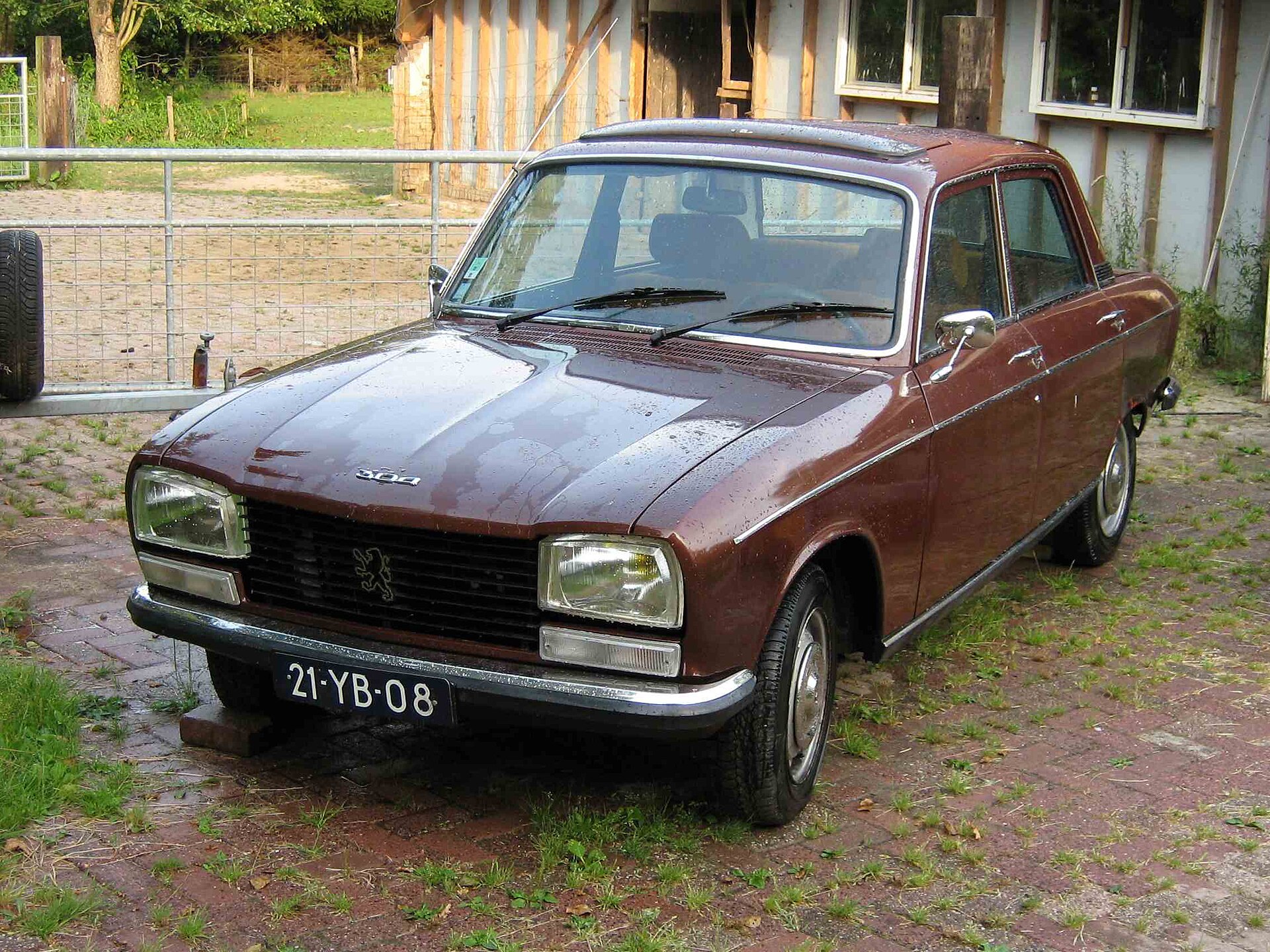
The Peugeot 304 is a front-wheel-drive family car that Peugeot built from 1969 to 1980 by giving the 204's centre section a longer tail, a 504-style face and a 1,288 cc engine. Sold as saloon, estate, coupé, cabriolet and van, it reached 1,178,423 units, about 36 per cent of them exported, and the twin-carburettor 304 S added 55 kW (75 PS) and 160 km/h.
In short
- Presented at the 1969 Paris Motor Show as a 7 CV car above the 204, a direct rival to the Renault 12.
- Petrol fours of 1,127-1,290 cc with 43-55 kW (59-75 PS); diesels of 1,357 and 1,548 cc with 33-35 kW (45-47 PS).
- 1,178,423 built: 849,103 saloons, 216,183 estates, 60,186 coupés, 18,647 cabriolets and 34,304 vans.
- Sold in the United States from 1970 to 1972 (4,269 cars); replaced by the 305 from 1977.
Size at a glance
| Dimensions | Peugeot 304 I |
|---|---|
| Length | 4,140 mm163.0 in |
| Width | 1,570 mm61.8 in |
| Height | 1,410 mm55.5 in |
| Wheelbase | 2,590 mm102.0 in |
Specs by version
Engines
| Version | Engine | Power | Drive | Production years |
|---|---|---|---|---|
| Diesel · 2 versions | ||||
| Diesel 1357 (XL4D) | 1.4 l · 4 cyl · Diesel XL4D | 33 kW 45 PS44 hp | Front-wheel drive | 1976–1979 |
| Diesel 1548 (XID) | 1.5 l · 4 cyl · Diesel XID | 35 kW 48 PS47 hp | Front-wheel drive | 1979–1980 |
| Petrol · 4 versions | ||||
| Break GL 1100 (XK5) | 1.1 l · 4 cyl · Petrol XK5 | 43 kW 58 PS58 hp | Front-wheel drive | 1976–1980 |
| 1300 (XL3) | 1.3 l · 4 cyl · Petrol XL3 | 48 kW 65 PS64 hp | Front-wheel drive | 1969–1975 |
| S 1300 (XL3S) | 1.3 l · 4 cyl · Petrol XL3S | 55 kW 75 PS74 hp | Front-wheel drive | 1972–1975 |
| Cabriolet S (XL3S) | 1.3 l · 4 cyl · Petrol XL3S | 55 kW 75 PS74 hp | Front-wheel drive | 1972–1975 |
Performance
Show all 2 versions
| Version | Top speed |
|---|---|
| 1300 (XL3) | 150 km/h93 mph |
| S 1300 (XL3S) | 160 km/h99 mph |
Dimensions and weight
Show all 3 versions
| Version | Length | Width | Height | Wheelbase |
|---|---|---|---|---|
| Break GL 1100 (XK5) | 3,990 mm157.1 in | - | - | - |
| 1300 (XL3) | 4,140 mm163.0 in | 1,570 mm61.8 in | 1,410 mm55.5 in | 2,590 mm102.0 in |
| Cabriolet S (XL3S) | 3,760 mm148.0 in | - | - | 2,310 mm90.9 in |
Verified Manufacturer and type-approval data from our catalog · Sources and methodology
Peugeot 304 at a glance
| Item | Peugeot 304 |
|---|---|
| Years | September 1969 to May 1980 (coupé and cabriolet to July 1975) |
| Production | 1,178,423 |
| Plants | Sochaux (saloon); Mulhouse (last estates) |
| Body styles | Four-door saloon, five-door Break, three-door coupé, two-seat cabriolet, van |
| Layout | Transverse front engine, front-wheel drive |
| Engines | 1,288 / 1,290 / 1,127 cc petrol; 1,357 / 1,548 cc diesel |
| Power | 33-55 kW (45-75 PS) |
| Dimensions | Saloon 4,140 mm long, 2,590 mm wheelbase; coupé and cabriolet 3,760 mm, 2,310 mm wheelbase |
| Weight | 890-970 kg |
| Top speed | 150 km/h (48 kW, 65 PS); 160 km/h (304 S), factory claims |
| 0-100 km/h | No figure in the sources consulted |
| Price new | GBP 1,278 (UK estate, 1971) |
Filling the gap between the 204 and the 504
By 1969 Peugeot's range had a hole between the 6 CV 204 and the larger 404 and 504. The 304, shown at the Paris Motor Show that autumn, filled it cheaply. It kept the 204's centre section, wheelbase and track, added about 15 cm behind the rear wheels for a bigger boot and took its trapezoidal headlamps and grille from the 504 of 1968. Zwischengas puts the total growth at 17 cm in length, 1 cm in width and 50 kg in weight. French Wikipedia classes it as a 7 CV mid-size car and notes that it arrived the same year as its main French rival, the Renault 12.
Mechanically it stayed close to its sister: a transverse all-alloy overhead-cam four with the gearbox below it, MacPherson struts at the front, independent coil-sprung rear suspension, disc and drum brakes with a servo and rack-and-pinion steering. Most engine and running gear parts interchange with the 204.
Bodies and production: from saloon to cabriolet
| Body | Built | Production period |
|---|---|---|
| Saloon | 849,103 | September 1969 - July 1979 |
| Break (estate) | 216,183 | September 1970 - May 1980 |
| Coupé | 60,186 | March 1970 - July 1975 |
| Cabriolet | 18,647 | March 1970 - July 1975 |
| Fourgonnette (van) | 34,304 | September 1976 - May 1980 |
| Total | 1,178,423 | 1969-1980 |
The coupé and cabriolet replaced the 204 versions in spring 1970 on a 2,310 mm wheelbase and gained the 504-style lamps of the saloon. The Break had the same length as the 204 estate, 3,990 mm. In 1973 the saloon received a new roof and rear pillars with rectangular tail lights, and from 1978 a wider front suspension was fitted.
Octane counts 836 right-hand-drive cabriolets officially imported into Britain from 1970 and estimates that about 60 remain there.

Engines: from the 1.3 to the 304 S and the diesels
The launch engine was the 1,288 cc XL3 with 48 kW (65 PS). From March 1972 the coupé and cabriolet received the twin-choke XL3S with 55 kW (75 PS), and the saloon followed that autumn as the 304 S for the 1973 model year. Peugeot's advertising called it the "New S motor super-powerful 60 kW (80 hp)", a gross figure that sits well above the net 55 kW (75 PS) once both are put into the same unit with our kW, PS and hp converter. The S engine was not offered on the estate.
| Engine | Displacement | Power | Introduced |
|---|---|---|---|
| XL3 petrol | 1,288 cc | 48 kW (65 PS) | 1969 |
| XL3S petrol (304 S) | 1,288 cc | 55 kW (75 PS) | 1972 |
| XL5 / XL5S petrol | 1,290 cc | 48 / 55 kW (65 / 75 PS) | 1975-1977 |
| XK5 petrol (GL Break, van) | 1,127 cc | 43 kW (59 PS) | 1976 |
| XL4D diesel | 1,357 cc | 33 kW (45 PS) | July 1976 |
| XID diesel | 1,548 cc | 35 kW (47 PS) | July 1979 |
Peugeot claimed 150 km/h for the 48 kW (65 PS) saloon, 152 km/h for the cabriolet and 160 km/h for the S versions. The 1,548 cc diesel needed a bulge in the bonnet. Inside, the 304 S had brown or amber leatherette seats until cloth became standard in 1976; its thicker seats cost rear legroom.

Period verdicts and the American episode
Motor Sport drove a 304 Estate in November 1971, when it cost GBP 1,278.12 in Britain. The magazine quoted 52 kW (70 bhp SAE) for the 1,288 cc engine, recorded 8.7 l/100 km (32.5 mpg), noted a 280 kg payload and about 1.5 cubic metres of load space with the rear seat folded, and called the car "a charming little vehicle and a useful load-carrier as well". It stayed composed even when heavily overloaded.
Peugeot also tried the United States. A federal 304 with 7.5:1 compression, instead of 8.8:1, was built from June 1970 to July 1972; output fell from 52 kW (70 hp) SAE gross in 1970 to 43 kW (58 hp) SAE net in 1972. Sales came to 1,407 in 1970, 2,153 in 1971 and 709 in 1972, a total of 4,269 saloons and estates.
The 304 never matched the 204's popularity in France, though export markets slightly preferred it. The coupé and cabriolet ended in July 1975, the saloon in summer 1979 and the last estates and vans in May 1980. Its successor, the 305 of 1977, was essentially a re-bodied development of the same front-drive layout.

Peugeot 304 today: what to check when buying
Octane's May 2024 buying guide to the 304 cabriolet names corrosion as the main concern, particularly for cars that spent their whole life in Britain. Check the underside for structural rot and every body panel, because replacement panels are hard to find. On the cabriolet, check the rear lights: they are unique to that body. The 204-derived mechanicals are durable, but specific parts can be hard to source outside France, so owners use French classified sites and the Peugeot clubs. On S models, make sure the twin-choke carburettor is present and correctly set up, since it accounts for the 7 kW advantage over the standard car.
The same guide put solid running cabriolets at about EUR 3,500 to 4,700 (GBP 3,000 to 4,000) and cars in excellent mechanical and body condition at about EUR 9,400 to 11,700 (GBP 8,000 to 10,000) in May 2024, converted at the exchange rate of that month. Octane notes that cars are plentiful in the Netherlands and France but fetch higher prices on the Continent.
The 304 is listed in our Peugeot catalogue, and its place in the company's story is covered in our Peugeot history. Its rival's maker is described in our history of Renault, and more cars of the period are in the classic cars section.
Peugeot 304 in our rankings
- No. 3 of 21 · Smallest station wagons (3,990 mm)
- No. 4 of 35 · Smallest convertibles and roadsters (3,760 mm)
- No. 33 of 552 · Smallest cars (3,760 mm · top 6%)
- No. 11 of 112 · Smallest sedans (4,140 mm · top 10%)
- No. 22 of 31 · Fastest cars of the 1960s (150 km/h · top 71%)
- No. 65 of 78 · Fastest sedans (160 km/h · top 85%)
Shorter than 94% of ranked cars in the 1CARS catalog (No. 33 of 552).
FAQ
What is the difference between the Peugeot 204 and 304?
The 304 uses the 204's centre section and running gear but adds about 15 cm at the back, a 504-style front and a larger 1,288 cc engine of 48 kW (65 PS) instead of 1,130 cc. Its coupé and cabriolet replaced the 204 versions in 1970.
How many Peugeot 304s were built?
1,178,423 between 1969 and 1980, according to English Wikipedia: 849,103 saloons, 216,183 estates, 60,186 coupés, 18,647 cabriolets and 34,304 vans. About 36 per cent were exported.
What is a Peugeot 304 S?
The sporting version with the twin-choke XL3S engine of 55 kW (75 PS) and a claimed 160 km/h. It came on the coupé and cabriolet from March 1972 and on the saloon from autumn 1972; the estate never had it.
Was the Peugeot 304 sold in the United States?
Yes, briefly. A federal version with lower compression was built from June 1970 to July 1972, and 4,269 saloons and estates were sold in America before Peugeot withdrew the model there.
Data sources
Data checked by an editor against the sources below.
- Wikipedia - Peugeot 304


