
 Ford Mustang GT
All generations, specs and history
Published Sources (5) Report an error
By Felix Hartmann, Automotive Technology & EV Contributor
- Built
- 1965–present
- Generations
- 4
- Top power
- 362 kW (492 PS)
Timeline
Mustang GT generations
Click a generation for its own page
- Mustang GT I 1965–1969 · Coupe, Convertible · 168–250 kW (228–340 PS)
- Mustang GT II 1982–2004 · Coupe, Convertible · 117–194 kW (159–264 PS)
- Mustang GT III 2005–2014 · Coupe, Convertible · 224–313 kW (305–426 PS)
- Mustang GT IV Current 2015–now · Coupe, Convertible · 324–362 kW (441–492 PS)
Newest first · 4 generations since 1965
- 2015 IV In production 2015–now · Coupe, Convertible · 324–362 kW (441–492 PS)
- 2005 III 2005–2014 · Coupe, Convertible · 224–313 kW (305–426 PS)
-
1982
- 1965 I 1965–1969 · Coupe, Convertible · 168–250 kW (228–340 PS)

All generations by year: Mustang GT IV (2015–now) · Mustang GT III (2005–2014) · Mustang GT II (1982–2004) · Mustang GT I (1965–1969)
Which one is mine?
Pick the year of first registration to see which generation it is.
- Mustang GT IV 2015–present
- Mustang GT III 2005–2014
- Mustang GT II 1982–2004
- Mustang GT I 1965–1969
The Ford Mustang GT is the core V8 Mustang. It began in April 1965 as the GT Equipment Group for 289 V8 cars, lasted until 1969, returned in 1982 with the 5.0 High Output engine and has stayed in the range ever since. The seventh-generation GT of 2024 makes 358 kW (480 hp) from its 5.0-litre Coyote V8.
In short
- First GT: the GT Equipment Group of April 1965, available only with the 225 hp or 271 hp 289 V8; Wikipedia counts 15,079 GT cars for 1965 and 25,517 for 1966.
- Big-blocks arrived with the 390 in 1967 and the 428 Cobra Jet in 1968; after 5,396 GTs in 1969 Ford dropped the name in favour of the Mach 1.
- The 1982 comeback GT had a 117 kW (157 hp) 5.0 H.O.; 4.6-litre modular V8s followed from 1996 and the 5.0 Coyote from 2011.
- The 2024 GT is rated at 358 kW (480 hp) and 563 Nm (415 lb-ft) in the US and 328 kW (446 PS) with 540 Nm in Europe.
Specs by version
| Version | Engine | Power | Torque | Gearbox | Drive | Production years |
|---|---|---|---|---|---|---|
| Mustang GT I · 289 K-code HiPo V8 (SAE gross), manual | 4.7 l · 8 cyl · Petrol 4,736 cc | 202 kW 275 PS271 hp | 423 Nm312 lb-ft | 4-sp Manual | Rear-wheel drive | 1965–1967 |
| Mustang GT I · 390 S-code 4V V8 (SAE gross) | 6.4 l · 8 cyl · Petrol 6,391 cc | 239 kW 325 PS321 hp | 579 Nm427 lb-ft | - | Rear-wheel drive | 1967 |
| Mustang GT II · 5.0 H.O. V8 (SAE net) | 4.9 l · 8 cyl · Petrol 4,949 cc | 168 kW 228 PS225 hp | 407 Nm300 lb-ft | - | Rear-wheel drive | 1987–1992 |
| Mustang GT III · 5.0 Coyote V8, manual | 5.0 l · 8 cyl · Petrol 4,951 cc | 307 kW 417 PS412 hp | 529 Nm390 lb-ft | 6-sp Manual | Rear-wheel drive | 2011–2012 |
| Mustang GT IV · 5.0 V8 446 PS (Europe) | 5.0 l · 8 cyl · Petrol 4,951 cc | 328 kW 446 PS440 hp | 540 Nm398 lb-ft | - | Rear-wheel drive | 2024 |
| Mustang GT IV · 5.0 V8 (US), active exhaust | 5.0 l · 8 cyl · Petrol 4,951 cc | 362 kW 492 PS485 hp | 567 Nm418 lb-ft | - | Rear-wheel drive | 2024 |
Verified Manufacturer and type-approval data from our catalog · Sources and methodology
Mustang GT at a glance
| Specification | Ford Mustang GT |
|---|---|
| Years | 1965-1969, 1982 to date |
| Bodies | hardtop coupé, fastback, convertible |
| Platforms | first-generation Mustang, Fox (1982-1993), Fox-4/SN95 (1994-2004), D2C/S197 (2005-2014), S550 (2015-2023), S650 (from 2024) |
| Engines | 289 (4.7 L), 390 (6.4 L) and 428 Cobra Jet (7.0 L) in the 1960s; 302 "5.0" (4.9 L), 4.6 L modular, 5.0 L Coyote |
| Power | 168 kW (225 hp, SAE gross) in 1965 to 358 kW (480 hp, SAE net) in 2024 |
| Torque | 414 Nm (305 lb-ft) in 1965 to 597 Nm (440 lb-ft) with the 428 Cobra Jet |
| Gearboxes | three- and four-speed manual, automatic; Borg-Warner T-5 from 1983; six-speed manual and 10-speed automatic today |
| 0-60 mph | 4.8 s, 2024 GT manual with Performance Pack (Edmunds, August 2023) |
| Quarter mile | 12.7 s at 111.6 mph (same test) |
| Price new | GT group about US$150 in 1965 plus the V8 option; GT from EUR 59,900 in Germany in February 2024 |
1965-1969: an equipment group for V8 cars
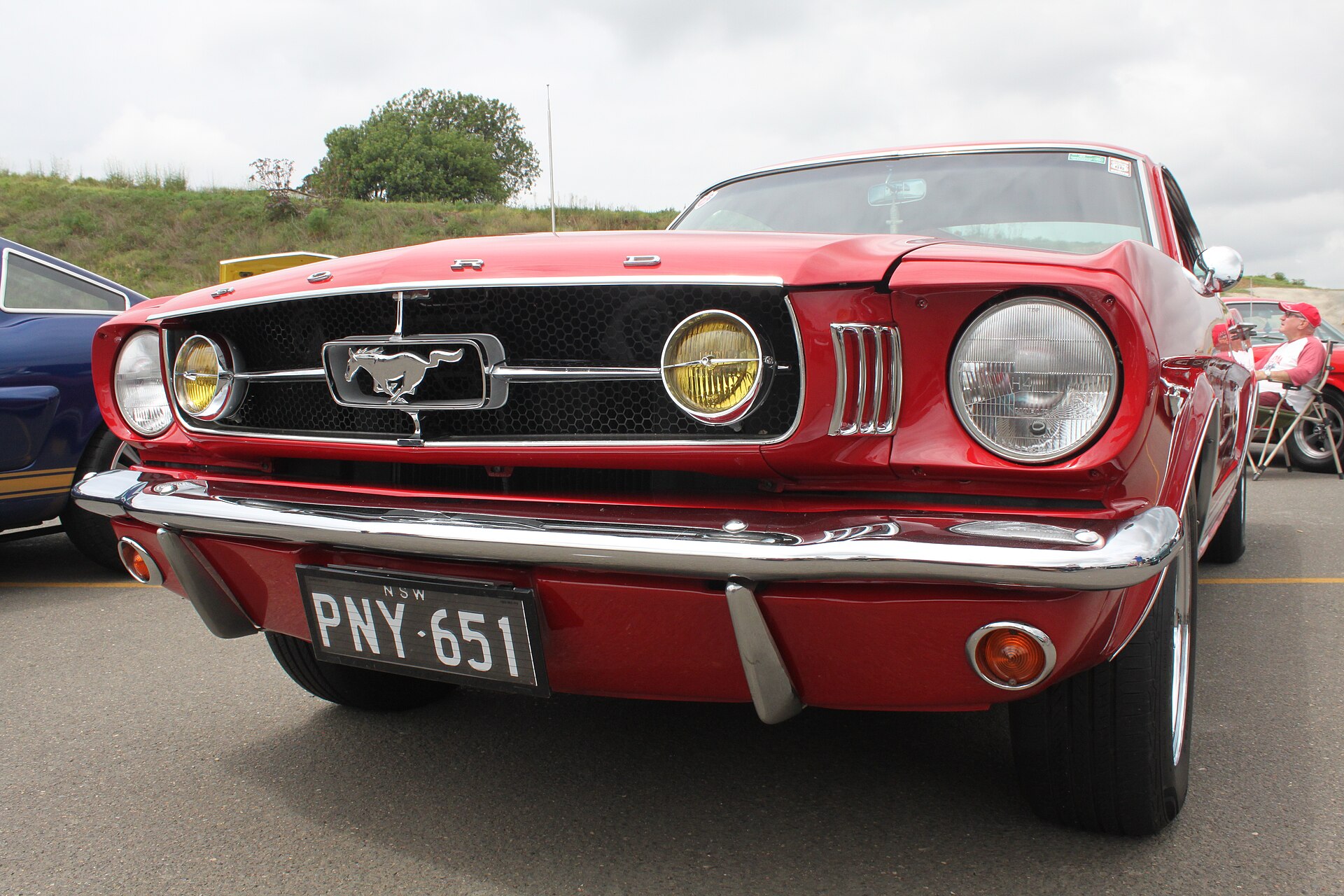
Ford added the GT Equipment Group in April 1965, around the first anniversary of the Mustang's launch. Buyers had to order a V8: the 225 hp Challenger Special 289 cost US$157 in 1965 and the high-performance 271 hp K-code 289 US$430. The group itself added about US$150, according to Old Cars Weekly, and brought:
- front disc brakes and quick-ratio steering;
- the Special Handling package;
- fog lamps built into the grille bar;
- chromed exhaust tips through the rear valance;
- a five-dial instrument panel in place of the Falcon-derived cluster;
- rocker-panel stripes and GT badges.
In metric terms the four-barrel A-code 289 gave 168 kW (225 hp) and 414 Nm (305 lb-ft); the K-code reached 202 kW (271 hp) at 6,000 rpm and 423 Nm (312 lb-ft). Wikipedia lists 15,079 GT cars for 1965 and 25,517 for 1966, while Old Cars Weekly writes that no exact figure for 1965 exists, so the early totals should be read as estimates.
Big-block GTs: the 390 and the 428 Cobra Jet
The redesigned 1967 Mustang was wide enough for Ford's FE big-block, and the GT could now have the S-code 390 four-barrel. Wikipedia's 1967 table rates it at 239 kW (320 hp) and 579 Nm (427 lb-ft), although the same article also mentions 335 hp, so figures vary between sources. For 1968 the options for a GT ranged from the 172 kW (230 hp) 302 four-barrel to a 390 listed at 242 kW (325 hp).
The big change came in mid-1968, when the 428 Cobra Jet with 250 kW (335 hp) and 597 Nm (440 lb-ft) joined the list, identified by the letter R in the VIN. The best-known 1968 GT never raced at all: Steve McQueen drove a modified GT 2+2 fastback in the film that later gave the Mustang Bullitt its name.
By 1969 the GT was overshadowed by the new fastback-only Mach 1, which came with stripes, a V8 and much stronger sales. Only 5,396 GTs were sold that year, and Ford discontinued the package.

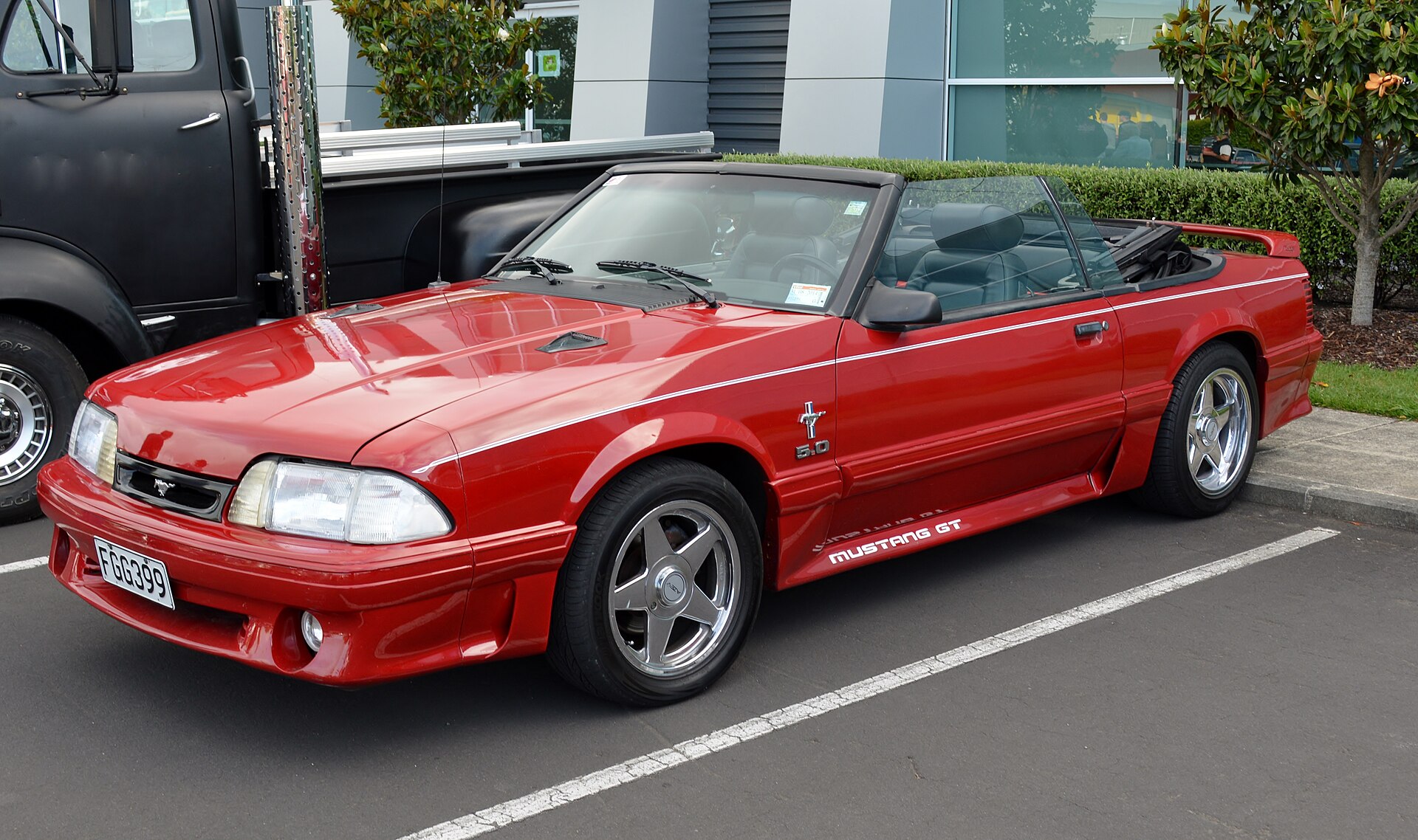
1982-1993: the 5.0 H.O. years
The GT returned for 1982 after 13 years, advertised as "The Boss is Back!". Its 302 V8, sold as the 5.0 High Output, produced 117 kW (157 hp) with a two-barrel carburettor and came only with a four-speed manual. Ford changed the induction and the rating several times during the Fox-body years.
| Model year | Induction | Power (SAE net) | Torque |
|---|---|---|---|
| 1982 | two-barrel | 117 kW (157 hp) | not published in source |
| 1983 | four-barrel | 130 kW (175 hp) | 332 Nm (245 lb-ft) |
| 1985 | four-barrel, manual cars | 157 kW (210 hp) | 366 Nm (270 lb-ft) |
| 1986 | sequential fuel injection | 149 kW (200 hp) | 386 Nm (285 lb-ft) |
| 1987-1992 | sequential fuel injection | 168 kW (225 hp) | 407 Nm (300 lb-ft) |
| 1993 | sequential fuel injection, re-rated | 153 kW (205 hp) | 373 Nm (275 lb-ft) |
The Borg-Warner T-5 five-speed became the standard gearbox behind the 302 early in the 1983 model year and was upgraded to the heavy-duty "World Class" version for 1985. The last third-generation Mustang left the line on 26 August 1993.

1994-2014: from pushrod 5.0 to Coyote
The SN95 Mustang of 1994 kept the 302 for two years at 160 kW (215 hp) and 386 Nm (285 lb-ft). For 1996 the GT switched to the 4.6-litre SOHC two-valve modular V8 with the same 215 hp rating; the 1999 New Edge facelift lifted it to 194 kW (260 hp) and 409 Nm (302 lb-ft). Manual GTs used a Borg-Warner T-45 five-speed and, from 2001, a Tremec TR-3650.
The S197 GT of 2005 had a three-valve 4.6 with 224 kW (300 hp) and 434 Nm (320 lb-ft), revised in 2010 to 235 kW (315 hp). The 2011 GT introduced the four-valve 5.0 Coyote: 307 kW (412 hp) and 529 Nm (390 lb-ft) on premium fuel, 402 hp on regular, with a Getrag/Ford MT82 six-speed manual or the 6R80 automatic. For 2013 the rating rose to 313 kW (420 hp).
2015 onwards: the GT goes global
The S550 GT of 2015 brought independent rear suspension and 324 kW (435 hp) with 542 Nm (400 lb-ft). It was the first Mustang planned for sale worldwide, in 120 countries including 25 right-hand-drive markets, and right-hand-drive production began on 24 August 2015.
The 2018 facelift added port and direct injection, 343 kW (460 hp), 569 Nm (420 lb-ft) and the 10-speed 10R80 automatic. For 2022 Ford quoted 336 kW (450 hp) and 556 Nm (410 lb-ft) to meet LEV III emission rules.
The S650 GT of 2024 uses the fourth-generation Coyote with a twin-throttle-body intake. In the US it is rated at 358 kW (480 hp) and 563 Nm (415 lb-ft), or 362 kW (486 hp) and 567 Nm (418 lb-ft) with the active-valve exhaust. The European version is homologated at 328 kW (446 PS) and 540 Nm; Motor1 Germany listed it from EUR 59,900 with the manual and EUR 62,900 with the automatic in February 2024. Above the GT now sits the 500 hp Mustang Dark Horse.

Mustang GT today: what to check
For a 1965-1969 GT the VIN shows the year, plant, body and engine letter (A, K, S or R, for example) but has no field for the GT group, so the equipment itself has to match: disc brakes, grille fog lamps, valance exhaust tips and the five-dial panel on 1965-1966 cars. The 428 Cobra Jet Registry points to Marti Auto Works, which holds complete Ford production records for 1967 to 1973; for those years a Marti Report can confirm the original options.
For Fox-body cars, the published figures need care: Wikipedia notes that the 1989 mass-air system slightly reduced factory horsepower, and the 1993 figure of 153 kW (205 hp) is a re-rating of the same 5.0. For a wider view of how the GT fits into each generation, see the Ford Mustang generations hub, the Mustang story from 1964 and the rival Chevrolet Camaro; every catalogue version is listed under Ford Mustang models.
Ford Mustang GT evolution in numbers
Did you know?
- The Ford Mustang GT has been around for 61 years: 4 generations in our catalog since 1965.
- The longest-running generation is the Mustang GT II (1982–2004): 22 years.
- The biggest jump in power came with the Mustang GT III: up to 313 kW (426 PS), 119 kW more than the Mustang GT II.
Most powerful version, kW
Figures from the 1cars catalog: power is the strongest version of each generation; generations without the figure are left out.
Ford Mustang GT: first vs latest generation
| Spec | Mustang GT I | Mustang GT IV | Change |
|---|---|---|---|
| Years | 1965–1969 | 2015–present | 50 years apart |
| Most powerful version | 250 kW (340 PS) | 362 kW (492 PS) | +112 kW (+45%) |
Oldest and newest generation in the 1cars catalog. Power is the strongest version of each; other rows are shown only when both generations have the figure.
Ford Mustang GT in our rankings
- No. 24 of 1104 · Longest-running car nameplates (44 years · top 3%)
- No. 19 of 381 · Oldest car models still on sale (44 years · top 7%)
- No. 87 of 658 · Biggest engines: cars (6,391 cc · top 14%)
- No. 33 of 187 · Most powerful American cars (362 kW · top 18%)
- No. 228 of 1035 · Most powerful cars (362 kW · top 23%)
- No. 59 of 198 · Biggest engines: coupes (6,391 cc · top 30%)
In production longer than 97% of ranked nameplates in the 1CARS catalog (No. 24 of 1104).
FAQ
When was the first Mustang GT made?
The GT Equipment Group was introduced in April 1965, during the first Mustang model year. It required a 289 V8 and added disc brakes, fog lamps, stripes, special gauges and handling parts.
Why was there no Mustang GT from 1970 to 1981?
Ford dropped the GT after 1969 because the new Mach 1 outsold it; only 5,396 GTs were sold in 1969. The name returned for 1982 with the 5.0 High Output V8.
How much power does the 2024 Mustang GT have?
In the US 358 kW (480 hp) and 563 Nm (415 lb-ft), or 362 kW (486 hp) with the active-valve exhaust. The European GT is rated at 328 kW (446 PS) and 540 Nm.
Which engines has the Mustang GT used?
The 289, 390 and 428 Cobra Jet in the 1960s, the 302 "5.0" from 1982 to 1995, the 4.6-litre modular V8 from 1996 to 2010 and the 5.0-litre Coyote V8 from 2011.
Data sources
Data checked by an editor against the sources below.
- Wikipedia - Ford Mustang
- Wikipedia - Ford Mustang (first generation)
- Wikipedia - Ford Mustang (third generation)
- Wikipedia - Ford Mustang (fifth generation)
- Wikipedia - Ford Mustang (sixth generation)


