 Mercury Cyclone GT
All generations, specs and history
Published Sources (4) Report an error
By Felix Hartmann, Automotive Technology & EV Contributor
- Built
- 1966–1970
- Generations
- 3
- Top power
- 291 kW (396 PS)
Timeline
Cyclone GT generations
Click a generation for its own page
- Comet Cyclone GT 1966–1967 · Coupe, Convertible · 239–250 kW (325–340 PS)
- Cyclone GT II 1968–1969 · Coupe · 157–291 kW (213–396 PS)
- Cyclone GT III 1970 · Coupe · 186–280 kW (253–381 PS)
Newest first · 3 generations since 1966
- 1970 III 1970 · Coupe · 186–280 kW (253–381 PS)
- 1968 II 1968–1969 · Coupe · 157–291 kW (213–396 PS)
- 1966 Comet Cyclone GT 1966–1967 · Coupe, Convertible · 239–250 kW (325–340 PS)
All generations by year: Cyclone GT III (1970) · Cyclone GT II (1968–1969) · Comet Cyclone GT (1966–1967)
Which one is mine?
Pick the year of first registration to see which generation it is.
- Cyclone GT III 1970
- Cyclone GT II 1968–1969
- Comet Cyclone GT 1966–1967
The Mercury Cyclone GT was the sporting version of Mercury's mid-size Cyclone from 1966 to 1970, built on the same body as the Ford Fairlane and later the Torino. It started as a 1966 Comet Cyclone GT with a 390 V8 of 250 kW (335 hp, SAE gross), paced the 1966 Indianapolis 500 and ended as a 1970 hardtop with concealed headlamps and up to 7.0 litres.
In short
- 1966: Comet Cyclone GT, 390 cu in (6.4 L) V8 with 250 kW (335 hp) and 579 Nm (427 lb-ft); 15,970 GTs built.
- 1968: the Cyclone becomes its own nameplate on the new fastback body; the 428 Cobra Jet joins mid-year at 250 kW (335 hp).
- 1969: the GT turns into an appearance package, with the CJ as the performance model.
- 1970: GT hardtop at US$3,025, 10,170 built; 429 Cobra Jet up to 276 kW (370 hp) gross.
Specs by version
Engines
| Version | Engine | Power | Torque | Drive | Production years |
|---|---|---|---|---|---|
| Comet Cyclone GT · 390 GT 4-barrel V8 (SAE gross) | 6.4 l · 8 cyl · Petrol S | 250 kW 340 PS335 hp | 579 Nm427 lb-ft | Rear-wheel drive | 1966 |
| Cyclone GT II · 428 Cobra Jet V8 (SAE gross) | 7.0 l · 8 cyl · Petrol 7,014 cc | 250 kW 340 PS335 hp | - | Rear-wheel drive | 1968–1969 |
| Cyclone GT III · 351 Cleveland 2-barrel V8 (SAE gross), manual | 5.8 l · 8 cyl · Petrol 5,752 cc | 186 kW 253 PS249 hp | - | Rear-wheel drive | 1970 |
| Cyclone GT III · 429 Cobra Jet V8 (SAE gross) | 7.0 l · 8 cyl · Petrol C | 276 kW 375 PS370 hp | 610 Nm450 lb-ft | Rear-wheel drive | 1970 |
Dimensions and weight
Verified Manufacturer and type-approval data from our catalog · Sources and methodology
Cyclone GT at a glance
| Specification | Mercury Cyclone GT |
|---|---|
| Model years | 1966-1970 (Montego Cyclone GT in 1971) |
| Bodies | two-door hardtop and convertible (1966-1967); fastback and hardtop (1968); fastback (1969); hardtop (1970) |
| Platform | Ford mid-size (Fairlane, later Torino) |
| Wheelbase 1966 | 2,946 mm (116.0 in); length 5,156 mm (203.0 in) |
| Engine 1966 | 390 cu in (6.4 L) V8, four-barrel, 250 kW (335 hp) at 4,800 rpm, 579 Nm (427 lb-ft) at 3,200 rpm |
| Engines 1968-1969 | 302 (4.9 L), 390 (6.4 L), briefly 427 (7.0 L), 428 Cobra Jet (7.0 L) |
| Engines 1970 | 351 Cleveland (5.8 L) two-barrel standard; 429 (7.0 L) options to 280 kW (375 hp) |
| Gearboxes | three-speed manual standard; four-speed manual or automatic optional |
| Production | 15,970 (1966); 10,170 (1970) |
| Price new | US$3,025 for the 1970 GT hardtop |
The 1966 Comet Cyclone GT and the Indy pace car
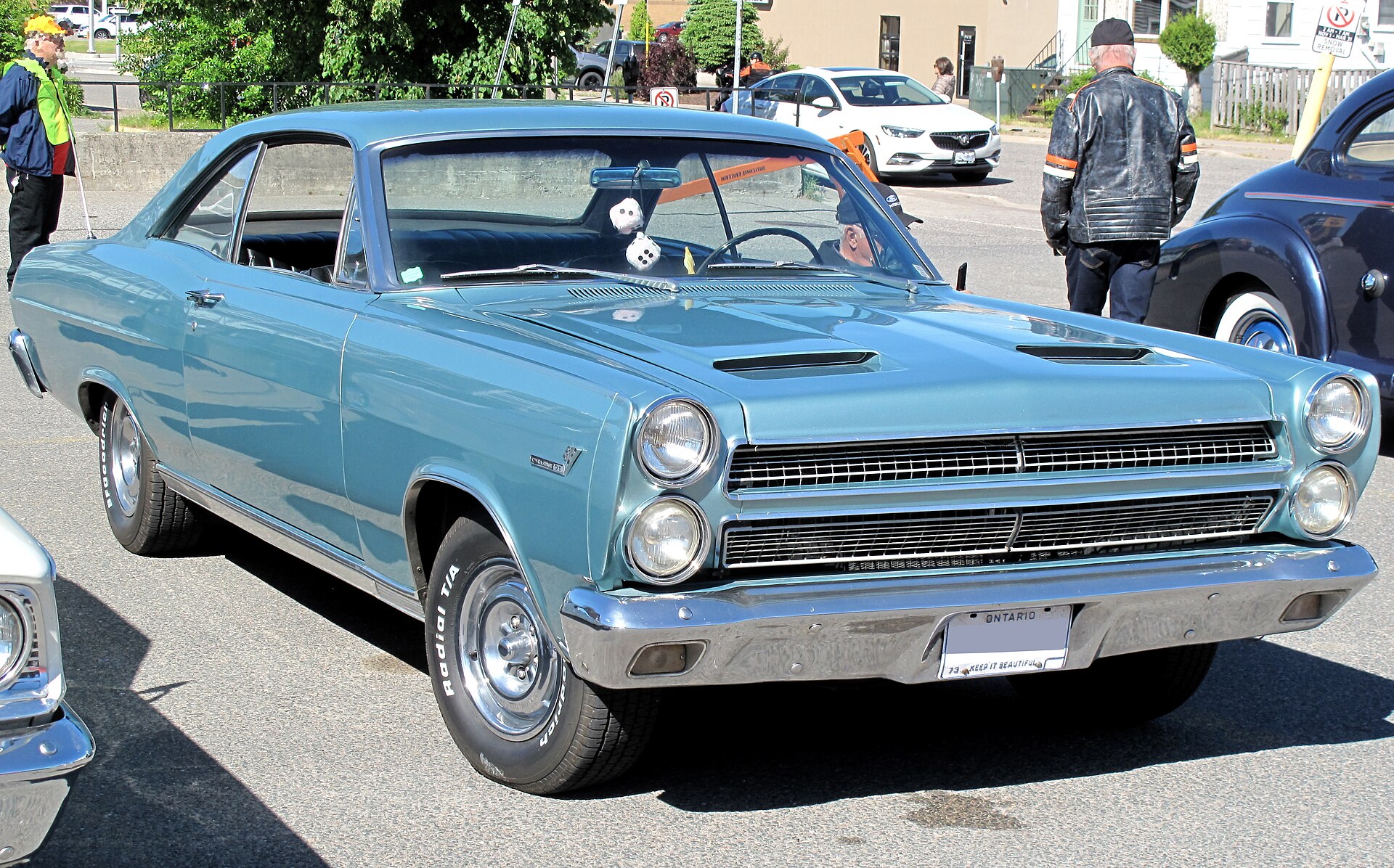
For 1966 Mercury moved the Comet onto the body of the Ford Fairlane, and the Cyclone became its sporting top line. The GT option brought the S-code 390 with a Holley four-barrel and 10.5:1 compression, a fibreglass bonnet with two scoops and body stripes. The axle was 3.25:1 as standard, with 3.00:1 optional.
A Cyclone GT convertible paced the 1966 Indianapolis 500, the only time a Mercury did so in the modern era according to Over-Drive magazine's fact sheet. The GT was clearly the version buyers wanted: Mercury built 13,812 GT hardtops and 2,158 GT convertibles against 6,882 plain Cyclone hardtops and 1,305 convertibles.
| 1966 version | Hardtop | Convertible |
|---|---|---|
| Comet Cyclone GT | 13,812 | 2,158 |
| Comet Cyclone | 6,882 | 1,305 |
For 1967 the formula carried over, with the 390 quoted by Wikipedia at 239 kW (320 hp). Total Cyclone output fell to 6,910 cars, 809 of them convertibles; no reliable GT split has been published for that year.
A fastback body for 1968
Mercury dropped the Comet name from the Cyclone for 1968 and gave it the new Torino-shaped intermediate body as a fastback and a notchback hardtop. The GT added an upper body stripe, bucket seats, wide whitewall tyres, special wheel covers, an all-vinyl interior and the handling package.
Sources differ on the GT's standard engine that year. Hagerty says the GT lost the 335 hp 390 as standard and started with the 302 of 157 kW (210 hp); Wikipedia lists the 390 as standard on the GT at 198 kW (265 hp) or 242 kW (325 hp). The engine list itself is not in dispute:
| Engine (1968) | Power, SAE gross |
|---|---|
| 302 V8 (4.9 L) | 157 kW (210 hp) or 172 kW (230 hp) |
| 390 V8 (6.4 L) | 198 kW (265 hp) or 242 kW (325 hp) |
| 427 V8 (7.0 L), early 1968 only | 291 kW (390 hp) |
| 428 Cobra Jet (7.0 L), from mid-1968 | 250 kW (335 hp) |
Mercury built 13,628 Cyclones of all kinds for 1968. On the track, Mercury Cyclones finished first and second in the 1968 Daytona 500.
1969: GT as a package, CJ as the muscle car
For 1969 Mercury split the roles. The Cyclone CJ, at US$3,207 according to Hagerty, carried the 428 Cobra Jet with 250 kW (335 hp), optional Ram Air and a 3.50:1 axle, and was aimed at the Plymouth Road Runner. The GT became an appearance and trim package; Wikipedia lists a 390 of 239 kW (320 hp) among its engines that year.
That split matters to collectors. A 1969 car with GT badges does not have to be a big-block car, and 3,261 of the year's 9,143 Cyclones were CJs. The aerodynamic Spoiler and Spoiler II models of the same year have their own history.
1970: concealed headlamps and the 429
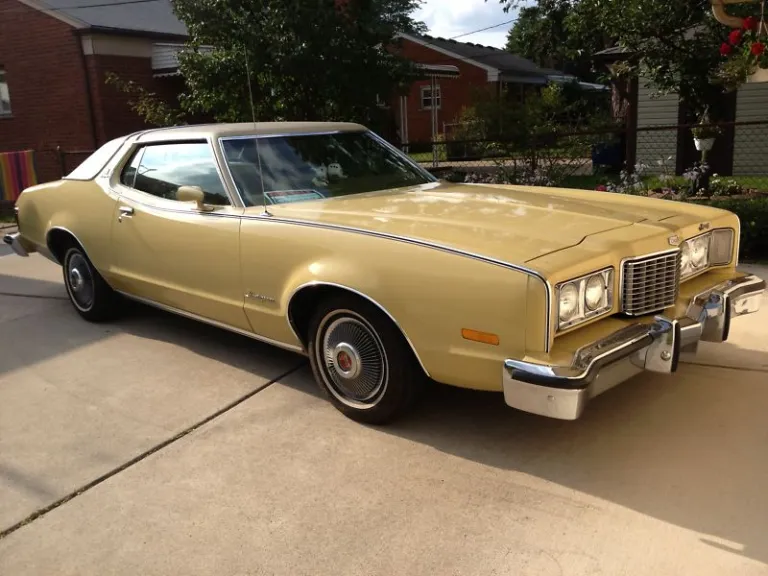
The 1970 Cyclone was restyled together with Ford's new Torino, and the GT was the version with concealed headlamps, a non-functional bonnet scoop and full-length lower body mouldings. Its standard engine was a two-barrel 351 Cleveland with a three-speed manual, rated at 186 kW (250 hp) by Hagerty. That made the GT, at US$3,025, slightly cheaper than the base Cyclone at US$3,035, which came with a 429 four-barrel of 268 kW (360 hp).
GT buyers could order the 429 in several forms, the four-barrel 360 hp unit, the 429 Cobra Jet at 276 kW (370 hp) and 610 Nm (450 lb-ft), and the Super Cobra Jet with the Drag Pack at 280 kW (375 hp), all SAE gross. Four-speed manual and automatic gearboxes were optional.
| Year | Cyclone GT production | Note |
|---|---|---|
| 1966 | 15,970 | hardtop and convertible |
| 1970 | 10,170 | of 13,496 Cyclones |
| 1971 | 2,287 | sold as Montego Cyclone GT |
The GT was the volume Cyclone of 1970. For 1971 the car was folded into the Montego line, and after that year the Cyclone name lived on only as a Montego option, with 30 cars built for 1972.

Cyclone GT today: what to check
The first document to ask for is a Marti Report, which decodes the original build from Ford's records. It shows engine, gearbox, colour and options, and it matters because many cars have been re-engined: Autoevolution described a 1970 GT in October 2026 whose Marti Report lists the N-code 429 with a close-ratio four-speed, a combination found on 192 cars, but which now has a 545 cu in engine and a different colour.
- Engine codes: the S-code identifies the 1966 GT's 390 four-barrel; on 1970 cars C-code is the 429 Cobra Jet and N-code the 429 four-barrel without Cobra Jet parts.
- 1969 badges: a GT emblem alone proves nothing about the engine; CJ cars carry the 428.
- Pace car claims: 1966 convertibles are often sold as pace cars; ask for documentation, because the number of cars built for the race and for dealers is not well recorded.
- Values: in the same October 2026 article Autoevolution wrote that ordinary 1970 Cyclones rarely exceed US$30,000, while some manual GT cars sell for more than US$50,000.
- Trim: the 1970 option list included an Action Special Equipment Package with a bench seat; Wikipedia gives 953 cars, conceptcarz 933.
For the full model line see the Mercury Cyclone history, and for the NASCAR cars the Cyclone Spoiler II. The GT's Ford twin was the Ford Torino, and Mercury's pony-car sibling with the same 428 was the Cougar Eliminator. The Mercury catalogue lists the remaining models, and the muscle car guide sets the Cyclone among its rivals.
Photo gallery

Mercury Cyclone GT evolution in numbers
Did you know?
- The Mercury Cyclone GT ran for 4 years, from 1966 to 1970, over 3 generations in our catalog.
- The biggest jump in power came with the Cyclone GT II: up to 291 kW (396 PS), 41 kW more than the Comet Cyclone GT.
Most powerful version, kW
Figures from the 1cars catalog: power is the strongest version of each generation; generations without the figure are left out.
Mercury Cyclone GT: first vs latest generation
| Spec | Comet Cyclone GT | Cyclone GT III | Change |
|---|---|---|---|
| Years | 1966–1967 | 1970 | 4 years apart |
| Most powerful version | 250 kW (340 PS) | 280 kW (381 PS) | +30 kW (+12%) |
Oldest and newest generation in the 1cars catalog. Power is the strongest version of each; other rows are shown only when both generations have the figure.
Mercury Cyclone GT in our rankings
- No. 7 of 100 · Longest coupes (5,156 mm)
- No. 24 of 533 · Longest cars (5,156 mm · top 5%)
- No. 40 of 658 · Biggest engines: cars (7,030 cc · top 7%)
- No. 30 of 198 · Biggest engines: coupes (7,030 cc · top 16%)
- No. 16 of 102 · Most powerful cars of the 1970s (280 kW · top 17%)
- No. 19 of 109 · Most powerful cars of the 1960s (291 kW · top 19%)
Longer than 95% of ranked cars in the 1CARS catalog (No. 24 of 533).
FAQ
What engine did the 1966 Mercury Comet Cyclone GT have?
The 390 cu in (6.4 L) S-code V8 with a four-barrel carburettor and 10.5:1 compression, rated at 250 kW (335 hp) and 579 Nm (427 lb-ft), SAE gross.
How many Cyclone GTs were built?
The figures available are 15,970 for 1966 (13,812 hardtops and 2,158 convertibles), 10,170 for 1970 and 2,287 Montego Cyclone GTs for 1971. Split GT figures for 1967-1969 are not reliably published.
Did the Cyclone GT have the 428 Cobra Jet?
Yes, from mid-1968 the 428 Cobra Jet with 250 kW (335 hp) was available. For 1969 Mercury sold it as the separate Cyclone CJ, while the GT became a trim package.
Why was the 1970 Cyclone GT cheaper than the base Cyclone?
The 1970 GT came with a two-barrel 351 V8 as standard, while the base Cyclone had a 429 four-barrel. The GT listed at US$3,025, the base car at US$3,035.
Data sources
Data checked by an editor against the sources below.
- Wikipedia - Mercury Cyclone
- Over-drive-magazine - 1966 Mercury Comet Cyclone Fact Sheet
- Hagerty - 1970 Mercury Cyclone
- Conceptcarz - Mercury Cyclone