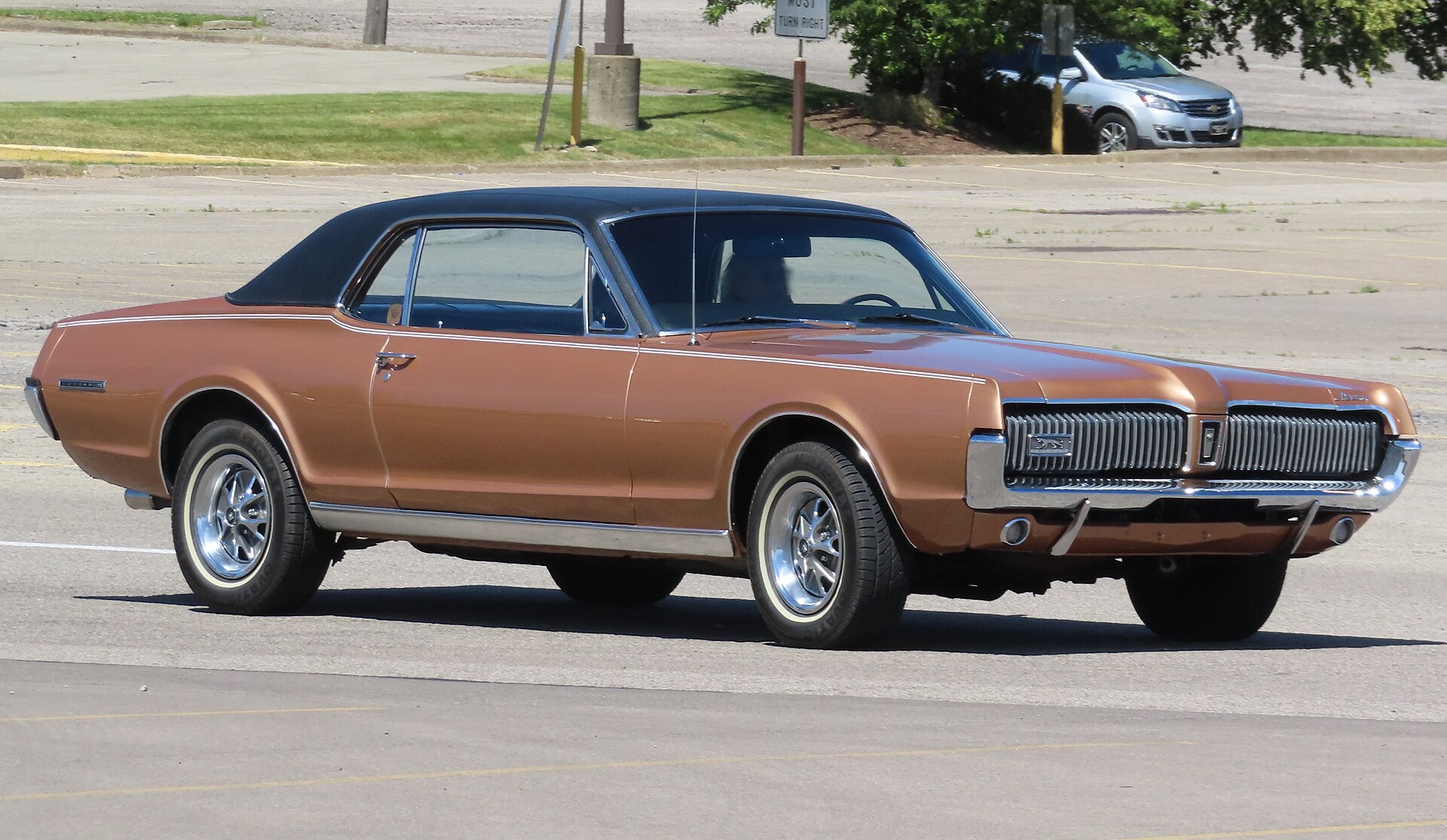
 Mercury Cougar Eliminator
Specs, engines and history
Published Sources (1) Report an error
By Sarah Whitmore, Senior Automotive Writer
- Built
- 1969–1970
- Top power
- 250 kW (340 PS)
Which Eliminator to choose
Our verdict · Sarah Whitmore
- For the strongest engine: a 428 Cobra Jet car, the quickest in a straight line.
- For the Trans-Am story: a Boss 302, the engine unique to the Eliminator.
- For easy use: a 351 car, simpler to run and to maintain.
- For rarity of the line: a 1968 GT-E, of which only 394 were made.
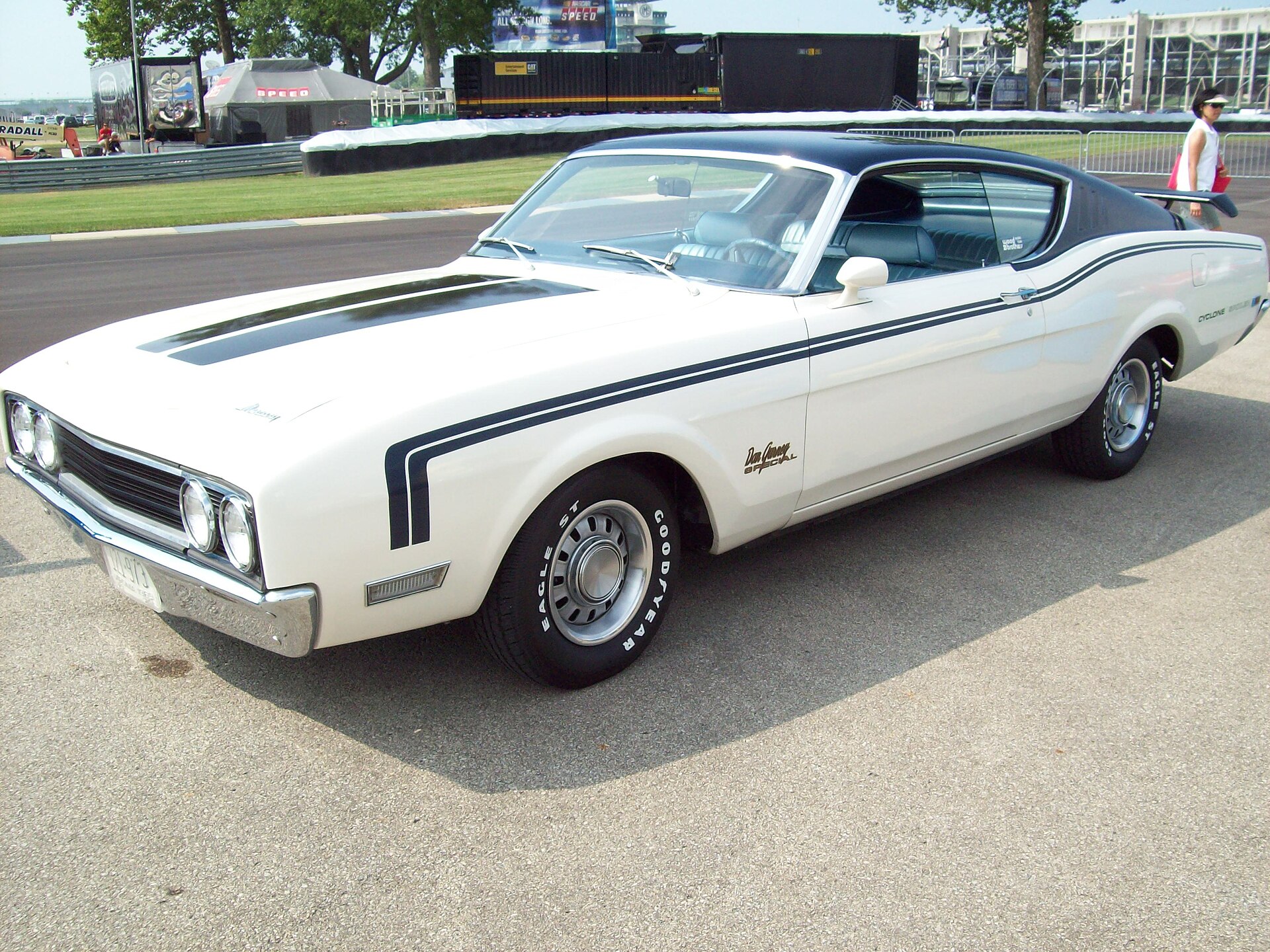
The Cougar's mid-size cousin is the Mercury Cyclone, and the whole brand story is told in our Mercury history. For more cars of the period, see the American muscle car guide and the power tables in our car rankings.
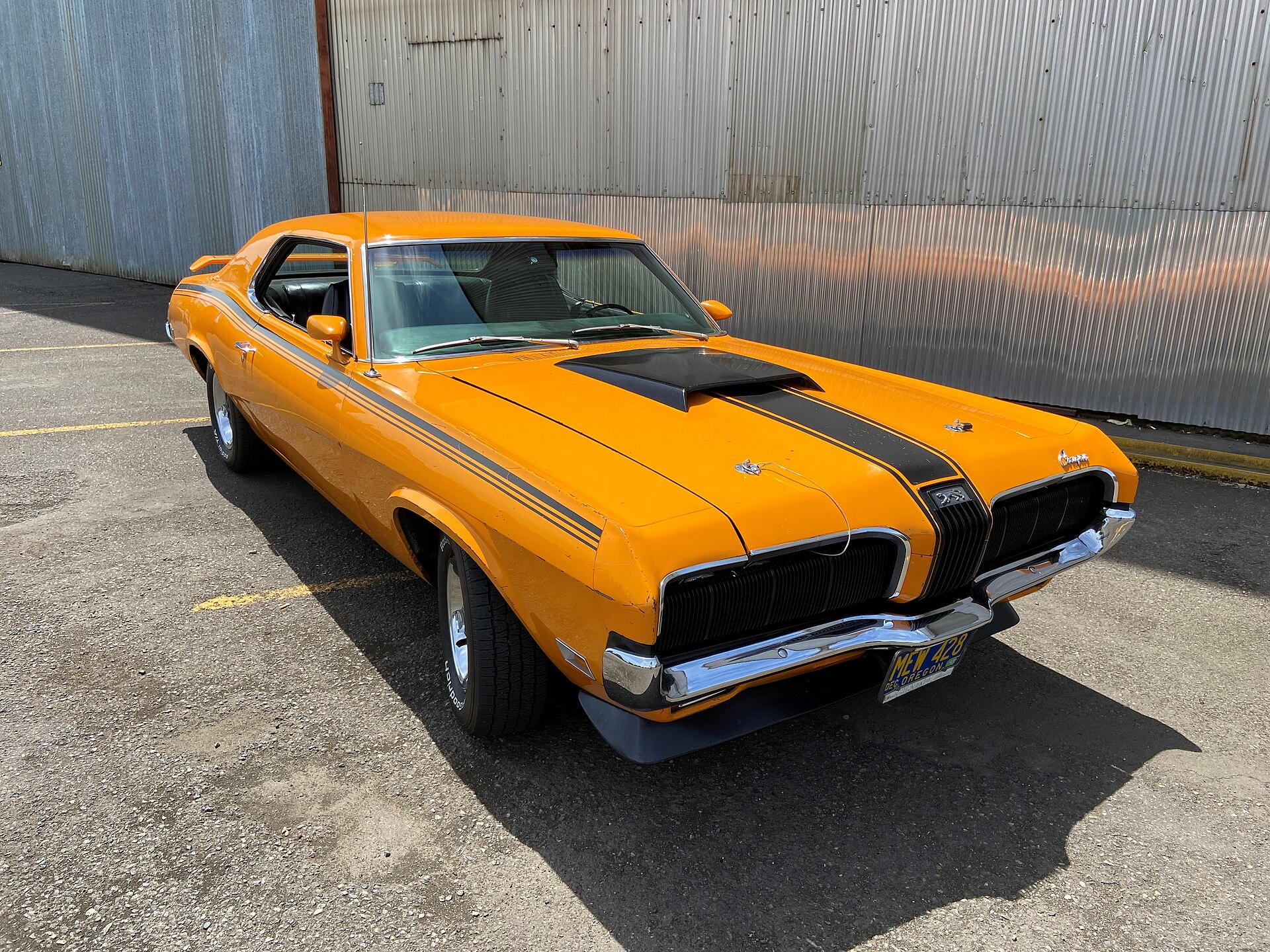
The Mercury Cougar Eliminator was the performance package of the first-generation Cougar, sold for the 1969 and 1970 model years. It replaced the Cougar GT on 1 April 1969 and combined spoilers, a hood scoop and stiffer suspension with V8s from the 351 to the 428 Cobra Jet and the Boss 302. Mercury built 2,250 in 1969 and 2,268 in 1970, which makes it one of the rarer pony cars of the golden age.
In short
- Based on the 1967–1970 Cougar, which used the Mustang's platform with a 111-inch (2,819 mm) wheelbase.
- Engines from 216 kW (290 hp, SAE gross) to 250 kW (335 hp) for the 428 Cobra Jet; the Boss 302 was offered only in the Eliminator.
- Hardtop only: no convertible and no XR-7 Eliminator left the factory.
- Its forerunner, the 1968 GT-E with the 427 V8 of 291 kW (390 hp), was built just 394 times.
Size at a glance
| Dimensions | Mercury Cougar Eliminator I |
|---|---|
| Length | 4,923 mm193.8 in |
| Width | 1,905 mm75.0 in |
| Height | 1,318 mm51.9 in |
| Wheelbase | 2,819 mm111.0 in |
Specs by version
Engines
| Version | Engine | Power | Drive | Production years |
|---|---|---|---|---|
| Boss 302 V8 (SAE gross) | 4.9 l · 8 cyl · Petrol 4,949 cc | 216 kW 294 PS290 hp | Rear-wheel drive | 1969–1970 |
| 351 Windsor 4V V8 (SAE gross) | 5.8 l · 8 cyl · Petrol 5,752 cc | 216 kW 294 PS290 hp | Rear-wheel drive | 1969 |
| 351 Cleveland 4V V8 (SAE gross) | 5.8 l · 8 cyl · Petrol 5,752 cc | 224 kW 305 PS300 hp | Rear-wheel drive | 1970 |
| 390 4V V8 (SAE gross) | 6.4 l · 8 cyl · Petrol 6,391 cc | 239 kW 325 PS321 hp | Rear-wheel drive | 1969 |
| 428 Cobra Jet V8 (SAE gross) | 7.0 l · 8 cyl · Petrol 7,014 cc | 250 kW 340 PS335 hp | Rear-wheel drive | 1969–1970 |
Dimensions and weight
Show all 5 versions
| Version | Length | Width | Height | Wheelbase |
|---|---|---|---|---|
| Boss 302 V8 (SAE gross) | - | - | - | 2,819 mm111.0 in |
| 351 Windsor 4V V8 (SAE gross) | 4,923 mm193.8 in | 1,905 mm75.0 in | 1,318 mm51.9 in | 2,819 mm111.0 in |
| 351 Cleveland 4V V8 (SAE gross) | 4,941 mm194.5 in | 1,885 mm74.2 in | 1,303 mm51.3 in | 2,819 mm111.0 in |
| 390 4V V8 (SAE gross) | 4,923 mm193.8 in | 1,905 mm75.0 in | 1,318 mm51.9 in | 2,819 mm111.0 in |
| 428 Cobra Jet V8 (SAE gross) | - | - | - | 2,819 mm111.0 in |
Verified Manufacturer and type-approval data from our catalog · Sources and methodology
Cougar Eliminator at a glance
| Specification | Cougar Eliminator |
|---|---|
| Model years | 1969 (from 1 April 1969) and 1970 |
| Built | 2,250 (1969) and 2,268 (1970), per Wikipedia |
| Body | two-door hardtop, four seats |
| Platform | Ford T-7 (Mustang/Falcon unibody), front engine, rear-wheel drive |
| Wheelbase | 2,819 mm (111 in) |
| Weight | about 1,540 kg (just under 3,400 lb) for the hardtop, per Old Cars Weekly |
| Engines | 351 Windsor, 351 Cleveland (1970), 390, 428 Cobra Jet, Boss 302 |
| Power | 216–250 kW (290–335 hp, SAE gross) |
| Plant | Dearborn Assembly; San Jose also built Cougars from 1968 to early 1969 |
| Predecessor | Cougar GT and GT-E (1967–1968) |
Every Eliminator is a two-door hardtop of the first Cougar generation. In our catalogue it sits as a version of the Mercury Cougar, whose current hub page covers the front-drive coupé of 1999–2002.
How the Cougar got its claws (1967–1968)
Mercury launched the Cougar for the 1967 model year as a more expensive relative of the Ford Mustang. It shared the Mustang's chassis but had a wheelbase three inches longer and its own body. The base car listed at US$2,854 in 1967, US$284 more than the comparable Mustang, while a fully optioned XR-7 came to about US$4,500, roughly the price of a basic Thunderbird. It won Motor Trend's 1967 Car of the Year award, which no other Mercury ever received.
Buyers took to it at once. Mercury built 150,893 Cougars in the first year, 113,720 in 1968, 100,069 in 1969 and 72,343 in 1970. The early engines ran from a 289 V8 with 149 kW (200 hp) to the GT's 390 "Marauder" with 239 kW (320 hp).
The Cougar also went racing. In the 1967 Trans-Am season Bud Moore ran factory-backed cars for Dan Gurney, Parnelli Jones, Peter Revson, David Pearson and Ed Leslie. Mercury lost the manufacturers' title to Ford by just two points.
For 1968 Mercury added the GT-E above the GT. It carried a 427 V8 with 291 kW (390 hp) and came only with a three-speed automatic at first. From 1 April 1968 the 428 Cobra Jet with Ram Air, rated at 250 kW (335 hp), replaced the 427, and a four-speed manual became available with it. Only 394 GT-Es were built: 357 with the 427 and 37 with the 428 CJ. The same year Shelby Automotive converted 619 cars into the XR7-G.

The Eliminator package of 1969
The 1969 Cougar received a new, longer body, and a convertible joined the range. Halfway through the model year, on 1 April 1969, the Eliminator took over from the GT as the performance Cougar. It was offered on the standard hardtop only.
The package was aimed at the street and the drag strip. According to Wikipedia and Old Cars Weekly, it included:
- a front air dam and a rear spoiler;
- a blacked-out grille and a hood scoop;
- argent styled steel wheels and side stripes;
- heavy-duty suspension and a performance rear axle;
- a rally clock and a tachometer.
With the 428 Cobra Jet the car also got hood pins and a competition handling package. Buyers of the Super Cobra Jet had to take the Drag Pak option with 3.91:1 or 4.30:1 gears and an engine oil cooler. In 1969 the paint palette was short: white, bright blue metallic, competition orange and bright yellow.
Two Boss 429 Cougars appear in the record too. Ford listed the engine as an Eliminator option in its sales material but never sold one to the public; the two hardtops were built as factory drag cars.

Engines: from 351 to Boss 302
| Engine | Years | Power (SAE gross) | Note |
|---|---|---|---|
| 351 Windsor V8, four-barrel | 1969 | 216 kW (290 hp) | standard Eliminator engine in 1969 |
| 351 Cleveland V8, four-barrel | 1970 | 224 kW (300 hp) | new standard engine for 1970 |
| 390 V8, four-barrel | 1969 | 239 kW (320 hp) | dropped for 1970 |
| 428 Cobra Jet V8 | 1969–1970 | 250 kW (335 hp) | with or without Ram Air; Super Cobra Jet with Drag Pak |
| Boss 302 V8 | 1969–1970 | 216 kW (290 hp) | Eliminator only, from 1 April 1969 |
The 428 Cobra Jet had the most torque and suited drag racing. Old Cars Weekly says a 428 car could run the quarter mile in about 14.1 seconds and pass 100 mph before the line straight off the showroom floor. The Boss 302 was a different kind of engine: a small-block with solid lifters and canted-valve heads, developed for Trans-Am homologation in the Mustang. On paper it matched the 351 Windsor at 216 kW.
Street Muscle quotes 522 Nm (385 lb-ft) of torque for the 1969 351 Windsor four-barrel and 597 Nm (440 lb-ft) for the 1970 Cobra Jet. Wikipedia gives no torque figures for these engines.

The 1970 Eliminator
The 1970 Cougar received a facelift with a split grille, wide vertical slots and a centre extension of the bonnet. On the Eliminator, the hood scoop was now finished in black. The Cleveland 351 with a four-barrel carburettor became the standard engine, the 390 was dropped, and the 428 Cobra Jet and the Boss 302 stayed on the list.
The colour range grew to Competition Orange, Competition Yellow, Competition Blue, Competition Gold, Competition Green and Pastel Blue. A handful of cars received special paint orders. Inside, the designer Pauline Trigère styled an optional houndstooth package for the 1970 Cougar range.
Mercury built 2,268 Eliminators in 1970; Street Muscle gives 2,267, a difference of one car. By our calculation the Eliminator made up about 2.2 % of all Cougars in 1969 and 3.1 % in 1970. Hertz also took Eliminators for its "Rent-A-Racer" programme: 101 cars in 1969 and 100 in 1970, all with the 351 four-barrel engine, the FMX automatic and an electric sunroof.

The end of the Eliminator
The second-generation Cougar of 1971 was larger, with a wheelbase of 2,847 mm (112.1 in) and a wider front track for big-block engines. The Eliminator name was dropped and the Boss 302 and the 428 went with it. The new top engine was the 429 Cobra Jet with 276 kW (370 hp, gross), which lasted only that one year.
Net ratings arrived for 1972, and the 351 Cobra Jet was then listed at 195 kW (262 hp). The convertible lasted until 1973, and a light blue and white 1973 XR-7 was the last convertible Ford Motor Company assembled for more than a decade.

Cougar Eliminator buying guide
An Eliminator is a rare car, and many Cougars have been dressed up to look like one. These facts help to check a car before buying:
- Body style: factory Eliminators are hardtops on the standard Cougar. A convertible or an XR-7 with Eliminator stripes is a tribute car.
- Date: the package started on 1 April 1969, so a 1969 car built before that date cannot be an original Eliminator.
- Engine: the Boss 302 was fitted only to Eliminators, and the 390 only in 1969. A 1970 car with a 390 is not original.
- Colour: the 1969 cars came in four colours, the 1970 cars in six main ones, plus a few special orders.
- Hertz cars: the 201 Rent-A-Racer Eliminators had the 351, the FMX automatic and an electric sunroof, so a car sold as an ex-Hertz Eliminator should show exactly that specification.
- 1970 detail: all 1970 Cougars had the federally required locking steering column, and the Eliminator had a black hood scoop.
Our Mercury catalogue lists the Cougar Eliminator with its generations and versions.
Photo gallery

Mercury Cougar Eliminator in our rankings
- No. 39 of 557 · Biggest engines: cars (7,014 cc · top 8%)
- No. 11 of 89 · Longest coupes (4,941 mm · top 13%)
- No. 66 of 420 · Longest cars (4,941 mm · top 16%)
- No. 29 of 173 · Biggest engines: coupes (7,014 cc · top 17%)
- No. 121 of 403 · Widest cars (1,905 mm · top 31%)
- No. 36 of 94 · Most powerful cars of the 1960s (250 kW · top 40%)
Bigger engine than 92% of ranked cars in the 1CARS catalog (No. 39 of 557).
FAQ
How many Cougar Eliminators were made?
2,250 in 1969 and 2,268 in 1970, according to Wikipedia. Old Cars Weekly gives about 2,200 for 1969, including 100 sold in Canada.
What engines did the Eliminator have?
The 351 Windsor in 1969 and the 351 Cleveland in 1970 as standard, with the 390 (1969 only), the 428 Cobra Jet and the Boss 302 as options, from 216 to 250 kW (290–335 hp, SAE gross).
Was there a Cougar Eliminator convertible?
No. The package was offered only on the standard hardtop; convertibles and XR-7s were not available as Eliminators.
What was the Cougar GT-E?
The 1968 top model with the 427 V8 of 291 kW (390 hp), later the 428 Cobra Jet. Only 394 were built.
Did Mercury build a Boss 429 Cougar?
Two Boss 429 Cougar hardtops were built as factory drag cars. The engine appeared in sales material but was never sold to the public in a Cougar.
Data sources
Data checked by an editor against the sources below.