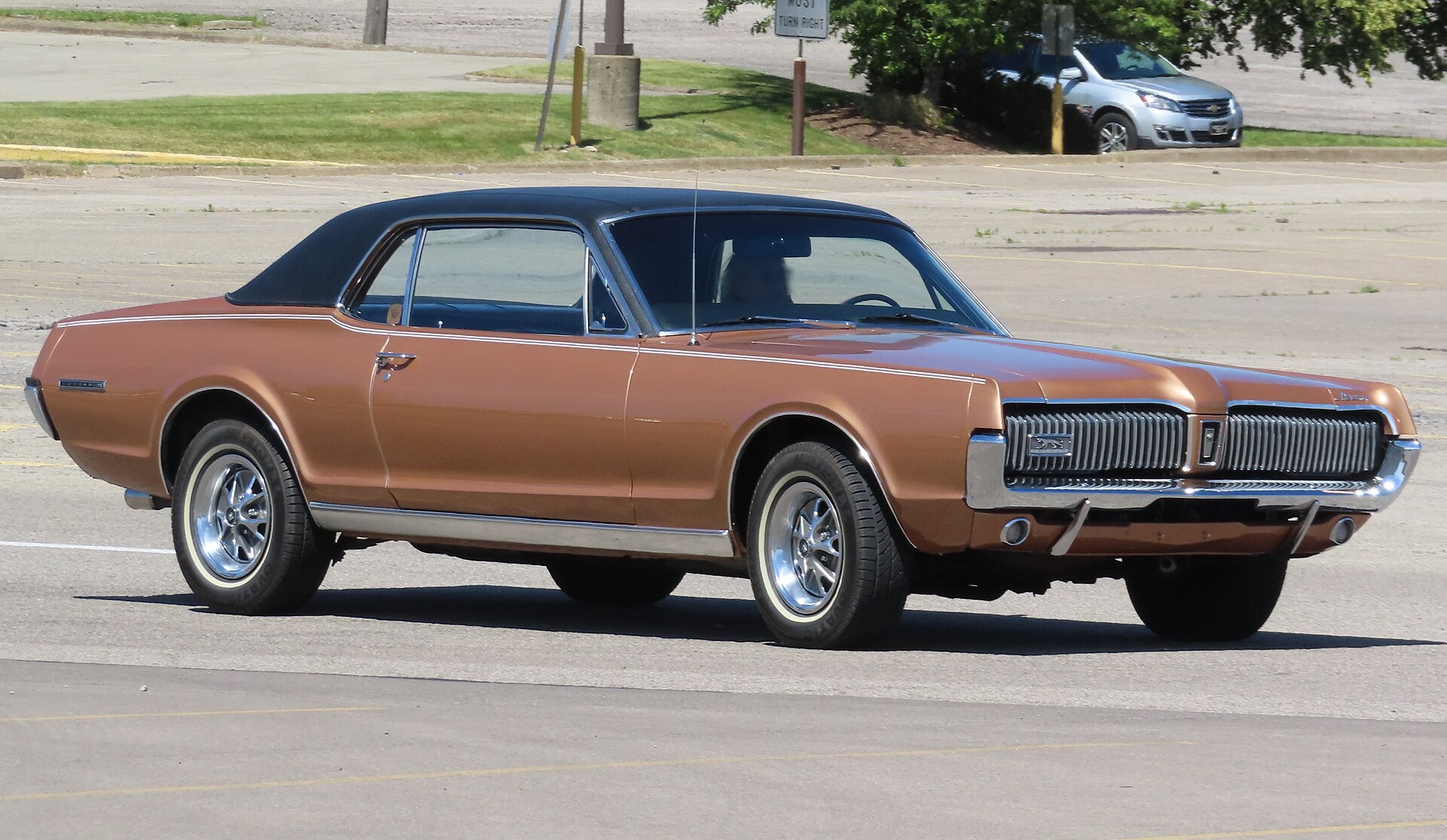
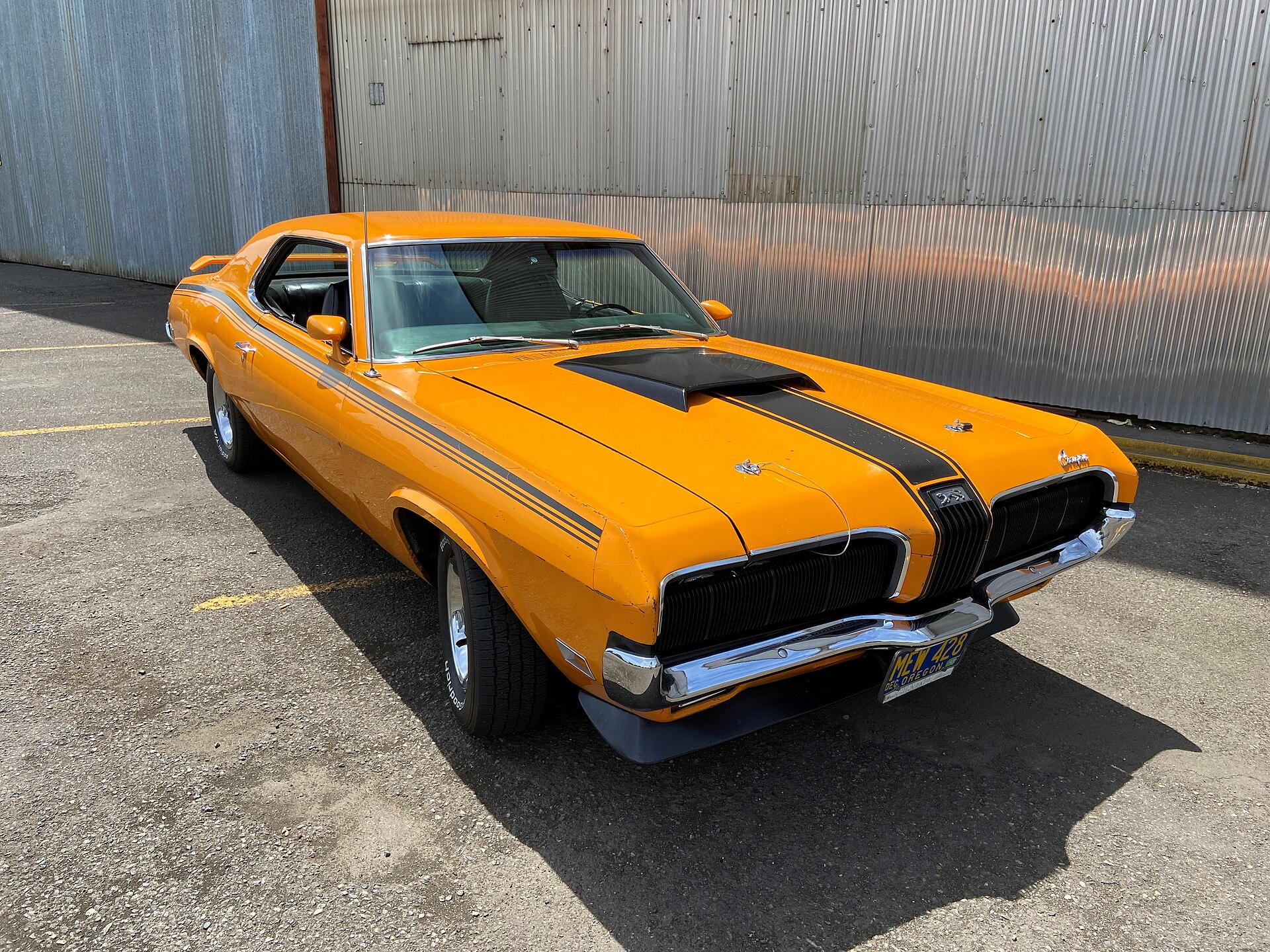
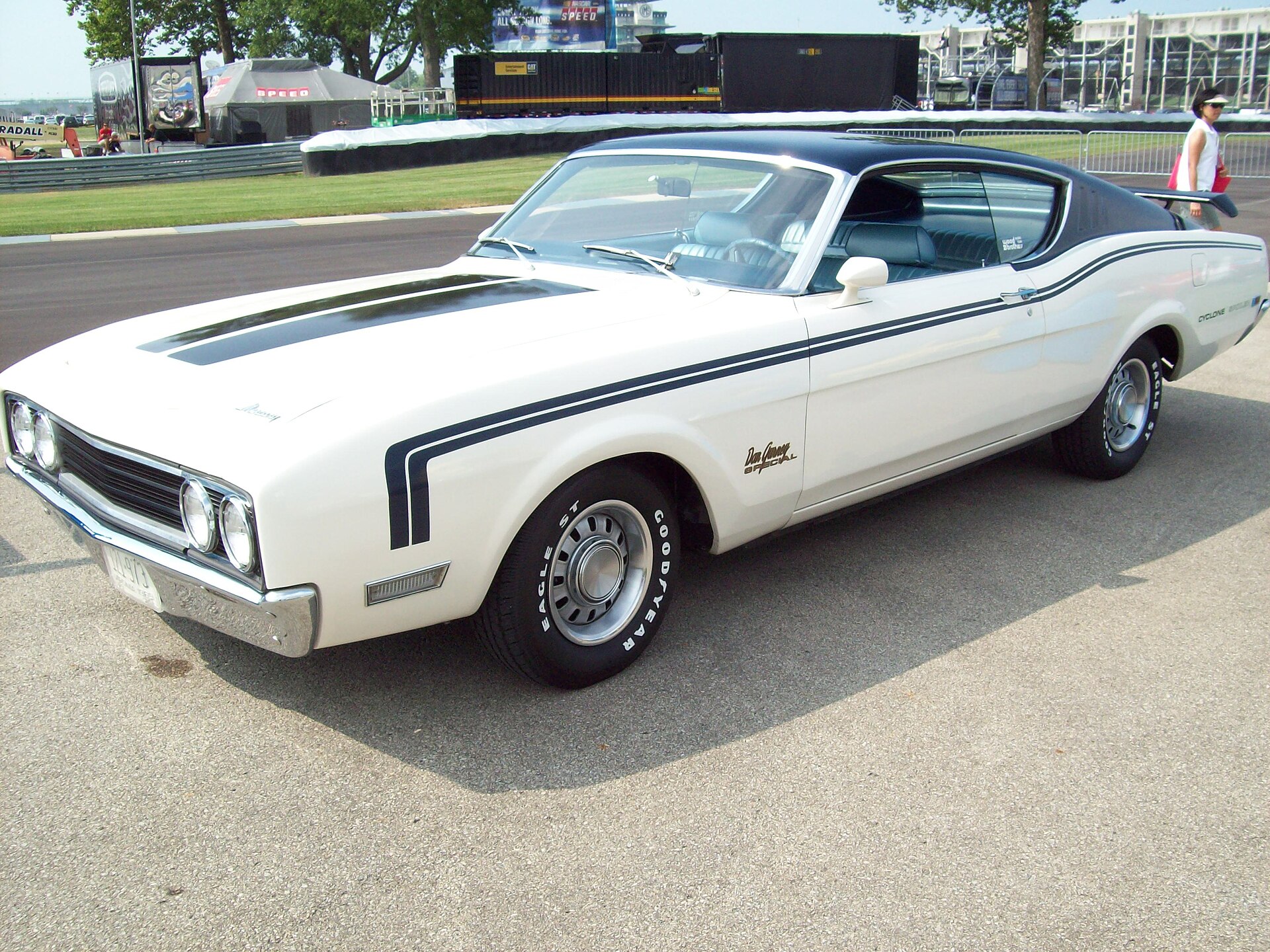
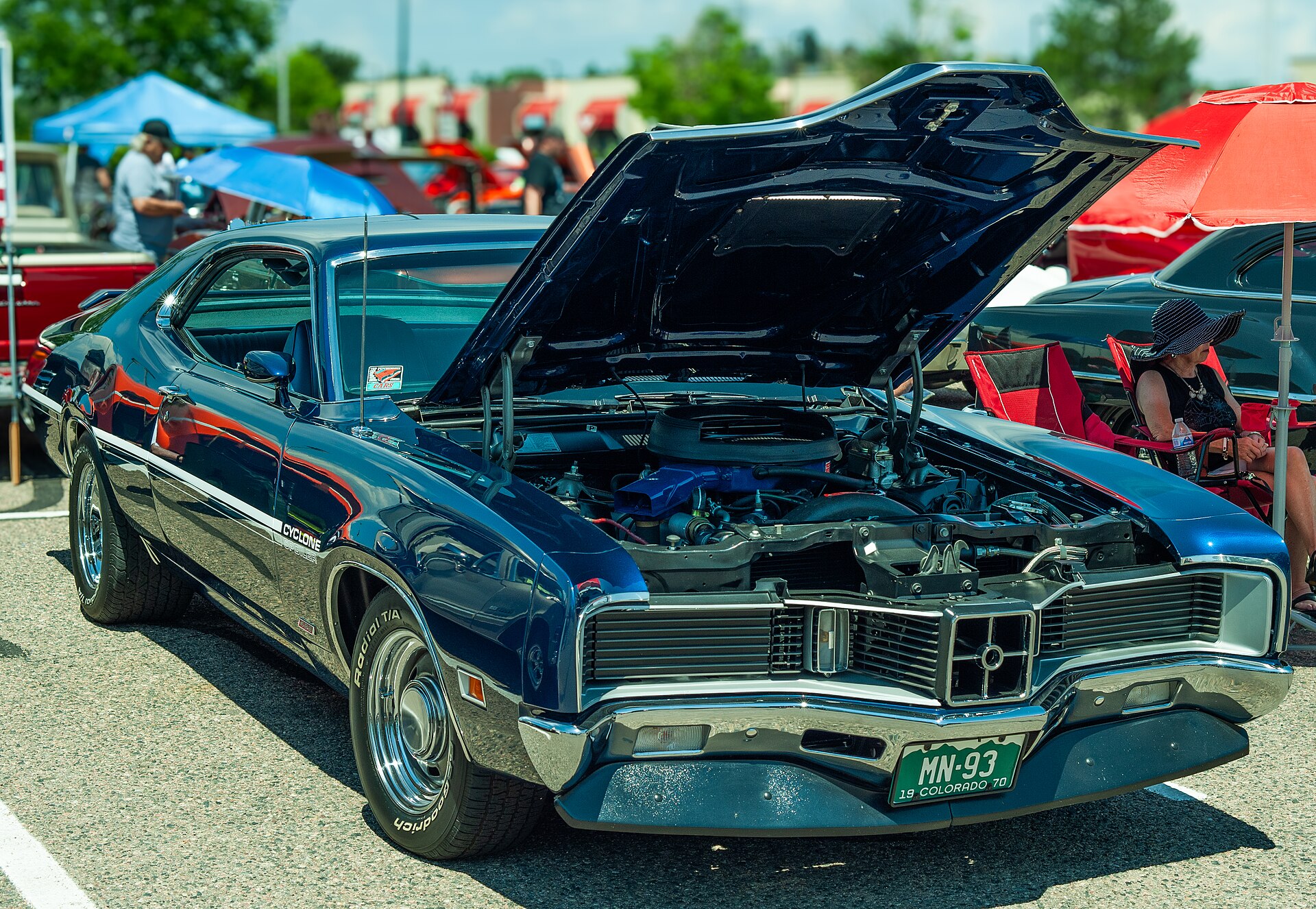
 Mercury Cyclone Spoiler
All generations, specs and history
Published Sources (2) Report an error
By Sarah Whitmore, Senior Automotive Writer
- Built
- 1969–1971
- Generations
- 3
- Top power
- 280 kW (381 PS)
Timeline
Cyclone Spoiler generations
Click a generation for its own page
and Spoiler II and II overlapped in 1969, so II sits on a second lane
- Cyclone Spoiler and Spoiler II 1969 · Coupe · 186–250 kW (253–340 PS)
- Cyclone Spoiler II 1969
- Cyclone Spoiler II 1970–1971 · Coupe · 280 kW (381 PS)
Newest first · 3 generations since 1969
- 1970 II 1970–1971 · Coupe · 280 kW (381 PS)
- 1969 and Spoiler II 1969 · Coupe · 186–250 kW (253–340 PS)
-
1969

All generations by year: Cyclone Spoiler II (1970–1971) · Cyclone Spoiler and Spoiler II (1969) · Cyclone Spoiler II (1969)
Which one is mine?
Pick the year of first registration to see which generation it is.
- Cyclone Spoiler II 1970–1971
- Cyclone Spoiler II 1969
- Cyclone Spoiler and Spoiler II 1969
Which Spoiler to choose
Our verdict · Sarah Whitmore
- For the NASCAR story: a 1969 Spoiler II, in Yarborough or Gurney trim.
- For the most power: a 1970 Spoiler with the 429 Super Cobra Jet and the Drag Pack.
- For the rarest regular Spoiler: a 1971 car, one of 353.
The Spoiler II's Ford twin is the Ford Torino Talladega, and its rivals were the Dodge Charger Daytona and the Plymouth Superbird. The brand story is in Mercury history, all versions are in the Mercury catalogue, and more cars of the period are in the American muscle car guide and the car rankings.
The Mercury Cyclone Spoiler was the performance version of Mercury's mid-size Cyclone from 1969 to 1971, and the Cyclone Spoiler II was its 1969 NASCAR homologation special with a longer, flush nose. Mercury built 503 Spoiler IIs, split between a Cale Yarborough and a Dan Gurney edition, to make the shape legal for racing. On the track the Spoiler II won eight Grand National races in 1969 and 1970, the same number as the Plymouth Superbird.
In short
- Spoiler II (1969): a Cyclone fastback with a longer nose and a flush grille shared with the Ford Torino Talladega; road cars used a 351 Windsor V8 and an automatic.
- 1969 Cyclone Spoiler: engines up to the 428 Cobra Jet with 250 kW (335 hp, SAE gross).
- 1970 Cyclone Spoiler: the 429 Cobra Jet with Ram Air as standard, 276 kW (370 hp, gross); the 429 Super Cobra Jet had 280 kW (375 hp).
- Production: 503 Spoiler IIs in 1969, 1,631 Spoilers in 1970 and 353 in 1971.
Specs by version
| Version | Engine | Power | Drive | Production years |
|---|---|---|---|---|
| Cyclone Spoiler and Spoiler II · 428 Cobra Jet V8 (SAE gross) | 7.0 l · 8 cyl · Petrol 7,014 cc | 250 kW 340 PS335 hp | Rear-wheel drive | 1969 |
| Cyclone Spoiler II · 429 Cobra Jet V8 (SAE gross) | 7.0 l · 8 cyl · Petrol 7,030 cc | 276 kW 375 PS370 hp | Rear-wheel drive | 1970 |
| Cyclone Spoiler II · 429 Super Cobra Jet V8 (SAE gross) | 7.0 l · 8 cyl · Petrol 7,030 cc | 280 kW 381 PS375 hp | Rear-wheel drive | 1970 |
Verified Manufacturer and type-approval data from our catalog · Sources and methodology
Cyclone Spoiler at a glance
| Specification | Mercury Cyclone Spoiler and Spoiler II |
|---|---|
| Model years | 1969–1971 (Spoiler); 1969 (Spoiler II) |
| Body | two-door fastback ("Sportsroof") |
| Spoiler II nose | about 6 in longer than a Cyclone's (Wikipedia); 19.5 in of added sheet metal (Talladega Spoiler Registry) |
| Spoiler II engine | 351 Windsor V8 with column-shift automatic |
| 1969 Spoiler engines | 351, 390 and 428 Cobra Jet V8s, up to 250 kW (335 hp, gross) |
| 1970 Spoiler engines | 429 Cobra Jet, 276 kW (370 hp); 429 Super Cobra Jet, 280 kW (375 hp), gross |
| Spoiler II editions | Cale Yarborough Special (red trim), Dan Gurney Special (blue trim) |
| Built | 503 Spoiler II (1969); 1,631 Spoilers (1970); 353 (1971) |
| Ford twin | Ford Torino Talladega |
The Spoiler is a version of the Mercury Cyclone, Mercury's intermediate muscle car of 1964–1971; the catalogue lists it separately.
Mercury in the aero war
Mercury already had NASCAR success with the Cyclone: in the 1968 Daytona 500 Cyclones finished first and second. For 1969 the race was about aerodynamics. Dodge prepared the Charger Daytona and Plymouth later the Superbird, while Ford built the Torino Talladega and Mercury the Cyclone Spoiler II. NASCAR required at least 500 cars to be built and offered for sale, which is the only reason the Spoiler II reached showrooms.

The Spoiler II body
The Spoiler II was based on the Cyclone "Sportsroof" fastback. The regular car's inset grille and headlights gave way to a longer nose with a flush grille, the same as on the Talladega. Wikipedia describes the extension as about six inches. The Talladega Spoiler Registry gives 19.5 inches of added sheet metal at a 35-degree angle, against 15.5 inches at 30 degrees for the Talladega, and claims the Mercury was 2 to 8 mph faster at high speed.
The registry lists more details:
- doors, bumpers, grilles and turn signals were shared with the Talladega;
- the front bumper was made from a rear bumper cut into three pieces and reshaped;
- re-rolled rocker panels let race teams run the cars about an inch lower within the rules;
- an inside bonnet release, taken from Lincoln, was needed because of the long nose;
- unlike the regular Spoiler, the Spoiler II had no bonnet scoop and no hood pins;
- the rear wings were installed by dealers, and some cars never received one.


Cale Yarborough and Dan Gurney editions
Every Spoiler II was white. The Cale Yarborough Special had red interior and trim, the Dan Gurney Special blue. Wikipedia counts 503 cars in all: 285 Yarborough and 215 Gurney versions, which leaves three cars without an edition in its count. The registry cites the Marti Report for the total of 503. Both editions also existed on the regular 1969 Cyclone Spoiler, according to the registry.
The road cars had a mild specification: Wikipedia lists a 351 Windsor V8, an automatic gearbox with a column shift and a front bench seat. The racing cars first used Ford's FE 427 "side oiler" and later the Boss 429, once NASCAR had approved it.

Engines: 1969 to 1971
| Engine | Years | Power (SAE gross) | Note |
|---|---|---|---|
| 351 V8, two-barrel | 1969 | 186 kW (250 hp) | Cyclone option |
| 351 V8, four-barrel | 1969 | 216 kW (290 hp) | Cyclone option |
| 390 "S" code V8 | 1969 | 242 kW (325 hp) | Cyclone Spoiler with a 735 cfm Holley |
| 428 Cobra Jet V8 | 1969 | 250 kW (335 hp) | Cyclone CJ and Spoiler |
| 429 Cobra Jet V8 | 1970 | 276 kW (370 hp); 227 kW (305 hp) net | standard Spoiler engine, with Ram Air |
| 429 Super Cobra Jet V8 | 1970 | 280 kW (375 hp); 250 kW (335 hp) net | with the Drag Pack |
| 351 Cleveland V8, four-barrel | 1971 | not given in the sources | new base engine |
Wikipedia rates the 1970 429 Cobra Jet without Ram Air at 276 kW (370 hp) with a 720 cfm Rochester Quadrajet, and the Super Cobra Jet with a 780 cfm Holley. The Drag Pack added an engine oil cooler and a 3.91:1 axle; the Super Drag Pack brought a 4.30:1 axle and a locking differential.
Racing results
The Spoiler II won eight Grand National races over the 1969 and 1970 seasons, matching the Plymouth Superbird, according to Wikipedia. The registry notes that Ford placed most of its drivers in Fords, so few Spoiler IIs started. Ford ended factory racing support after 1969, but many teams kept racing their Spoiler IIs in 1970. From 1971 NASCAR limited the aero cars to engines of 305 cubic inches or less.
Mercury planned a 1970 Spoiler II with an even sharper nose, but only one prototype was built. The regular Cyclone kept racing: the Wood Brothers' No. 21 1971 Cyclone won 18 of its 32 races, and 12 of the 40 starters of the 1972 Daytona 500 were Cyclones.
1970–1971: the later Cyclone Spoiler
In 1970 the Spoiler came with the 429 Cobra Jet and Ram Air as standard. It came only in competition colours, although 31 buyers ordered the "colour of your dreams" option. Mercury built 1,631 Spoilers that year, next to 1,695 Cyclones and 10,170 Cyclone GTs.
For 1971 the car was marketed as the Montego Cyclone. The Super Cobra Jet and the Drag Pack were dropped, the base engine became the 351 Cleveland four-barrel, and Ram Air became optional on the Spoiler. Production fell to 353 Spoilers. After that the Cyclone name survived only as a 1972 Montego option package, built 30 times.
Production by year
| Year | Spoiler production | Other Cyclones |
|---|---|---|
| 1969 | 503 Spoiler II (regular Spoiler not given separately) | 5,882 Cyclones, 3,261 Cyclone CJs |
| 1970 | 1,631 | 1,695 Cyclones, 10,170 GTs |
| 1971 | 353 | 444 Cyclones, 2,287 GTs |
Photo gallery


Mercury Cyclone Spoiler: first vs latest generation
| Spec | Cyclone Spoiler and Spoiler II | Cyclone Spoiler II | Change |
|---|---|---|---|
| Years | 1969 | 1970–1971 | 1 years apart |
| Most powerful version | 250 kW (340 PS) | 280 kW (381 PS) | +30 kW (+12%) |
Oldest and newest generation in the 1cars catalog. Power is the strongest version of each; other rows are shown only when both generations have the figure.
Image credits · Photos from Wikimedia Commons under free licences
- Mercury Cyclone Spoiler II · Photo: BUTTON74 / Wikimedia Commons, CC BY-SA 4.0
Mercury Cyclone Spoiler in our rankings
- No. 36 of 557 · Biggest engines: cars (7,030 cc · top 7%)
- No. 26 of 173 · Biggest engines: coupes (7,030 cc · top 16%)
- No. 15 of 88 · Most powerful cars of the 1970s (280 kW · top 18%)
- No. 313 of 859 · Most powerful cars (280 kW · top 37%)
- No. 37 of 94 · Most powerful cars of the 1960s (250 kW · top 40%)
- No. 68 of 154 · Most powerful American cars (280 kW · top 45%)
Bigger engine than 93% of ranked cars in the 1CARS catalog (No. 36 of 557).
FAQ
How many Mercury Cyclone Spoiler IIs were made?
503, according to Wikipedia and the Marti Report cited by the Talladega Spoiler Registry: 285 Cale Yarborough and 215 Dan Gurney versions in Wikipedia's split.
What engine did the Spoiler II have?
Road cars had a 351 Windsor V8 with an automatic gearbox; racing cars used the 427 and later the Boss 429.
What is the difference between the Cyclone Spoiler and the Spoiler II?
The Spoiler II had a longer, flush nose for NASCAR and no bonnet scoop; the regular Spoiler kept the standard Cyclone front and could have bigger engines.
How many races did the Spoiler II win?
Eight Grand National races in 1969 and 1970, the same as the Plymouth Superbird.
What engine did the 1970 Cyclone Spoiler have?
The 429 Cobra Jet with Ram Air as standard, 276 kW (370 hp, gross), and optionally the 429 Super Cobra Jet with 280 kW (375 hp).
Data sources
Data checked by an editor against the sources below.
- Wikipedia - Mercury Cyclone
- Wikipedia - Mercury Cyclone Spoiler II