
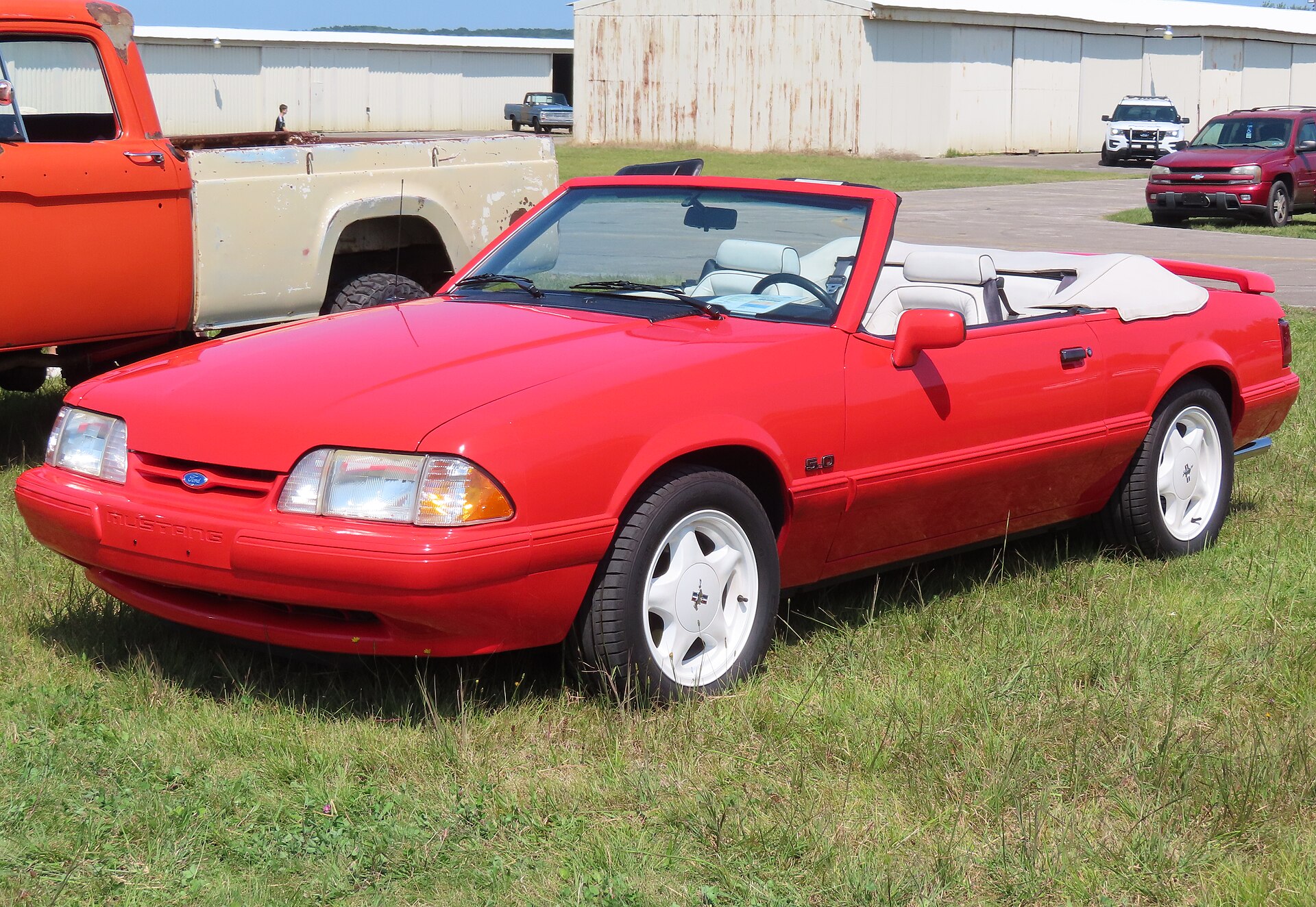
 Ford Mustang LX 5.0
Specs, engines and history
Published Sources (2) Report an error
By Felix Hartmann, Automotive Technology & EV Contributor
- Built
- 1987–1993
- Top power
- 168 kW (228 PS)
The Ford Mustang LX 5.0 was the plain-trim Fox-body Mustang ordered with the GT's fuel-injected 5.0 L (302 cu in) High Output V8. From 1987 to 1992 that engine was rated at 168 kW (225 hp) and 407 Nm (300 lb-ft) in both cars, yet the LX went without the GT's skirts and spoilers and was the only 5.0 Mustang sold as a notchback.
In short
- Fox-platform Mustang, 2,553 mm (100.5 in) wheelbase, as a two-door notchback, three-door hatchback or convertible; the 168 kW (225 hp) rating applied from 1987 to 1992.
- The LX trim arrived for 1984; the 5.0 HO had returned to the Mustang range in 1982 at 117 kW (157 hp) with the GT.
- With the V8 the LX came with a limited-slip axle and either the five-speed T-5 manual or the four-speed AOD automatic.
- For 1993 Ford re-rated the engine at 153 kW (205 hp) and 373 Nm (275 lb-ft); the last Fox Mustang was built on 26 August 1993.
Specs by version
| Version | Engine | Power | Torque | Gearbox | Drive | Production years |
|---|---|---|---|---|---|---|
| 5.0 HO V8 (205 hp, 1993) | 4.9 l · 8 cyl · Petrol 4,949 cc | 153 kW 208 PS205 hp | 373 Nm275 lb-ft | 5-sp Manual | Rear-wheel drive | 1993 |
| 5.0 HO V8 notchback (225 hp) | 4.9 l · 8 cyl · Petrol 4,949 cc | 168 kW 228 PS225 hp | 407 Nm300 lb-ft | 5-sp Manual | Rear-wheel drive | 1987–1992 |
| 5.0 HO V8 hatchback (225 hp) | 4.9 l · 8 cyl · Petrol 4,949 cc | 168 kW 228 PS225 hp | 407 Nm300 lb-ft | 5-sp Manual | Rear-wheel drive | 1987–1992 |
| 5.0 HO V8 convertible (225 hp) | 4.9 l · 8 cyl · Petrol 4,949 cc | 168 kW 228 PS225 hp | 407 Nm300 lb-ft | 5-sp Manual | Rear-wheel drive | 1987–1992 |
| 5.0 HO V8 AOD automatic (225 hp) | 4.9 l · 8 cyl · Petrol 4,949 cc | 168 kW 228 PS225 hp | 407 Nm300 lb-ft | 4-sp Automatic | Rear-wheel drive | 1987–1992 |
Verified Manufacturer and type-approval data from our catalog · Sources and methodology
Mustang LX 5.0 at a glance
| Specification | Mustang LX 5.0 |
|---|---|
| Model years | 1987-1993 (LX trim from 1984, 5.0 HO from 1982) |
| Built | not split out by trim; 73,200 to 188,559 Mustangs a year in 1987-1993, all engines |
| Body | two-door notchback, three-door hatchback, two-door convertible |
| Platform | Ford Fox, 2,553 mm (100.5 in) wheelbase |
| Engine | 4.9 L (302 cu in, badged 5.0) V8, sequential multiport fuel injection |
| Power | 168 kW (225 hp, SAE net) 1987-1992; 153 kW (205 hp) in 1993 |
| Torque | 407 Nm (300 lb-ft) 1987-1992; 373 Nm (275 lb-ft) in 1993 |
| Gearboxes | five-speed T-5 manual; four-speed AOD automatic |
| Weight (1987, by body) | notchback 1,236 kg (2,724 lb), hatchback 1,262 kg (2,782 lb), convertible 1,325 kg (2,921 lb) |
| Quarter mile | low 14-second range for the 1987-1992 cars (Hagerty) |
| Price new | Mustang range USD 9,050 (four-cylinder notchback) to about USD 17,000 (V8 convertible) in 1989 |
How the 5.0 reached the cheaper Mustang
The Fox Mustang started in 1979 with a 302 V8 that Ford's own fact sheet put at 104 kW (140 hp), then lost it for 1980 and 1981 to a 4.2 L (255 cu in) V8 of 89 kW (119 hp) and later 86 kW (115 hp). The High Output 302 came back with the 1982 GT at 117 kW (157 hp), behind a four-speed manual. A four-barrel carburettor and new intake lifted it to 130 kW (175 hp) for 1983, the year the convertible joined the range and the T-5 five-speed became the standard gearbox behind the V8.
Ford added the LX trim for 1984. A year later the range had shrunk to LX, GT and the turbocharged SVO, and the carburetted 5.0 reached 157 kW (210 hp) in its last season with a carburettor. Multiport injection followed for 1986 at 149 kW (200 hp).
The decisive year was 1987. The facelift gave every Mustang an SVO-style nose, a new dashboard and new tail lamps, the SVO and the V6 were dropped, and the range became a simple choice between a 2.3 L four and the 5.0 V8 in either LX or GT trim. Buyers who ticked the V8 on an LX got the GT's drivetrain in the plainer body. Conceptcarz notes that by 1989 Ford called this combination the LX 5.0L Sport.
The 5.0 HO and what came with it
The 1987 engine gained E7 cylinder heads and forged pistons with valve reliefs, which brought the 168 kW (225 hp) and 407 Nm (300 lb-ft) ratings. For 1989 a mass airflow sensor replaced the speed-density fuel management; Wikipedia notes this cost a little factory output, although the published figures stayed the same. Cast hypereutectic pistons arrived for 1993 together with the lower 153 kW (205 hp) rating. Hagerty reads the cut as a paper exercise, because the new 1994 Mustang was quoted at 160 kW (215 hp) and Ford did not want the outgoing car to look stronger.
Drivingline lists the LX 5.0 hardware as the GT engine with dual exhaust, a limited-slip rear axle, wider tyres and small 5.0 badges. The T-5 had been upgraded to heavy-duty specification in 1985, and the AOD automatic, first offered for 1984, remained the alternative.
LX against GT on the showroom floor
The difference was mostly in the body kit. For 1987 the GT received round fog lamps, bodyside skirting and 15-inch turbine wheels, while the LX kept the plainer nose and sills it shared with the four-cylinder car. Drivingline adds that the notchback was the stiffest and lightest Fox shell, and the LX was the only way to buy one with the V8. Mustangspecs puts the LX 5.0 at about 91 kg (200 lb) lighter than a comparable GT.
Prices stayed close together. Conceptcarz lists the 1989 V8 convertible at about USD 17,000 and the GT convertible at USD 17,500, while the cheapest Mustang, a four-cylinder notchback, cost USD 9,050 in 1989. By 1991 even the base Mustang had passed USD 10,000, and sales began to fall.
The notchback also had an official career. The Special Service Package, offered from 1982 for police and government fleets, was almost always ordered as a two-door sedan with the 302. The official SSP name ended in 1993, though Wikipedia notes that some agencies kept buying ordinary Mustangs for highway and undercover work.


Mustang LX 5.0 production and ratings by year
Ford's published Fox figures are split by body, not by engine, so the numbers below include four-cylinder LX cars and the GT as well as the LX 5.0.
| Model year | 5.0 rating (SAE net) | Notchback | Hatchback | Convertible |
|---|---|---|---|---|
| 1987 | 168 kW (225 hp) | 58,100 | 80,717 | 20,328 |
| 1988 | 168 kW (225 hp) | 71,890 | 74,331 | 33,344 |
| 1989 | 168 kW (225 hp) | 42,349 | 105,692 | 40,518 |
| 1990 | 168 kW (225 hp) | 17,808 | 71,798 | 25,624 |
| 1991 | 168 kW (225 hp) | 16,846 | 53,358 | 20,181 |
| 1992 | 168 kW (225 hp) | 13,836 | 36,818 | 22,546 |
| 1993 | 153 kW (205 hp) | 23,579 | 65,220 | 26,560 |
Figures vary between sources: conceptcarz and Mustangspecs give 209,769 Mustangs for 1989, against 188,559 in the Wikipedia table. LX and GT cars built from spring 1989 into the 1990 model year carried a dashboard plaque for the 25th anniversary (start dates vary between sources: 27 March or 17 April 1989), so the plaque alone does not mark a limited edition.
Three limited LX convertible runs stand out. In 1990 Ford built a batch for a 7-Up basketball promotion; the contest was cancelled and 4,103 cars went to dealers. The 1992 Summer edition added 2,193 LX convertibles with the V8, and 1993 brought Limited Edition cars in Chrome Yellow or white.
The last Fox year and the 1994 change
The Fox body lasted 14 model years. Wikipedia counts 2,518,948 Mustangs from 1979 to 1993, Hagerty about 2.6 million. The 1993 range also included the SVT Cobra with 175 kW (235 hp) and 386 Nm (285 lb-ft), which sat above the GT and is covered in the Mustang SVT Cobra hub. The new SN95 Mustang arrived for 1994, and the V8 car from then on wore the GT badge, a story told in the Mustang GT history.
Chevrolet's V8 rival in the same showrooms was the tuned-port Camaro, and the Camaro IROC-Z hub has its figures for comparison.

Mustang LX 5.0 today: what to check
Start with the identity. A real LX 5.0 should show the V8 engine code in the VIN and match its door data plate, because four-cylinder LX cars were cheap and many were converted later. The 1993 cars with the 153 kW (205 hp) rating are mechanically close to earlier ones; check for the hypereutectic pistons if the original engine matters to you.
Modifications are the norm. The 5.0 created a large aftermarket, and the 1993 LX 5.0 that Hagerty used as a market example had wheels, lowering springs, a shifter, rocker arms, headers and exhaust. Drivingline notes that a clean, unabused LX has become rare and sells at a premium, and Hagerty states that good Fox-bodies are no longer priced as ordinary used performance cars. Original paperwork, stock exhaust parts and an unmodified interior add more value than horsepower.
Mechanically, look at the T-5 synchromesh, the limited-slip axle and the convertible's scuttle shake. Notchbacks were raced and used as police cars, so check for welded subframe connectors, cut floors and roll-cage holes. The Fox Mustangs and other Fords are listed in the Ford catalogue. The LX 5.0 leads the manual-gearbox choices in our list of the best malaise-era muscle cars.
Ford Mustang LX 5.0 in our rankings
- No. 2 of 113 · Biggest engines: hatchbacks (4,949 cc)
- No. 23 of 117 · Most torque: hatchbacks (407 Nm · top 20%)
- No. 41 of 186 · Biggest engines: sedans (4,949 cc · top 23%)
- No. 44 of 171 · Most powerful hatchbacks (168 kW · top 26%)
- No. 16 of 63 · Biggest engines: convertibles and roadsters (4,949 cc · top 26%)
- No. 200 of 772 · Biggest engines: cars (4,949 cc · top 27%)
Bigger engine than 97% of ranked hatchbacks in the 1CARS catalog (No. 2 of 113).
FAQ
Was the Mustang LX 5.0 faster than the GT?
On paper the two had the same 168 kW (225 hp) engine from 1987 to 1992. The LX was the lighter car, about 91 kg (200 lb) by one estimate, and Drivingline calls the notchback the lightest and stiffest Fox shell, so the manual LX notchback was the lightest 5.0 Mustang Ford sold.
What does LX 5.0 mean?
LX was the standard trim level of the Fox Mustang from 1984. Ordered with the optional 5.0 L (302 cu in) V8, it carried 5.0 badges on the wings; conceptcarz notes that Ford called the 1989 version the LX 5.0L Sport.
Why is the 1993 Mustang LX 5.0 rated lower?
Ford re-rated the 1993 engine at 153 kW (205 hp) and 373 Nm (275 lb-ft) when it adopted cast hypereutectic pistons. Hagerty argues the change was partly on paper, so the outgoing car would not outrate the 160 kW (215 hp) Mustang of 1994.
Could you buy a GT notchback?
No. Through 1987-1993 the GT came only as a hatchback or convertible, so anyone wanting a V8 notchback had to order the LX with the 5.0.
Data sources
Data checked by an editor against the sources below.
- Wikipedia - Ford Mustang (third generation)
- Drivingline - Budget Hero The 87 93 Lx 50 Is One Of The Greatest Mustangs Ever


