 Ford Fairlane 427
Specs, engines and history
Published Sources (3) Report an error
By Felix Hartmann, Automotive Technology & EV Contributor
- Built
- 1966–1967
- Top power
- 317 kW (431 PS)
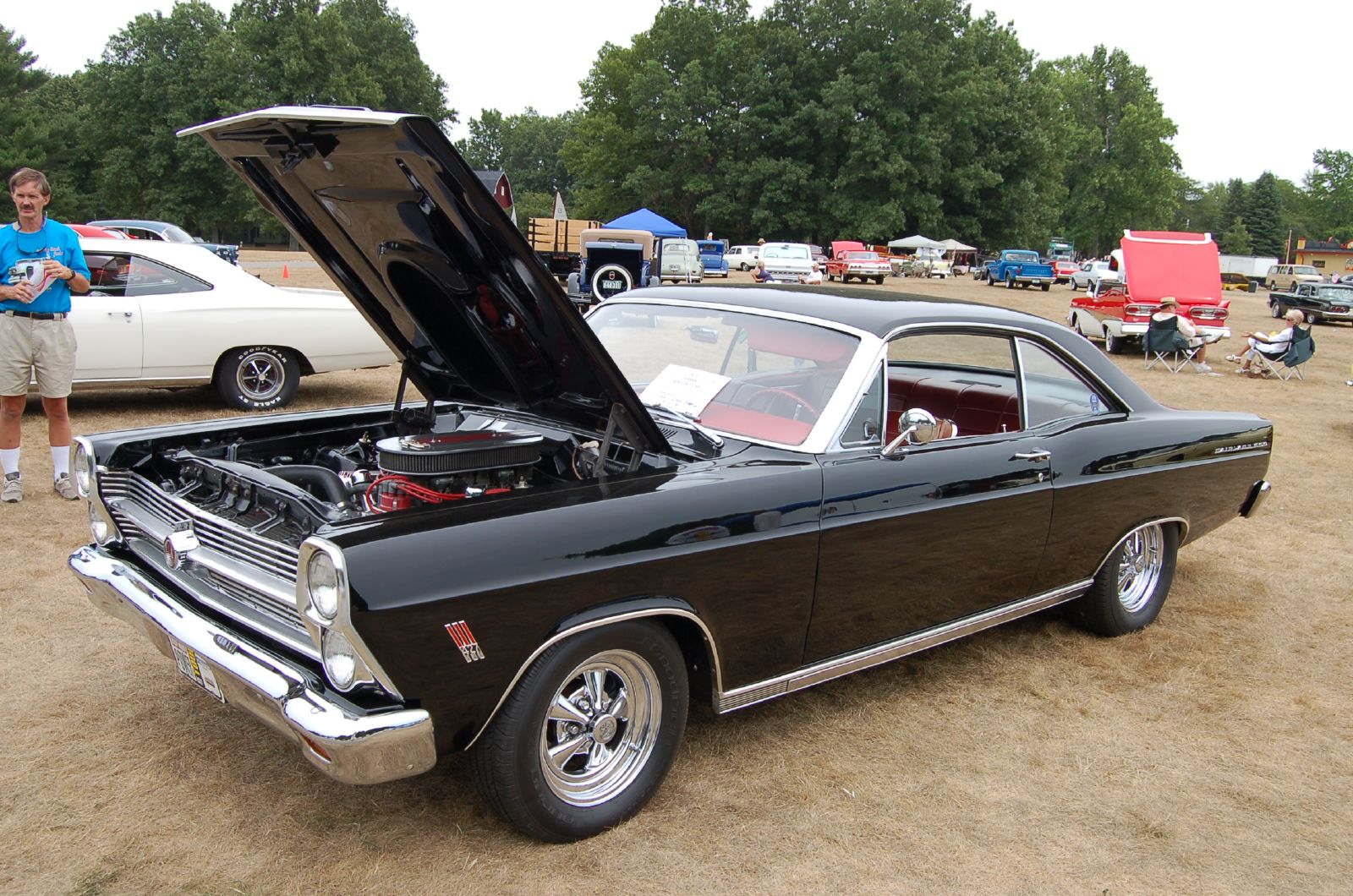
The Ford Fairlane 427 was the 1966-1967 intermediate hardtop that Ford fitted at the factory with the 7.0 L (427 cu in) side-oiler V8 from its NASCAR and Le Mans programme. The dual-quad R-code engine was rated at 317 kW (425 hp, SAE gross), and the cars existed mainly to qualify the combination for Super Stock drag racing. Only 57 were built for 1966.
In short
- Two-door hardtops on the 2,946 mm (116 in) wheelbase Fairlane; 1966 cars were Fairlane 500s, 1967 cars Fairlane 500 or 500XL.
- R-code: two Holley four-barrels, 317 kW (425 hp) and 651 Nm (480 lb-ft); 1967 W-code: one four-barrel, 306 kW (410 hp) and 645 Nm (476 lb-ft).
- Four-speed manual only, 3.89:1 rear axle, fibreglass bonnet with a forward-facing scoop held by pins.
- In 1966 the race package added USD 1,725.20 to a Fairlane 500 costing USD 2,378.40.
Specs by version
| Version | Engine | Power | Torque | Gearbox | Drive | Production years |
|---|---|---|---|---|---|---|
| 427 W-code 4V (410 hp) | 7.0 l · 8 cyl · Petrol 6,978 cc | 306 kW 416 PS410 hp | 645 Nm476 lb-ft | 4-sp Manual | Rear-wheel drive | 1967 |
| 427 R-code 8V (425 hp) | 7.0 l · 8 cyl · Petrol 6,978 cc | 317 kW 431 PS425 hp | 651 Nm480 lb-ft | 4-sp Manual | Rear-wheel drive | 1967 |
Verified Manufacturer and type-approval data from our catalog · Sources and methodology
Ford Fairlane 427 at a glance
| Specification | Ford Fairlane 427 |
|---|---|
| Model years | 1966 (from mid-year) and 1967 |
| Built | 57 in 1966; 1967 counts vary between sources (see below) |
| Body | two-door hardtop (Fairlane 500, 1967 also 500XL) |
| Platform | Ford Fairlane intermediate, 2,946 mm (116 in) wheelbase, 5,004 mm (197 in) long |
| Engine | 7.0 L (427 cu in nominal, 425.8 cu in actual) V8, cross-bolted main bearings, mechanical lifters |
| Power | R-code 317 kW (425 hp) at 6,000 rpm; W-code 306 kW (410 hp) at 5,600 rpm, SAE gross |
| Torque | R-code 651 Nm (480 lb-ft) at 3,700 rpm; W-code 645 Nm (476 lb-ft) at 3,400 rpm |
| Compression | 10.5:1 to 11.5:1 depending on source |
| Gearbox | four-speed Top Loader manual only |
| Rear axle | 9-inch, 3.89:1 |
| Price new | USD 2,378.40 Fairlane 500 plus USD 1,725.20 race package in 1966 |
Why Ford built a 427 Fairlane
Ford had already put the 427 into the 1964 Fairlane two-door sedan for drag racing, a story covered in the Fairlane Thunderbolt hub. Those were drag cars built in a run of 111 to 127, depending on the source. The 1966 Fairlane offered a better starting point: it had become a longer-wheelbase version of the revised Falcon structure, with a new body that could take the big-block engines. The GT and GTA of 1966, a separate street-car story, carried the 6.4 L (390 cu in) V8 at 250 kW (335 hp) for street buyers.
The 427 version had a narrower purpose. Ford needed a production car to qualify the 427 and four-speed combination for NHRA and IHRA Super Stock classes, so in the middle of the 1966 model year it built a short run of Fairlane 500 hardtops with the racing engine. SlashGear notes that the shortage of cast-iron exhaust manifolds held production back.

The side-oiler and the race package
The engine took its nickname from an oil gallery along the left side of the block. Ford had developed it for stock-car racing, and the same engine family powered the GT40 Mk IV that won Le Mans in 1967 with Dan Gurney and A.J. Foyt. Over-Drive's factory data list a 4.23 x 3.78 in bore and stroke, five cross-bolted main bearings, mechanical lifters and a camshaft with 324 degrees of duration and 0.524 in lift.
Ford sold the 1966 car as the 427-8V Race Car Package. SlashGear lists forged pistons, cast-iron exhaust manifolds, 2.25 in exhaust pipes, a Top Loader four-speed with no automatic option and a 9-inch rear axle with 3.89:1 gears and an open differential. The fibreglass bonnet was needed to clear the two Holley carburettors on their medium-rise intake; its scoop faced forward and ran out at the front edge of the bonnet.
The 1966 cars were plain. Wikipedia and SlashGear agree that all 57 were painted white, which SlashGear names as Wimbledon White, with a bench seat, steel wheels and dog-dish hub caps. They had front disc brakes but no power steering, power brakes or air conditioning.

1967 brings the W-code and the XL
For 1967 Ford offered two versions of the engine. The R-code kept the two four-barrels and its 317 kW (425 hp) rating, and the new W-code used a single four-barrel for 306 kW (410 hp). The 1967 Fairlane range also had a mild trim update and the new federal safety items, among them an energy-absorbing steering column and dual-circuit brakes.
| Fairlane V8 | Years | Carburettors | Power (SAE gross) | Torque |
|---|---|---|---|---|
| 390 GT/GTA | 1966 | one four-barrel | 250 kW (335 hp) | not given |
| 390 two-barrel | 1967 | one two-barrel | 205 kW (275 hp) | not given |
| 390 four-barrel | 1967 | one four-barrel | 239 kW (320 hp) | not given |
| 427 W-code | 1967 | one Holley four-barrel | 306 kW (410 hp) at 5,600 rpm | 645 Nm (476 lb-ft) |
| 427 R-code | 1966-1967 | two Holley four-barrels | 317 kW (425 hp) at 6,000 rpm | 651 Nm (480 lb-ft) |
The second change was the body. SlashGear writes that the 1967 package was also available on the better-trimmed XL, with more colours, power brakes and bucket seats. The red 1967 500XL R-code sold by RM Sotheby's at Auburn in 2013 for USD 90,750 had a tachometer, bucket seats, a console, styled steel wheels and a dealer-installed fibreglass bonnet with scoop and bonnet pins. SlashGear instead describes a steel bonnet with carburettor clearance for 1967, so bonnet type should be checked against each car's paperwork.
How many 427 Fairlanes were built
The 1966 total of 57 cars is consistent across sources. The 1967 numbers are not. Over-Drive's fact sheet gives 92 R-code two-door hardtops and states it is unclear whether any 306 kW (410 hp) cars were made. Barn Finds quotes 153 R-code cars for 1967. SlashGear gives 229 Fairlane 427s in total, 72 of them 500XLs, and adds that 60 more 427 packages went into the Mercury Comet. The Marti Report for the RM Sotheby's car called it one of 72 built with that engine and gearbox code combination.
The sensible reading is that only the 1966 figure is firm, and that a car's own Marti Report matters more than any summary. For scale, Ford delivered 337,792 Fairlanes in 1966 and 256,931 in 1967, so the 427 cars were a tiny share either way.
Fairlane 427 vs Hemi rivals and the Torino
The Fairlane 427 met Chrysler's 426 Hemi intermediates in Super Stock, and the Dodge Coronet hub traces the Hemi side of that fight. On the street the 427 option was more a racing licence than a model for ordinary buyers, who were steered towards the 390 GT.
The Fairlane was restyled for 1968, gaining a fastback and a more expensive Torino line at the top, and the Torino took over the performance role. The wider family story, from the 1955 car to the end of the name in North America, is in the Ford Fairlane overview.
Fairlane 427 today: what to check
The VIN tells most of the story. The RM Sotheby's 1967 car carried the number 7H40R163502, where R is the engine code in fifth position; a W-code car should show W in the same place. A Marti Report then confirms engine, gearbox, body and paint as built, and with production this small every claimed 427 car should have one.
Many cars raced, so original engines are scarce. The RM car had a date-correct replacement R-code engine with documented drag-racing history. Check for the cross-bolted block, the correct Holley carburettors and intake, the Top Loader four-speed, the 9-inch axle and the right bonnet for the year. Because the 1966-1967 body was built in large numbers, any 427 claim without paperwork should be treated as a possible clone.
Values are high. RM Sotheby's sold its car for USD 90,750 in 2013, Barn Finds reported a 1967 R-code at USD 126,500 at Mecum Dallas in 2022, and in June 2024 SlashGear quoted recent auction results of USD 200,000-296,000. Other Fairlanes are listed in the Ford catalogue.
Ford Fairlane 427 in our rankings
- No. 66 of 797 · Biggest engines: cars (6,978 cc · top 9%)
- No. 17 of 167 · Most powerful cars of the 1960s (317 kW · top 12%)
- No. 54 of 265 · Biggest engines: coupes (6,978 cc · top 21%)
- No. 156 of 672 · Most torque: cars (651 Nm · top 24%)
- No. 335 of 1227 · Most powerful cars (317 kW · top 28%)
- No. 74 of 240 · Most powerful American cars (317 kW · top 34%)
Bigger engine than 91% of ranked cars in the 1CARS catalog (No. 66 of 797).
FAQ
What is the difference between an R-code and a W-code Fairlane 427?
The R-code had two Holley four-barrel carburettors and 317 kW (425 hp, SAE gross); the 1967-only W-code had one four-barrel and 306 kW (410 hp). The letter appears as the engine code in the VIN.
How many 1966 Fairlane 427s were built?
Ford built 57 Fairlane 500 two-door hardtops with the R-code 427 in 1966, all white, with four-speed manual gearboxes, to qualify the combination for Super Stock drag racing.
Is the Fairlane 427 the same car as the Thunderbolt?
No. The Thunderbolt was a 1964 drag-racing Fairlane sedan with lightweight panels. The 1966-1967 Fairlane 427 used the new, larger Fairlane body as a regular-production hardtop with a fibreglass bonnet.
Did the Fairlane 427 come with an automatic?
No. Every Fairlane 427 used a four-speed Top Loader manual gearbox driving a 9-inch rear axle with 3.89:1 gears. Ford offered no automatic with the race package, because the cars were built to qualify the 427 and four-speed combination for Super Stock.
Data sources
Data checked by an editor against the sources below.
- Wikipedia - Ford Fairlane (Americas)
- Over-drive-magazine - 1966 Ford Fairlane Fact Sheet
- Over-drive-magazine - 1967 Ford Fairlane Fact Sheet