
 Ford Falcon Sprint
All generations, specs and history
Published Sources (2) Report an error
By Felix Hartmann, Automotive Technology & EV Contributor
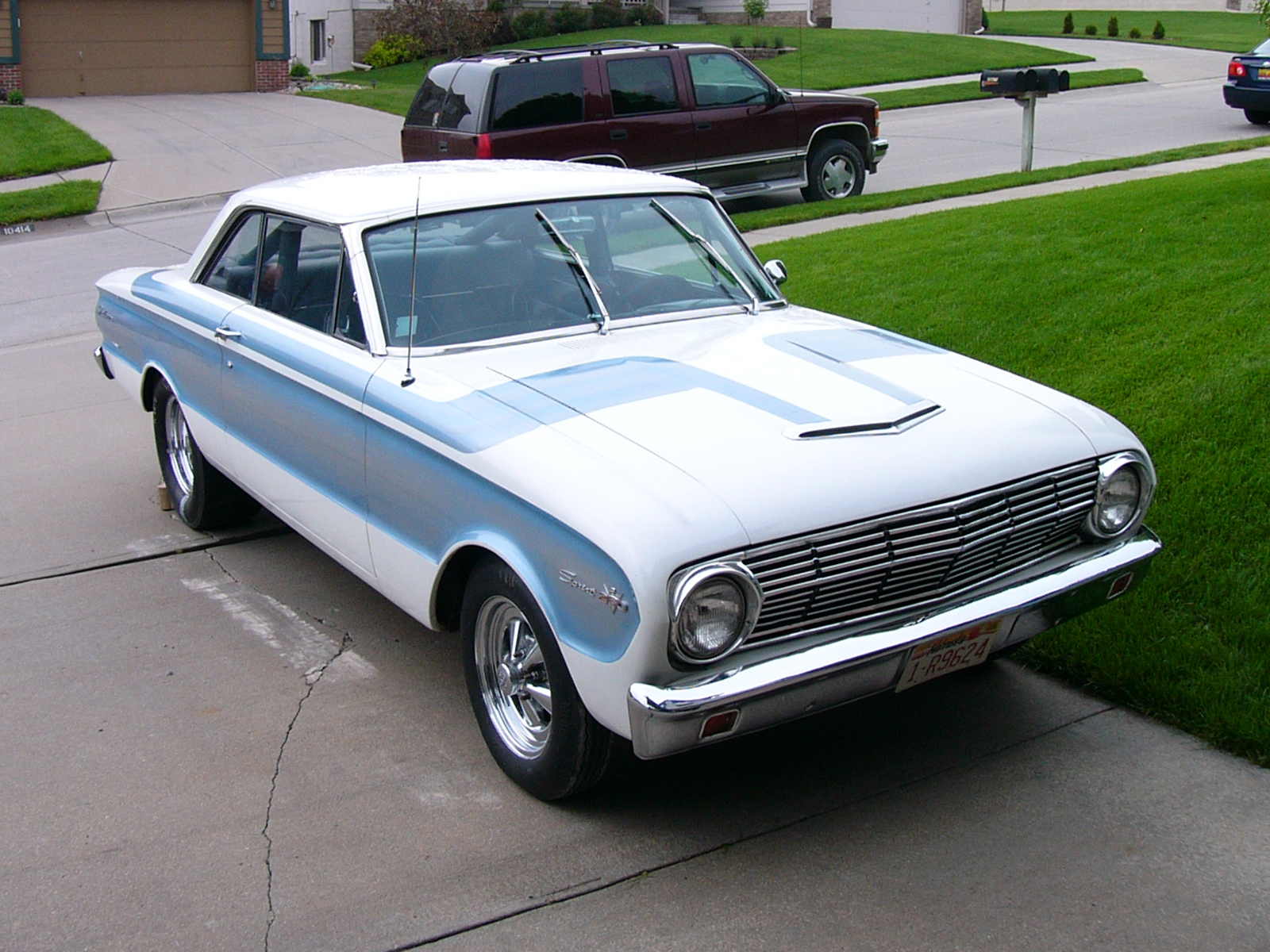
- Built
- 1963–1965
- Generations
- 2
- Top power
- 122 kW (166 PS)
Timeline
Falcon Sprint generations
Click a generation for its own page
- Falcon Sprint I 1963 · Coupe, Convertible · 122 kW (166 PS)
- Falcon Sprint II 1964–1965 · Coupe, Convertible · 122 kW (166 PS)
Newest first · 2 generations since 1963
- 1964 II 1964–1965 · Coupe, Convertible · 122 kW (166 PS)
- 1963 I 1963 · Coupe, Convertible · 122 kW (166 PS)
All generations by year: Falcon Sprint II (1964–1965) · Falcon Sprint I (1963)
Which one is mine?
Pick the year of first registration to see which generation it is.
- Falcon Sprint II 1964–1965
- Falcon Sprint I 1963
The Ford Falcon Sprint was the V8 sports version of the American Falcon compact, sold from the middle of the 1963 model year to 1965 as a two-door hardtop or convertible. It used the 4.3 L (260 cu in) Challenger V8 at 122 kW (164 hp, SAE gross), later the 4.7 L (289 cu in). Ford launched it at Monaco alongside a works team in the 1963 Monte Carlo Rally.
In short
- First V8 in a US Falcon, introduced in February 1963; hardtop and convertible bodies with bucket seats and a dash-mounted tachometer.
- 1963: 10,479 hardtops and 4,602 convertibles; 1964: 18,108 in total; 1965: little more than 3,000.
- Bo Ljungfeldt set the fastest time on every special stage of the 1963 and 1964 Monte Carlo Rallies and finished second overall in 1964.
- Wikipedia describes the 1964½ Mustang as nearly identical mechanically, and the Mustang took the Sprint's buyers.
Specs by version
Engines
| Version | Engine | Power | Drive | Production years |
|---|---|---|---|---|
| Falcon Sprint I · 260 V8 hardtop (164 hp) | 4.3 l · 8 cyl · Petrol 4,261 cc | 122 kW 166 PS164 hp | Rear-wheel drive | 1963 |
| Falcon Sprint I · 260 V8 convertible (164 hp) | 4.3 l · 8 cyl · Petrol 4,261 cc | 122 kW 166 PS164 hp | Rear-wheel drive | 1963 |
| Falcon Sprint II · 289 V8 | 4.7 l · 8 cyl · Petrol 4,736 cc | - | Rear-wheel drive | 1965 |
| Falcon Sprint II · 260 V8 hardtop (164 hp) | 4.3 l · 8 cyl · Petrol 4,261 cc | 122 kW 166 PS164 hp | Rear-wheel drive | 1964 |
| Falcon Sprint II · 260 V8 convertible (164 hp) | 4.3 l · 8 cyl · Petrol 4,261 cc | 122 kW 166 PS164 hp | Rear-wheel drive | 1964 |
Dimensions and weight
Show all 2 versions
| Version | Length | Wheelbase | Kerb weight |
|---|---|---|---|
| Falcon Sprint II · 260 V8 hardtop (164 hp) | 4,613 mm181.6 in | 2,781 mm109.5 in | 1,331 kg2,934 lb |
| Falcon Sprint II · 260 V8 convertible (164 hp) | - | - | 1,420 kg3,131 lb |
Verified Manufacturer and type-approval data from our catalog · Sources and methodology
Ford Falcon Sprint at a glance
| Specification | Falcon Sprint |
|---|---|
| Model years | 1963½-1965 |
| Built | 15,081 (1963), 18,108 (1964), about 3,300 (1965) |
| Body | two-door hardtop, two-door convertible |
| Platform | Ford Falcon compact, 2,781 mm (109.5 in) wheelbase |
| Engines | 4.3 L (260 cu in) V8; 4.7 L (289 cu in) V8 for 1965 |
| Power | 122 kW (164 hp, SAE gross) for the 260 |
| Gearboxes | three-speed manual, four-speed floor manual, two-speed Fordomatic automatic |
| Brakes | 254 mm (10 in) drums all round, five-stud hubs |
| Weight (1964) | hardtop 1,331 kg (2,935 lb), convertible 1,420 kg (3,130 lb) |
| Length (1964) | 4,613 mm (181.6 in) |
| 0-60 mph | mid-to-high 9 s, four-speed with 3.50:1 axle (Martyn Schorr, period drive) |
A V8 for Ford's economy compact
The Falcon arrived for 1960 as a light, simple six-cylinder car; Silodrome notes a base price of USD 1,912, more than USD 250 under the cheapest full-size Ford. The Futura of 1961 added bucket seats and sporty trim without extra performance. That changed in February 1963, halfway through the model year, when the 260 V8 from the Fairlane became available. The Sprint packaged it with a freer-flowing air cleaner and silencers, firmer suspension, wire wheel covers, bucket seats and a tachometer mounted on the dashboard.
These were the only V8 Falcons of the first generation, and they came only as the Futura hardtop and convertible. Silodrome adds chrome engine dress-up parts, 254 mm (10 in) drum brakes on all four wheels and five-stud hubs. Buyers could choose a three-speed column-change manual, a four-speed floor change or the two-speed Fordomatic.
It was an early answer to a question that the Pontiac GTO asked more loudly a year later. The GTO, covered in the Pontiac GTO hub, put a much bigger engine into an intermediate; the Sprint stayed a compact with a mid-sized V8.

Falcon Sprint at the Monte Carlo Rally 1963 and 1964
Ford used the rally to introduce the car. Just Cars reports that more than 100 journalists were flown to Monaco, while Ford entered three Falcon coupes in the January 1963 event. Holman and Moody built the rally cars; team mechanics quoted output anywhere from 179 kW (240 hp) to over 224 kW (300 hp), according to Martyn Schorr, who covered the event and drove a Sprint over part of the route.
The rules favoured small cars, so an outright win was never expected. Peter Jopp and Trant Jarman finished 35th overall and won the class for engines over 3,000 cc. Bo Ljungfeldt and Gunnar Haggbom were 43rd overall and second in class, yet set the fastest time on all six special stages. Anne Hall and Margaret McKenzie were excluded on a technicality.
The 1964 rally came closer to a sensation. Ljungfeldt, in a car prepared by Alan Mann, again set the fastest time on every special stage, and Silodrome reports that Holman and Moody had fitted 289 V8s and Borg-Warner four-speeds to the team cars, with glassfibre panels and aluminium bumpers. Under the penalty-point system Paddy Hopkirk's Mini Cooper S won with 2,536.2 points against Ljungfeldt's 2,566.7, although the Falcon was 17 seconds ahead on the road.
The 1964 body and the 289
For 1964 the Falcon received its second-generation body, 4,613 mm (181.6 in) long, and the Sprint carried on with the 260. Silodrome gives a kerb weight of 1,331 kg (2,935 lb) for the hardtop and 1,420 kg (3,130 lb) for the convertible. The standard gearbox was now a synchronised three-speed manual, with the four-speed and Fordomatic as options.
Martyn Schorr timed a four-speed car with a 3.50:1 axle in the mid-to-high nine-second range to 60 mph, with some runs into the tens because it had no limited-slip differential. Wikipedia dates the arrival of the 4.7 L (289 cu in) V8 to late 1964, which made it the Sprint engine for the 1965 model year. The 1965 car changed little beyond a simpler grille and revised side trim on the better models.

Falcon Sprint production by year
| Model year | Hardtop | Convertible | Total |
|---|---|---|---|
| 1963½ | 10,479 | 4,602 | 15,081 |
| 1964 | 13,830 | 4,278 | 18,108 |
| 1965 | fewer than 3,000 | about 300 | about 3,300 |
Sources differ slightly: Silodrome rounds 1963 convertible output to about 4,600, and Just Cars prints 19,479 hardtops, which looks like a typing error for 10,479. The 1964 total was a small share of roughly 300,000 Falcons built that year.
The Mustang takes over
The Sprint was squeezed by its own family. Wikipedia describes the 1964½ Mustang as nearly identical mechanically to the 1963½ Sprint, and the Mustang offered the same engines and options for only a little more money. Silodrome notes that the Mustang's base V8 was the same 122 kW (164 hp) 260 until August 1964, when a 289 two-barrel replaced it. Sales fell from 18,108 to about 3,300 in a year, and the Sprint was dropped after 1965; the last Falcon convertible was built on 26 June 1965. The rest of the Falcon line moved for late 1965 to a shortened Fairlane platform.
The Mustang side of that story is in the Ford Mustang overview, and the whole compact range from 1960 to 1970 in the Ford Falcon hub. Chevrolet's rival compact of the period is covered in the Chevy II and Nova hub.
Falcon Sprint today: what to check when buying
A real Sprint should be a V8 Futura hardtop or convertible with the five-stud hubs, the dash tachometer and Sprint badging. Because a six-cylinder Futura shares the body, conversions are common; check the VIN engine code and the data plate before believing the badges. The Just Cars feature car, a March 1963 convertible with the 260 and Fordomatic, shows another route: it had been rebuilt with a later 5.0 L Falcon V8 and modern automatic.
Rally replicas form a separate market. Motor Sport's 2016 Dream Garage example was a genuine 1964 Sprint converted to a racer with FIA papers, a 289 and a T-10 four-speed, offered at EUR 97,500 in 2016. Original cars with the factory four-speed and V8 are the ones collectors seek; on any car, check floors, sills and the convertible's rear structure for rust before anything else. The Falcon family's catalogue entries sit on the Ford catalogue page.
Photo gallery

Ford Falcon Sprint: first vs latest generation
| Spec | Falcon Sprint I | Falcon Sprint II | Change |
|---|---|---|---|
| Years | 1963 | 1964–1965 | 1 years apart |
| Most powerful version | 122 kW (166 PS) | 122 kW (166 PS) | same (0%) |
Oldest and newest generation in the 1cars catalog. Power is the strongest version of each; other rows are shown only when both generations have the figure.
Ford Falcon Sprint in our rankings
- No. 7 of 46 · Longest convertibles and roadsters (4,613 mm)
- No. 216 of 785 · Biggest engines: cars (4,736 cc · top 28%)
- No. 36 of 115 · Lightest coupes (1,331 kg · top 32%)
- No. 20 of 64 · Biggest engines: convertibles and roadsters (4,261 cc · top 33%)
- No. 169 of 523 · Lightest cars (1,331 kg · top 33%)
- No. 13 of 37 · Heaviest convertibles and roadsters (1,420 kg · top 36%)
Longer than 82% of ranked convertibles and roadsters in the 1CARS catalog (No. 7 of 46).
FAQ
Was the Falcon Sprint a muscle car?
It came before the usual starting point, the 1964 Pontiac GTO, and used a mid-sized 4.3 L V8 in a compact. It is best described as an early compact V8 performance model that led directly to the V8 Mustang.
What engine did the Falcon Sprint have?
The 1963 and 1964 cars used the 4.3 L (260 cu in) V8 rated at 122 kW (164 hp, SAE gross). The 4.7 L (289 cu in) V8 arrived in late 1964 and powered the 1965 Sprint.
How did the Falcon do on the Monte Carlo Rally?
In 1963 Jopp and Jarman won the over-3,000 cc class while Ljungfeldt set the fastest time on all six special stages. In 1964 Ljungfeldt finished second overall to Hopkirk's Mini Cooper S.
How many Falcon Sprints were built?
Ford built about 36,500 Falcon Sprints in total: 15,081 in 1963, 18,108 in 1964 and about 3,300 in 1965. Hardtops outnumbered convertibles by roughly three to one, and the 1965 cars are the rarest.
Data sources
Data checked by an editor against the sources below.
- Wikipedia - Ford Falcon (North America)
- Silodrome - 1964 Ford Falcon Sprint


