
 Ford Cortina
All generations, specs and history
Published Sources (5) Report an error
By Sarah Whitmore, Senior Automotive Writer
- Built
- 1962–1982
- Generations
- 5
- Top power
- 87 kW (118 PS)
Timeline
Cortina generations
Click a generation for its own page
- Cortina Mk I 1962–1966 · Sedan, Station wagon · 45–78 kW (61–106 PS)
- Cortina Mk II 1966–1970 · Sedan, Station wagon
- Cortina TC 1970–1976 · Sedan, Station wagon
- Cortina TC2 1976–1979 · Sedan, Station wagon
- Cortina TC3 1979–1982 · Sedan, Station wagon
Newest first · 5 generations since 1962
- 1979 TC3 1979–1982 · Sedan, Station wagon
- 1976 TC2 1976–1979 · Sedan, Station wagon
- 1970 TC 1970–1976 · Sedan, Station wagon
-
1966
- 1962 Mk I 1962–1966 · Sedan, Station wagon · 45–78 kW (61–106 PS)

All generations by year: Cortina TC3 (1979–1982) · Cortina TC2 (1976–1979) · Cortina TC (1970–1976) · Cortina Mk II (1966–1970) · Cortina Mk I (1962–1966)
Which one is mine?
Pick the year of first registration to see which generation it is.
- TC3 1979–1982
- TC2 1976–1979
- TC 1970–1976
- Cortina Mk II 1966–1970
- Cortina Mk I 1962–1966
The Ford Cortina is the family saloon and estate that Ford of Britain built at Dagenham from 1962 to 1982 in five generations, Mk I to Mk V. Engines ran from a 1.2-litre Kent four to a 2.3-litre Cologne V6 of 87 kW (116 bhp), with the Lotus twin-cam as the sporting exception. More than 2.8 million were sold in Britain alone.
In short
- Five generations: Mk I (1962), Mk II (1966), Mk III (1970), Mk IV (1976) and Mk V (1979); the last car left Dagenham on 22 July 1982.
- Mk I and Mk II each passed one million: 1,013,391 and 1,024,869 built according to Classics World.
- From the Mk III of 1970 the Cortina shared its platform with the German Ford Taunus; the Mk IV differed only in badging.
- Britain's best-selling car in nine of the ten years from 1972 to 1981, with a record of more than 193,000 sales in 1979.
Size at a glance
| Dimensions | Ford Cortina Mk I |
|---|---|
| Length | 4,267 mm168.0 in |
| Width | 1,645 mm64.8 in |
| Height | 1,391 mm54.8 in |
| Wheelbase | 2,490 mm98.0 in |
Specs by version
Engines
| Version | Engine | Power | Gearbox | Drive | Production years |
|---|---|---|---|---|---|
| Cortina Mk I · 1500 GT | 1.5 l · 4 cyl · Petrol 1,498 cc | 58 kW 79 PS78 hp | 4-sp Manual | Rear-wheel drive | 1963–1966 |
| Lotus Cortina Mk I | 1.6 l · 4 cyl · Petrol 1,558 cc | 78 kW 106 PS105 hp | 4-sp Manual | Rear-wheel drive | 1963–1966 |
| Lotus Cortina Mk II | 1.6 l · 4 cyl · Petrol 1,558 cc | 81 kW 110 PS109 hp | - | Rear-wheel drive | 1967–1970 |
| TC2 · 1976–1979 | |||||
| TC2 · 2.3 V6 | 6 cyl · Petrol | 81 kW 110 PS109 hp | - | Rear-wheel drive | 1977–1979 |
| TC3 · 1979–1982 | |||||
| TC3 · 2.3 V6 | 6 cyl · Petrol | 87 kW 118 PS117 hp | - | Rear-wheel drive | 1979–1982 |
Performance
Show all 2 versions
| Version | Top speed |
|---|---|
| Cortina Mk I · 1500 GT | 146 km/h91 mph |
| Lotus Cortina Mk I | 172 km/h107 mph |
Dimensions and weight
Show all 1 versions
| Version | Length | Width | Height | Wheelbase | Kerb weight |
|---|---|---|---|---|---|
| Cortina Mk I · 1500 GT | 4,267 mm168.0 in | 1,645 mm64.8 in | 1,391 mm54.8 in | 2,490 mm98.0 in | 864 kg1,905 lb |
Verified Manufacturer and type-approval data from our catalog · Sources and methodology
Ford Cortina at a glance
| Specification | Ford Cortina |
|---|---|
| Years | September 1962 to July 1982 (UK) |
| Production | Mk I 1,013,391; Mk II 1,024,869; more than 2.8 million sold in Britain in total |
| Plants | Dagenham, England; also Amsterdam, South Africa, Australia, New Zealand, Taiwan; Hyundai licence build in Ulsan |
| Body styles | two-door and four-door saloon, five-door estate; pickup in South Africa |
| Designers | Roy Brown Jr. (Mk I), Roy Haynes (Mk II); Harley Copp led Mk III engineering |
| Layout | front engine, rear-wheel drive, unitary body |
| Engines | Kent and Crossflow fours 1.2-1.6 l, Pinto SOHC 1.6-2.0 l, Cologne V6 2.3 l; Lotus twin-cam 1,558 cc |
| Power | 45 kW (60 bhp, 1500 Super) to 87 kW (116 bhp, Mk V 2.3 V6); Lotus Cortina 78 kW (105 bhp) |
| Kerb weight | 864 kg (Mk I 1500 GT, Auto Express) |
| Top speed | 146 km/h (91 mph), Mk I 1500 GT |
| 0-60 mph | 12.1 s, Mk I 1500 GT (Auto Express data) |
| Price new | GBP 1,100 for the Lotus Cortina in 1963; GBP 3,475 for a basic Mk V 1.3 in 1979 |
Mk I Cortina 1962-1966 and Project Archbishop
Ford of Britain developed the car under the code name Archbishop, with former Edsel designer Roy Brown Jr. as chief stylist. It went on sale on 20 September 1962 as the Consul Cortina, type 113E, a two-door saloon in standard or De Luxe trim with a 1,198 cc pushrod Kent engine enlarged from the 997 cc unit of the Ford Anglia.
In January 1963 a five-bearing 1,498 cc engine arrived, standard on the Super, and the 1500 Super made 45 kW (60 bhp). The October 1964 facelift added a full-width grille, standard front disc brakes and Aeroflow through-flow ventilation.
Mk I GT and the Lotus Cortina
The GT of spring 1963 had a Weber-carburetted 1,498 cc engine of 58 kW (78 bhp) at 5,200 rpm and 123 Nm (91 lb-ft), uprated suspension and front discs. Auto Express lists 146 km/h (91 mph), 0-60 mph in 12.1 seconds and 864 kg.
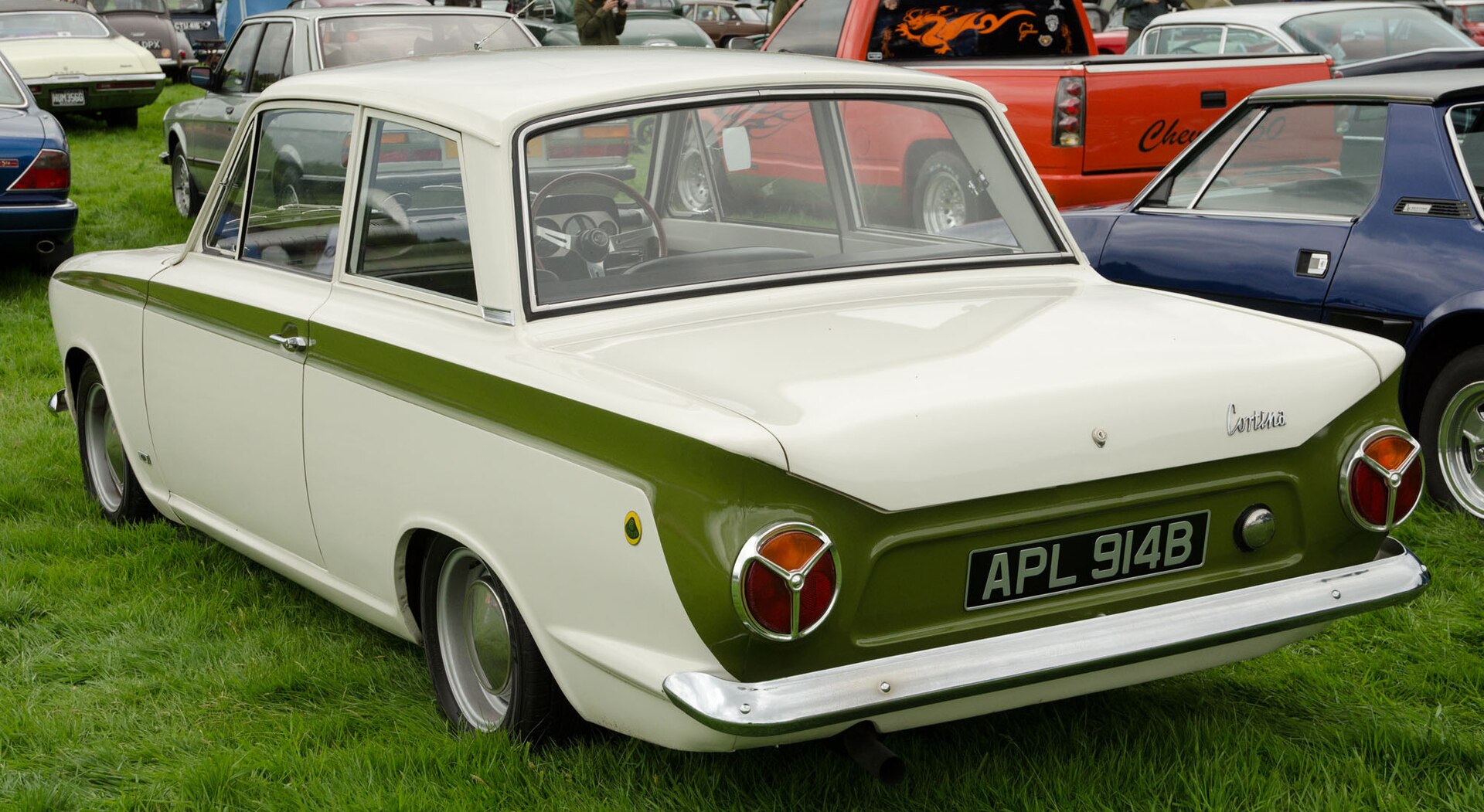
The Lotus Cortina, launched in January 1963 as Lotus type 28, went much further. Lotus fitted a 1,558 cc twin-cam with two Weber 40 DCOE carburettors and 78 kW (105 bhp) at 5,500 rpm, aluminium doors, bonnet and boot lid, and an A-bracket locating the rear axle. All Mk I cars were white two-doors with a green side flash. Classic & Sports Car gives a top speed of 172 km/h (107 mph), a weight of 827-886 kg and a price of GBP 1,100, cut to GBP 992 in June 1964 as the alloy panels were phased out. The A-bracket caused differential housing trouble and gave way to GT leaf springs and radius arms in July 1965. About 3,300 Mk I cars were made.
Jim Clark won the 1964 British Saloon Car Championship in a Lotus Cortina, and in 1966 Bengt Söderström and Gunnar Palm won the RAC Rally outright. The Lotus history covers Colin Chapman's side of the partnership.
Mk II, the 1600E and Hyundai (1966-1970)
Roy Haynes restyled the car for the Mk II, launched on 18 October 1966 with a body 64 mm (2.5 in) wider. From late summer 1967 the Crossflow engines of 1,298 cc and 1,599 cc replaced the earlier Kent units, and the 1600E four-door shown at the Paris Motor Show in October 1967 combined the GT engine with the Lotus Cortina's lowered suspension, a walnut-trimmed dashboard and bucket seats. Graham Robson calls it the first Cortina to be recognised as a classic.
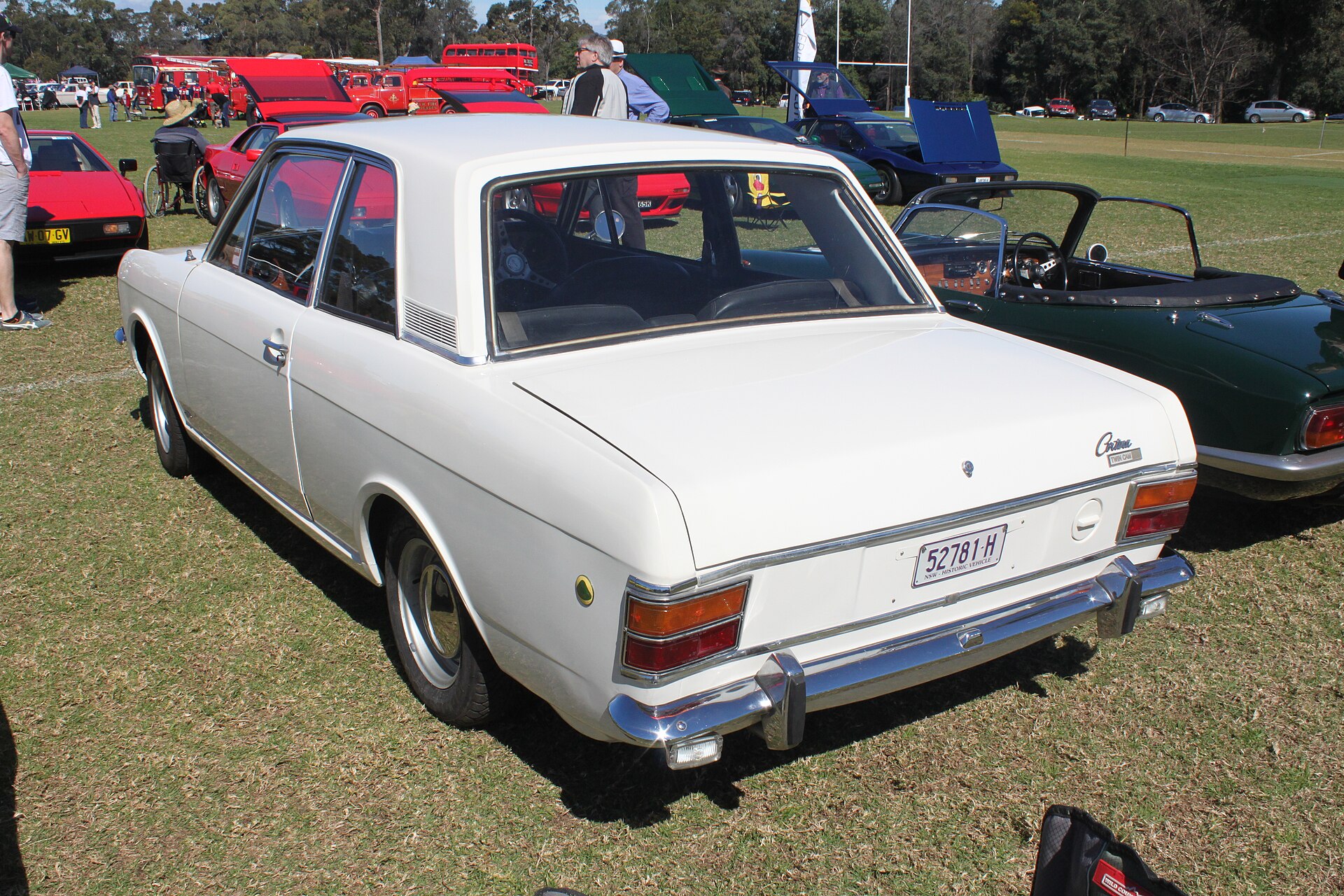
The Lotus version continued, now built at Dagenham, with 81 kW (109 bhp); 4,093 were made, and after the first few months it wore a Twin Cam badge in place of the Lotus emblem. The Mk II also crossed the Atlantic, selling 22,983 cars in the USA in 1968, and from 1967 Hyundai assembled it under licence at Ulsan in South Korea. Classics World counts 1,024,869 Mk IIs.

Mk III and the merger with the Taunus (1970-1976)
The Mk III, internally TC1 for Taunus-Cortina, went on sale on 23 October 1970. Engineered under Harley Copp at Ford's Brentwood centre, it shared its platform with the new German Taunus, with different door skins, bonnet and boot lid. It was 100 mm wider than the Mk II, the wheelbase grew by more than 76 mm, and double wishbones replaced MacPherson struts at the front. Engines ranged from the 1.3 Kent to the 2.0 Pinto overhead-cam four of the GT and GXL. A ten-week strike in 1971 cost about 100,000 cars.
The late-1973 TD facelift brought a new dashboard, rectangular headlamps on upper versions, a 2000E in place of the GXL and the 1.6 Pinto engine.
| Generation | On sale | Main UK engines | Built |
|---|---|---|---|
| Mk I | Sept 1962 | 1,198 cc, 1,498 cc Kent; 1,558 cc Lotus twin-cam | 1,013,391 |
| Mk II | Oct 1966 | 1,298 cc, 1,599 cc Crossflow; Lotus twin-cam | 1,024,869 |
| Mk III (TC) | Oct 1970 | 1.3 Kent; 1.6 Kent or Pinto; 2.0 Pinto | not published by sources used |
| Mk IV (TC2) | Sept 1976 | fours up to 2.0 Pinto; 2.3 V6 from 1977 | not published by sources used |
| Mk V (TC3) | Aug 1979 | 1.3 to 2.0 fours; 2.3 V6 87 kW (116 bhp) | not published by sources used |

Mk IV, Mk V and Britain's best-seller (1976-1982)
The Mk IV went on sale on 29 September 1976 with a more conservative body that differed from the Taunus only in its badges, and it introduced the Ghia trim. A 2.3-litre Cologne V6 of 81 kW (108 bhp) joined in 1977. The Mk V followed on 24 August 1979, officially a facelift called the Cortina 80, with the V6 raised to 87 kW (116 bhp). Prices started at GBP 3,475 for a basic 1.3 in 1979.
The Cortina topped the British sales chart in nine of the ten years from 1972 to 1981, losing only 1976 to the Ford Escort, and in 1979 set a British record of more than 193,000 sales. The final Crusader special edition sold about 30,000, and a silver Crusader was the last car built at Dagenham on 22 July 1982. The Sierra replaced it in October 1982. South African production ran on until 1984, including the XR6 and the Perana conversions by Basil Green Motors.
Ford Cortina today: what to check when buying
Rust has removed most Cortinas from British roads; in December 2023 only 4,658 were registered for use. On the Mk I and Mk II, check the inner wings, strut tops, scuttle, sills, floor, rear chassis rails, spring hangers and boot floor. A GT or 1600E should have the factory-welded radius-rod brackets under the rear floor, and Classic Car Hub notes that a genuine two-door GT carries the digits 77 in its VIN and a four-door GT 78. On the Mk III, inner sills rot from inside and the strut tops are structural; the Pinto cambelt needs changing every 30,000 miles (48,000 km). Mk IV and Mk V cars rust around the battery tray, inner wings, bonnet hinges and upper suspension mounts.
The Kent and Pinto engines are simple, but expect worn valve gear, tired timing chains on Kent units and weak second-gear synchromesh. For a Lotus Cortina, provenance comes first: Classic & Sports Car warns that the chassis number on the strut top is often cut out or plated over and that reshelled cars and replicas are worth much less.
Classic Car Hub's July 2026 guide put a clean Mk I GT at GBP 7,000-8,000 (about EUR 8,000-9,200) and a Mk II 1600E at GBP 8,000-15,000 (about EUR 9,200-17,300), while Mk IV and Mk V drivers sat at GBP 1,500-3,000. Classic & Sports Car valued an average early Lotus Cortina at GBP 50,000 in August 2019. For Ford's other European and American models, open the Ford catalogue.
Ford Cortina evolution in numbers
Did you know?
- The Ford Cortina ran for 20 years, from 1962 to 1982, over 5 generations in our catalog.
- The longest-running generation is the Cortina TC (1970–1976): 6 years.
Most powerful version, kW
Figures from the 1cars catalog: power is the strongest version of each generation; generations without the figure are left out.
Ford Cortina: first vs latest generation
| Spec | Cortina Mk I | Cortina TC3 | Change |
|---|---|---|---|
| Years | 1962–1966 | 1979–1982 | 17 years apart |
| Most powerful version | 78 kW (106 PS) | 87 kW (118 PS) | +9 kW (+12%) |
Oldest and newest generation in the 1cars catalog. Power is the strongest version of each; other rows are shown only when both generations have the figure.
Ford Cortina in our rankings
- No. 8 of 90 · Lightest sedans (864 kg)
- No. 24 of 535 · Lightest cars (864 kg · top 5%)
- No. 195 of 1278 · Longest-running car nameplates (20 years · top 17%)
- No. 23 of 134 · Smallest sedans (4,267 mm · top 18%)
- No. 66 of 493 · Cars with the most generations (5 generations · top 21%)
- No. 179 of 676 · Smallest cars (4,267 mm · top 27%)
Lighter than 95% of ranked cars in the 1CARS catalog (No. 24 of 535).
FAQ
How many Ford Cortinas were made?
More than 2.8 million Ford Cortinas were sold in Britain between 1962 and 1982, and Classic Car Hub puts worldwide output at over four million. Classics World counts 1,013,391 Mk I and 1,024,869 Mk II cars.
What is the difference between the Ford Cortina and the Taunus?
From the Mk III of 1970 both were built on the same platform; the Cortina had its own door skins, bonnet and boot lid. From the Mk IV of 1976 the two cars differed only in badging.
How many Lotus Cortinas were built?
About 3,300 Mk I Lotus Cortinas were built from 1963 to 1966 (Wikipedia gives 3,306) and 4,093 Mk II cars from 1967 to 1970. The Mk I had a 1,558 cc twin-cam of 78 kW (105 bhp).
What replaced the Ford Cortina?
The Ford Sierra replaced it in October 1982, three months after the last Cortina, a silver Crusader, was built at Dagenham. In South Africa the Cortina stayed on sale until 1984.
Data sources
Data checked by an editor against the sources below.
- Wikipedia - Ford Cortina
- Co - Ford Cortina Mk1 Mk2 And Mk3 Buying Guide
- Co - Ford Cortina Mk1 Buying Guide And Review 1962 1966
- Classicandsportscar
- Wikipedia - Lotus Cortina


