
 Opel Ascona
All generations, specs and history
Published Sources (5) Report an error
By Oleksandr Hnatiuk, Automotive Editor & Used Car Specialist
- Built
- 1970–1988
- Generations
- 3 · A to C
- Top power
- 106 kW (144 PS)
Timeline
Ascona generations
Click a generation for its own page
- Ascona A 1970–1975 · Sedan, Station wagon · 44–66 kW (60–90 PS)
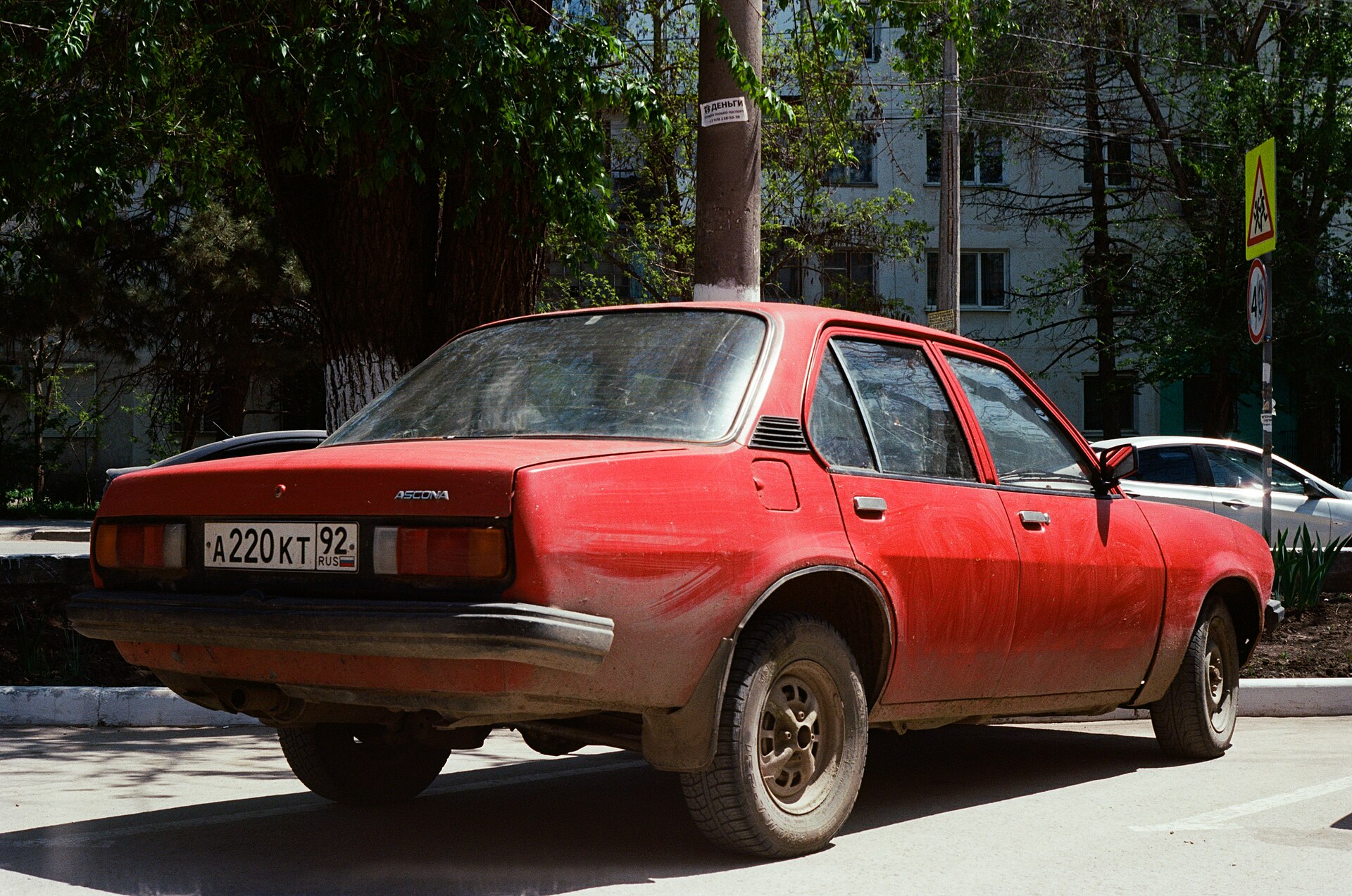
- Ascona B 1975–1981 · Sedan · 40–106 kW (54–144 PS)
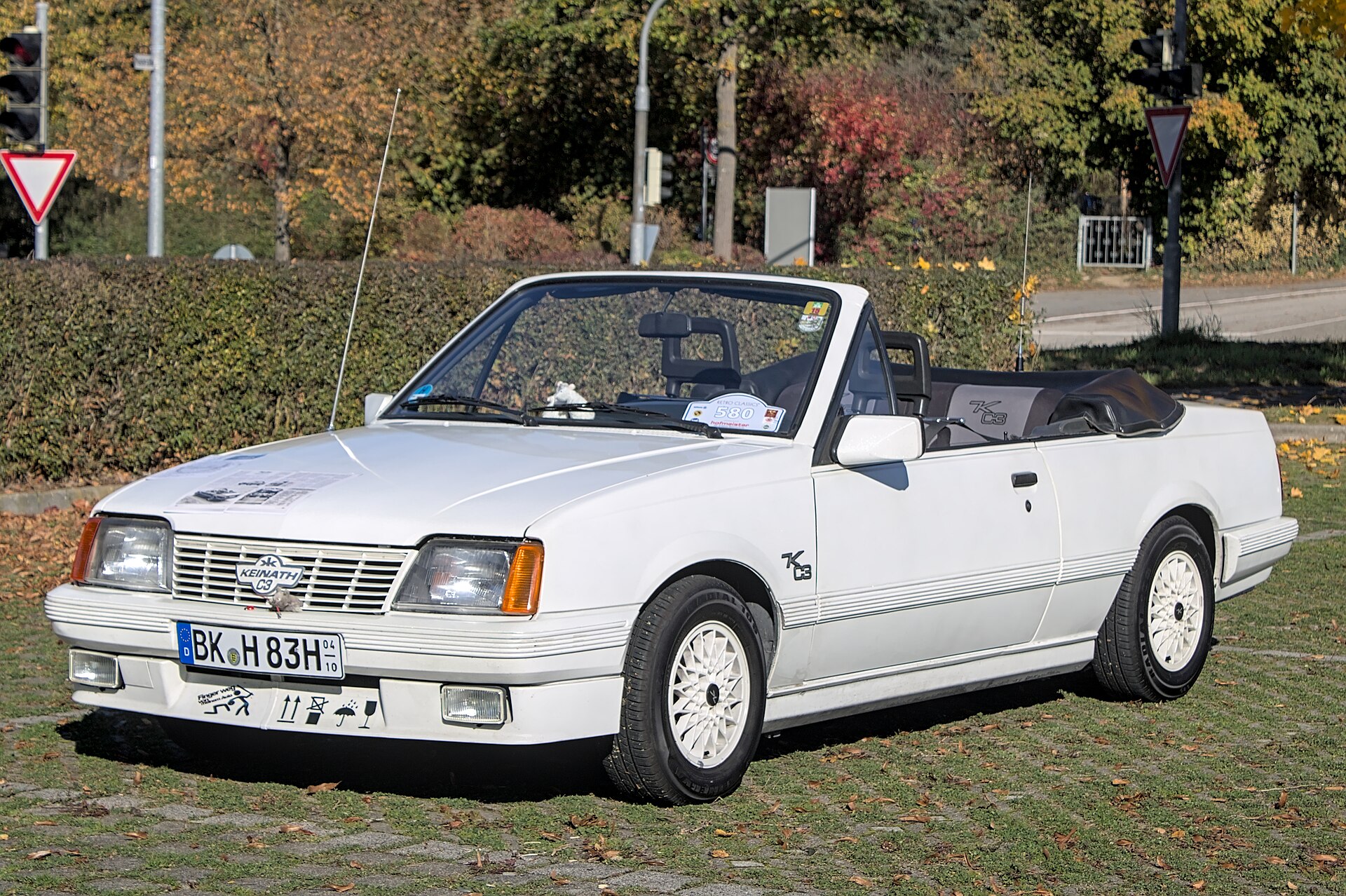
- Ascona C 1981–1988 · Sedan, Hatchback · 40–96 kW (54–131 PS)
Newest first · 3 generations since 1970
-
1981
- 1975 B 1975–1981 · Sedan · 40–106 kW (54–144 PS)
- 1970 A 1970–1975 · Sedan, Station wagon · 44–66 kW (60–90 PS)

All generations by year: Ascona C (1981–1988) · Ascona B (1975–1981) · Ascona A (1970–1975)
Which one is mine?
Pick the year of first registration to see which generation it is.
Check by VINThe Opel Ascona is the mid-size family car Opel built from 1970 to 1988 in three generations: the rear-wheel-drive Ascona A (1970-1975) and Ascona B (1975-1981), and the front-wheel-drive Ascona C (1981-1988). It filled the gap between the Kadett and the Rekord, carried Walter Röhrl to the 1974 European rally title and, as the Ascona 400, to the 1982 world drivers' championship.
In short
- Three generations: Ascona A (about 690,000 built), Ascona B (about 1.2 to 1.5 million, depending on the source) and Ascona C (1,721,647).
- Petrol fours from 1.2 to 2.4 litres plus 2.0 and 1.6 diesels, 40-106 kW (55-144 PS) in road form.
- Ascona 400: 268 homologation cars with 106 kW (144 PS); the Group 4 rally version gave up to 191 kW (260 PS).
- The Opel Vectra A took over the Ascona's production lines in 1988.
Specs by version
Engines
| Version | Engine | Power | Drive | Production years |
|---|---|---|---|---|
| Diesel · 1 version | ||||
| B · 2.0 D | 2.0 l · 4 cyl · Diesel 1,998 cc | 43 kW 58 PS58 hp | Rear-wheel drive | 1978–1981 |
| Petrol · 6 versions | ||||
| A · 1.6 S | 1.6 l · 4 cyl · Petrol 1,584 cc | 59 kW 80 PS79 hp | Rear-wheel drive | 1970–1975 |
| A · 1.9 S (SR) | 1.9 l · 4 cyl · Petrol 1,897 cc | 66 kW 90 PS89 hp | Rear-wheel drive | 1971–1975 |
| B · 2.0 E | 2.0 l · 4 cyl · Petrol 1,979 cc | 81 kW 110 PS109 hp | Rear-wheel drive | 1980–1981 |
| B · 400 2.4 16V | 2.4 l · 4 cyl · Petrol 2,420 cc | 106 kW 144 PS142 hp | Rear-wheel drive | 1979–1981 |
| C · 1.3 S | 1.3 l · 4 cyl · Petrol 1,297 cc | 55 kW 75 PS74 hp | Front-wheel drive | 1981–1988 |
| C · 2.0 GT | 2.0 l · 4 cyl · Petrol 1,998 cc | 96 kW 131 PS129 hp | Front-wheel drive | 1986–1988 |
Performance
Show all 1 versions
| Version | Top speed |
|---|---|
| C · 1981–1988 | |
| C · 2.0 GT | 193 km/h120 mph |
Verified Manufacturer and type-approval data from our catalog · Sources and methodology
Opel Ascona at a glance
| Item | Opel Ascona |
|---|---|
| Years | November 1970 to October 1988, three generations (A, B, C) |
| Production | A about 690,000; B about 1.2-1.5 million; C 1,721,647 |
| Plants | Bochum (A, B); Antwerp (from B); Ascona C also Rüsselsheim, Luton, Kikinda and plants in Latin America and South Africa |
| Body styles | Two- and four-door saloon; three-door estate (A); five-door hatchback (C); cabriolet conversion (C) |
| Layout | Front engine, rear-wheel drive (A, B); transverse engine, front-wheel drive (C, GM J-car) |
| Engines | 1.2-2.4 litre petrol fours; 2.0 D (B) and 1.6 D (C) diesels |
| Power | 40-106 kW (55-144 PS); strongest Ascona C: 2.0 GT with 96 kW (130 PS) |
| Weight | Just under 1,000 kg (Ascona B, Wikipedia DE) |
| Top speed | 143 km/h (C 1.6 D) to 193 km/h (C GT), German-market figures |
| 0-100 km/h | No factory figure in the sources consulted |
| Price new | DM 10,400-11,630 (Ascona B, 1975); DM 29,990 (Ascona 400, 1981) |
| Successor | Opel Vectra A (1988) |
Project 1450: a new Opel class between Kadett and Rekord
By the late 1960s the Rekord had grown, leaving a gap above the Kadett. Opel's Project 1450 filled it with two cars: the Manta coupé, presented in September 1970, and the Ascona saloon, shown at the Turin Motor Show in November 1970. The name refers to the Swiss resort of Ascona on Lake Maggiore and broke with the naval-rank names Opel had used until then.
The Ascona A was built at Bochum, with engines and gearboxes supplied from Kaiserslautern and Strasbourg. Buyers could choose a two- or four-door saloon or a three-door estate, sold as the Voyage in luxury trim and, from March 1974, as the CarAVan. In the United States, Buick-Opel dealers sold the car as the Opel 1900; the 1975 federal version used Bosch L-Jetronic injection and produced 56 kW (75 hp). About 690,000 Ascona A were built before production ended in July 1975.
The Ascona A also gave Opel its first big rally title. Walter Röhrl and co-driver Jochen Berger won the 1974 European Rally Championship in an Ascona 1.9 SR, and Röhrl ended the car's career with victory on the 1975 Acropolis Rally.
Ascona B: longer, wider and still rear-wheel drive
The second generation was shown at the Frankfurt IAA in September 1975. Opel's own anniversary release of July 2025 gives the changes: a body about 20 cm longer and 4 cm wider, a wheelbase almost 9 cm longer, a newly developed front chassis, longer spring travel and wider tracks. The Ascona B came only as a two- or four-door saloon, because the Manta B now supplied the coupé. Production ran at Bochum and the new Antwerp plant, and the launch prices ran from DM 10,400 to DM 11,630 across the Basis, L and SR versions.
A 2.0-litre diesel with 43 kW (58 PS) and 115 Nm joined the range in September 1978, optionally with a three-speed automatic. A facelift in September 1979 brought plastic bumpers and a new grille, and from January 1980 the 2.0 E with Bosch L-Jetronic injection gave 81 kW (110 PS). Irmscher's i2000, sold only in yellow and white, raised the 2.0 SR to 88 kW (120 PS) with twin carburettors. The two-millionth Ascona of all generations left the line in April 1980.
Total Ascona B output is unclear: English Wikipedia gives over 1.2 million by August 1981, German Wikipedia and Secret Classics about 1.5 million. In Britain the car became the first Vauxhall built abroad, as the Antwerp-made Cavalier with a "droop snoot" nose designed by Wayne Cherry.
Ascona 400: the last rear-drive world champion
The Ascona 400 appeared at Frankfurt in 1979 as a homologation special for Group 4. Its 2,420 cc 16-valve twin-cam engine (95 x 85 mm) used a block reworked at Cosworth and produced 106 kW (144 PS) and about 210 Nm in road trim, with a five-speed Getrag gearbox and discs all round. Motor1 Germany quotes a price of DM 29,990 in 1981 and 268 cars built; the homologation target of 400 was never reached.
The works rally car developed up to 191 kW (260 PS) at 7,000 rpm and 280 Nm, weighed about 1,050 kg without crew and reached up to 225 km/h depending on the final drive, according to Opel's 2022 press material. Anders Kulläng won the 1980 Swedish Rally, Röhrl won the 50th Monte Carlo Rally and the Ivory Coast Rally in 1982, and Ari Vatanen won the 1983 Safari. Röhrl took the 1982 drivers' title with 109 points against Michèle Mouton's Audi quattro, although Audi won seven rounds that season to Opel's two. No rear-wheel-drive car has won the drivers' title since.

Ascona C: front-wheel drive and a German best-seller
The Ascona C of August 1981 was Opel's version of the General Motors J-car, with a transverse engine and front-wheel drive, Opel's second front-drive model after the 1979 Kadett D. It was offered as a two- or four-door saloon and as a five-door hatchback; Opel never built an estate. The car won the Goldenes Lenkrad at the end of 1981, became West Germany's best-selling car and narrowly lost the 1982 European Car of the Year award to the Renault 9.
Facelifts in 1984 and 1986 brought a new grille, Kadett E-style instruments and, on the GT, spoilers. Catalytic converter versions of the 1.8 and 2.0 gave 74 kW (100 PS). Hammond & Thiede converted nearly 2,900 two-door saloons into cabriolets between 1983 and 1988 and Irmscher produced 1,399 Sprint models. Sister J-cars included the Vauxhall Cavalier, Holden Camira, Isuzu Aska and the Brazilian Chevrolet Monza; Chevrolet avoided the Ascona name there because "asco" means disgust in Spanish and Portuguese. Production ended in October 1988 after 1,721,647 cars, and the lines were converted to the Vectra.

Ascona engines by generation
| Generation | Engine | Displacement | Power | Years |
|---|---|---|---|---|
| A | 1.2 S | 1,196 cc | 44 kW (60 PS) | 1972-1975 |
| A | 1.6 N / 1.6 S | 1,584 cc | 50 / 59 kW (68 / 80 PS), later 44 / 55 kW | 1970-1975 |
| A | 1.9 S (SR) | 1,897 cc | 66 kW (90 PS) | 1971-1975 |
| B | 1.2 N / S | 1,196 cc | 40 / 44 kW (55 / 60 PS) | 1975-1979 |
| B | 1.3 N / S | 1,297 cc | 44 / 55 kW (60 / 75 PS) | 1979-1981 |
| B | 2.0 S / 2.0 E | 1,979 cc | 74 / 81 kW (100 / 110 PS) | 1977-1981 / 1980-1981 |
| B | 2.0 D diesel | 1,998 cc | 43 kW (58 PS) | 1978-1981 |
| B | 400 (2.4 16V) | 2,420 cc | 106 kW (144 PS) | 1979-1981 |
| C | 1.3 N / S | 1,297 cc | 44 / 55 kW (60 / 75 PS) | 1981-1988 |
| C | 1.6 D diesel | 1,598 cc | 40 kW (54 PS) | 1982-1988 |
| C | 1.8 E / 2.0 E | 1,796 / 1,998 cc | 85 kW (115 PS) | from 1982 |
| C | 2.0 GT (SEH) | 1,998 cc | 96 kW (130 PS) | 1986-1988 |
Opel Ascona today: what to check when buying
Rust is the main enemy of every Ascona. AutoScout24's buying guide warns that a rust-free car is hard to find and that an owner should be able to weld, with the Opel club scene the best place to learn each generation's rust traps. The same guide rates the four-cylinder engines as very durable; worn rubber bushes, tired dampers and oil-sweating engines count as normal wear, and the manual gearboxes give no real trouble. Drivetrain parts are plentiful and cheap through independent suppliers, while interior trim and period accessories are harder to find.
The i2000, the Ascona 400 and Irmscher specials cost far more than standard cars, and replicas exist, so ask for documents that prove the specification. On cheap Ascona C saloons, mileage is a recurring question: AUTO BILD noted in October 2026 that a 1982 1.3 offered at EUR 3,350 had no papers backing its 55,900 km.
Values depend heavily on generation. Sales recorded by Classic.com put Ascona C saloons at EUR 2,600 to 5,050 between 2020 and 2023. Asking prices on Classic Trader in November 2026 were higher: EUR 22,000 to 34,990 at dealers for restored or low-mileage Ascona A and B saloons, against EUR 7,000 for a private 1975 1.9 S listed earlier in 2026.
Our Opel catalogue lists the full range, the history of the Opel Kadett covers the smaller sister car whose platform family the Ascona B shared, and Opel's company history puts the Ascona in context. More European cars of the period are in our classic cars section.
Opel Ascona evolution in numbers
Did you know?
- The Opel Ascona ran for 18 years, from 1970 to 1988, over 3 generations in our catalog.
- The longest-running generation is the Ascona C (1981–1988): 7 years.
- The biggest jump in power came with the Ascona B: up to 106 kW (144 PS), 40 kW more than the Ascona A.
- The most powerful Opel Ascona is not the newest: the Ascona B (1975–1981) offered up to 106 kW (144 PS), the Ascona C up to 96 kW (131 PS).
Most powerful version, kW
Figures from the 1cars catalog: power is the strongest version of each generation; generations without the figure are left out.
Opel Ascona: first vs latest generation
| Spec | Ascona A | Ascona C | Change |
|---|---|---|---|
| Years | 1970–1975 | 1981–1988 | 11 years apart |
| Most powerful version | 66 kW (90 PS) | 96 kW (131 PS) | +30 kW (+45%) |
Oldest and newest generation in the 1cars catalog. Power is the strongest version of each; other rows are shown only when both generations have the figure.
Opel Ascona in our rankings
- No. 224 of 1102 · Longest-running car nameplates (18 years · top 22%)
- No. 84 of 150 · Biggest engines: sedans (2,420 cc · top 56%)
- No. 36 of 64 · Fastest sedans (193 km/h · top 57%)
- No. 376 of 656 · Biggest engines: cars (2,420 cc · top 58%)
- No. 176 of 426 · Cars with the most generations (3 generations · top 63%)
- No. 238 of 380 · Fastest cars (193 km/h · top 64%)
In production longer than 78% of ranked nameplates in the 1CARS catalog (No. 224 of 1102).
FAQ
How many Opel Asconas were built?
About 3.6 to 3.9 million across three generations: about 690,000 Ascona A, between 1.2 and 1.5 million Ascona B depending on the source, and 1,721,647 Ascona C. The two-millionth Ascona was built in April 1980.
Which Ascona won the World Rally Championship?
The Ascona 400. Walter Röhrl won the 1982 drivers' title with 109 points, including wins on the Monte Carlo and Ivory Coast rallies. The road version had a 2.4-litre 16-valve engine with 106 kW (144 PS); 268 were built.
Is the Opel Ascona front- or rear-wheel drive?
Both. The Ascona A (1970-1975) and Ascona B (1975-1981) have a front engine and rear-wheel drive. The Ascona C (1981-1988) is a front-wheel-drive GM J-car with a transverse engine, closely related to the Vauxhall Cavalier Mk2.
What replaced the Opel Ascona?
The Opel Vectra A, which took over the Ascona C's production lines in 1988. German sources give October 1988 as the end of Ascona production, English Wikipedia August 1988.
Data sources
Data checked by an editor against the sources below.
- Wikipedia - Opel Ascona
- Wikipedia - Opel Ascona A
- Wikipedia - Opel Ascona B
- Wikipedia - Opel Ascona C
- Motor1 - Opel Ascona 400 1981 Fahrbericht


