 Audi Quattro
Specs, engines and history
Published Sources (1) Report an error
By Felix Hartmann, Automotive Technology & EV Contributor
- Built
- 1980–1991
- Top power
- 162 kW (220 PS)
Which Quattro to choose
Our verdict · Felix Hartmann
- For the original experience: an early 10-valve WR car with the manual differential locks.
- For the best road car: a 1989–1991 20-valve RR with 162 kW and the Torsen differential; auto motor und sport puts these among the most valuable regular Quattros.
- For a collection: the Sport quattro, one of a little over 200 cars.
- Check before buying: auto motor und sport advises against badly restored cars, since parts are scarce and the drivetrain needs specialists.
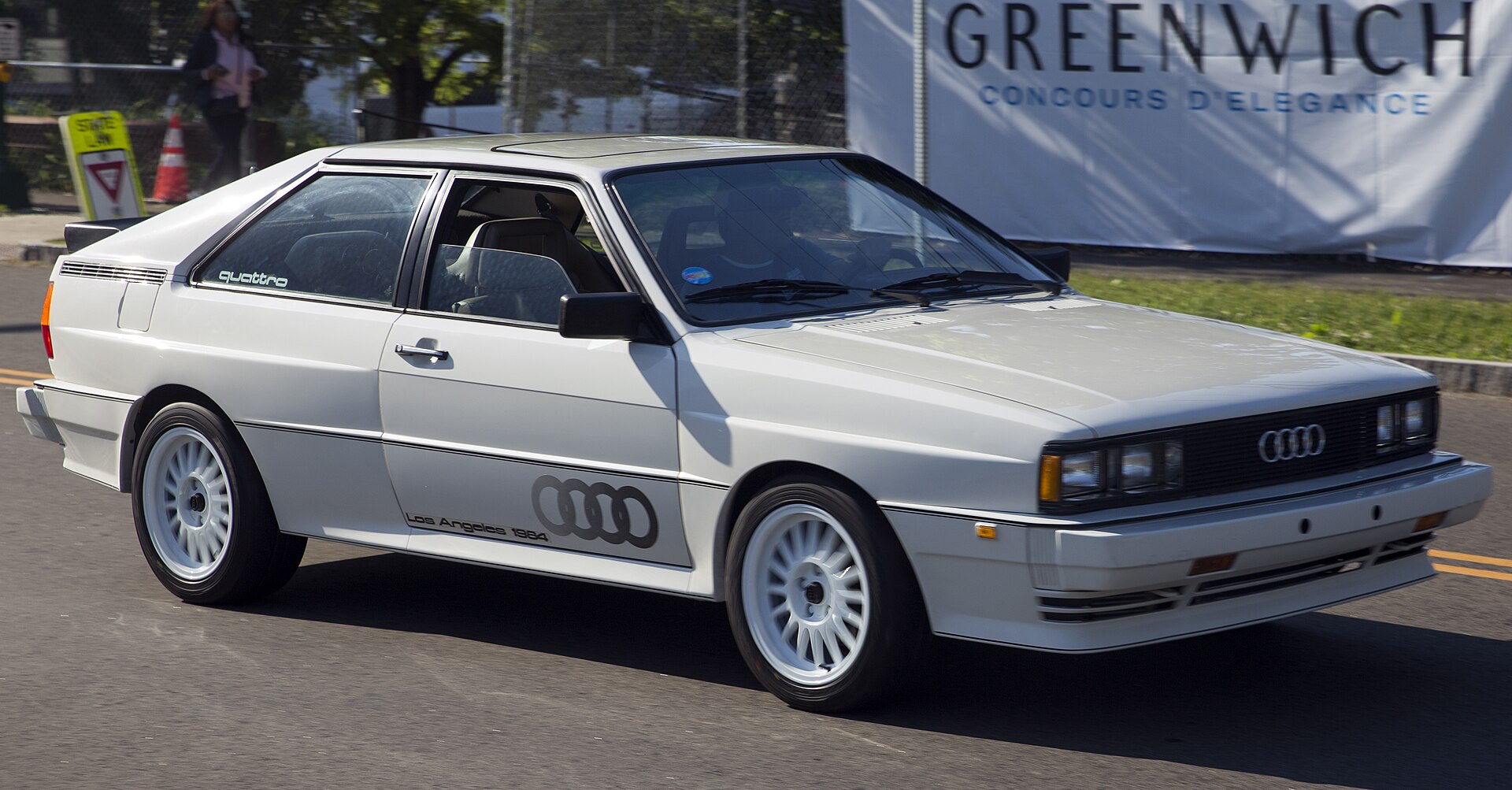
The Audi Quattro is a two-door coupé with a turbocharged five-cylinder engine and permanent all-wheel drive, built at Ingolstadt from 1980 to 1991. It put permanent four-wheel drive into a fast road car. In rallying it changed the sport, and Audi won the World Rally Championship for makes in 1982 and 1984. Enthusiasts call it the Ur-Quattro, the "original Quattro", to tell it apart from the quattro drive system that Audi later fitted across its range.
In short
- Built 1980–1991: 11,452 cars, all coupés, developed from the Audi 80.
- Engines: 2.1-litre and 2.2-litre five-cylinder turbo with 147 kW (200 PS), from 1989 a 20-valve unit with 162 kW (220 PS).
- Original car: 7.1 seconds from 0 to 100 km/h and more than 220 km/h flat out.
- Rally world titles for makes in 1982 and 1984 and for drivers Hannu Mikkola (1983) and Stig Blomqvist (1984).
Size at a glance
| Dimensions | Audi Quattro (Typ 85) |
|---|---|
| Length | 4,404 mm173.4 in |
| Width | 1,722 mm67.8 in |
| Height | 1,346 mm53.0 in |
| Wheelbase | 2,524 mm99.4 in |
Specs by version
Engines
| Version | Engine | Power | Gearbox | Drive | Production years |
|---|---|---|---|---|---|
| 2.1 10V turbo (WX, North America) | 2.1 l · 5 cyl · Petrol WX | 119 kW 162 PS160 hp | 5-sp Manual | All-wheel drive | 1983–1985 |
| 2.1 10V turbo | 2.1 l · 5 cyl · Petrol 2,144 cc | 147 kW 200 PS197 hp | 5-sp Manual | All-wheel drive | 1980–1987 |
| 2.2 10V turbo (MB) | 2.2 l · 5 cyl · Petrol MB | 147 kW 200 PS197 hp | 5-sp Manual | All-wheel drive | 1987–1989 |
| 2.2 20V turbo | 2.2 l · 5 cyl · Petrol 2,226 cc | 162 kW 220 PS217 hp | 5-sp Manual | All-wheel drive | 1989–1991 |
Performance
Show all 2 versions
| Version | 0–100 km/h | Top speed |
|---|---|---|
| 2.1 10V turbo | 7.1 s 0–62 mph | — |
| 2.2 20V turbo | — | 230 km/h143 mph |
Dimensions and weight
Show all 4 versions
| Version | Length | Width | Height | Wheelbase |
|---|---|---|---|---|
| 2.1 10V turbo (WX, North America) | 4,404 mm173.4 in | 1,722 mm67.8 in | 1,346 mm53.0 in | 2,524 mm99.4 in |
| 2.1 10V turbo | 4,404 mm173.4 in | 1,722 mm67.8 in | 1,346 mm53.0 in | 2,524 mm99.4 in |
| 2.2 10V turbo (MB) | 4,404 mm173.4 in | 1,722 mm67.8 in | 1,346 mm53.0 in | 2,524 mm99.4 in |
| 2.2 20V turbo | 4,404 mm173.4 in | 1,722 mm67.8 in | 1,346 mm53.0 in | 2,524 mm99.4 in |
Verified Manufacturer and type-approval data from our catalog · Sources and methodology
Audi Quattro at a glance
| Parameter | Value |
|---|---|
| Production | 1980–1991 (last car 17 May 1991) |
| Plant | Ingolstadt, partly hand-built on a dedicated line |
| Built | 11,452 |
| Body | two-door coupé |
| Engines | 2,144 cc and 2,226 cc turbocharged five-cylinder |
| Power | 147–162 kW (200–220 PS); North America 119 kW (162 PS) |
| Torque | 285 Nm at 3,500 rpm (10-valve WR) |
| Gearbox | 5-speed manual |
| Drive | permanent all-wheel drive |
| Kerb weight | 1,290–1,350 kg |
| Length / wheelbase | 4,404 mm / 2,524 mm |
Origins: the Iltis in the snow
The idea came from chassis engineer Jörg Bensinger in 1977. During winter tests he saw that the Volkswagen Iltis, a four-wheel-drive off-roader, outperformed much more powerful cars on snow. Walter Treser, head of pre-development, worked with him on a version based on the Audi 80, and Wikipedia also credits Ferdinand Piëch. Transmission engineer Tengler solved the drive to the rear axle with a hollow secondary shaft. Martin Smith styled the flared wheel arches.
Audi unveiled the car on 3 March 1980 at the Geneva show, and European sales began in late 1980. According to auto motor und sport it cost as much as a base Porsche 911 at launch. Autocar tested it in May 1981 and called it very good value at £14,500. UK buyers first had left-hand drive only; evo dates the first right-hand-drive cars to 1982, Wikipedia to summer 1983. US sales began with the 1983 model year, and only 664 cars were sold there. Canada took 99 between 1983 and 1986, 61 of them in the first year.

Timeline 1977–1991
| Year | Event |
|---|---|
| 1977 | Jörg Bensinger proposes four-wheel drive after Iltis snow tests |
| 1980 | Geneva debut on 3 March; sales start in Europe late in the year |
| 1981 | Rally debut at the Jänner Rallye; Michèle Mouton wins a world championship rally |
| 1982 | World Rally Championship for makes |
| 1983 | LCD instruments; US sales; Hannu Mikkola world champion |
| 1984 | Sport quattro homologated for Group B; makes and drivers' titles (Stig Blomqvist) |
| 1985 | Facelift with a sloping grille; Mouton wins Pikes Peak in the Sport quattro |
| 1987 | 2.2-litre MB engine; Torsen centre differential; Walter Röhrl wins Pikes Peak |
| 1989 | 20-valve RR engine with 162 kW |
| 1991 | Production ends after 11,452 cars |
Engines: 10-valve WR and MB, 20-valve RR
| Engine | Years | Displacement | Power | Top speed |
|---|---|---|---|---|
| WR 10-valve | 1980–1987 | 2,144 cc | 147 kW (200 PS) | over 220 km/h |
| WX (USA, Canada) | from 1983 | 2,144 cc | 119 kW (162 PS) | — |
| MB 10-valve | 1987–1989 | 2,226 cc | 147 kW (200 PS) | — |
| RR 20-valve | 1989–1991 | 2,226 cc | 162 kW (220 PS) | 230 km/h |
The WR used one overhead camshaft, 0.85 bar of boost, an intercooler and Hitachi engine electronics. The North American WX lost 28 kW to its emissions equipment. The MB of 1987 had more displacement but lower peak torque, and from that year the turbocharger was water-cooled. The final RR engine had twin overhead camshafts and four valves per cylinder. evo quotes 228 lb ft (309 Nm) at only 1,950 rpm and 0–62 mph in 6.5 seconds. Our power converter translates these outputs into other units.
Changes through the years: dashboards, differentials, faces
The Quattro changed in small steps. In 1983 the analogue instruments gave way to a green LCD display and the headlights became combined units. In 1984 the interior was redesigned, 8x15-inch wheels with 215/50 Pirelli tyres arrived and the suspension was lowered by 20 mm. The 1985 facelift brought a sloping grille and a revised dashboard, and in 1988 the LCD turned orange.
The biggest technical change came in 1987. The early cars had manually locking differentials, and engaging the locks also switched off the anti-lock brakes. A Torsen centre differential then replaced the manual lock and split torque automatically. Autocar measured a 60/40 front-to-rear weight distribution, and evo's testers still describe the car as nose-heavy, with understeer when driven too fast into a corner.
Driving impressions
evo's testers drove both the 10-valve and the 20-valve car decades after they were new. The 10-valve, wrote Peter Tomalin, is "not bonkers fast, but it's fast enough to be fun", as long as the engine stays on boost. Its steering feels slow until the car settles. The 20-valve felt bigger and heavier than he expected and less tightly controlled, yet it "still feels quick across the ground". The weak points evo lists are a dead feel to the brakes, very weak dipped headlights and catalytic converters that dulled the 20-valve's exhaust note.
Sport quattro and the S1 E2: the short-wheelbase cars
For Group B Audi homologated the Sport quattro in 1984. Its wheelbase was 320 mm shorter and its body used carbon fibre and Kevlar. The all-aluminium 2,133 cc engine had about 224 kW (304 PS) in series form, according to auto motor und sport. Wikipedia counts 224 short-wheelbase cars, offered at DM 203,850 each when the car was homologated in 1984 (about €104,000 at the fixed conversion rate). auto motor und sport puts the total at 212, of which 164 were road cars. evo gives the road car 0–62 mph in 4.8 seconds.
The S1 E2 of late 1985 was the final evolution. It had large wings, weighed 1,090 kg, and its 2,110 cc engine was officially rated at 353 kW (480 PS). Walter Röhrl and Christian Geistdörfer won the 1985 Sanremo Rally with it. Today the road cars are rare collector's items: in March 2019 a 1984 Sport quattro sold at Gooding for US$434,000, about €386,200 according to auto motor und sport. The Group B era also produced the Porsche 959, another four-wheel-drive car developed for the class.

Rally record: from the Jänner Rallye to Pikes Peak
The Quattro started its first event at the Jänner Rallye in Austria in 1981. Later that year Michèle Mouton became the first woman to win a world championship rally. Audi won the makes' title in 1982, finished second in 1983 and won again in 1984.
| Season | Manufacturers' position | Drivers' champion with Audi |
|---|---|---|
| 1982 | 1st (116 points) | — (Mouton 2nd) |
| 1983 | 2nd (116 points) | Hannu Mikkola |
| 1984 | 1st (120 points) | Stig Blomqvist |
The A2 version alone won eight world rallies in 1983 and 1984. The short Sport quattro then went to Pikes Peak in Colorado. Mouton won the hill climb in 1985 with a record time, and Röhrl won it in 1987.

Legacy: a name for all-wheel drive
The Quattro proved that permanent four-wheel drive could work in a fast road car. Its name became Audi's label for all-wheel drive across the range, written in lower case as quattro. Its base, the Audi 80, and the company's later models are covered in our history of Audi.
Photo gallery


Audi Quattro in our rankings
- No. 9 of 16 · Fastest cars of the 1980s (230 km/h)
- No. 26 of 89 · Smallest coupes (4,404 mm · top 30%)
- No. 159 of 420 · Smallest cars (4,404 mm · top 38%)
- No. 326 of 912 · Longest-running car nameplates (11 years · top 39%)
- No. 114 of 281 · Fastest cars (230 km/h · top 44%)
- No. 28 of 59 · Most powerful cars of the 1980s (162 kW · top 50%)
Shorter than 70% of ranked coupes in the 1CARS catalog (No. 26 of 89).
FAQ
Why is it called the Ur-Quattro?
"Ur" is German for "original". The name separates the 1980–1991 coupé from Audi's later quattro all-wheel-drive models.
How many Audi Quattros were made?
11,452 between 1980 and May 1991, plus a little over 200 short-wheelbase Sport quattros.
How much horsepower does the Audi Quattro have?
147 kW (200 PS) with the 10-valve engines and 162 kW (220 PS) with the 1989–1991 20-valve engine; North American cars had 119 kW (162 PS).
Did the Audi Quattro win the World Rally Championship?
Yes. Audi won the makes' title in 1982 and 1984, Hannu Mikkola the drivers' title in 1983 and Stig Blomqvist in 1984.
What is the difference between the Quattro and the Sport quattro?
The Sport quattro has a 320 mm shorter wheelbase, a carbon-Kevlar body and an aluminium engine with about 224 kW. Audi built it in small numbers to homologate the Group B rally car.
Data sources
Data checked by an editor against the sources below.