 Audi A1
All generations, specs and history
Published Sources (5) Report an error
By Felix Hartmann, Automotive Technology & EV Contributor
- Built
- 2010–2026
- Generations
- 2 · 8X to GB
Timeline
A1 generations
Click a generation for its own page


Newest first · 2 generations since 2010
All generations by year: A1 GB (2018–2026) · A1 8X (2010–2018)
Which one is mine?
Pick the year of first registration to see which generation it is.
Check by VINThe Audi A1 is Audi's premium subcompact (B-segment) car. It was presented to the public at the Geneva motor show on 4 March 2010 and has been built as a three-door hatchback and as the five-door A1 Sportback. Two generations have appeared; the second was unveiled at the Paris motor show in 2018. Its roots go back to the 2007 "metroproject quattro" show car, followed in 2008 by the A1 project quattro and A1 Sportback Concept. Audi had built a small car on Polo foundations once before: the Audi 50 of the 1970s.
In short
- First generation (2010–2018): three-door from summer 2010, Sportback from November 2011, facelift in 2014; PQ25 platform shared with the VW Polo and SEAT Ibiza.
- Second generation (8GB, from 2018): Sportback only, on the MQB A0 platform, wheelbase 91 mm longer.
- Engines from a 1.0 TFSI with 70 kW (95 PS) to a 2.0 TFSI with 147 kW (200 PS).
- Boot: 270 litres in the first generation, 355 litres in the second.
Audi A1 at a glance
The A1 is a compact, front-wheel-drive car for easy city driving and parking, with premium materials and many personalisation options. More Audi models are in our Audi catalogue, and the brand's story is told in the history of Audi.
Audi A1 generations
First generation (2010–2018)
The three-door A1 arrived in summer 2010 and the five-door Sportback in November 2011. The 2014 update brought smoother bumpers, revised headlights and grille, new paint colours, a slightly longer body, a wider range of engines and two design packages, "Sport" and "Design", with styling cues borrowed from the high-performance S1. At the front, the Audi Singleframe grille sits between xenon headlights with LED daytime running lights, and rectangular fog lamps are integrated into the side intakes. A rising crease runs along the doors, and the LED tail lights are set entirely into the tailgate, as on the Audi Q5. Ground clearance is 125 mm.
The cabin is a four-seater as standard, with a three-seat rear bench as an option. It is well laid out and practical, with a three-spoke steering wheel, clear instruments with a central display, a pop-up infotainment screen controlled by a rotary knob, and round air vents inspired by aircraft. Materials are of high quality, with several design packages available. Space is good for the class, but rear passengers are tight, and the boot is small: 270 litres, or 920 litres with the rear seats folded.
Before the update, the Sportback had a 1.4-litre turbocharged direct-injection four-cylinder with 90 kW (122 PS) and 200 Nm, paired with a six-speed manual or a seven-speed S tronic dual-clutch gearbox. It reached 100 km/h in 9.0 seconds and 203 km/h, using 5.4 l/100 km with the manual and 5.3 l/100 km with S tronic. The facelift added three-cylinder turbo engines — a 1.0 TFSI with 70 kW (95 PS) using about 4.3 l/100 km and a 1.4 TDI with 66 kW (90 PS) using about 3.4 l/100 km — and improved four-cylinder engines: 1.4 TFSI with 92 kW (125 PS) or 110 kW (150 PS), 1.8 TFSI with 141 kW (192 PS) and a 1.6 TDI with 85 kW (116 PS).
The PQ25 platform uses MacPherson struts at the front and a torsion beam at the rear; sports suspension with electronically controlled adaptive dampers was optional, and quattro all-wheel drive was offered with some petrol engines in Europe. The electromechanical steering was retuned in the facelift, and the brakes are discs all round: 288 mm ventilated at the front, 230 mm at the rear. Base cars had 15-inch alloys, LED daytime running lights, front and side airbags, ABS, EBD, ESP and ASR, air conditioning, heated front seats and an eight-speaker audio system.
Second generation: 8GB (2018 onwards)
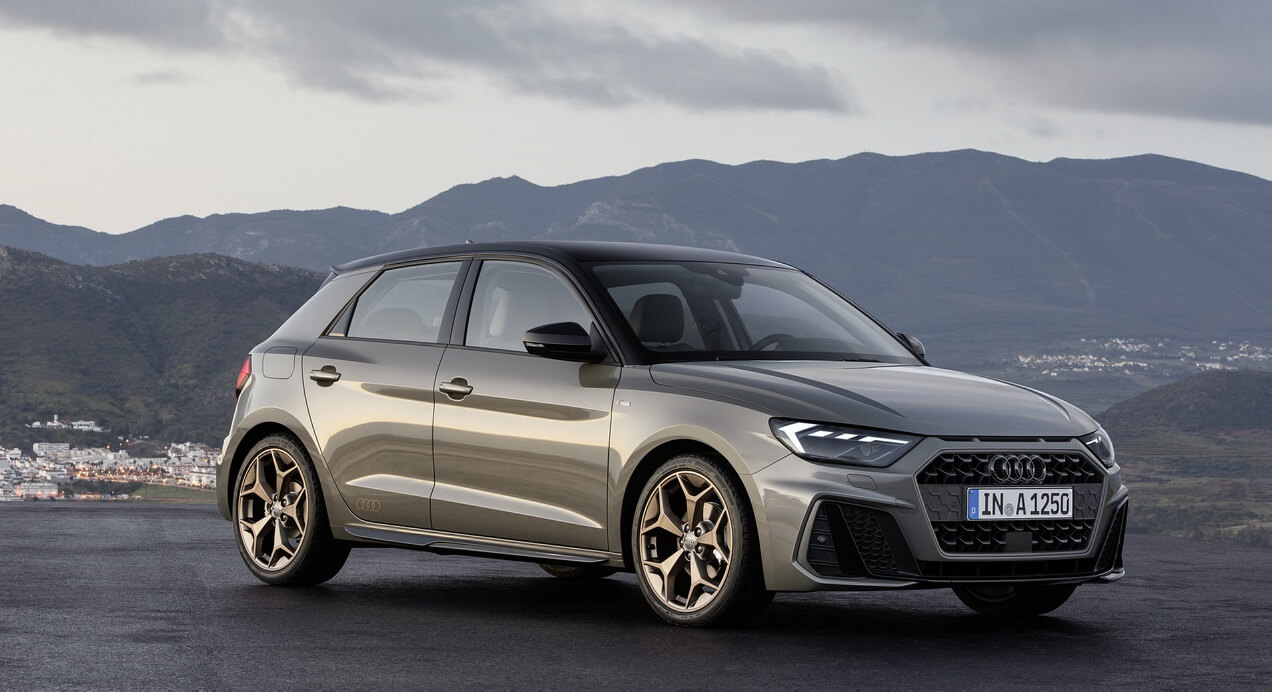
The second A1 was unveiled at the Paris motor show in 2018 and moved to the MQB A0 platform, also used by the current VW Polo and SEAT Ibiza. Its styling follows the Audi A6 and A7: three-segment LED headlights, a three-part slot beneath the bonnet edge (with gills on S line versions), a forward-leaning Singleframe grille in black rather than chrome and large lower intakes. Flared wheel arches hold 15- to 18-inch wheels. Four design lines are offered: Basic, Advanced, S line and Edition.
The wheelbase grew by 91 mm, so the cabin is roomier in length and width. Front seats offer light side support, with electric adjustment on higher trims. A 10.25-inch digital instrument display is standard, with the Audi virtual cockpit and navigation optional; the centre console, angled towards the driver, holds an 8.8- or 10.1-inch MMI touchscreen. Options include an 11-speaker Bang & Olufsen system, dual-zone climate control, Qi wireless charging and ambient lighting with 30 colours. The rear seat has three headrests but is best for two. The boot holds 355 litres, or 1,090 litres with the 40:60 split rear seat folded.
Engines and transmissions (second generation)
| Version | Engine | Power (kW / PS) | Torque |
|---|---|---|---|
| 25 TFSI | 1.0 three-cylinder turbo | 70 kW / 95 PS | 175 Nm |
| 30 TFSI | 1.0 three-cylinder turbo | 85 kW / 116 PS | 200 Nm |
| 35 TFSI | 1.5 four-cylinder turbo | 110 kW / 150 PS | 250 Nm |
| 40 TFSI | 2.0 four-cylinder turbo | 147 kW / 200 PS | 320 Nm |
The base version reaches 100 km/h in 9 seconds and the 40 TFSI in 6.5 seconds; every version exceeds 200 km/h. Consumption ranges from just over 5 l/100 km to about 8 l/100 km. All engines can have a seven-speed S tronic gearbox; the base engine is also offered with a six-speed manual. Drive is to the front wheels.
Suspension is MacPherson at the front with a semi-independent rear axle; adaptive sports suspension is optional. The MQB A0 body uses 27% ultra-high-strength steel and is stiffer. The electric power steering adapts its ratio automatically, and brakes are discs all round: 276 mm front and 230 mm rear as standard, or 312 mm and 272 mm as an option.
Safety
The second-generation A1 offers lane departure warning, cruise control, airbags and curtain airbags, ISOFIX, blind-spot monitoring, pedestrian recognition, stability and traction control, hill-hold assist, a traffic-jam assistant that keeps the distance to the car ahead up to 65 km/h, automatic high beam and Audi pre sense basic, which tightens the belts and closes the windows when a collision is imminent.
Key specifications by generation
| Parameter | 1st generation | 2nd generation (8GB) |
|---|---|---|
| Years | 2010–2018 | 2018 onwards |
| Bodies | 3-door, 5-door Sportback | 5-door Sportback |
| Platform | PQ25 | MQB A0 |
| Power (kW / PS) | 66–141 kW / 90–192 PS | 70–147 kW / 95–200 PS |
| Boot | 270 / 920 l | 355 / 1,090 l |
Image credits · Photos from Wikimedia Commons under free licences
- Audi A1 8X · Photo: OSX / Wikimedia Commons, Public domain
- Audi A1 GB · Photo: Vauxford / Wikimedia Commons, CC BY-SA 4.0
Audi A1 in our rankings
- No. 234 of 912 · Longest-running car nameplates (16 years · top 27%)
- No. 294 of 345 · Cars with the most generations (2 generations)
In production longer than 73% of ranked nameplates in the 1CARS catalog (No. 234 of 912).
FAQ
When was the Audi A1 launched?
It was unveiled at the Geneva motor show on 4 March 2010; the three-door went on sale that summer and the Sportback in November 2011.
What platform is the Audi A1 based on?
The first generation uses the PQ25 platform of the VW Polo and SEAT Ibiza; the second uses MQB A0.
What engines does the second-generation Audi A1 have?
1.0 TFSI three-cylinders with 70 or 85 kW (95 or 116 PS), a 1.5 TFSI with 110 kW (150 PS) and a 2.0 TFSI with 147 kW (200 PS).
How big is the Audi A1 boot?
355 litres in the second generation (1,090 litres with the seats folded) and 270 litres in the first (920 litres).
Data sources
Data checked by an editor against the sources below.
- Wikipedia — Audi A1
- Wikipedia — Audi A1 8X
- Euro NCAP — 818c8c95 63dd 4a2f 96d8 D210c8461a03
- Wikipedia — Audi A1 GB
- Euro NCAP — Seven Earn Safety Accolades In Latest Round Of Euro Ncap Testing