 Audi RS 2 Avant
Specs, engines and history
Published Sources (1) Report an error
By Felix Hartmann, Automotive Technology & EV Contributor
- Built
- 1994–1995
- Top power
- 232 kW (315 PS)
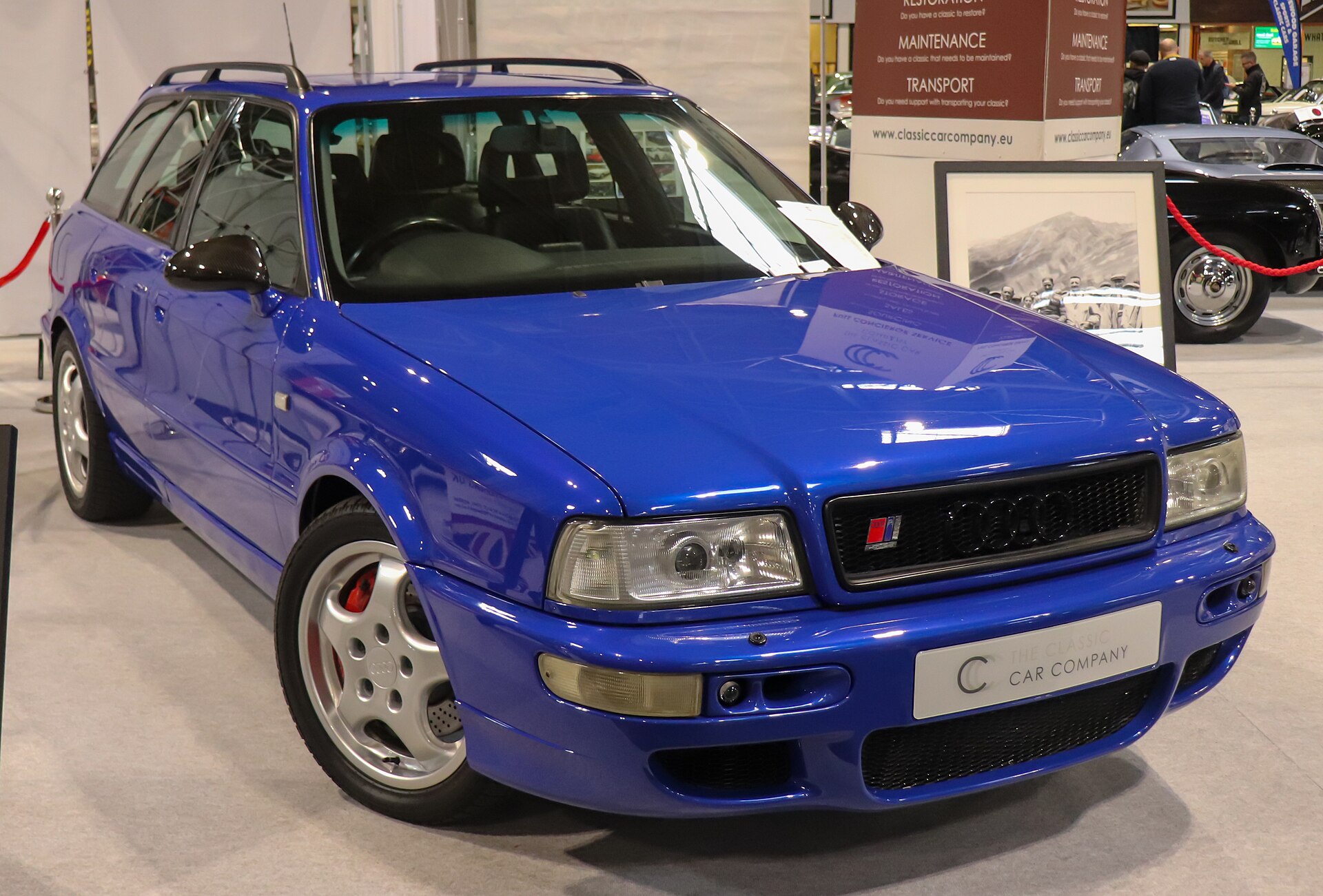
The Audi RS 2 Avant is the high-performance estate that Audi and Porsche developed together on the basis of the Audi 80 Avant (B4). It was announced at the 1993 Frankfurt IAA, went on sale in Germany on 19 March 1994 and was built until July 1995. It was the first Audi to carry the RS badge and the first of Audi's high-performance RS estates.
In short
- 2,891 cars were built in 1994–1995, assembled by Porsche in Zuffenhausen; only 180 had right-hand drive.
- 2.2-litre turbocharged five-cylinder with 232 kW (315 PS) and 410 Nm, six-speed manual and permanent quattro four-wheel drive.
- Top speed 262 km/h; Audi and Porsche quoted 5.4 s from 0 to 100 km/h.
- Price in Germany at launch in 1994: DM 98,900 (about €50,600 at the later fixed conversion rate).
RS 2 Avant at a glance
| Item | Audi RS 2 Avant |
|---|---|
| Production | March 1994 – July 1995 |
| Assembly | Porsche, Rössle-Bau plant, Zuffenhausen (Stuttgart) |
| Number built | 2,891 (180 right-hand drive) |
| Body | five-door estate (Avant) |
| Platform | Audi 80 / S2 Avant, B4 (type 8C) |
| Engine | 2,226 cc turbocharged inline five, 20 valves, code ADU |
| Power / torque | 232 kW (315 PS) at 6,500 rpm / 410 Nm at 3,000 rpm |
| Gearbox and drive | six-speed manual, quattro four-wheel drive with Torsen centre differential |
| Kerb weight | about 1,595 kg (evo); "over 1,600 kg" (Wikipedia) |
| Related model | Audi S2 Avant (base car, 169 kW) |
The RS 2 is listed in the Audi catalogue. Its base car is described in our article on the Audi 80 B4, the last Audi 80, and the full story of the 80 range is in the Audi 80 history.
Why Audi asked Porsche to build a fast estate
In the early 1990s Audi wanted an image car that could take on the BMW M3, but its own engineers were busy with the A4, A6 and A8. Ferdinand Piëch, then head of Audi's supervisory board according to evo, turned to Porsche, which offered engineering services to other carmakers and had just finished building the Mercedes-Benz 500 E under contract. The project was called P1 inside Porsche, and Michael Hölscher led it there.
Audi supplied painted bodies and add-on parts from Ingolstadt. Porsche did the rest at the historic Rössle-Bau works in Zuffenhausen, the building where the 500 E had been assembled. Hölscher later estimated that about 20 per cent of the car came from Porsche. Audi first planned some 2,200 cars, but demand pushed the total to 2,891.
Audi did not sell the RS 2 in the United States or Canada; certification would have cost too much for the small volume. Official exports outside Europe went in small numbers to Hong Kong, South Africa, Brazil and New Zealand. For a later fast Audi estate, see the Audi RS6 Avant generations.

Engine: the S2 five-cylinder reworked by Porsche
The engine is the 2,226 cc 20-valve inline five of the Audi S2, which made 169 kW (230 PS) in its last ABY form. Porsche turned it into the ADU unit with:
- a larger KKK turbocharger (Hagerty: about 30 per cent bigger, with 1.4 bar boost);
- a larger intercooler;
- new camshaft, higher-flow injectors and a more efficient intake;
- a low-pressure exhaust and a modified Bosch engine control unit.
Peak power rose to 232 kW (315 PS), reached at 6,500 rpm, and maximum torque to 410 Nm, available from 3,000 rpm; compression was 9.0:1. The engine was set up for 98 RON fuel; knock control allowed 95 RON with a small loss of power. The only gearbox was a six-speed manual (code 01E). The quattro system used a Torsen centre differential and a rear differential lock that the driver engaged by hand.

Performance figures and road tests
| Measure | Figure | Source |
|---|---|---|
| 0–100 km/h | 5.4 s | Audi/Porsche factory figure |
| 0–100 km/h | 5.3 s | test value cited by Wikipedia DE |
| 0–100 km/h (62 mph) | 4.8 s | Autocar & Motor test, cited by evo and Wikipedia EN |
| 0–48 km/h (30 mph) | 1.5 s | Autocar & Motor, 1995 |
| 0–200 km/h | 22.7 s | Wikipedia DE |
| Top speed | 262 km/h, electronically limited | factory |
| Fuel consumption | 9.2 l/100 km | Wikipedia DE |
The Autocar 0–30 mph figure became famous because the magazine noted that the estate got off the line faster than the McLaren F1. Porsche's history team calls the RS 2 the first Audi to pass 250 km/h. Former rally world champion Walter Röhrl summed it up as a real alternative to a sports car with plenty of room for people and luggage.
Brakes, chassis and the Porsche parts
Porsche replaced the Audi 80 brakes and suspension. At the front there were 304 mm ventilated discs with four-piston Brembo calipers painted red and lettered "PORSCHE"; a 322 mm front disc option, linked by Wikipedia DE to the 993 Turbo, fitted only under 17-inch wheels. The rear used 299 mm ventilated discs. Ride height was 40 mm lower than a standard 80 Avant, with firmer springs and dampers and thicker anti-roll bars.
The visible Porsche parts are what collectors look for:
- 7J × 17-inch "Cup" wheels of the 964 Turbo design, on 245/40 ZR17 Dunlop tyres;
- door mirrors from the 911 (964 Turbo per Wikipedia EN and Hagerty, 993 per Wikipedia DE);
- indicators, fog lamps and the rear light bar taken from the 964 and 993 generations of the 911;
- "PORSCHE" lettering in the RS 2 badges on the grille and tailgate.
The family resemblance is clear if you compare it with the Porsche 911 of the 964 generation.

Interior, equipment and colours
Inside, the RS 2 had Recaro sports seats in leather or leather/Alcantara, a three-spoke leather wheel and wood or carbon-fibre trim. Accent colours were RS blue or silver-grey, chosen to match the paint. Standard equipment included electric windows all round, headlamp washers, a fully galvanised body and ABS. Full-size driver and passenger airbags were fitted from July 1994 and an immobiliser from 1995; climate control, an electric sunroof and cruise control were options.
Sources give different numbers of paint colours (Hagerty 13, Wikipedia DE 11, five in the UK according to Octane). The best-known colour is RS Blue, also called Nogaro Blue.
Production, rarity and the RS 2 saloon
| Year | Event |
|---|---|
| 1993 | RS 2 Avant announced at the Frankfurt IAA |
| 19 March 1994 | German market launch at DM 98,900 |
| July 1994 | driver and passenger airbags become standard |
| 1995 | immobiliser standard |
| July 1995 | production ends after 2,891 cars |
Audi confirmed four RS 2 saloons built outside the series: one belongs to the Audi museum, two are in the United Arab Emirates and the location of the fourth is unknown. In Germany, registration figures cited by Wikipedia DE show 273 registered RS 2 cars on 1 January 2015, down from 552 in 2003. The 25-year rule made imports to the United States possible from 2019.

Buying an RS 2 today: checks and parts
Octane's buying guide (September 2025) gives practical advice:
- Authenticity: a genuine car has an "ARGE" chassis plate; dressed-up S2 Avants exist.
- Engine: strong if serviced regularly with good oil; most cars have covered more than 160,000 km (100,000 miles).
- Gearbox: check for smooth changes and records of gearbox work on hard-driven cars.
- Brakes and suspension: Porsche-specific parts are expensive to refurbish.
- Parts: many mechanical parts are shared with the S2, but RS 2 trim, brake parts and body panels are scarce.
Octane put the entry point at £25,000 in 2025 for a high-mileage left-hand-drive car, with low-mileage examples above £40,000 and a premium for right-hand drive. To set the RS 2 against a modern fast estate, use the car comparison tool.
Photo gallery


Audi RS 2 Avant in our rankings
- No. 10 of 27 · Most powerful station wagons (232 kW)
- No. 30 of 111 · Most powerful cars of the 1990s (232 kW · top 28%)
- No. 453 of 1011 · Most powerful cars (232 kW · top 45%)
- No. 91 of 151 · Most powerful German cars (232 kW · top 61%)
- No. 1049 of 1082 · Longest-running car nameplates (1 year)
More powerful than 72% of ranked cars of the 1990s in the 1CARS catalog (No. 30 of 111).
FAQ
How many Audi RS 2 Avants were built?
2,891 cars from March 1994 to July 1995, of which 180 had right-hand drive. Audi also confirmed four one-off RS 2 saloons.
How much power does the RS 2 have?
Its 2.2-litre turbo five-cylinder produces 232 kW (315 PS) at 6,500 rpm and 410 Nm at 3,000 rpm.
Did Porsche build the Audi RS 2?
Yes. Porsche developed the RS-specific parts and assembled the cars at its Rössle-Bau works in Zuffenhausen from bodies and parts supplied by Audi.
How fast is the Audi RS 2 Avant?
Top speed is 262 km/h. The official sprint figure to 100 km/h was 5.4 s, while Autocar & Motor recorded 4.8 s to 62 mph.
Why was the RS 2 not sold in the United States?
Certification for such a small series would have cost too much. Since 2019 the cars are old enough to be imported under the 25-year rule.
Data sources
Data checked by an editor against the sources below.